


How the LinkedIn Algorithm Works in 2026
October 7, 2026
8 min read

Summarize with AI

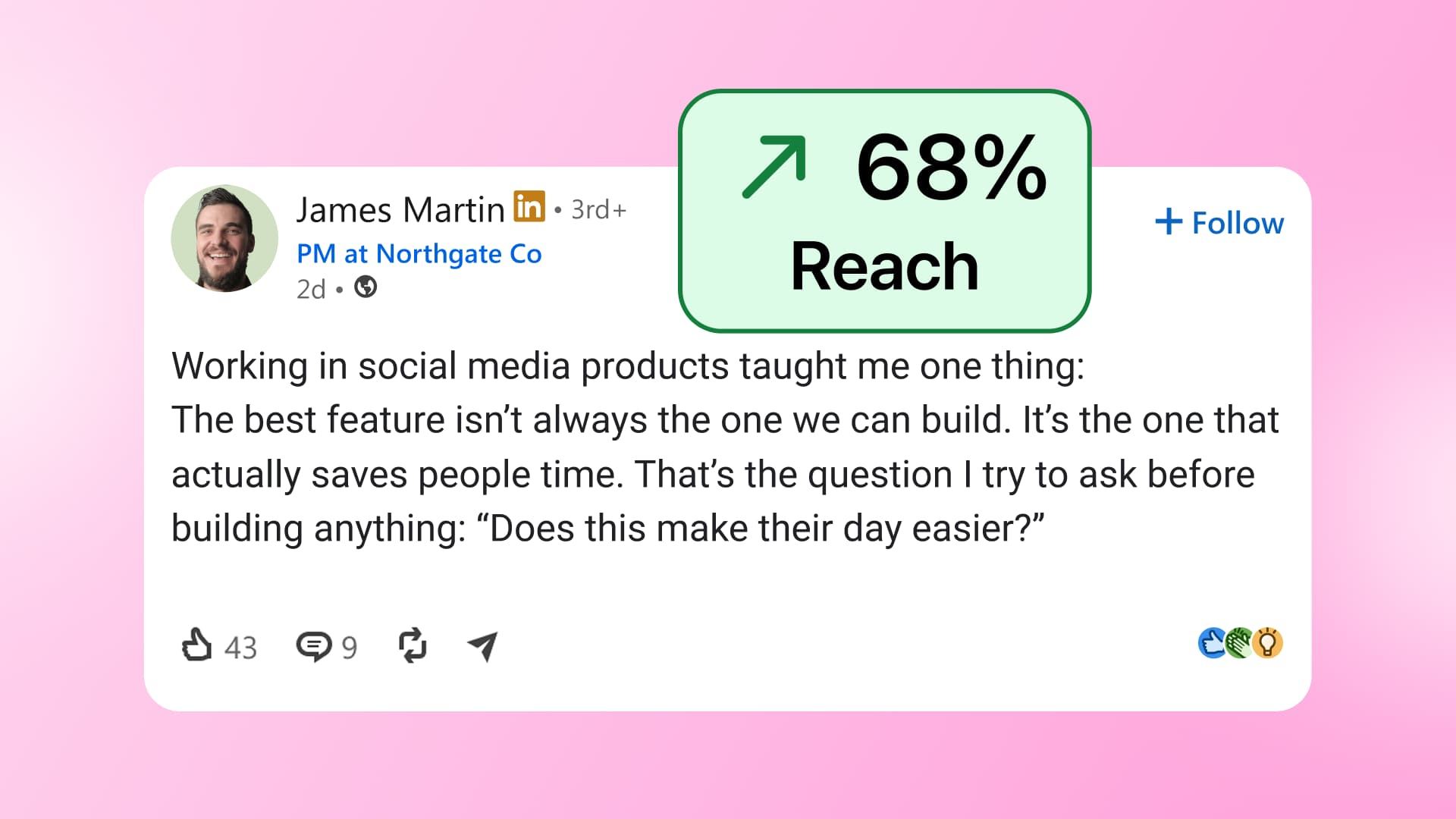
Table of contents
Share

Vista Social

X (Twitter)


You timed the company post carefully. The hook was polished, the hashtags were chosen, and the team engaged early. It still stalled.
That afternoon, a colleague’s plain-text post traveled beyond their network. The gap makes a careful content plan feel arbitrary and sends you back to posting-time charts, hook formulas, and recycled advice while leadership still expects an answer.
The LinkedIn algorithm is the recommendation system that selects and ranks posts for each member using the post’s meaning, the member’s professional context, their behavior history, and live engagement signals.
In 2026, your job is to make the audience fit clear, add evidence worth finding, and use each result to plan the next test.
The short version
- Audience fit is personal: LinkedIn compares each post with a member’s profile, network, activity, and changing interests.
- Meaning travels: A specific, useful idea can reach relevant people outside your follower base.
- First-hand evidence stands out: Decisions, results, failed tests, and practitioner insight give the system something clear to classify.
- Your workflow should learn: Compare like with like, choose one test, and make the result shape the next post.
Table of contents
Why the old LinkedIn playbook wastes your time
Older advice treats reach as a recipe: publish at one time, use a preferred format, and collect early reactions. That playbook cannot explain a feed tailored to one member at a time.
That leaves you with three daily problems:
- Unpredictable reach wastes production time: A post can consume hours across writing, design, legal, and approval, then stall without showing which input failed. Your team either repeats the same plan or changes everything at once.
- Leadership asks a question the report cannot answer: “Why did this post travel while that one stopped?” Impressions describe the outcome, but a mixed test cannot isolate whether the topic, evidence, format, or audience fit made the difference.
- Briefs never get smarter: Results land in a monthly deck, while the next brief reopens timing, format, topic, and hook from scratch. The same debate consumes another planning meeting.
The real job is to turn each post into evidence for the next decision.
How LinkedIn ranks the feed in 2026
LinkedIn’s next-generation feed uses LLMs and transformer models to retrieve and rank posts. It also balances content from a member’s network with relevant posts from people they do not follow. Its generative recommender can process more than 1,000 prior interactions for one viewer.
The ranking process uses five broad kinds of evidence:
| What LinkedIn reads | Examples LinkedIn has confirmed | What you should do |
| Viewer context | Industry, experience, skills, geography, network, and activity | Define the role, problem, and level of expertise the post serves. |
| Post meaning | The topic and its relationship to professional interests | State the subject early and make the text and media tell the same story. |
| Behavior history | What someone read, liked, commented on, returned to, or skipped | Build a few useful topic lanes instead of changing direction with every trend. |
| Post signals | Popularity, engagement, recency, affinity, and other numerical features | Compare each post with work that had a similar goal, topic, and format. |
| Quality feedback | Hides, disinterest, reports, and other direct feedback | Remove generic, repetitive, or attention-only material before publishing. |
Each post competes for a place in a specific professional history. It does not enter the same race for every LinkedIn member.
What changed for your content strategy
Clear topics can travel beyond your followers
Out-of-network content has to work without private company context. A post that begins “we are thrilled to announce” asks a new reader to care before they understand the problem. Put the lesson, evidence, and professional relevance inside the post so the idea can stand alone.
Compare “We launched a new approval feature” with “Three approval bottlenecks slow enterprise social teams, and this is how we removed one.” The second version gives an unfamiliar reader a problem, a claim, and a reason to keep reading before the product appears.
Viewer history changes what appears next
A member who starts reading about enterprise AI governance gives LinkedIn a new signal. Consistent topic lanes help the system understand who values your page while giving your audience a reason to return.
Map three to five lanes to the jobs your audience owns, such as governance, reporting, content operations, or executive visibility. Each post can take a new angle while reinforcing the expertise your page wants to be known for.
Generic AI content now carries a visible risk
LinkedIn lets members select “Seems like AI slop” on posts and comments. The signal informs its content-quality work. AI can structure source material, but your team still has to supply the experience, approve the claims, and own the point of view.
For a practical way to keep AI output recognizable, use the brand voice pressure tests in this playbook before a post reaches approval.
Retire these four LinkedIn algorithm myths
| Old advice | What is true in 2026 |
| Turn on Creator Mode for more reach | LinkedIn removed the Creator Mode toggle in March 2024. Eligible members kept creator tools, but the toggle is no longer a ranking switch. |
| Newsletters receive an algorithm boost | Subscribers can receive push, in-app, or email notifications for new editions. LinkedIn does not document a universal feed boost. |
| Video automatically outranks every format | LinkedIn has not documented a universal ranking boost for video. Test it against posts with a similar topic, audience, and goal. |
| Early likes decide the outcome | Engagement matters, but the current system also reads meaning, viewer history, recency, affinity, profile context, and negative feedback. |
Give LinkedIn evidence only your team can supply
Because LinkedIn is getting better at matching meaning with interest, first-hand information becomes more valuable. Start with material another account cannot reproduce from a generic prompt:
- A decision and the tradeoff behind it
- Results with a period, baseline, and method
- One customer question that changed the campaign
- Failed tests and the conditions that caused them
- Checklists, teardowns, or decision trees from the work
Turn each source into a simple claim-proof-implication structure. State what changed, show how you know, and explain what the reader can do with it. That gives LinkedIn a clear topic while giving a busy practitioner a complete idea.
Ask one question before publishing: “What in this post could only have come from us?” If the answer is nothing, the post is easy to imitate and forget. The same check belongs in any AI-assisted social media workflow.
Match the format to the job
Time spent can help LinkedIn understand passive interest. Its October 1, 2024 dwell-time update explains that dwell is normalized by factors such as content type, creator type, and distribution method. A format does not win merely because it takes longer to consume.
Choose the format by the work it needs to do:
| Format | Use it when | What to evaluate |
| Text | The insight depends on a clear argument or timely point of view | Qualified comments, saves, profile visits, and response quality |
| Document | A process, teardown, or framework benefits from steps and visuals | Completion, saves, and questions about the method |
| Video | Motion, voice, demonstration, or a visible practitioner improves the explanation | Watch quality and response from the intended roles |
| Newsletter | You can sustain one useful theme and want subscribers to return | Subscriber growth, edition opens, and repeat engagement |
Do not force every format into one scorecard. A document may earn saves because it works as a reference, while a video may prove its value through watch quality and qualified replies. Name the behavior you expect before publishing, then judge the post against that job.
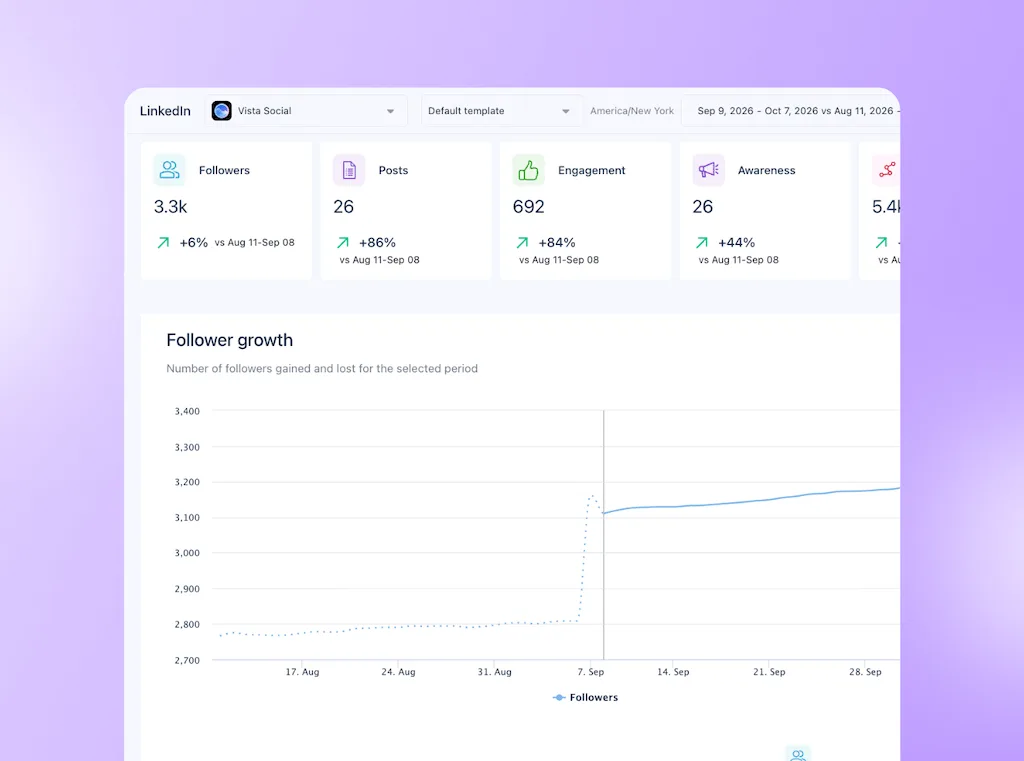
Measure each format against posts with a similar purpose. For example, the Vista Social LinkedIn analytics guide explains which page, post, and audience metrics can support that comparison.
Replace the Monday reporting scramble with a learning loop
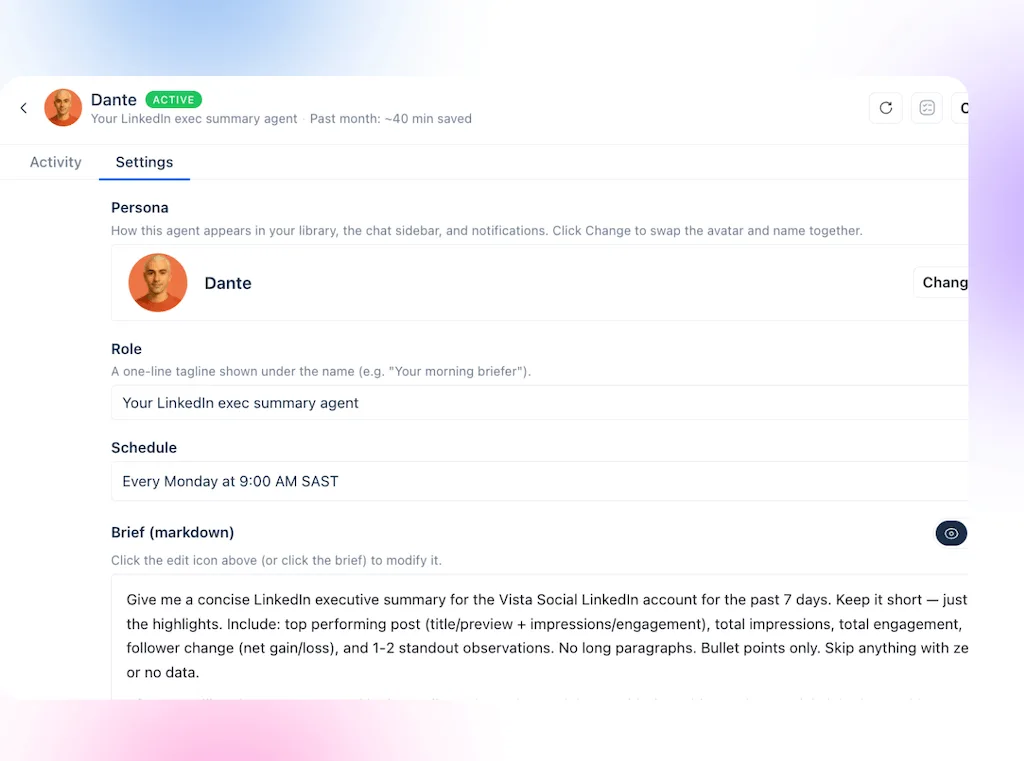
Monday morning often begins with exports, post tagging, calendar checks, and approval follow-ups. By the time you find a useful pattern, the next week’s content is already moving. An agent can handle that recurring collection and bring you the decision that needs judgment.
Vista Social’s Ask Vista agents can run on a schedule, monitor performance, surface content gaps, and catch approval bottlenecks. Availability varies by plan, while actions depend on workspace setup and user permissions.
| Stage | What the agent handles | What you control |
| Observe | Pulls post results, checks the next seven days, and finds stalled approvals | Profile group, date range, and success metrics |
| Decide | Groups results by topic and format, then proposes one account-backed test | Business context and whether the test deserves to run |
| Act | Creates a draft and routes it into the configured approval flow | Brand judgment and final approval |
| Verify | Compares the next result with the chosen baseline | Whether to repeat, refine, or stop the pattern |
For a deeper setup, see how AI social media reporting turns results into next steps and how social media agents run recurring jobs. Ask Vista can execute approved work inside the platform, while Vista Social MCP prompts let another connected AI client query results or work with the calendar.
Run one controlled 30-day test
Changing five variables turns a winning post into a guess. Use one month to produce a decision you can defend:
| Week | Work | Decision produced |
| 1: Baseline | Tag 60 to 90 days of posts by topic, format, speaker, and goal. Record medians for comparable groups. | Which two topic-format pairs have enough data to test? |
| 2: Topic test | Publish two posts for the same audience and format, using different evidence or angles. | Which angle produced stronger qualified attention? |
| 3: Format test | Express one strong idea in two suitable formats. | Did the format change who watched, read, or responded? |
| 4: Repeat | Repeat the stronger pattern with a new example and compare medians. | Is the pattern reliable enough to enter the calendar? |
What to expect from LinkedIn in 2027
LinkedIn has not published a 2027 algorithm roadmap, so treat these as inferences rather than confirmed launches:
- Clear expertise will outlast surface tactics: A feed that can interpret meaning has less reason to rely on fixed hook, hashtag, or format recipes.
- Direct quality feedback will put more pressure on empty repetition: Low-substance posts give both the member and the system fewer reasons to keep recommending the account.
- Fast learning loops will become the advantage: Personalized feeds make one global benchmark less useful, so the edge shifts toward teams that can inspect their own results and act on them quickly.
Give LinkedIn a reason to recommend the post
The LinkedIn algorithm needs a clear professional idea, a recognizable audience, and proof that makes the post useful beyond your immediate network. Build around those signals, review the outcome against comparable posts, and let the evidence shape the next test.
If you want the analysis to continue after you close the dashboard, start a Vista Social trial, connect LinkedIn, and build the weekly agent above. It can monitor the account and route the approved next step while you retain control of the strategy.
Frequently asked questions
Which signals shape the LinkedIn feed in 2026?
LinkedIn considers post meaning, viewer context, network activity, behavior history, popularity, engagement, recency, affinity, and direct quality feedback. No single signal controls reach, and the mix changes by member. Your own account history is a better benchmark than a universal formula.
Can a company page reach people who do not follow it?
Yes. LinkedIn mixes network posts with relevant suggestions. Give new readers enough context to understand the problem and use the idea without knowing your company.
Does posting time still matter on LinkedIn?
Timing can help the intended audience encounter a post, but it is one signal among many. Judge it alongside topic, format, audience fit, and comparable account results.
Do hashtags still matter on LinkedIn?
Hashtags can label the topic and make the context clearer, but they cannot rescue a vague post. Use only relevant tags, then judge the post by qualified response rather than the number of hashtags attached to it.
About the Author

Content Writer
Orion loves to write content that refuses to be boring. As part of Vista Social, he helps brands, creators, and agencies stop doom scrolling and start winning with social media. When he's not in front of a keyboard, he's watching films in IMAX with his wife, dissecting football tactics (the European kind), and getting lost in a good book.