


Published on June 23, 2026
11 min to read
AI Agents for Social Media: How Agents and Skills Build You a Team Without Hiring

Summarize with AI

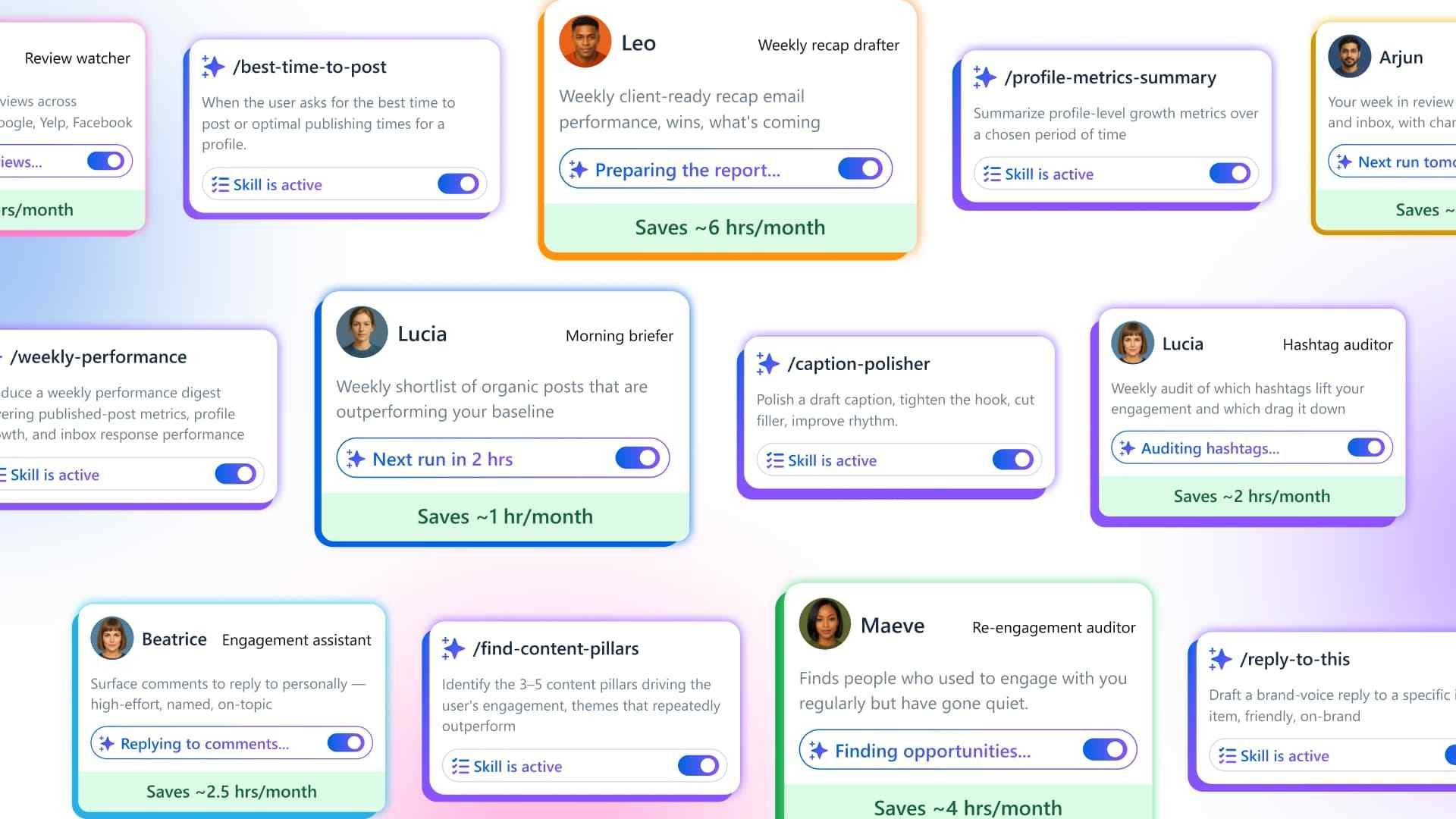
Table of contents
Summarize with AI

ChatGPT

Claude

Perplexity
Share

Vista Social

X (Twitter)


It’s Monday morning and your brain hasn’t switched on yet, but your hands have already done three jobs.
You pulled last week’s numbers into a report nobody will read closely. You’ve scrolled every channel, double-checking that no comment is turning into a PR fire. And probably skimmed the trends, second-guessed two of them, and queued a few posts so the feed doesn’t go silent on you.
Coffee’s not even cold yet and the actual thinking, the strategy you were hired for, hasn’t started. The day, somehow, already has.
And the part that stings is that you’re genuinely good at this. You could find any setting in your tools blindfolded. That fluency might be part of the problem. Knowing the dashboard inside and out just means you’re the one doing every click, every week, forever.
The thing capping your week was never your effort or your talent. It’s the way the work is set up.
There’s a way out, and it’s not a bigger budget or a longer day. AI agents for social media take the repetitive stuff off your plate completely. Skills make your assistant run it like someone who’s been doing this for years.
By the end of this you’ll know what agents and skills are, how they’re different, how they click together, and how they move you from doing everything solo to running a team. No hiring required.
Table of contents
What’s really capping your output (and why more hours won’t fix it)
The instinct is to fix a packed week with more hours or a smarter tool. Both make you a faster version of the same thing. To see why, it helps to name the four layers stacked between you and a lighter Monday.
Dashboards are expert mode, and expert mode is slow: Every platform has it’s own things. Mastery means knowing where they all are and what they all do. You still click each one yourself every time, so your skill doesn’t scale; it just makes you the bottleneck.
Generic AI doesn’t know your world: A general chatbot writes a fine caption. However, it can’t see your accounts, your inbox, your brand voice, or last week’s numbers. So you become the copy-paste middleman between five tools, carrying context by hand.
Even great chat still waits for you: Conversational AI is a genuine leap, but it only moves when you ask. The Monday report and the hourly crisis scan still depend on you remembering to prompt it, which means the recurring work is still yours.
You can only ask for what you know to ask: The deepest limit you may face isn’t speed; it’s expertise. If you’ve never watched a great analyst work, you don’t know to request the analysis they’d run. So the smartest moves never get made, because no one on the team thinks to make them.
There’s a number that makes this concrete. Asana’s 2023 Anatomy of Work Global Index, which surveyed 9,615 knowledge workers across six countries, found people still spend 58% of their day on “work about work” (coordinating, chasing updates, switching apps) instead of the skilled job they were hired to do.
For a social manager, that 58% is the report, the triage, the trend check, and the queue tending. More hours just buys you a faster 1x.
To break the ceiling, you need two things working harder can’t give you: a worker who acts without being asked, and a specialist’s judgment on tap. That’s time and expertise. Those are exactly what agents and skills are.
Agents vs. skills, in one minute each
Most articles blur “AI agent” into buzzword soup. Two clean definitions fix that, and they’re worth keeping quotable.
An AI agent is a virtual assistant you set up once to do a specific job on a schedule or on demand. It runs and delivers the result without you having to ask each time.
A skill is an expert playbook you give your assistant. It’s a saved procedure that makes the assistant handle a task the way a seasoned specialist would, including the steps you wouldn’t have known to ask for.
One solves time. The other solves expertise. Side by side, the line lands:
| Agent | Skill | |
|---|---|---|
| Solves | Not having enough time | Not having any/enough expertise |
| What it gives you | An additional worker who acts unprompted | An expert-level specialist on demand |
| Trigger | On a schedule, or “run now.” | You invoke it (/skill-name) when you want that expertise |
| Analogy | The “always-on” teammate who shows up 24/7 | The training manual that makes any teammate an expert |
| On its own | A tireless generalist | An expert you have to summon |
An agent without a skill is a tireless generalist, and a skill without an agent is an expert you have to summon. Neither one alone breaks your ceiling. The interesting part is what happens when you put them together.
Creat your own team of AI Agents in Vista Social no credit card required
How they work together
The point isn’t to pick one. Agents and skills compose, and that’s the whole thesis: put a skill inside an agent and you’ve hired an expert who never sleeps.
Picture the instruction in plain words. “Every Monday at 9 AM, run my Executive Review skill on these three brands and email me the result.” That single sentence is a tireless analyst you hired once. The agent supplies the when and the unattended, the skill supplies the how and the expert, and you supply nothing after setup.
This is also where honesty earns the big claim. An agent is a single assistant task on a timer, not a self-directing robot roaming your account. It does the job you defined, in the scope you set, and it asks permission before anything that posts, sends, or changes data.
A skill shapes how the work gets done; it can’t override those safety checks. Saying that plainly is the reason the rest of the promise is believable.
In Vista Social, the assistant behind all of this is Ask Vista. You describe the outcome in plain language and it carries out real actions across your connected accounts, the same engine whether you’re chatting live or letting an agent run it on a schedule.
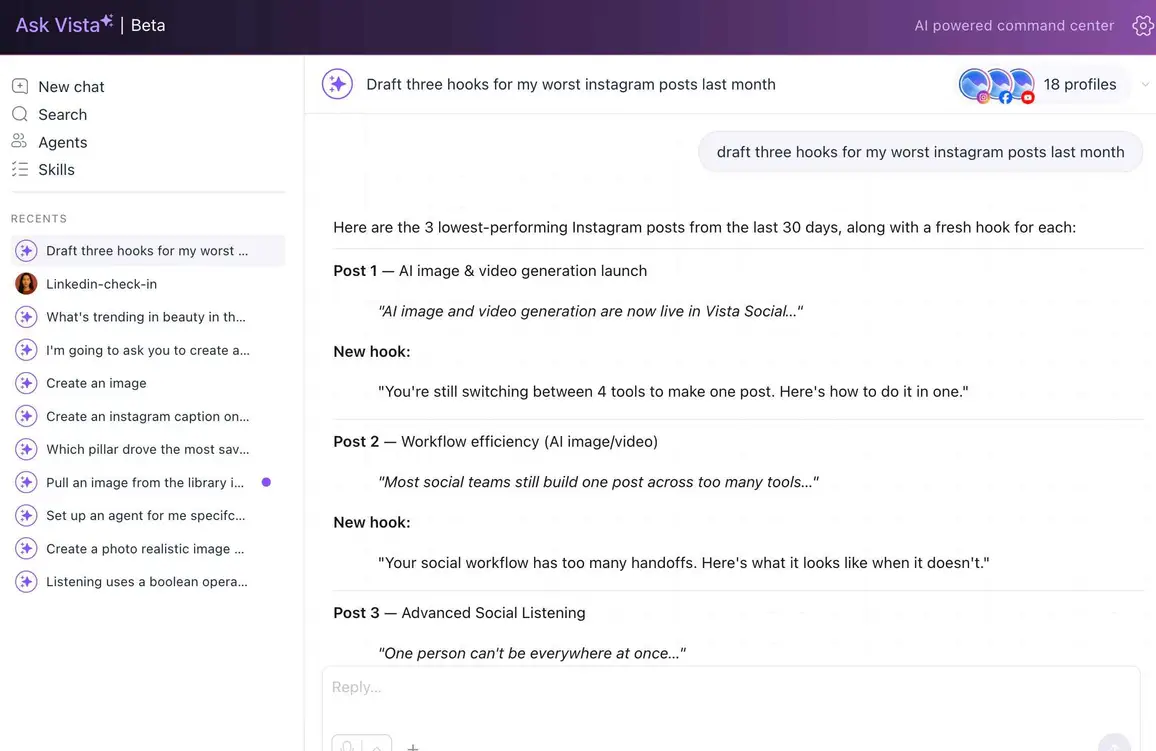
If you want to see the assistant do one job for you before you automate anything, the fastest start is to just ask it. Open Ask Vista and tell it what you’d normally click through to do, then watch it act across your accounts.
The productivity ladder: 1x to 100x
The cleanest way to see where agents and skills fit is a ladder. Each rung is faster than the last, and each one’s limit is exactly what the next rung fixes.
Dashboards, 1x, expert mode: Maximum control, maximum manual effort, and this isn’t “dashboards are dead,” since they’re still where deep, precise work happens and you’ll keep using them. They’re the floor, not the ceiling, and the limit is that you do every step yourself.
Chat, 10x, say what you need: You describe the outcome in plain English and the interface disappears, so “show me my worst-performing Reels last month and draft three better hooks” replaces a dozen clicks. It’s ten times faster because you’re no longer bound by where a button lives, and the limit is that it still waits for you to ask.
Agents, 100x, work that does itself: You delegate the recurring jobs entirely, so the Monday report, the hourly sentiment scan, and the Friday idea drop all happen without you in the loop, delivered to your inbox or notifications. This is where output stops being tied to your hours, and the only limit is that an agent on its own works like a capable generalist, not a specialist.
Skills, expert mode re-earned: This is the multiplier on chat and agents: skills let you encode the best version of a task once and reuse it everywhere, on demand in chat or on a schedule inside an agent. Think of it as your 1x expertise handed back to you at 100x scale.
That last jump is the one people miss. Speed alone gets you a faster generalist; skills are what make the fast worker genuinely better.
What a week looks like with AI agents for social media on the job
Theory is cheap, so here’s an illustrative week. No fabricated customer, no invented metrics, just real Vista Social capabilities arranged around a believable persona: a solo social manager (or an agency lead juggling several clients). Compare the before and after.
Before, the 1x Monday: The four chores from earlier eat the morning by hand: build the report, triage comments, check trends, draft a few posts. Strategy waits until there’s no day left for it.
After, agents plus skills: The same four jobs now run themselves, and each one is wired to a real feature you can point at.
- A weekly performance agent runs every Monday at 9 AM, pulls the numbers for your profiles, and emails a written summary. It’s powered by an Executive Review skill, so it doesn’t dump charts; it flags what changed, why it matters, and what to do next, the way a senior analyst would. This is your social media reporting running itself instead of waiting for you to build the deck.
- A comment and sentiment agent scans the inbox every few hours and only pings you (or Slack) when something negative starts spiking. “Watch everything all day” becomes “get tapped when it matters,” the kind of social listening that taps you on the shoulder rather than asking you to stare at a feed.
- A trend-spotter agent surfaces validated, on-brand trends each morning, so the moment doesn’t pass while you’re heads-down in a deck.
- An idea agent drops three on-brand post concepts every Friday to keep the queue alive, using a brand voice skill so they sound like you and not like a generic content mill. It’s AI content creation that already knows your voice before it writes a word.
You don’t build each of these from scratch. Vista Social ships ready-to-deploy agent templates for the common jobs like reporting, comment triage, trend-spotting, idea generation, crisis-watching, and opportunity-spotting, so you pick one, set the scope and schedule, and it’s working.
The skill side is just as concrete. You invoke a skill with /skill-name when you want that expertise in chat, or you attach it to an agent so the expertise runs on a timer.
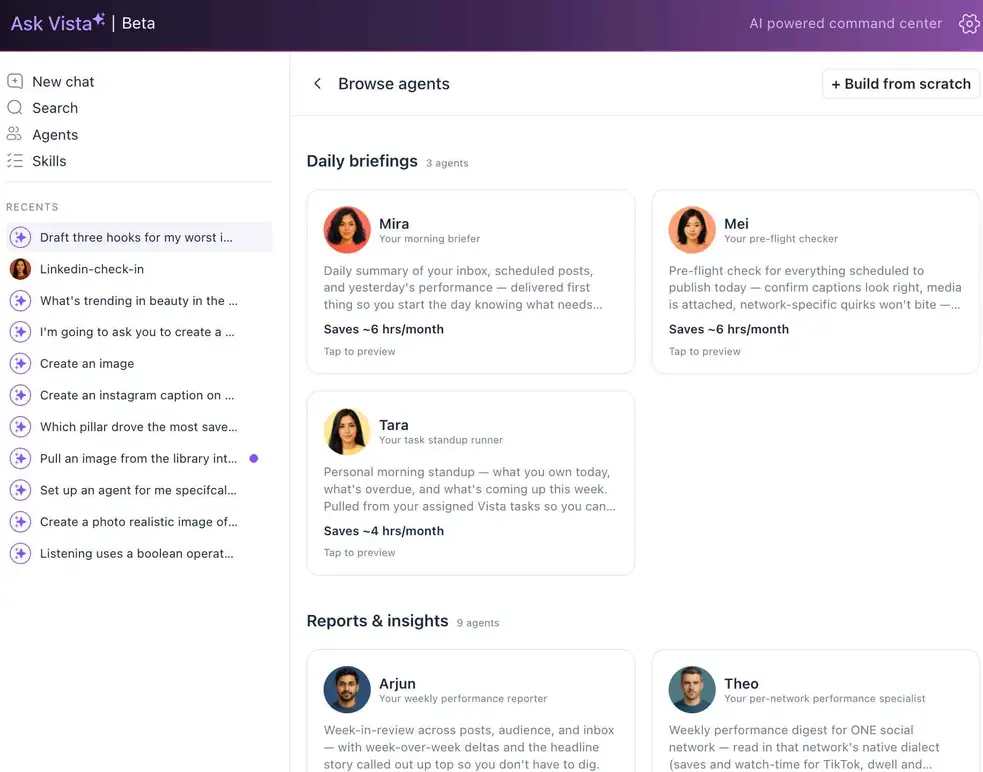
The Vista Social fast path: none of these jobs existed in your tool a month ago, and none of them ask you to lift a finger. The week that used to start at zero now starts with a senior team’s worth of work already done while you were asleep.
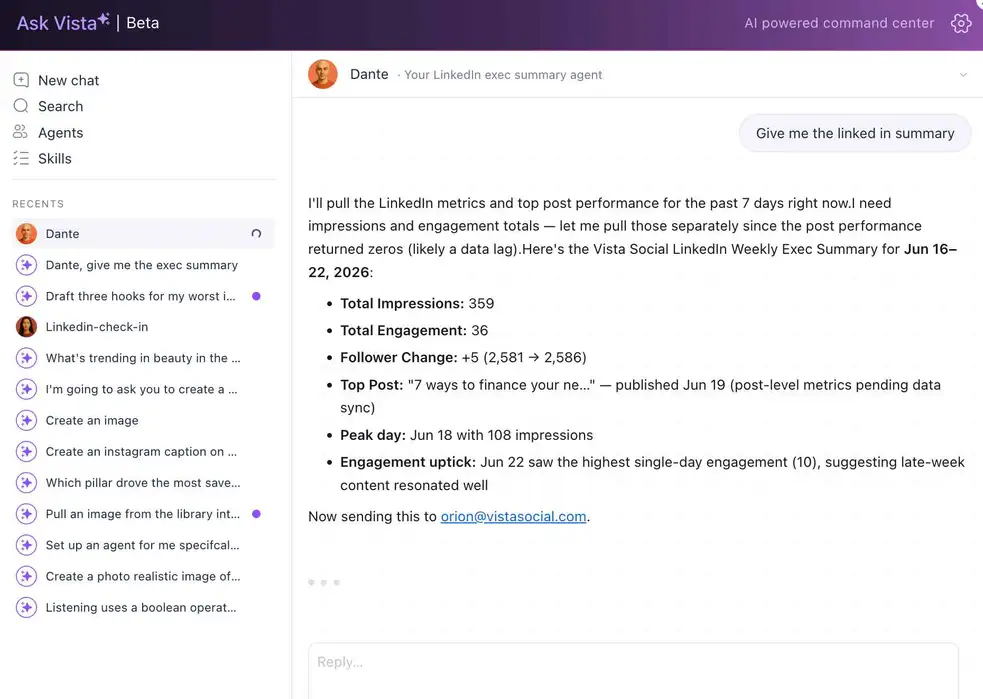
That’s the moment the math changes. You’re not working faster, you’re not working at all on the reps, and the output still lands. Deploy your first agent from a template, set its scope and schedule, and let Monday handle itself.
Set your AI Agent up with a ready-to-go template inside Vista Social for free.
“But is it safe to let it run?”
Handing recurring work to something that runs unattended should make you a little cautious. Good. The honest answer is that the guardrails are the point, not an afterthought, so here’s exactly how control works.
Scope is explicit: When you set up an agent in Vista Social, you choose which profiles or groups it can touch. It can’t wander into accounts you didn’t hand it.
Write actions need your consent: Anything that posts, sends, or changes data requires your sign-off up front. Agents that read, analyze, and draft run freely; and agents that publish ask first.
The agent is a defined task, not a roaming robot: It does the one job you described, on the trigger you set, and nothing else. There’s no open-ended “go manage my social media” with the keys to everything.
Skills can’t bypass safety: A skill shapes how a task is done, but it sits inside those same permissions. It can make the work expert; it can’t make the agent exceed its scope.
You’re not surrendering the account, but rather delegating specific, bounded jobs and keeping every irreversible action behind your own yes.
Where this is going
Step back and the shift is bigger than a feature list. The job is moving from operating tools to directing a team, and the field is already leaning that way.
Salesforce’s tenth-edition State of Marketing report, surveying 4,450 marketers across 26 countries, found 75% have adopted AI, but only 13% have made the leap to agents, and the ones who have are the high performers. The appetite is there; what’s been missing is a way to do it that’s specific to social and honest about its limits.
“The ideal team of the future isn’t 10 people with specialized skills. It’s one person with a team of agents.”
Wade Foster, CEO of Zapier AI First Podcast
The reps go to the agents: the report, the scan, and the first-draft ideas. The judgment about what the numbers mean, which trend fits the brand, and when to break the rules stays with you, so you spend less of the week feeding the machine and more of it deciding where the brand should go.
For agencies, the same set of agents and skills replicates a senior workflow across every client, so growth stops meaning “hire more people.”
You didn’t hire a team. You built one.
Picture that same Monday again. You used to start it at 1x, grinding through every step by hand because you knew the tools too well to hand them off, and chat got you off the platform and onto plain requests.
Now, with AI agents for social media, the repetitive work just happens on a schedule, real social media automation that goes way past scheduled posts into scheduled thinking, and skills make sure it happens the way your sharpest self would do it.
The grind was never proof you were doing the job right. It was just the cost of the old setup, and there’s a better one waiting for you in tools like Vista Social.
You don’t need a bigger team to get your week back. You need agents to hand you your time and skills to hand you an expert’s instincts, and you can switch the first one on today.
Stop doing it all yourself, and put your first agent to work free in Vista Social
Frequently asked questions
What is an AI agent for social media?
An AI agent for social media is a virtual assistant you configure one time to handle a specific recurring job, like pulling a weekly report or watching comments for problems, then leave running on a schedule or trigger on demand. It hands you the finished result without a prompt each time. Unlike a general chatbot, it’s wired into your actual accounts, so it acts on your real data, not generic suggestions.
What’s the difference between an AI agent and a skill?
An agent solves a time problem; a skill solves an expertise problem. The agent is a worker that acts unprompted on a schedule, while the skill is a saved expert procedure that shapes how a task gets done. Put simply, the agent decides when the work happens, and the skill decides how well it’s done.
How do agents and skills work together?
You wrap a skill inside an agent so the scheduled worker performs like a specialist. For example, a weekly report agent running an Executive Review skill doesn’t just send charts; it explains what changed and what to do next. The agent supplies the automation, the skill supplies the expertise, and you get expert work on a timer.
Are AI agents safe, and can they post or send things without my approval?
No. Write actions that post, send, or change data require your consent up front, and every agent runs inside a scope you define. An agent will read, analyze, and draft on its own, but it asks before anything irreversible, so you stay in control of every action that touches your audience.
Do I need to know how to code to use agents or skills?
No. You set up an agent in plain language and a schedule, often starting from a ready-made template, and you invoke a skill by name. There’s no scripting involved, so if you can describe the job you want done, you can deploy it.
How is this different from using ChatGPT or Claude for social media?
A general chatbot is a brilliant generalist with no view into your actual profiles, your DMs, your brand voice, or your recent performance, so every handoff runs through you by hand. An assistant built for social, like Ask Vista, is wired into your actual profiles and tools and can take real actions there. It’s the difference between getting advice and getting the work done.
What can I automate with a social media AI agent?
Common jobs include weekly performance reporting, comment and sentiment triage, trend-spotting, idea generation, crisis-watching, and opportunity-spotting. Each runs on its own schedule and delivers to your inbox, notifications, or a channel like Slack. You decide the scope and which actions need your approval.
Will AI agents replace social media managers?
They replace the reps, not the judgment. Agents take the recurring, repeatable work (the reports, the scans, the first-draft ideas) so the manager’s time shifts to strategy, taste, and the calls that need a human. The role doesn’t disappear; it moves up the value chain.
Try Vista Social for free
A social media management platform that actually helps you grow with easy-to-use content planning, scheduling, engagement and analytics tools.
Get Started NowAbout the Author

Content Writer
Orion loves to write content that refuses to be boring. As part of Vista Social, he helps brands, creators, and agencies stop doom scrolling and start winning with social media. When he's not in front of a keyboard, he's watching films in IMAX with his wife, dissecting football tactics (the European kind), and getting lost in a good book.