


Published on June 19, 2026
13 min to read
The Brand Voice Playbook: How to Make AI Content Sound Like You

Summarize with AI

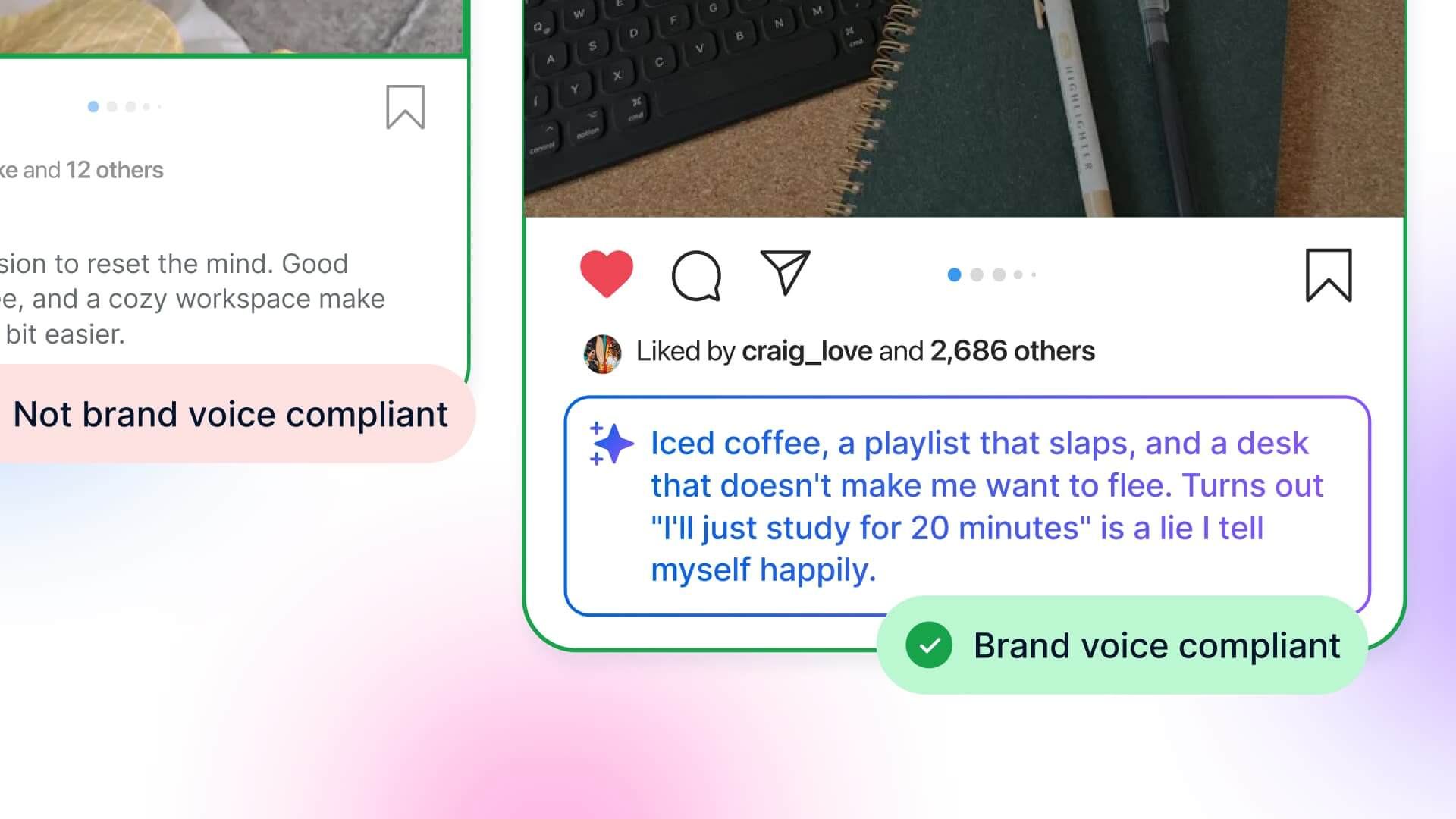
Table of contents
Summarize with AI

ChatGPT

Claude

Perplexity
Share

Vista Social

X (Twitter)


Open three of your brand’s last ten posts side by side and read them out loud. One is warm and a little funny, one sounds like a press release, and one is a polite AI draft nobody fully rewrote.
Same logo on all three, three different personalities. Your audience feels the gap even if they could never name it. That drift is a steady tax on a small social team. You are writing fast. Often across five platforms, sometimes handing the first draft to a tool, and every handoff is a chance for the voice to wobble.
The cost is cumulative. A feed that feels slightly off, a brand that is harder to recognize, and trust that builds slower than it should.
Consistency turns scattered posts into a brand people remember, and that recognition is what earns trust. It is worth real money, because trust now sits alongside price and quality in how people decide what to buy.
The Edelman Trust Barometer found that 80% of people trust the brands they use more than they trust business, government, media, or NGOs, and that trust has become a third axis of competition next to price and quality.
This playbook fixes the drift. By the end you will have a documented brand voice, short enough that anyone can actually use it, a way to encode it so AI tools draft in your voice instead of their own, and a one-page template you can fill in this week.
Table of contents
What brand voice is
Brand voice is the consistent personality and style your brand uses everywhere it communicates. The recognizable way you sound that stays the same even as the message changes. It is the “who is talking” underneath every caption, reply, and email.
It helps to separate two words people mix up. Voice is your constant personality. The traits that never change, while tone is how that voice flexes to fit the moment.
You stay lighter on a fun launch and steadier during a customer complaint. You have one voice and many tones, and a good social media style guide captures both, so the personality holds while the tone adapts.
It also helps to name what voice is not. It is not your visual identity, your logo, colors, and fonts, and it is not your style rules, like whether you use the Oxford comma. Voice sits underneath all of that. It is the personality that those things dress up.
Think of it the way you think of a friend. Their personality is steady whether they are cheering you on or breaking bad news. However, the way they say it shifts to suit the moment. A brand that gets this right feels like that same recognizable person across every post.
It is worth being honest about what a voice cannot do, so you aim it at the right job. A strong voice will not rescue a weak offer or paper over a product nobody wants. It is not a substitute for actually having something to say. What it does is make everything you do and say unmistakably yours. The good work you already produce gets the recognition it has earned.
“AI can regurgitate any idea, but it can’t refract it through its non-existent lived philosophy.”
Dan Koe (You don’t need a niche, you need a point of view)
Why brand voice is your 2026 moat
Two things make brand voice more urgent in 2026 than it was a couple of years ago, and they pull in the same direction.
The first is consistency’s payoff, which is bigger than most teams assume. A recognizable voice across every touchpoint is part of how a brand earns that trust, and the same Edelman research found that 73% of people say their trust in a brand would rise if it authentically reflected the culture around it. Authenticity is hard to fake without a clear voice, so recognition compounds into trust and trust compounds into sales.
The second is AI, and this is the shift that changes everything. Using AI for content creation is no longer an edge but the baseline. When every team is prompting the same handful of models, the output converges on the same competent, faceless mush.
That sameness is exactly why voice is now the moat. When AI handles the volume, your judgment handles the direction, and brand voice is how that direction gets encoded into what the tool produces. The teams winning don’t avoid AI, they have defined their voice clearly enough that a model can reproduce it on demand.
The job has shifted from “write in our voice” to “define our voice clearly enough that a person or a tool can repeat it without us in the room.” Tools designed to humanize AI content can also help brands create more natural, engaging material while preserving the personality and tone that make their voice distinctive.
There is another benefit. A documented voice protects you when people leave, when a freelancer steps in, or when you scale from one writer to five. The personality lives in the guide instead of in one person’s head, so it survives the turnover that breaks most small teams.
The playbook
Seven steps, in order. The first three define and document the voice, and the next three put it to work and keep it consistent, AI included. Run them top to bottom once, then keep the artifacts as living documents you use.
Step 1: Find your voice in what you already sound like
You do not invent a brand voice from a thesaurus, you discover it in your best existing work. Pull together the posts, replies, and emails that felt the most like you and got the warmest response, then read for the pattern underneath them.
As you read, ask a few plain questions. Are we formal or casual, playful or serious, plainspoken or polished, and do we crack jokes or stay warm and steady?
Write down the recurring traits you see, not the aspirational ones you wish were there.
Here’s how to know it’s done well: You can describe how your brand sounds in three or four honest adjectives, and you can point to a real post that proves each one.
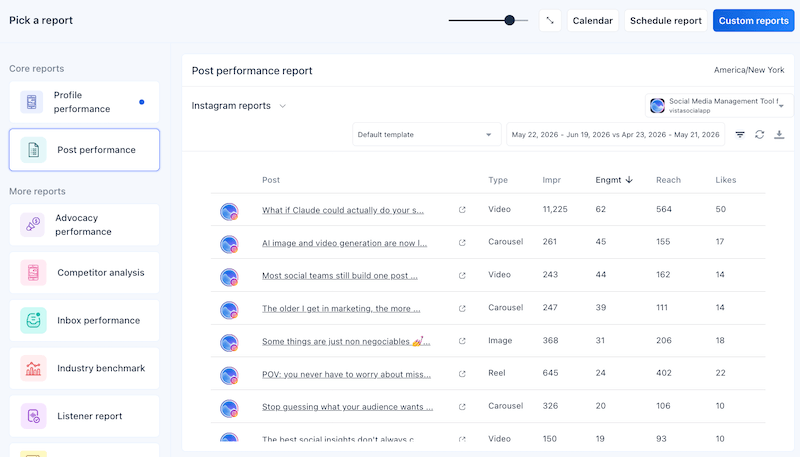
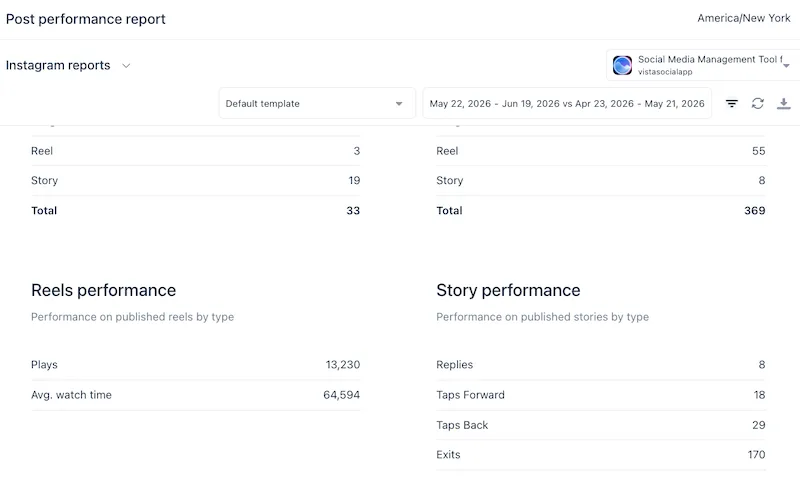
The Vista Social fast path: Review your highest-performing posts in social media analytics to see which voice resonates with your audience so your definition is grounded in what works.
Step 2: Define your voice with four pillars, not vibes
“Friendly and professional” describes half the internet, so push past vibes into something a writer or a tool can act on. The cleanest way to do that is to define your voice across four pillars.
Persona: Who your brand sounds like if it were a person. A witty insider, a calm expert, a hype friend. Name it in a sentence.
Tone: The emotional register you default to and how far it is allowed to flex. Warm and upbeat at launch, steady and plain in a complaint.
Vocabulary: The words you reach for and the ones you never use. “We say ‘happy to help,’ we don’t say ‘we’re absolutely thrilled to assist you on this wonderful journey.’”
POV: The opinions you actually hold. The hot takes, the things you believe about your category that a faceless competitor would never say. This is where a voice gets its spine.
For each pillar, write what it means, what it looks like in practice, and what it is not, because the “is not” is where a voice gets its edges. A three-column shape per trait does it: the trait, a “we do this” example, and a “we don’t do this” counterexample.
Here’s how to know it’s done well: Someone who has never worked with you could read your four pillars and rewrite an off-brand caption to sound right.
The Vista Social fast path: Store these pillars where your team drafts so the definition lives next to the work in your social media management workflow rather than in a doc nobody reopens.
Step 3: Write the voice doc, short enough to actually use
A voice that lives only in your head cannot scale past you, so put it on paper, briefly. The best voice guides are one page, not a fifty-slide brand bible.
Keep it tight. Include a two-to-three sentence voice statement; your four pillars with do/don’t examples; a short “words we use and words we avoid” list; three to five sentences rewritten from off-voice to on-voice; and two or three sample posts. The full template is at the end of this playbook, ready to copy.
The off-voice to on-voice rewrites do more work than anything else on the page. A single example of a flat caption turned on-brand teaches the feel of your voice faster than a paragraph of description ever could, so include a few real ones.
Here’s how to know it’s done well: A new contributor can read the page once and produce a caption that sounds like you, without a back-and-forth.
The Vista Social fast path: Build it as a living social media style guide your whole team can reach while they post, so the guide is a tool, not a trophy.
Not sure where to start? Get in on Vista Social for free, no credit card required.
Step 4: Pressure-test it with the swap test
Before you trust the voice, try to break it. Take one of your posts, cover the logo, and ask a blunt question: could a competitor put their name on this and have it pass as theirs? If the answer is yes, the voice is not distinct enough yet.
The fix is almost always more POV and sharper vocabulary. Generic posts are generic because they could have come from anyone, so push the opinion further and swap the safe words for the ones only you would use, then run the swap test again.
Here’s how to know it’s done well: A follower could cover your logo, read a post or a reply on any platform, and still know it is you.
The Vista Social fast path: Run the swap test against your live engagement and replies, not just your polished posts, since the brand only feels like one person when the quick comments sound like you too.
Step 5: Encode your voice for AI
This is the 2026 step most brand-voice advice skips. A model will default to its own bland register unless you hand it something specific to copy, so turn your voice doc into a compact instruction the AI gets on every generation: the persona in a line, the tone, the do/don’t word lists, and two or three real posts to imitate.
The difference is stark when you see it side by side. Same brief, two prompts:
| Weak, generic prompt | Voice-encoded prompt |
| “Write an Instagram caption announcing our new oat milk latte.” | “Write an Instagram caption announcing our new oat milk latte. Voice: a witty neighborhood barista, never corporate. Tone: warm and a little cheeky. We say ‘grab one,’ we never say ‘indulge’ or ‘elevate your experience.’ POV: good coffee shouldn’t be precious. Match these two posts: [paste two real captions from the past].” |
| Returns: “✨ Say hello to our newest obsession! ☕️✨ Introducing our creamy Oat Milk Latte – the perfect blend of smoothness and flavor in every sip. 🌱 Come savor the goodness today! #OatMilkLatte #CoffeeLove #SustainableSipping” | Returns: “☕️ Got a latte love to share? Our new oat milk latte is here, and it’s ready to make your taste buds dance without the fancy frills. Grab one and let’s keep it cozy, not pretentious. Who needs a golden spoon when you’ve got a warm mug? 🥛✨ #OatMilkMagic” |
The first returns the faceless content everyone else is publishing. The second returns something that already sounds like “you”, so your edit is about sharpening, not rescuing.
Treat the first output as a starting point, never a finished post, because you can make a tool echo your voice but you cannot make it care about the post. The human pass is where the warmth comes back.
Here’s how to know it’s done well: The AI’s first draft already sounds mostly like you, and your edits are about polish, not personality transplant.
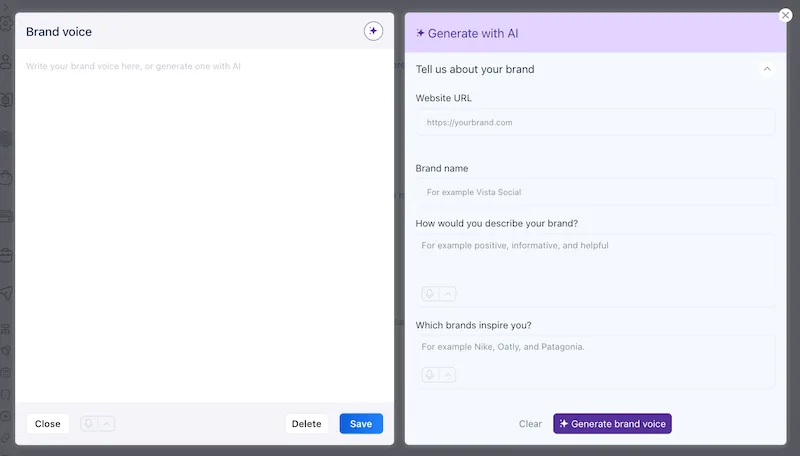
The Vista Social fast path: Instead of pasting your voice into every prompt, set your brand voice once in Vista Social, and the AI content creation tools apply it automatically to generated captions and inbox replies. You can even have Vista Social help generate the voice policy itself from a description of your brand. Pair it with AI Knowledge, which grounds the same output in your real facts, offers, and positioning, so captions come out both on-voice and accurate.
Set your brand voice once in Vista Social → free.
Step 6: Enforce the voice in your workflow
A voice only holds if something checks it. Left to good intentions, it drifts. Three lightweight habits keep it honest: one shared voice doc everyone drafts from, a quick review step before anything ships, and, for AI output, automatic application so no one has to remember to paste the voice in.
The review step matters most for AI-assisted posts, where it is easy to let a competent-but-generic draft slip through because it is not wrong, just not you. A second set of eyes on the voice doc catches that before it publishes.
Here’s how to know it’s done well: On-voice is the default path, not a thing someone has to remember to do.
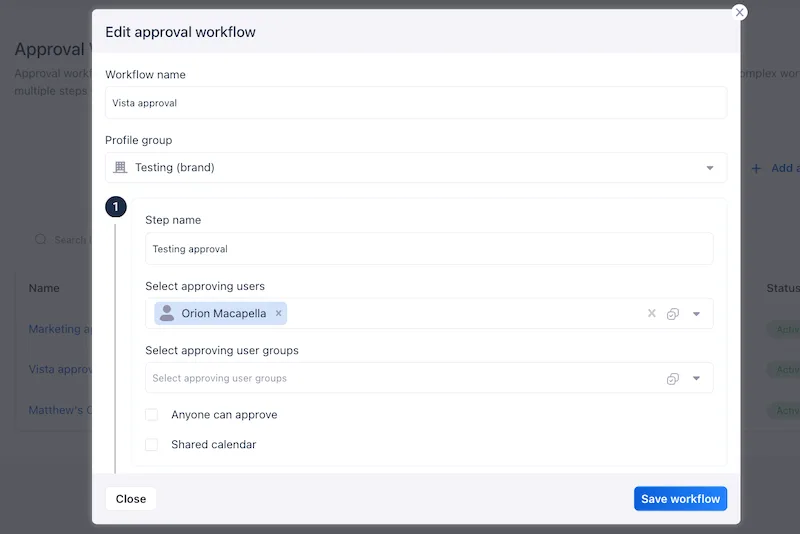
The Vista Social fast path: Route AI-assisted content through social media management approval workflows so a human signs off on voice before anything goes live, and because brand voice is set per profile group, agencies keep each client sounding like themselves at scale rather than blurring into one house style.
Step 7: Audit and evolve the voice over time
A brand voice is not frozen, it grows as your brand, your audience, and your own taste do. Re-audit about once a quarter: read a sample of recent posts against your guide, look for the wobble, fold in the new phrases that are clearly working, and tighten anything that has drifted.
Bring the people who post into that review, because the writers closest to the work feel the off-notes first. The goal is deliberate edits.
Here’s how to know it’s done well: Your voice doc reflects how your best posts sound today, and each quarterly read turns up fewer off-brand surprises than the last.
The Vista Social fast path: Pull a sample of recent posts in social media analytics for your quarterly voice audit so the review starts from real published work rather than memory.
Common mistakes and honest guardrails
A few traps catch good teams, and a couple are easy to under-do rather than things people ignore on purpose.
- Confusing tone with voice: Tone shifts by context; voice stays constant. Changing the personality post to post is the drift you are trying to fix.
- A bible nobody reads: A fifty-page brand book is easy to overbuild and hard to use. One page that gets opened beats fifty that gather digital dust.
- Letting AI default to its own register: If no one encoded the voice, the model fills the gap with generic content. Encoding it (Step 5) is what stops that.
- Set and forget: A voice guide written once and never revisited slowly stops matching reality. Schedule the audit so it stays true.
- Over-policing humans into stiffness: A voice doc should free writers to sound like the brand without second-guessing, not handcuff them into stiff, by-the-rules copy. If it is making your best writers worse, it is too rigid.
Your one-page brand voice doc (copy this)
Here is the whole thing as a fillable template. Copy it, fill in the blanks from Steps 1 to 4, and you have a voice doc you or a teammate can use. Or skip the doc and, better yet, store your voice in Vista Social so AI uses it automatically.
| Section | Fill in |
| Voice statement (2–3 sentences) | We sound like ___. We are ___ and ___, never ___. |
| Persona | If our brand were a person, they’d be ___. |
| Tone (and how far it flexes) | Default: ___. At launch: ___. In a complaint: ___. |
| Vocabulary (use / avoid) | We say: ___, ___, ___. We never say: ___, ___, ___. |
| POV (opinions we hold) | We believe ___. We’ll say ___ when others won’t. |
| Off-voice → on-voice rewrites | Before: ___. After: ___. (add 3–5) |
| Sample posts | 1) ___ 2) ___ 3) ___ |
Conclusion
Go back to that generic AI draft, the one that could have belonged to any brand in your category. The model did not fail you. It just had nothing of yours to copy.
Find your voice in your best work. Document it on a single page, teach your AI to use it. Keep it consistent across platforms, and audit it as it grows. Do that and the drift disappears. The feed starts to feel like one brand, and the recognition that drives revenue gets a chance to compound.
Treat the whole effort as a small investment with outsized returns. An afternoon spent defining your voice pays back every single time you or a tool sits down to write. The hardest question, “who is talking?” is already answered before the first word.
Your voice is already in your best posts. The work is making it repeatable. Define your brand voice and keep it consistent across every post, with Vista Social, for free.
Frequently asked questions about brand voice
What is brand voice?
Brand voice is the consistent personality and style your brand uses everywhere it communicates. The recognizable way you sound across captions, replies, and emails. It stays the same even as your message and platform change. A strong voice is what makes scattered posts feel like one brand people can recognize.
What is the difference between brand voice and tone?
Voice is your constant personality. The traits that do not change, while tone is how that voice flexes to fit the moment. You might stay playful on a launch and steadier during a complaint, but the underlying personality holds. In short, you have one voice and many tones.
How do I define my brand voice?
Start with your best existing posts and read for the pattern in how you already sound. Then capture three or four honest traits with “we do this / we don’t do this” examples for each. Write it up as a one-page guide that includes tone notes and a few before-and-after rewrites. The goal is a definition someone else could follow.
How do I keep my brand voice consistent with AI tools?
Give the AI your voice traits. Your do/don’t examples, and two or three real posts to imitate, then treat its first draft as a starting point you sharpen rather than a finished post. Watch for hollow enthusiasm and generic phrasing, and edit those out. Tools that draft inside your defined voice from the start need far less rescuing.
Why is brand voice consistency important?
Consistency builds recognition, and recognition builds the trust that now drives buying decisions as much as price and quality do. A wobbling voice makes a brand harder to recognize and slows that trust from forming. Holding one voice across every touchpoint is how scattered posts become a brand people remember and choose.
How often should I update my brand voice guide?
Review it about once a quarter by reading a sample of recent posts against the guide and tightening anything that has drifted. Your market, your audience, and your own taste evolve, so the guide should be edited deliberately rather than left to go stale. Bringing the people who post into the review catches off notes early.
Try Vista Social for free
A social media management platform that actually helps you grow with easy-to-use content planning, scheduling, engagement and analytics tools.
Get Started NowAbout the Author

Content Writer
Orion loves to write content that refuses to be boring. As part of Vista Social, he helps brands, creators, and agencies stop doom scrolling and start winning with social media. When he's not in front of a keyboard, he's watching films in IMAX with his wife, dissecting football tactics (the European kind), and getting lost in a good book.