

Published on July 21, 2026
9 min to read
AI Agents for Marketing That Check Each Other’s Work

Summarize with AI

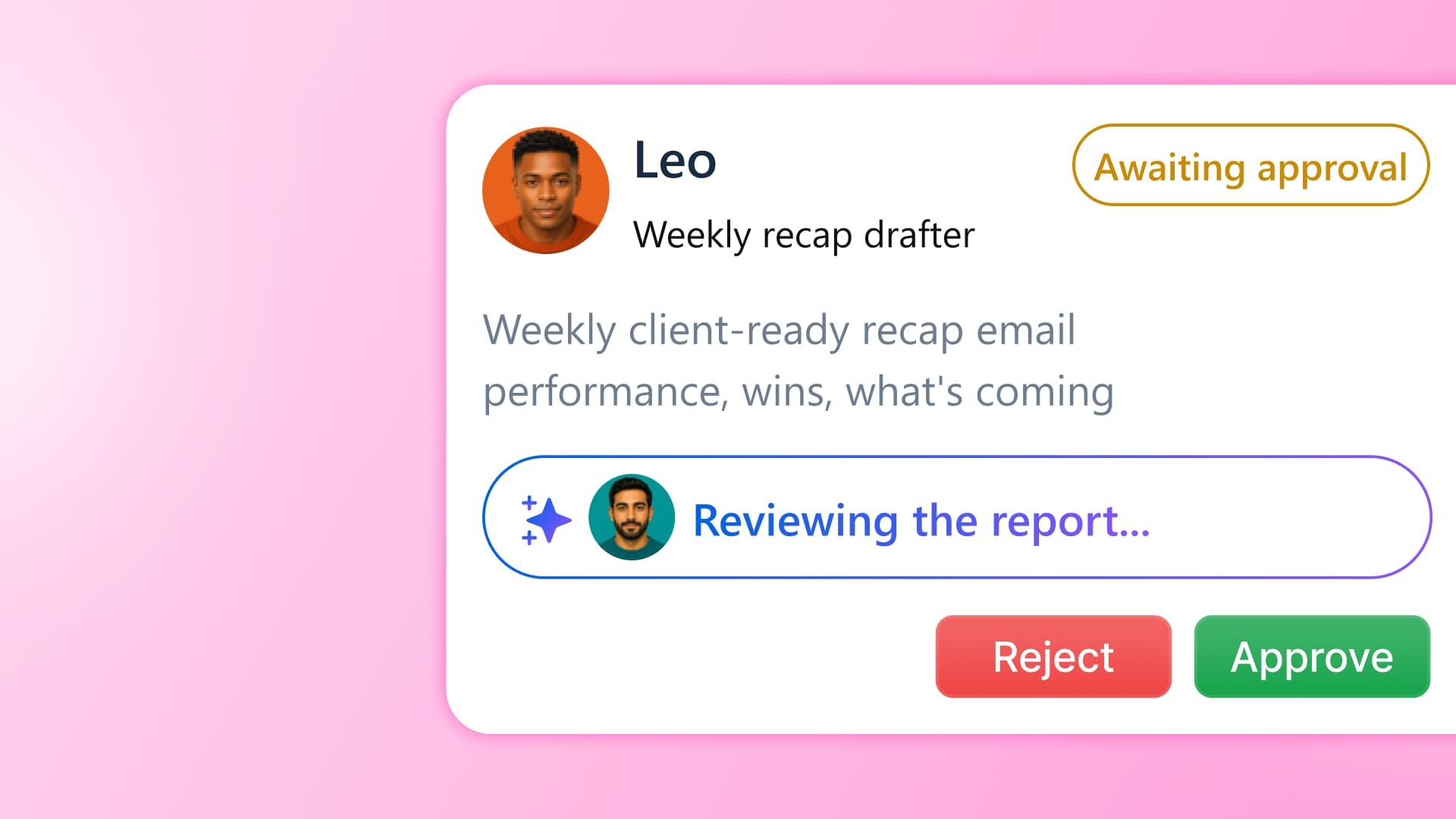
Table of contents
Summarize with AI

ChatGPT

Claude

Perplexity
Share

Vista Social

X (Twitter)


The number looked perfect in the caption just scheduled: “90% faster response times.” It gave the post a clean hook, made the product sound useful, and arrived in the same tone your team had spent months teaching the AI.
Then you opened the case study it’s based on. The reported improvement was much smaller, and the AI had rounded its way into a claim your company couldn’t defend.
You caught it before publishing, but the relief lasted about four seconds before another thought took over. How many polished mistakes have slipped through when you were tired, rushed, or reviewing the ninth post of the day?
AI agents for marketing can produce more work than one person can check line by line. A safer setup gives the draft its own review team, then keeps the final decision with a human who understands the brand and carries the responsibility.
Table of contents
The short version
- One agent drafts: It can move quickly and still produce a confident mistake.
- Three agents review: Separate checks look for factual errors, voice drift, and claims the brand can’t support.
- A human approves: Agent review improves the draft, while accountability stays with the person who signs off.
- The current path: You can use grounded drafts, brand voice, and approval workflows today without pretending a full agent debate is already built into every marketing tool.
Why one AI agent working alone is a liability
A single agent has no editor unless you give it one. It can write, summarize, schedule, and reply at speed, but it doesn’t feel the moment when a believable sentence has crossed into a false claim.
The risk has already moved beyond a hypothetical. McKinsey’s survey for 2025 found that 51% of respondents from AI-using organizations had seen at least one negative consequence. Nearly one-third of all respondents reported a consequence caused by inaccurate AI output.
The Air Canada case shows what an unreviewed answer can cost. In February 2024, British Columbia’s Civil Resolution Tribunal ruled that the airline was responsible for false bereavement-fare information its chatbot gave a passenger.
Air Canada argued that the chatbot was a separate legal entity responsible for its own actions, and the tribunal rejected that position.
The decision was blunt: the chatbot was part of the airline’s website, so the company remained responsible for what it said. The compensation was modest, but the tribunal finding gave every marketing team a useful rule: software can produce the answer, while the brand still owns the consequence.
Peep Laja, founder of Wynter, compresses the operating risk into one line:
“Bad data + AI = automated mistakes at scale.”
Peep Laja, AI trust research (2025)
That equation also explains why speed raises the stakes. A weak draft in a text box creates editing work. An inaccurate agent with permission to act can turn the same weakness into a public post, customer promise, or scheduled campaign.
You can try it free with no credit card required and keep approval on while your first agent learns the job.
What a team of agents means in newsroom terms
Multi-agent AI review is a setup where one agent produces work and separate agents check it for accuracy, brand voice, and compliance before a human sees it. Each agent gets a narrow role, so one generalist isn’t being asked to write the copy and grade its own homework.
A newsroom gives the idea a useful shape:
| Newsroom role | Agent role | Question it answers |
|---|---|---|
| Reporter | Draft agent | What should the first version say? |
| Fact-checker | Accuracy reviewer | Can every factual claim be supported? |
| Copy desk | Brand-voice reviewer | Does this sound like the brand on this channel? |
| Standards editor | Compliance reviewer | Can the company stand behind every promise? |
| Editor-in-chief | Human approver | Is this ready to represent us in public? |
The principle has research behind it. A 2024 paper in the ACL Anthology tested a multi-agent text-evaluation setup with a devil’s-advocate reviewer. It outperformed the prior methods on two evaluation benchmarks, although research results don’t mean every marketing workflow needs a formal debate.
The useful lesson is narrower. A model can hold onto its first answer, so giving another agent a different job and viewpoint can expose problems that self-review misses.
If you want the broader view of where these systems fit, our guide to AI marketing covers the surrounding strategy. The newsroom model focuses on the review layer between a generated draft and your approval.
The three reviewers every marketing team needs
Marketing review works best when each pass has a clear question. “Make this better” produces another opinion, while a narrow assignment produces an issue the human can accept, reject, or investigate.
The accuracy check
The accuracy reviewer asks whether the draft invented a number, feature, quote, customer result, or source. It should return the claim, the evidence it found, and a clear status: verified, unsupported, or needs human review.
Give it rules that match the work:
- Check every number: Percentages, dates, prices, and performance claims need a source.
- Open the source: A plausible citation isn’t enough if the linked page doesn’t contain the claim.
- Flag missing evidence: Unsupported facts should be removed or sent to a person, never repaired with another guess.
- Protect product truth: The reviewer should compare feature claims with current help documentation or an approved knowledge base.
In a social workflow, the accuracy check can inspect a caption before it reaches the calendar. It can also flag a draft that names a product capability your team hasn’t released yet.
The brand-voice check
The brand reviewer listens for a subtler problem. A caption can be grammatical and accurate while sounding like a polite stranger wearing your logo.
Give this reviewer a defined brand voice, several approved examples, and a short list of phrases the brand doesn’t use. Ask it to point to the line that drifts and explain why, instead of rewriting the entire post by default.
That last instruction protects the original idea. The reviewer should tune the off-key note, not turn every caption into the same safe paragraph.
The compliance and claims check
The standards reviewer looks for promises that create legal, regulatory, contractual, or reputational risk. It needs approved claim language and a clear escalation list, because “sounds reasonable” is a poor compliance standard.
Common flags include:
- Absolute promises: Guarantees, “always,” “never,” and results the company can’t assure.
- Regulated claims: Health, financial, employment, or safety statements that need expert review.
- Missing conditions: An offer or result that leaves out the eligibility rule holding it together.
- Sensitive context: A joke, reply, or campaign that changes meaning during a crisis or breaking event.
The output should name the risky phrase and the policy it may conflict with. A human can then revise the claim or route it to the right specialist.
You can test it free with no credit card required and bring grounded facts, brand voice, and approval into the same workspace.
The human still holds the yes
Human-in-the-loop AI means the system prepares the work while a person gives final approval before anything is published or sent. The human isn’t redoing every review; they are resolving the remaining judgment calls and taking responsibility for what ships.
This is where the newsroom analogy earns its keep. The copy desk can catch errors, but the editor-in-chief still knows the campaign context, the audience mood, and the business decision behind the post.
Agent review and human approval solve different problems:
- Agents provide stamina: The same checks can run on the first post and the fiftieth.
- Humans provide context: A person can recognize sarcasm, cultural risk, client history, and a change in strategy.
- Agents create evidence: Reviewers can surface the sentence and rule that needs attention.
- Humans make the call: The approver decides whether the evidence is enough for the brand to act.
Vista Social’s approval system supports internal and client review. A post moves from creation to review, and it isn’t allowed to publish until the required approvers have signed off.
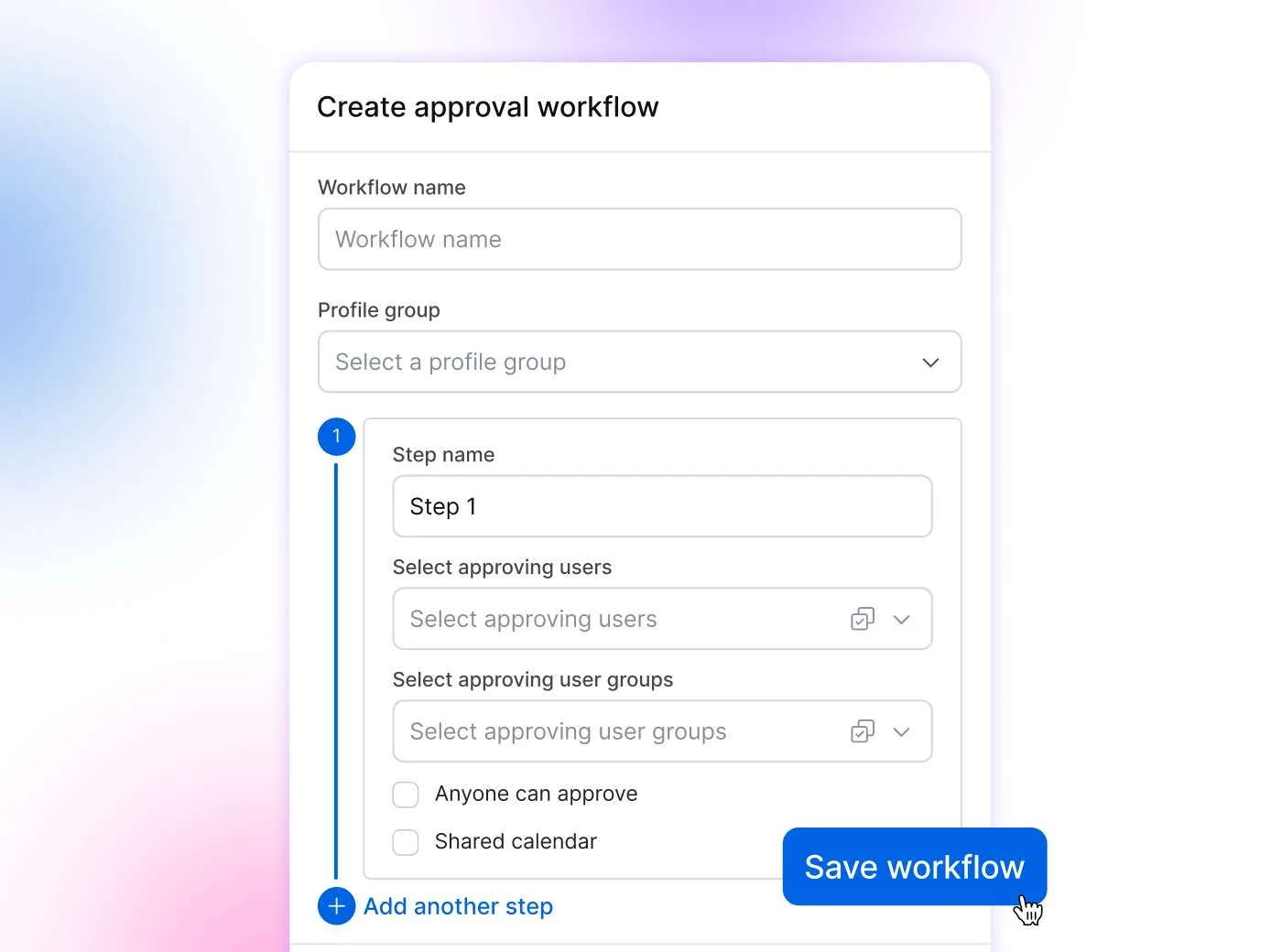
The Vista Social fast path: putting the draft and approval history in the same calendar removes the screenshots, chat threads, and version confusion that make a careful review easy to rush.
What this looks like in a real social workflow today
The full agent newsroom is an emerging pattern, and current marketing tools offer important parts of it. In Vista Social today, agents can prepare work. AI Training & Knowledge can ground selected outputs, brand voice can shape the draft, and approval workflows can hold publication until a person signs off.
Start with the version that already ships:
| Workflow moment | Current Vista Social path | Human responsibility |
|---|---|---|
| Drafting | Ask Vista or the AI assistant prepares a caption using connected context or selected knowledge | Judge the idea and final wording |
| Inbox triage | Ask Vista reviews inbox work and prepares or organizes the next action | Handle sensitive conversations and approve replies |
| Factual grounding | AI Knowledge supplies approved documents, pages, and guidance for selected use cases | Maintain current sources and test edge cases |
| Voice consistency | Brand voice applies the profile group’s writing policy | Decide whether the post still sounds alive and appropriate |
| Publication | The agent asks before publishing, sending, or changing connected account data | Give or withhold consent |
| Team review | Single-step or multi-step approvals route the post to named reviewers | Resolve comments and give final approval |
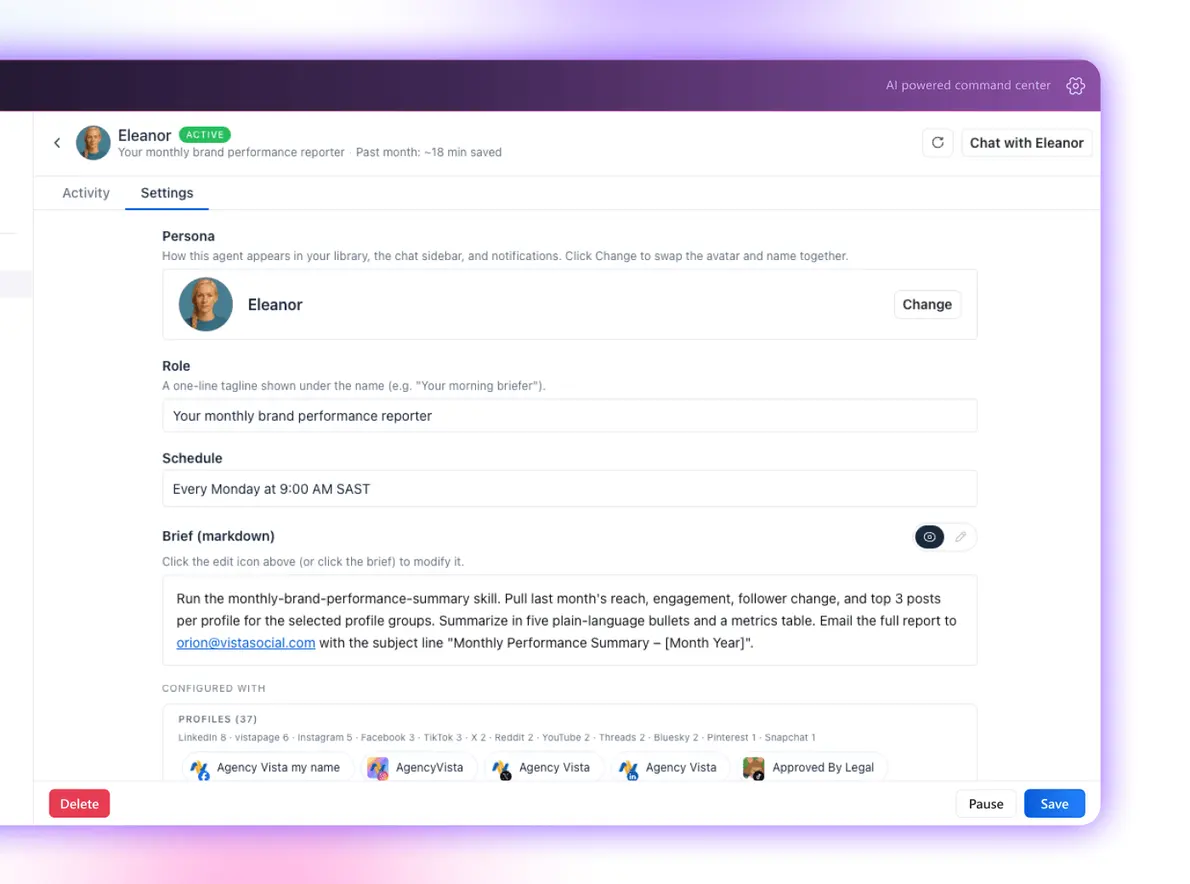
Ask Vista is connected to the social workspace, which lets it work with profiles, the calendar, inbox, and analytics. Its Scheduled Agents can run recurring tasks and report back, while public actions wait for confirmation. That control model is covered in Vista Social’s guide to AI safety.
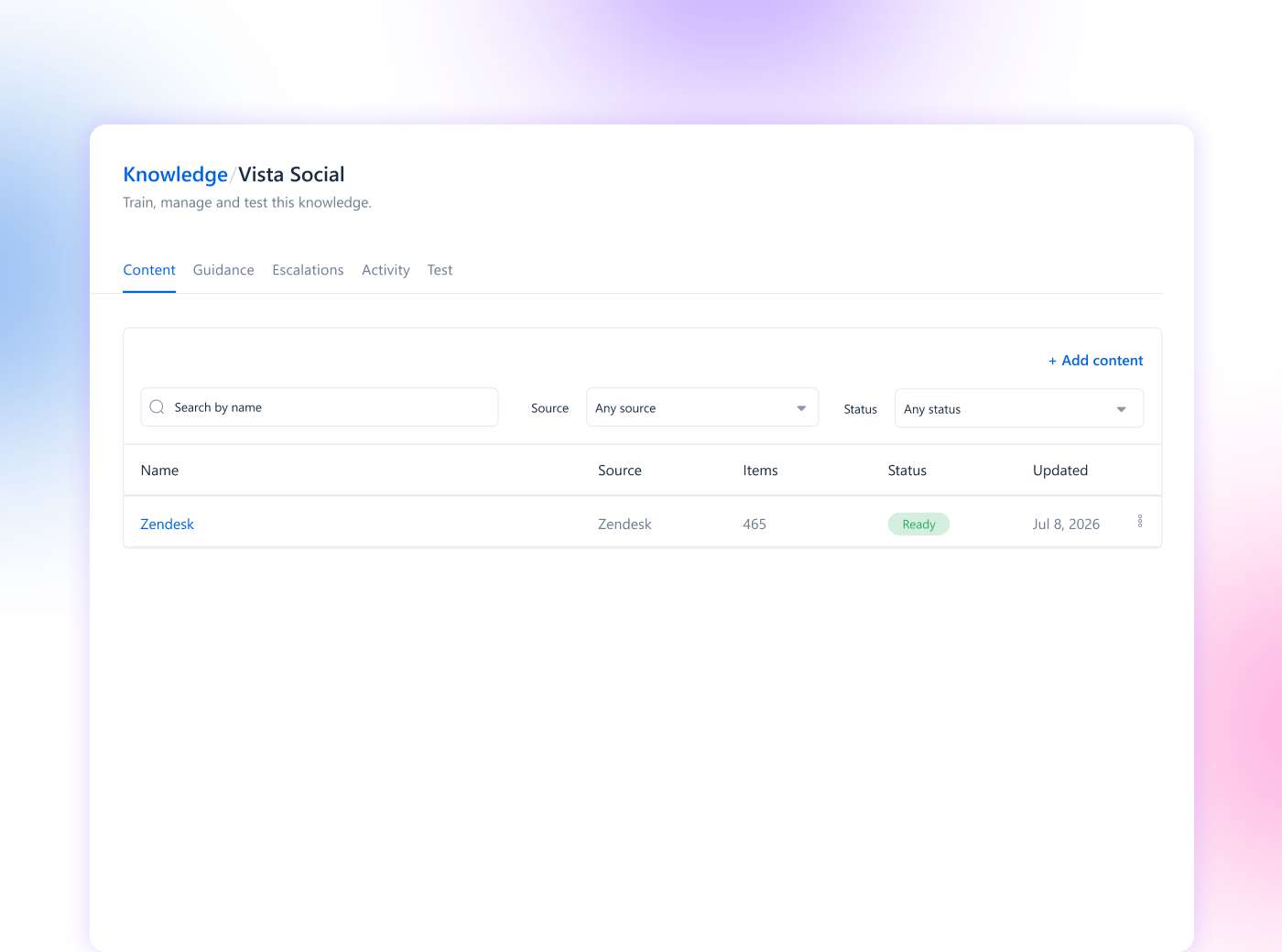
AI Training & Knowledge gives the draft a factual home base. You can add documents, webpages, sitemaps, or Zendesk articles to your knowledge base. Write guidance, test the answers, and review an Activity log. Knowledge is scoped to a profile group.
Brand voice handles style besides those facts. Vista Social applies a profile group’s voice policy to captions and inbox replies, while Knowledge supplies the relevant information for the selected task.
Our guides to inbox intent and automation risks cover two places where routing and oversight matter most. A high-volume inbox benefits from AI sorting, while a sensitive reply still deserves the person who knows the customer and the account.
You can start free with no credit card required and build the approval gate before you increase the agent’s workload.
When you need this and when you don’t
A solo marketer publishing a few low-risk updates each week can work well with one capable assistant and a careful human review. Building three automated reviewers for every caption would add more machinery than safety.
The review layer earns its place when at least one condition is true:
- Volume is high: Your new production speed has created more work than one person can verify with care.
- Claims are risky: A factual or legal mistake could cost trust, money, or access to the account.
- Several brands are involved: Voice, facts, permissions, and client rules change from one profile group to another.
- Approvals are distributed: Internal teams, clients, legal reviewers, or regional owners need a visible sequence.
- Agents can act: The system can publish, send, schedule, or change something beyond a private draft.
You can also scale the review according to risk. An evergreen tip may need one automated check and your approval, while a health claim may need all three reviewers plus a qualified human specialist.
This is the practical version of agents checking each other’s work. The near future may look more like a formal standup where agents debate a draft, but the current win is already useful. Grounded work, a defined voice, visible approvals, and a person who still holds the final yes.
The best AI agents for marketing bring you a draft that has already faced the right questions. The 90% claim from the opening shouldn’t depend on a tired reflex, so build a workflow that surfaces the source and checks the promise before asking for your decision.
When you’re ready, try Vista Social free with no credit card required and give your next AI-assisted post a review path before it reaches the calendar.
Frequently asked questions
Can AI agents check each other’s work?
Yes. One agent can generate a draft while separate agents review facts, style, or policy compliance. Marketing tools vary in how much of that pattern they automate, so human approval remains the dependable final control.
Do I still need a human to approve AI content?
Yes. Automated reviewers can catch repeatable errors and surface evidence, but they can’t accept accountability for the brand. A person should approve public posts, customer replies, and sensitive claims.
What is a multi-agent AI system?
It is a group of specialized AI agents working on different parts of one task. In a marketing review flow, one agent drafts while others check accuracy, voice, and claims before the work reaches a person.
Why do single AI agents make mistakes?
AI systems generate responses from patterns in their data and instructions, so a fluent answer can still be wrong. They also struggle when the source material is missing, outdated, or ambiguous.
What is human-in-the-loop AI?
Human-in-the-loop AI keeps a person at a defined decision point in an automated process. For social media, that often means the AI prepares the post or reply and waits for approval before acting.
What can go wrong when marketing agents run unchecked?
They can publish invented statistics, drift away from the brand voice, or make promises the company can’t support. The risk grows when an agent can act across real accounts without a grounded source and approval rule.
Try Vista Social for free
A social media management platform that actually helps you grow with easy-to-use content planning, scheduling, engagement and analytics tools.
Get Started NowAbout the Author

Content Writer
Orion loves to write content that refuses to be boring. As part of Vista Social, he helps brands, creators, and agencies stop doom scrolling and start winning with social media. When he's not in front of a keyboard, he's watching films in IMAX with his wife, dissecting football tactics (the European kind), and getting lost in a good book.
Loading related tools...

The most complete social media management platform for teams who demand more.






Tools
PublishingAnalyticsEngagementIntegrations
FacebookInstagramLinkedInRedditSnapchatThreadsTikTokX (Twitter)YouTubeMCPVista Page (link-in-bio)All IntegrationsCopyright © 2026 Vista Social LLC. All Rights Reserved.