

Published on October 16, 2026
7 min to read
How to Manage LinkedIn for Executives Without Taking Over Their Calendar

Summarize with AI

Table of contents
Summarize with AI

ChatGPT

Claude

Perplexity
Share

Vista Social

X (Twitter)


When was the last time you logged into LinkedIn and furiously refreshed your feed, hoping to see a brand post?
Probably never.
That’s not to say that LinkedIn business profiles aren’t important. They are. They build credibility and are what people check during vetting. But now, more than ever, people are looking elsewhere.
aren’t important. They are. They build credibility and are what people check during vetting. But now, more than ever, people are looking elsewhere.
They’re looking at the profiles of the company’s executives. That’s where they get a sense of whether they can trust the business and do business with it. People go to LinkedIn to follow people, and the brand comes along for the ride.
Every post and comment an executive leaves carries their company’s name. Their presence turns into a billboard for the business.
The irony is that the people with the most expertise usually have the least time to share it.
So their LinkedIn gets their mental scraps. A rogue post here, a company repost there. Their presence lacks the continuity and consistency that makes people want to come back for more.
They’re just…there.
If you’re a marketing leader or social manager figuring out how to manage LinkedIn for executives, you want them posting consistently, in their own voice, without eating up their calendar.
I’ve posted on LinkedIn every weekday for over seven years, and everything I’ve learned from showing up that often goes into the system I now run for the executives I ghostwrite for.
Table of contents
Why an executive’s LinkedIn presence matters to the brand
I’ve said it once, and I’ll say it another million times. People do business with people. That’s why relationships matter, and today LinkedIn gives us a way to build and nurture those online and off.
When I first started working with a home service executive, his LinkedIn didn’t match his business success.
His profile was mostly sporadic reposts of company content, which is pretty common for someone at his level with a packed calendar.
But he knew he needed to do more, so I started bringing his presence back online. I refreshed his profile and started posting three times a week.
In the first month, 12 posts brought in more than 22,000 impressions and 152 new followers, and one of them led to a direct message from a business owner who had just crossed $1 million in revenue and wanted help scaling. That DM turned into a discovery call, which is the metric a CFO can get behind.
This small example is proof that people want to know the person leading the company, and once they believe in that person, believing in the product or service comes a lot easier.
Getting past the mental block
It might come as a surprise, but plenty of executives have doubts that people even want to hear from them in the first place.
“Who cares what I have to say?” is a phrase that I’ve heard more times than I can count.
We park that thought pretty quickly, because to get to their seat, they had to work hard, fail, and grow. Those experiences come with stories and lessons worth sharing because somebody on LinkedIn wants to be in their position one day, and sharing what they learned on the climb makes them a mentor to people they’ve never met.
The other hesitation is control, and that one makes sense. An executive who has never been public-facing has a lot more to protect. That’s why every piece of content that goes out under their name gets their approval first, so nothing gets posted without their knowledge. That final say comes with one condition, though.
Approvals need to move quickly, because if another executive in their space is showing up consistently, that person is collecting the attention, trust, and likely the business that could’ve gone to your brand.
Their stories, opinions, and voice are the good stuff
Rewriting the same all-hands slide four times the night before makes a better post than a paragraph about the importance of clear communication in an ever-changing digital landscape. Give me a second while I recover from that jargon…
OK, I’m back.
When you share real stories people can relate to, they head to the comments to share their version, which expands your reach. A win-win.
When an executive copies whatever everyone else is posting, the people who know them in real life can tell it doesn’t sound like them.
Remember, a best practice is only a best practice if it fits the person posting it, and LinkedIn already has enough regurgitated garbage without your CEO adding to the pile.
The best way to share stories and opinions and establish your voice is to use the 3:1 ratio.
For every three business posts, one shows who you are outside of work, like a book you’re reading or a weekend trip you took that brought you back from burnout. I call these palate cleansers. They’re like the sorbet between courses, giving people a break from the business content so your next post lands fresh. They also remind people there’s a human behind the title.
One 30-minute conversation a month beats chasing them every week
A few days before our monthly 30-minute call, I send my clients 10 questions so they have time to mull them over. They tie back to the goals we set during onboarding, like who they want to reach and what they want to be known for, and build on what worked the month before.
On the call, my questions act as guardrails for our conversation. I’ve found that people talk more freely than they type, since nobody edits themselves mid-sentence the way they do at a keyboard. My favorite part is when they go off on tangents when one answer reminds them of something else. Those tangents turn into the best posts.
I use Otter.ai to transcribe the call so I get their exact phrasing. That frees me up to jot down notes of angles I want to pursue and listen for how they say things.
When someone lights up about a project, or sounds like they’ve been banging their head against a wall, that energy needs to make it into the post. When I can tell they’re holding back, I take the question down a different path.
If you’re running this in-house, preparation matters even more, because executives are hard to track down. I learned that firsthand ghostwriting for executives inside my previous company, long before I had this system.
To really nail their voice, pay attention to how your executive talks in meetings and writes in emails, down to whether they use ellipses or toss in side comments, because those habits help you write posts that sound like them. The more you nail their voice, the less time they’ll spend reading and approving posts, which works in your favor.
Between calls, your company’s blog and podcast are a gold mine. Those topics have already made it through approvals, so putting your executive’s voice on them gives you a fast, low-risk place to start.
All in, the executive spends about 30 minutes on the call and maybe an hour reviewing and approving posts, which adds up to a full month of content for about 90 minutes of their time.
You can’t forget about commenting
Content creation and commenting are what I call the yin and yang of social media. You need to strike a balance between both to build your audience and opportunities.
Commenting is the one piece that stays on the executive’s plate. I can help respond to comments on their own posts when they’re stuck in meetings (more on that later), but comments on other people’s content need to come from them, since that’s where real relationships form.
So aside from posting at least twice a week, I coach my clients to check in periodically during the first hour after a post goes live. That’s the “golden hour” to respond to any comments that come in early. The more comments they get in the first hour, the more likely their post is to stay in people’s newsfeeds.
I also encourage them to spend five to 10 minutes a day commenting on other people’s content. Every comment carries their company name and doubles as free press for the brand.
If posting is a megaphone, think of commenting as a phone call.
How to tell if it’s working
Impressions matter, and they’re worth tracking. But I watch what happens after a post goes live. I’m looking at the comments, DMs, connection requests, and new followers. All those data points tell me a topic landed, and we should build on it.
When those signals keep showing up month after month, it means what we’re talking about and how we’re talking about it is working, and that’s when we double down.
My advice is to commit to three months (minimum) of consistent posting and commenting before judging your results.
You’ll start to see a ripple effect by then, but organic growth on LinkedIn is a long game.
Check in at three months, adjust as you go, and keep pushing through six, nine, 12, and so on.
I’ve been doing this on my own profile for seven years, and I’ve learned something new every month.
How I manage an executive’s profile without their password
Sharing your login or giving someone else access to your account is a big LinkedIn no-no. That puts ghostwriters, agencies, and in-house social teams in an awkward spot, since the person running the content usually needs to post on someone else’s behalf. I solve it with Vista Social.
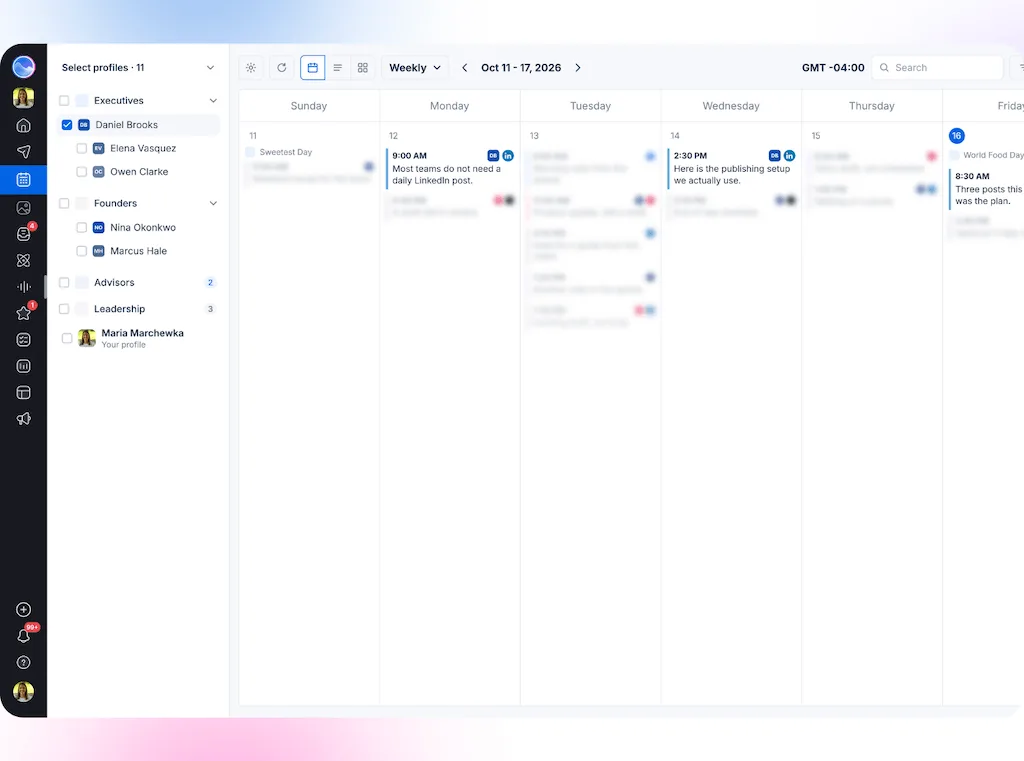
My clients connect their LinkedIn profile to Vista Social through LinkedIn’s sign-in screen, where they approve the connection themselves and keep their password.
From there, I can schedule posts to their profile, track how the content performs, and respond to comments on their content for them when they’re stuck in back-to-back meetings.
For a marketing leader, that’s one less security conversation with IT, and for the executive, it means someone on their team (or a partner like me) can run their LinkedIn day-to-day while the account stays fully theirs.
A strong executive presence takes a marketing leader who knows why it matters and a social manager or partner who makes it happen every week. Give your executive one good conversation a month and a secure way to hand off the posting, and their expertise finally has somewhere to go.
Maria Marchewka is a LinkedIn ghostwriter for executives and founders and writes The Lunch Break, a weekly newsletter on LinkedIn strategy that lands in inboxes every Monday at noon.
Try Vista Social for free
A social media management platform that actually helps you grow with easy-to-use content planning, scheduling, engagement and analytics tools.
Get Started NowAbout the Author

Content Writer
I'm a LinkedIn ghostwriter for executives and founders. Basically, I write the posts you know you should be writing but never actually get around to. Once a month, we hop on a 30-minute call, and I ask 10 custom questions based on your industry and goals. From your answers, I write you a full month of content that sounds like you (the real you, not a stiffer, more buttoned-up version). I don't invent takes or hand you generic "thought leader" fluff. Everything comes from your own stories, opinions, and experience. I pull it out and shape it into posts worth reading. From there, I grow your profile the organic way. We show up multiple times a week and stay in front of the people who actually care what you have to say. I'm obsessed with positioning, not posturing. If you've got the expertise and none of the time, we'll get along great.
Loading related tools...

The most complete social media management platform for teams who demand more.






Tools
PublishingAnalyticsEngagementIntegrations
FacebookInstagramLinkedInRedditSnapchatThreadsTikTokX (Twitter)YouTubeMCPVista Page (link-in-bio)All IntegrationsCopyright © 2026 Vista Social LLC. All Rights Reserved.