

Published on May 12, 2026
16 min to read
How to Build Brand Awareness: 15 Key Strategies

Summarize with AI

Table of contents
Summarize with AI

ChatGPT

Claude

Perplexity
Share

Vista Social

X (Twitter)


When you think coffee, your mind probably goes straight to Starbucks or Dunkin’. Band-Aid and Kleenex have become so well-known that people use the actual brand names for the products themselves. And “google” is now a verb in the dictionary literally meaning to look something up on the Google search engine.
This is brand awareness at its finest.
As you market your own brand, it’s very likely one of your top goals is boosting brand awareness. This is the best way to become top of mind in your industry and get more people spreading the word about your business.
But the how-to can get a little murky. This guide breaks brand awareness down into something you can actually run, from definition to strategy to measurement. Whether you’re a social media manager at a mid-market brand or an agency building a proposal for a client, you’ll walk away with 15 strategies you can put to work this week.
Table of contents
What is brand awareness?
Brand awareness measures how familiar your target audience is with your brand. It’s the degree to which people recognize your name, logo, products, or voice when they encounter them.
Think of it this way: If someone in your target market has a problem your product solves, does your brand come to mind? That’s the question brand awareness answers. It’s the space your brand occupies in your audience’s memory, and it directly shapes whether they’ll consider you when they’re ready to buy.
Brand awareness vs. brand recognition
These two terms often get used interchangeably, but they describe different things.
Brand awareness is broader and covers everything from knowing a brand exists to understanding what it stands for. Brand recognition is narrower, focused on identifying a brand through visual or auditory cues like a logo, color scheme, or jingle.
Here are a few simple ways to think about the difference:
| Brand awareness | Brand recognition | |
| Definition | How well your audience knows your brand and what it represents | The ability to identify your brand through visual or sensory cues |
| Depth | Deep understanding of values, products, and positioning | Surface-level identification based on logos, colors, or slogans |
| Measurement | Unaided recall, share of voice, branded search volume | Aided recall, visual identification tests |
| Example | A marketer thinks of your platform first when they need a social scheduling tool | A marketer sees your logo and recognizes it from a LinkedIn ad |
| Goal | Top-of-mind association with a need or category | Instant identification in a crowded market |
Both matter for growth, but they require different strategies. Brand recognition gets your foot in the door. Brand awareness keeps you in the room when buying decisions happen.
Aided vs. unaided brand awareness
The difference here comes down to prompting.
Aided awareness means someone recognizes your brand when they see it on a list or in a lineup. You show them a set of logos or names, and they can point to yours. It tells you your marketing is registering on some level.
Unaided awareness is the gold standard. It means someone names your brand without any prompts at all. When asked “What social media management tools do you know?”, they say your name from memory.
That kind of recall doesn’t happen by accident. It’s the result of repeated, consistent exposure across channels over time, which is why the Marketing Rule of 7 suggests audiences need at least seven interactions with a brand before it sticks.
Why is brand awareness important?
Brand awareness isn’t just a top-of-funnel metric you track and forget. It’s the upstream signal that powers everything else in your marketing, from lead generation to customer retention. Without it, every other effort costs more and converts less.
And the reasons go beyond theory:
- It drives purchase decisions. The 2025 Edelman Trust Barometer found that trust now sits alongside price and quality as a deciding factor for buyers. People won’t buy from brands they don’t know or trust, and awareness is the first step toward building that trust.
- It reduces your cost per acquisition. When prospects already know who you are, they move through the funnel faster. Warm audiences click more, convert more, and need less convincing than cold ones. That means your ad spend, your content, and your outreach all work harder.
- It creates a competitive moat. In crowded markets, the brand people remember first wins. The Rule of 7 dictates that it takes five to seven impressions for consumers to remember a brand. Once you’ve earned that recall, competitors have to fight much harder to displace you.
- It compounds over time. Unlike paid campaigns that stop working when you stop spending, brand awareness builds on itself. Every piece of content, every employee share, and every review adds another layer of familiarity that makes future efforts more effective.
- It gives leadership something to measure. One of the biggest frustrations social media managers face is proving the value of their work. Brand awareness metrics like share of voice, branded search volume, and sentiment give you a real narrative to bring to your CMO, not just vanity numbers.
15 strategies to build brand awareness
Building brand awareness isn’t about doing one thing well. It’s about running a coordinated social media marketing strategy that reinforces itself across every channel where your audience shows up.
These 15 strategies move from foundational work (getting your voice and workflow right) to amplification plays (employee advocacy, UGC, listening) to measurement.
1. Create a consistent brand voice across every channel
If your Instagram sounds playful but your LinkedIn reads like a legal brief, your audience won’t build a clear picture of who you are. Inconsistency confuses people, and confused people don’t remember you.
A documented brand voice guide that includes tone, vocabulary, and messaging pillars gives every team member a shared reference point.
This matters more than most teams realize. When you’re managing multiple regions, product lines, or client accounts, voice drift is almost inevitable without guardrails. Manually policing every post doesn’t scale. Instead, build the right tools into your workflow so consistency happens by default.
With Vista Social, you can use AI to help generate your brand voice guidelines. Head to Settings > Profile groups. Select your profile group (if you have multiple), then click to the Brand settings tab.
From there, you can either create your brand voice policy or use AI to generate one for you.
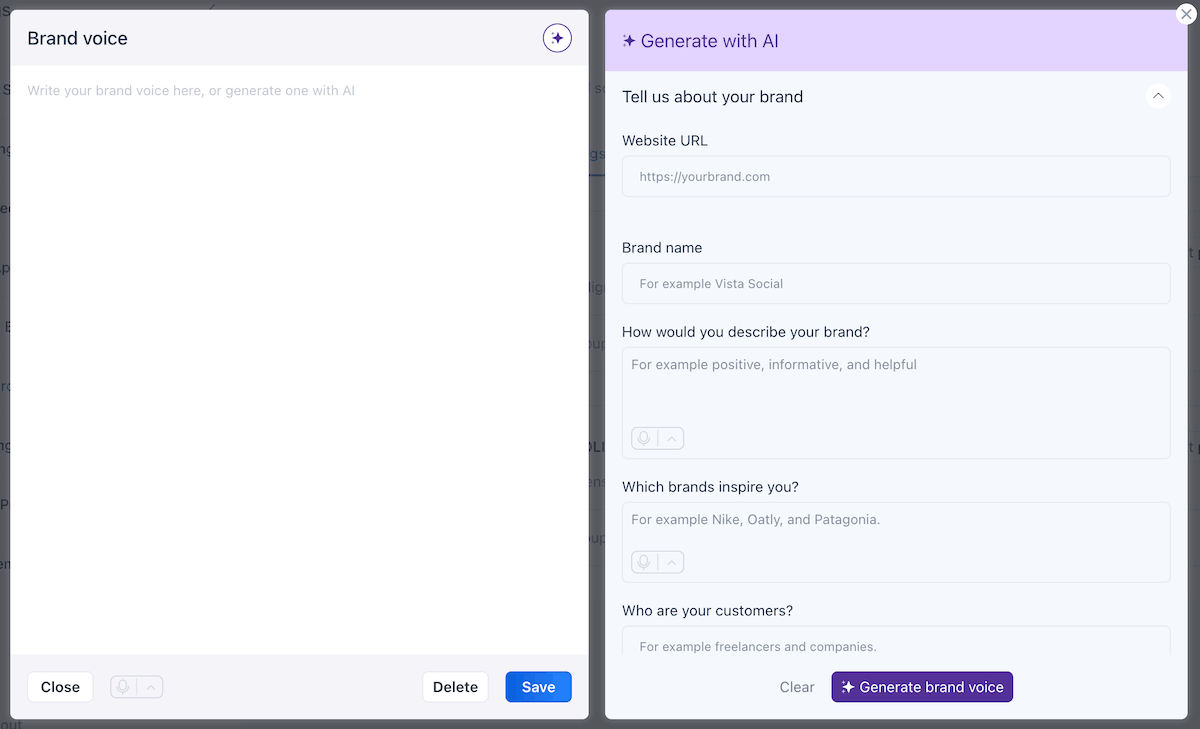
You get to tell the AI all about your brand, giving it all of the information it needs to generate a policy that should align well with your mission. Plus, you can make any tweaks you want before you launch it.
From there, you can also take advantage of Vista Social’s AI assistant, selecting your new brand voice from the dropdown to ensure all generated content and caption ideas match exactly how you want your brand to sound. Consistency down to the last letter.
2. Build a content calendar your whole team can see
You can’t build awareness if your team is publishing in silos. When the product team schedules a launch post that conflicts with a brand campaign running that same week, both messages get diluted. A shared, cross-channel content calendar eliminates this kind of overlap and gives everyone a single source of truth.
The real value of a visible calendar goes beyond organization. It creates alignment. When your regional teams, your agency partners, and your executives can all see what’s going out and when, you catch conflicts before they go live. You also spot gaps where key social media platforms aren’t getting enough attention.
For teams managing content across multiple networks, a unified calendar makes this kind of alignment possible.
In Vista Social, you can plan and view content across 12+ networks in one place, grouping profiles by brand, region, or client for multi-brand setups. For example, the Vista Social team uses one calendar to schedule content across multiple platforms including Instagram, X/Twitter, TikTok, and Threads.
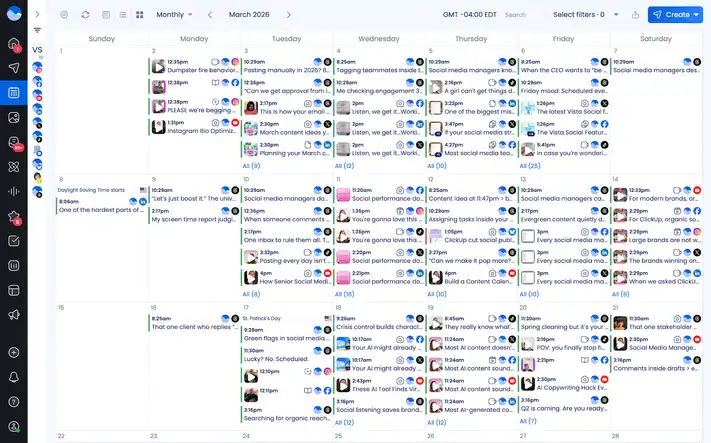
If you don’t have a content calendar structure yet, you can grab a free social media calendar template to get started!
3. Tighten your approval workflows so campaigns ship faster
Slow approvals are a silent killer for brand awareness. A trending topic moves fast, and if your post sits in an approval queue for three days, the moment is gone. The irony is that approval processes exist to protect your brand, but when they’re clunky, they end up hurting it by preventing timely, relevant content from reaching your audience.
That doesn’t mean you should remove approvals altogether. You just need workflows that are fast enough to keep up with social media’s pace while still giving stakeholders the oversight they need. Role-based permissions let the right people approve the right content without creating bottlenecks.
Vista Social handles this with multi-step approval workflows and role-based permissions, so content moves from draft to published without endless email chains.
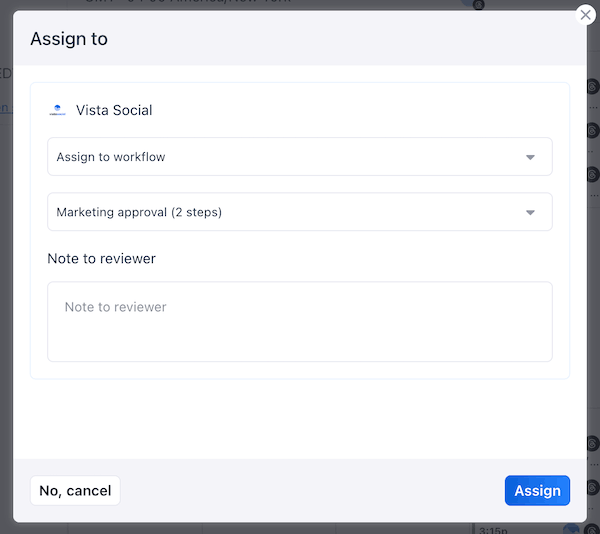
Different approval paths for different content types or profiles mean a routine post doesn’t need the same sign-off process as a crisis response.
4. Show up consistently on the right platforms (not all of them)
Trying to maintain a presence on every social network is a fast track to burnout and mediocre content. Your audience isn’t everywhere, and your resources aren’t unlimited. The smarter play is to pick two or three platforms where your target audience is most active and go deep.
Depth beats breadth when it comes to awareness. A brand that posts thoughtful, engaging content each day on LinkedIn or Instagram will build more recognition than one that scatters forgettable posts across eight platforms.
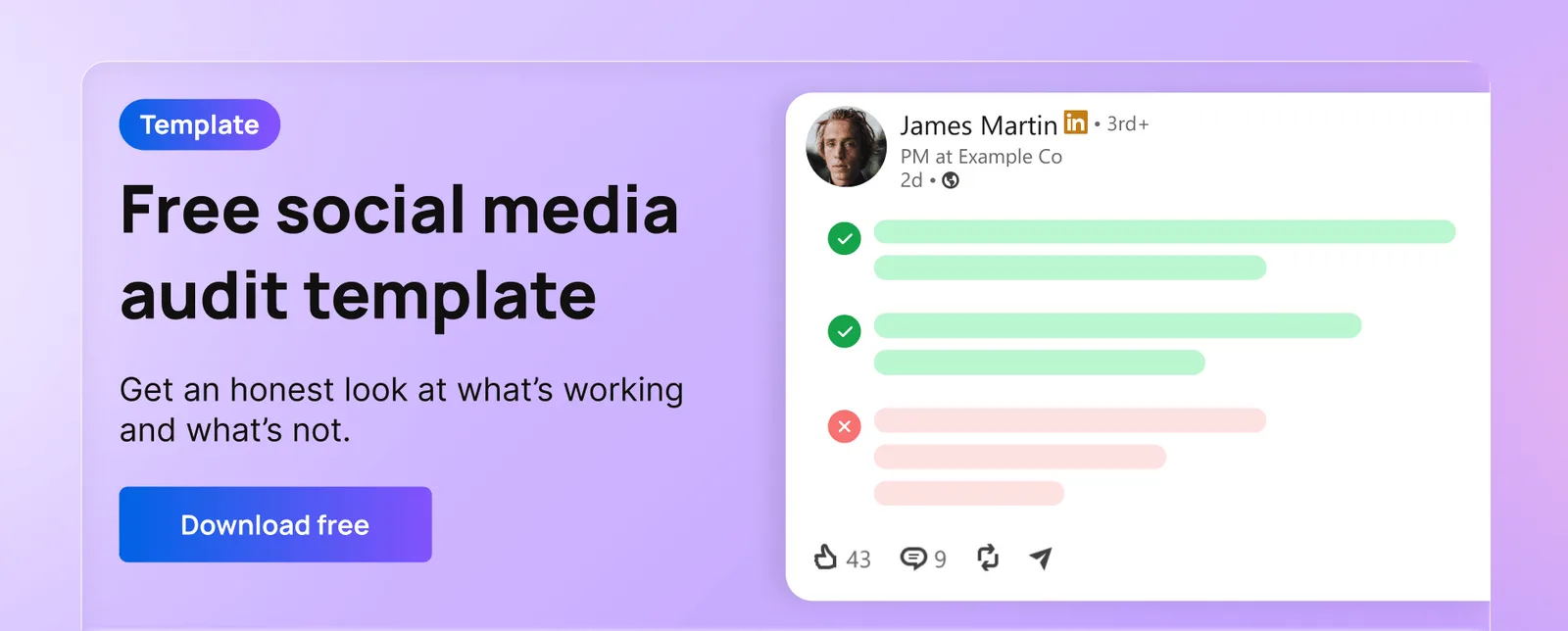
Audit where your audience actually spends time, and focus your energy there. You’ll produce better content, respond faster, and build stronger community connections on the platforms that matter.
You can use an auditing template like the one below to help you.
5. Invest in short-form video as your discovery engine
Short-form video continues to dominate how people discover new brands. Reels, TikTok, and YouTube Shorts are built around algorithmic discovery, which means your content can reach people who’ve never heard of you. That’s exactly the kind of exposure brand awareness depends on.
Repurposing makes this scalable. You don’t need to create unique video content for every platform. One strong video can be adapted for three or four networks with minor adjustments to aspect ratio, captions, and hooks. This stretches your production budget while multiplying your touchpoints.
Get 25 Instagram Reels ideas you can start using for inspiration for building out your own short-form video strategy.
6. Launch an employee advocacy program
This is one of the highest-impact plays for brand awareness, and most teams aren’t doing it yet. According to DSMN8’s Employee Advocacy Benchmarks report, brands report seeing an 8x increase in reach from employee advocacy programs compared to corporate channels.
That’s because employees collectively have larger, more diverse networks than any corporate page, and their posts carry more trust.
The logic is straightforward. People trust people more than they trust logos. When your team shares a product update or a company milestone, their connections see it as a genuine recommendation, not a corporate broadcast. That trust transfer is what makes employee advocacy so powerful for social media amplification.
Running this at scale requires a system for curating content, distributing it, and measuring results. Vista Social’s employee advocacy feature handles all three, letting you distribute shareable content to employees via email or Slack and track earned media value in real time.
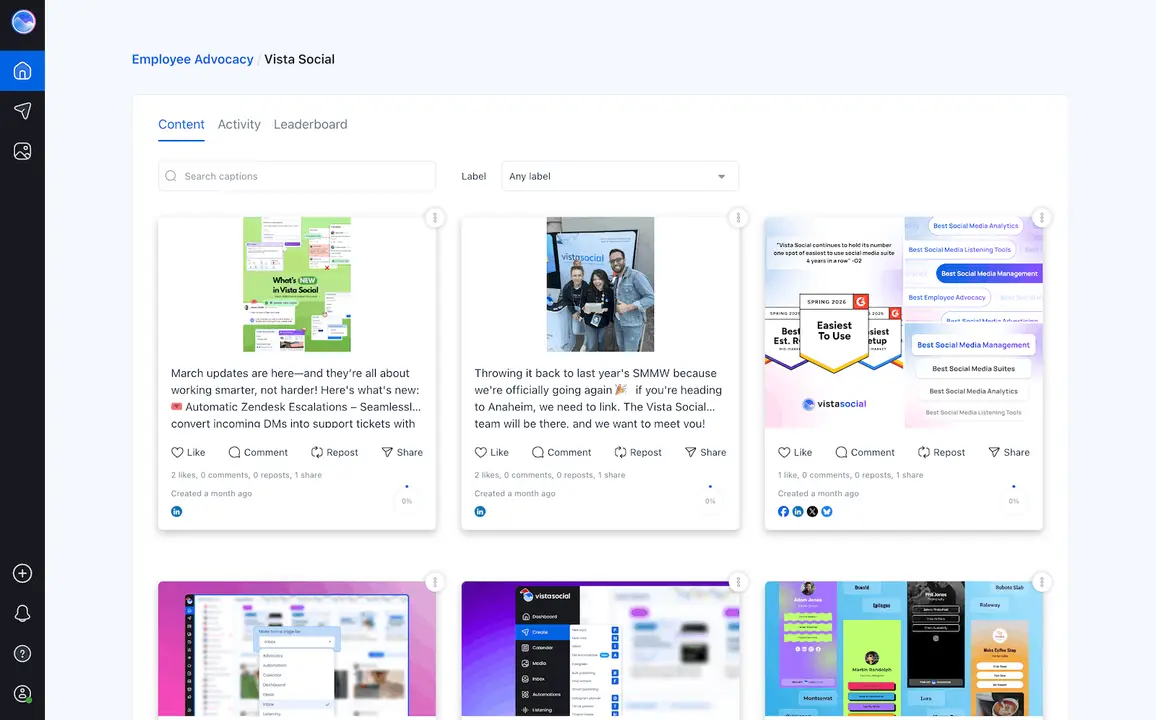
Employees can reshare, comment on, or like posts with a few clicks, so participation doesn’t feel like extra work.
7. Encourage and share user-generated content (UGC)
Your customers are your most credible storytellers, and consumers tend to trust word-of-mouth and user-generated content over traditional advertising. When real people share their experiences with your product, it builds the kind of trust that no amount of polished brand content can replicate.
Start by creating the conditions for UGC to happen. Launch a branded hashtag, run a photo contest, or feature customer stories in your feed. The goal is to make it easy and rewarding for your audience to create content about your brand, then amplify what they create.
Finding and organizing that content doesn’t have to be manual. Vista Social’s media library lets you store approved UGC alongside your other assets, organized by client, campaign, or label.
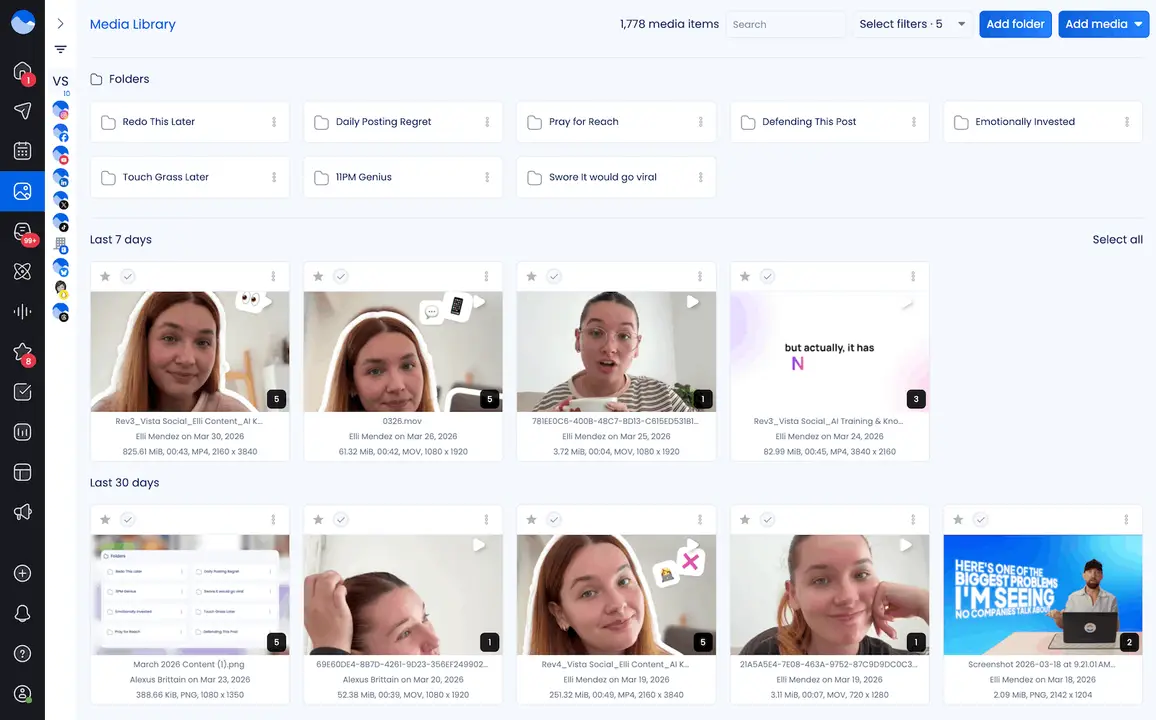
The built-in content finder searches Instagram hashtags and users, so you can spot customer content worth resharing and save it directly to your library for scheduling. You can also customize the filters and labels to make it even easier for you to locate your assets.
8. Partner with creators and micro-influencers
You don’t need a celebrity endorsement to build awareness. Micro-influencers with 10,000 to 100,000 followers often drive stronger results for niche awareness because their audiences are more engaged and more trusting.
A recommendation from a creator who genuinely uses your product carries more weight than a sponsored post from someone with millions of followers and no real connection to your brand.
Focus on relevance over reach. Find creators whose audience overlaps with yours and whose content style aligns with your brand voice. Genuine partnerships built over time will do more for awareness than a single splashy collaboration, so prioritize ongoing relationships rather than one-off sponsored posts.
If you’re building an influencer marketing strategy from scratch, start small. Test with three to five creators, measure the results, and scale what works.
9. Use social listening to find awareness opportunities
Most brands only track their own mentions. But the biggest awareness opportunities often live in conversations that don’t include your name at all. People discussing problems you solve, comparing competitors, or asking for recommendations in your category are all signals you can act on.
Social listening lets you tap into these conversations and join them at the right moment. You can spot trending topics in your space before competitors do, find gaps in how rivals are being discussed, and identify the questions your audience keeps asking so you can answer them with content.
What sets some listening tools apart is coverage. Vista Social’s social listening tracks mentions across 10+ sources, including networks that many tools miss, like Bluesky, Reddit, Yelp, and the App Store.
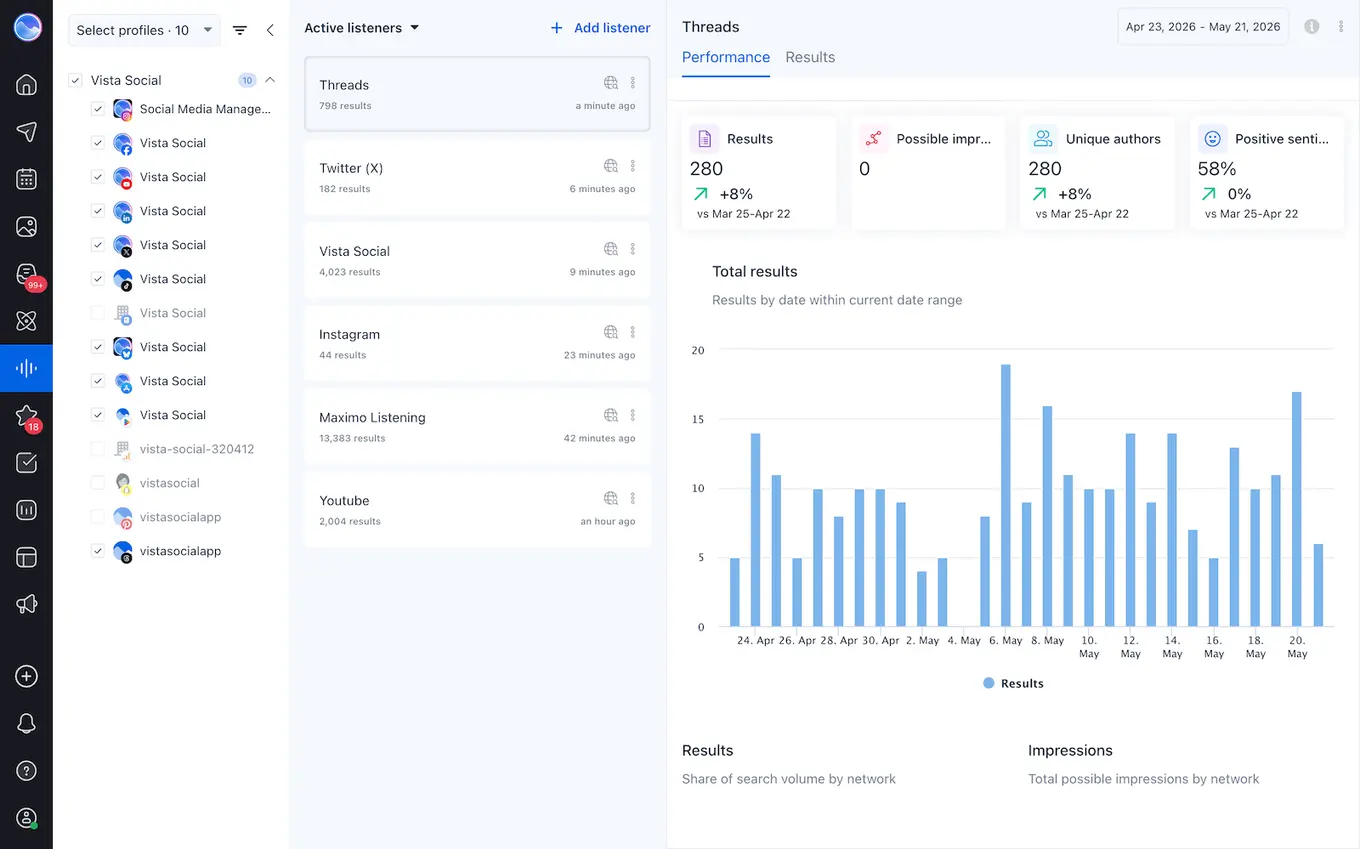
That broader reach means you’re catching conversations that competitors focused only on major networks would overlook entirely. You can simply set up an internal and/or external listener, and our platform will do the work for you.
10. Engage actively in DMs and comments
Every reply is a brand impression. When someone comments on your post and you respond thoughtfully, their followers see it too. Most teams think of community management as customer service, but it doubles as an awareness play. The brands that reply fastest and most helpfully are the ones that get remembered.
This is especially true in DMs. Private conversations might feel invisible, but they shape how individuals feel about your brand. A helpful DM exchange turns a casual follower into someone who recommends you to colleagues. At scale, those micro-interactions compound into real awareness gains.
11. Make reviews and reputation management part of your brand awareness strategy
Reviews don’t just influence the person reading them. They influence search visibility, too. Google, Yelp, TripAdvisor, and OpenTable reviews all feed into how discoverable your brand is when someone searches for solutions in your category. A strong review profile makes you more visible and more trustworthy at the same time.
Think of reviews as brand awareness assets that work around the clock. Every five-star review is a public endorsement that shows up in search results, maps, and recommendation feeds.
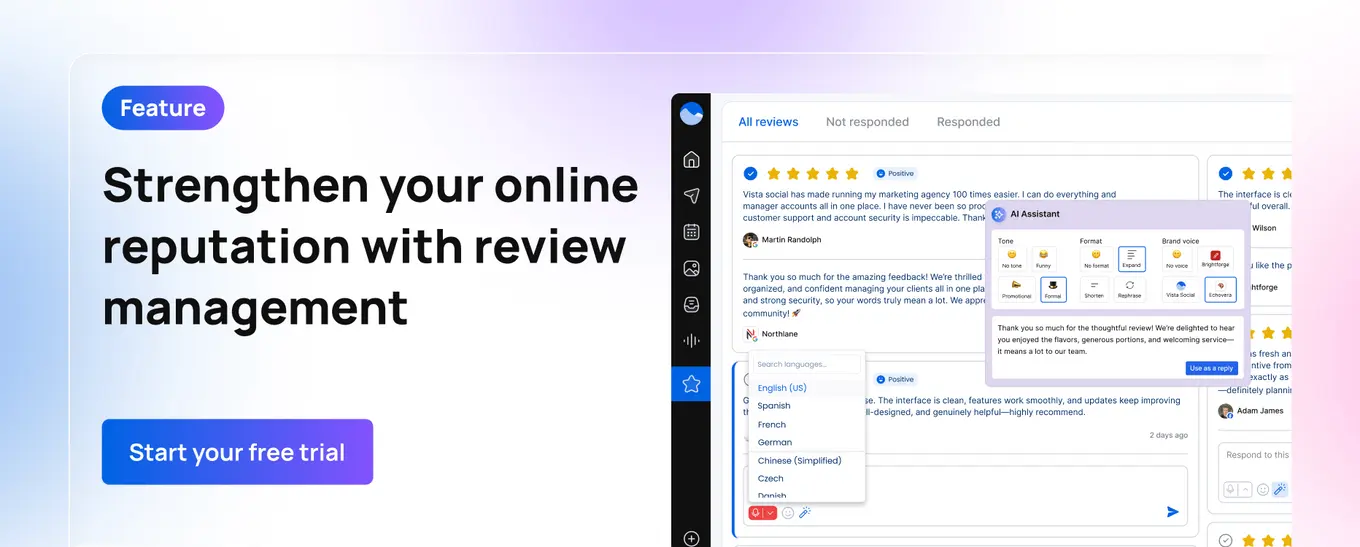
Managing your reviews actively, responding to feedback and encouraging happy customers to share their experience, is one of the simplest ways to expand your brand’s visibility without increasing your ad spend.
You can centralize this process in Vista Social, which lets you monitor and respond to reviews across major review sites from one dashboard so nothing slips through the cracks.
12. Run targeted paid campaigns to boost organic momentum
Organic reach has limits, especially on platforms where algorithms favor paid content. But you don’t need a massive ad budget to move the needle on awareness. The smartest approach is to boost your top-performing organic posts rather than building paid campaigns from scratch.
When you boost a post that’s already generating engagement, you’re feeding the algorithm content it already knows performs well. This approach is more cost-effective than cold social media advertising because you’re amplifying proven content instead of testing from zero. It also keeps your paid and organic strategy aligned, which makes reporting cleaner.
When your organic and paid workflows live in the same tool, this becomes much simpler. Vista Social lets you set up boost configurations and apply them right when scheduling posts. Paid and organic results also show up side by side in one report, which makes it easy to show leadership how paid amplification supports overall awareness.
13. Show up where your buyers search
Social content isn’t just for social feeds anymore. Instagram posts are now indexed by Google. AI-powered search tools like Google AI Overviews and ChatGPT are pulling from social content to answer queries. That means the captions you write, the alt text you add, and the way you structure your profile bio all affect whether your brand shows up when someone searches.
Treat your social profiles like lightweight SEO assets. That means using clear, descriptive language in your bios, writing captions that include the terms your audience actually searches for, and adding alt text to every image.
These small optimizations won’t replace your website’s SEO strategy, but they create additional entry points for people discovering your brand through search (and even through AI).
14. Build strategic partnerships and co-marketing campaigns
One of the fastest ways to reach a new audience is to borrow one. Co-marketing with a non-competing brand that shares your target audience lets both brands benefit from each other’s reach without direct competition. Joint webinars, co-authored content, bundled offers, and collaborative social campaigns all create exposure to audiences that already trust your partner.
The best partnerships feel natural to both audiences. Look for brands whose products complement yours and whose values align with your own.
A social media management platform and a graphic design tool, for example, share an audience without competing for the same budget. Perfect co-marketing opportunity.
15. Measure brand awareness consistently and report it up
If you can’t show leadership a trend line, they won’t fund your awareness efforts. This is where many social media managers get stuck. They’re doing the work, but they can’t translate it into a story that resonates with a CMO or a client who thinks in terms of pipeline and revenue.
The fix is committing to a consistent measurement cadence and focusing on the metrics that actually signal awareness, not just engagement. Share of voice, branded search volume, mention volume, sentiment, and reach all tell a clearer awareness story than likes and comments alone.
Report monthly, and prioritize trend lines over snapshots. Any single month’s data can mislead you, but six months of consistent tracking gives you a story you can defend in a leadership meeting.
The right reporting setup makes this cadence sustainable. In Vista Social, built-in brand awareness scores for Facebook and Instagram, sentiment analysis, competitor benchmarking, and scheduled reporting let you build custom reports tied directly to awareness KPIs.
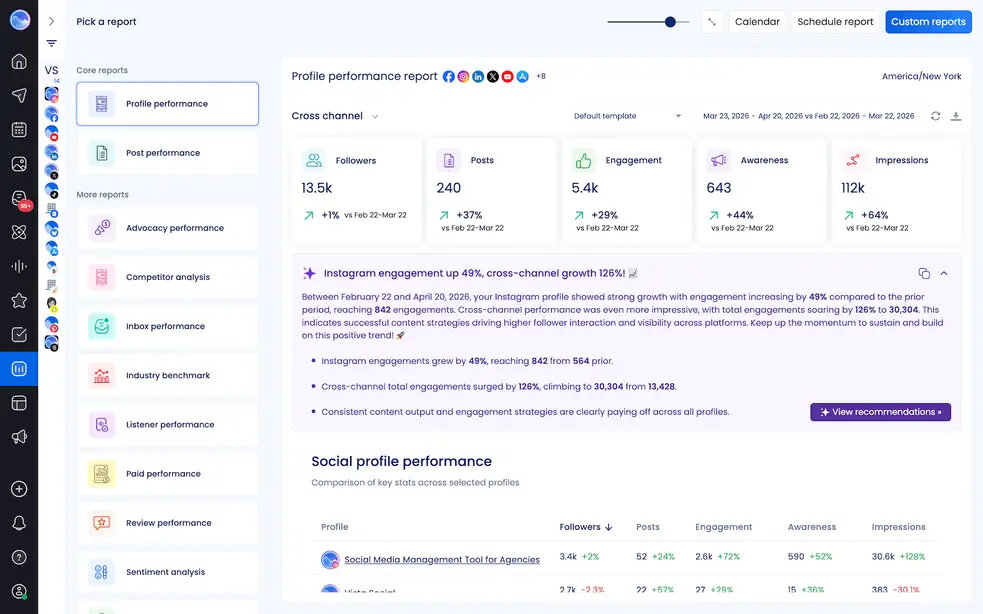
The screenshot above shows one of Vista Social’s core reports, the profile performance, but you can also create custom reports to cover other performance metrics like competitor analysis, review performance, and sentiment analysis—to name a few. You can send them automatically to stakeholders on a set cadence so the data speaks for itself.
How to measure brand awareness
Brand awareness can feel hard to measure because it doesn’t come with a single, clean number. But that doesn’t mean you can’t track it. The key is combining several signals that, together, paint a clear picture of how your brand’s visibility and perception are changing over time.
Here are the metrics that matter most:
- Mention volume tracks how often your brand gets discussed across social media, forums, blogs, and news sites
- Share of voice measures your brand’s share of the total conversation in your category compared to competitors
- Branded search volume shows how many people are searching for your brand name directly, a strong signal of top-of-mind awareness
- Direct traffic counts visitors who type your URL directly into their browser, bypassing search entirely
- Reach and impressions quantify how many people see your content across channels
- Sentiment reveals whether conversations about your brand skew positive, neutral, or negative
- Follower growth shows audience expansion, though it should always be paired with engagement data to avoid chasing vanity metrics
- Survey-based recall uses aided and unaided recall questions to measure whether your audience actually remembers you
The distinction between vanity metrics and meaningful awareness signals matters. A spike in impressions looks great in a report, but if sentiment is trending negative, that visibility is working against you. Always pair volume metrics with quality metrics.
Report on awareness monthly. Weekly data is too noisy to draw conclusions from, and quarterly reporting is too infrequent to catch problems early. What matters most is the trend line. Leadership doesn’t need to know you got 50,000 impressions last Tuesday. They need to know that your share of voice grew from 12% to 18% over the last quarter.
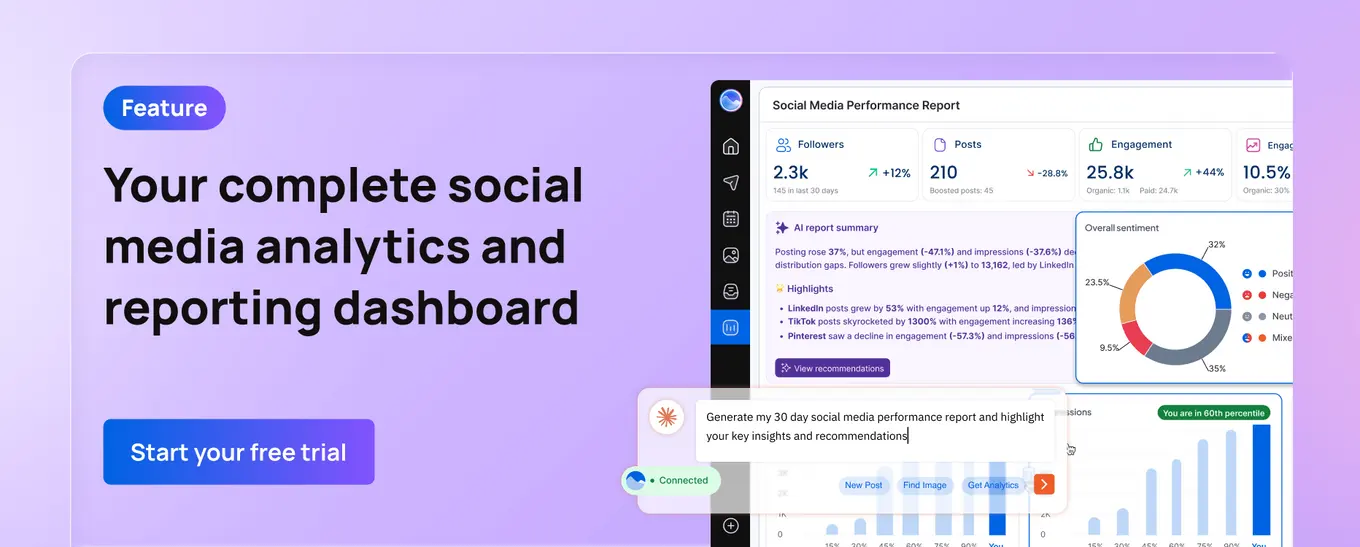
Automating this reporting removes the manual burden. With Vista Social, you can automatically deliver scheduled reports to stakeholders at your preferred cadence.
Brand awareness FAQs
What is brand awareness in marketing?
Brand awareness is a measure of how familiar your target audience is with your brand. It covers everything from basic recognition (seeing your logo and knowing your name) to deeper understanding of your products, values, and positioning. In marketing, brand awareness is typically the first stage of the funnel, and it’s what makes every downstream effort, from lead generation to conversion, more effective and more efficient.
How do you measure brand awareness?
You measure brand awareness through a combination of quantitative and qualitative signals. Quantitative metrics include branded search volume, mention volume, share of voice, reach, impressions, and direct traffic. Qualitative methods include aided and unaided recall surveys, where you ask respondents to name brands in your category with or without prompts. Most social media managers rely on a mix of both, using tools like Vista Social’s brand awareness score and sentiment tracking for ongoing measurement and periodic surveys for deeper insight.
What’s the difference between brand awareness and brand recognition?
Brand awareness is the broader concept. It means your audience knows your brand exists and understands what you stand for, what you sell, and what makes you different. Brand recognition is a subset of awareness focused on identifying your brand through visual or auditory cues like your logo, colors, or tagline. Think of recognition as knowing the face and awareness as knowing the person.
How long does it take to build brand awareness?
There’s no fixed timeline because it depends on your industry, budget, competition, and consistency. Most brands start seeing measurable awareness gains within three to six months of sustained effort. The marketing Rule of 7 suggests that audiences need at least seven exposures to your brand before it registers in their memory, so frequency and consistency matter more than any single campaign. Brand awareness compounds over time, so the earlier you start building a system, the faster results accumulate.
What are examples of brand awareness campaigns?
Some well-known brand awareness campaigns include Spotify’s annual Wrapped campaign, which turns user data into shareable social content that floods every platform each December. Dove’s Real Beauty campaign shifted the brand’s awareness from “soap” to “self-esteem” by leading with values over product features. On a smaller scale, any company that launches an employee advocacy program, runs a branded hashtag challenge, or creates a co-marketing campaign with a complementary brand is running a brand awareness play. The best campaigns give people a reason to talk about the brand and make it easy for them to do so.
Can small businesses build brand awareness without a big budget?
Yes, and many of the strategies in this guide are designed for exactly that. Employee advocacy costs nothing beyond the time to set up and manage the program. User-generated content relies on your existing customers rather than paid production. Social listening helps you find organic conversation opportunities without spending on ads. Even short-form video can be produced with a smartphone and basic editing. The advantage small businesses have is authenticity. Smaller teams can respond faster, personalize more, and build genuine community connections that large brands struggle to replicate.
Try Vista Social for free
A social media management platform that actually helps you grow with easy-to-use content planning, scheduling, engagement and analytics tools.
Get Started NowAbout the Author

Content Writer
Russell Tan is a content marketing specialist with over 7 years of experience creating content across gaming, healthcare, outdoor hospitality, and travel—because sticking to just one industry would’ve been boring. Outside of her current role as marketing specialist for Vista Social, Russell is busy plotting epic action-fantasy worlds, chasing adrenaline rushes (skydiving is next, maybe?), or racking up way too many hours in her favorite games.
Loading related tools...

The most complete social media management platform for teams who demand more.




Tools
PublishingAnalyticsEngagementIntegrations
FacebookInstagramLinkedInRedditSnapchatThreadsTikTokX (Twitter)YouTubeMCPVista Page (link-in-bio)All IntegrationsCopyright © 2026 Vista Social LLC. All Rights Reserved.