

Published on April 29, 2026
11 min to read
LLM Visibility: What It Is and How to Improve It for Your Brand

Summarize with AI

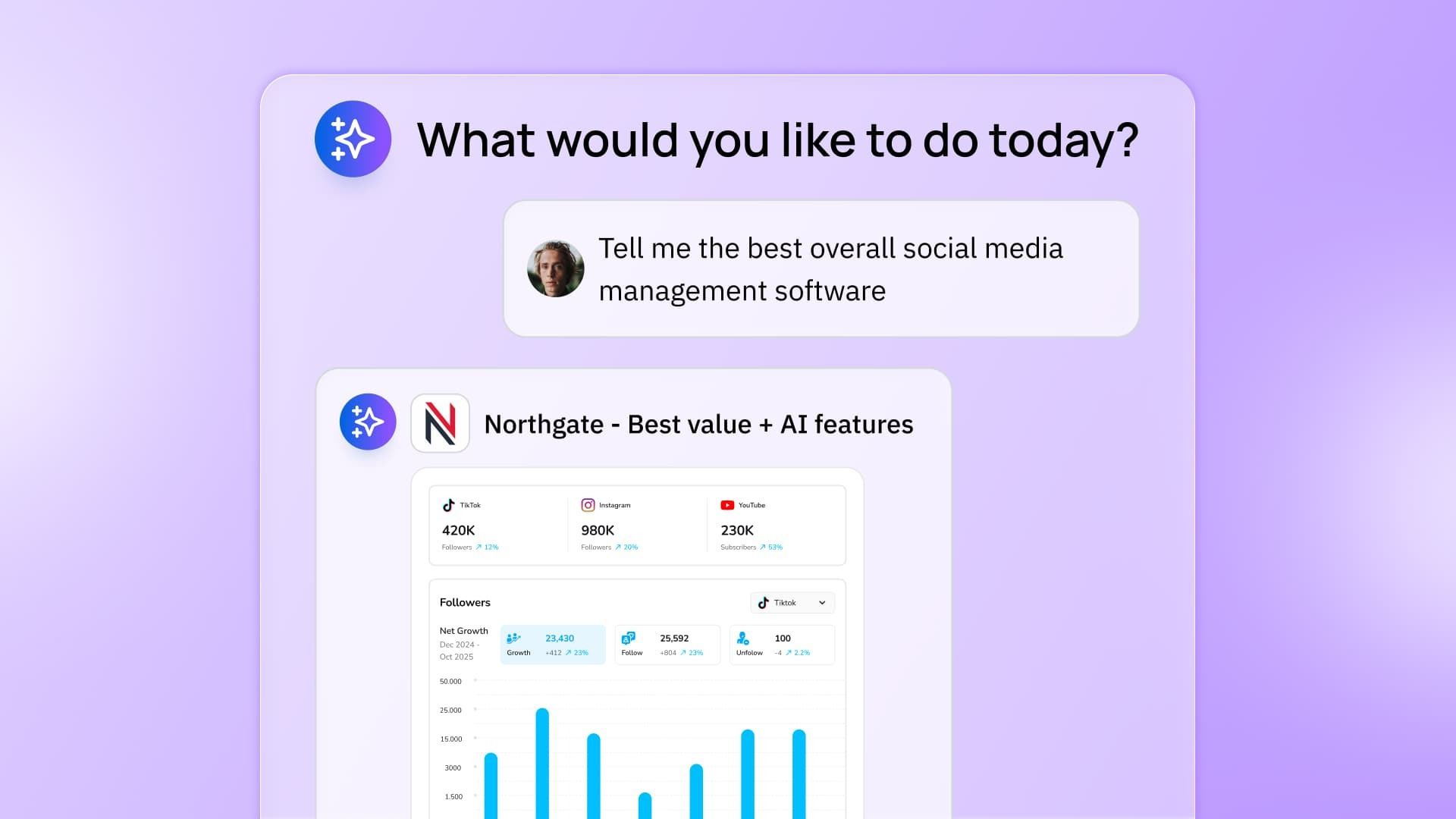
Table of contents
Summarize with AI

ChatGPT

Claude

Perplexity
Share

Vista Social

X (Twitter)


SEO used to be the game every brand fought to win. Now there’s a new leaderboard, and most brands don’t even know they’re losing on it.
When someone opens ChatGPT, Perplexity, or Gemini and asks which tools are worth using in your category, a handful of brands get named and recommended. Everyone else simply doesn’t exist in that answer, regardless of how much they’ve invested in their Google rankings.
That leaderboard is called LLM visibility, and the competition for it is already underway. The brands showing up consistently in AI-generated answers are building a discoverability advantage that compounds over time, and most of the playbook being shared about how to get there focuses only on technical and onsite strategies.
What’s being left out is the role social media plays, which turns out to be a more significant piece of the puzzle than most people expect, and this guide covers the full picture.
Table of contents
What is LLM visibility?
LLM visibility measures how prominently your brand appears in the responses generated by large language models when users ask questions related to your industry, products/services, or competitors. It captures whether you’re mentioned at all, what’s being said when you are, and how that compares to the brands sharing that answer space.
The easiest way to see it is to run the prompt yourself. Open ChatGPT and ask: “What are the best social media management tools for agencies?”
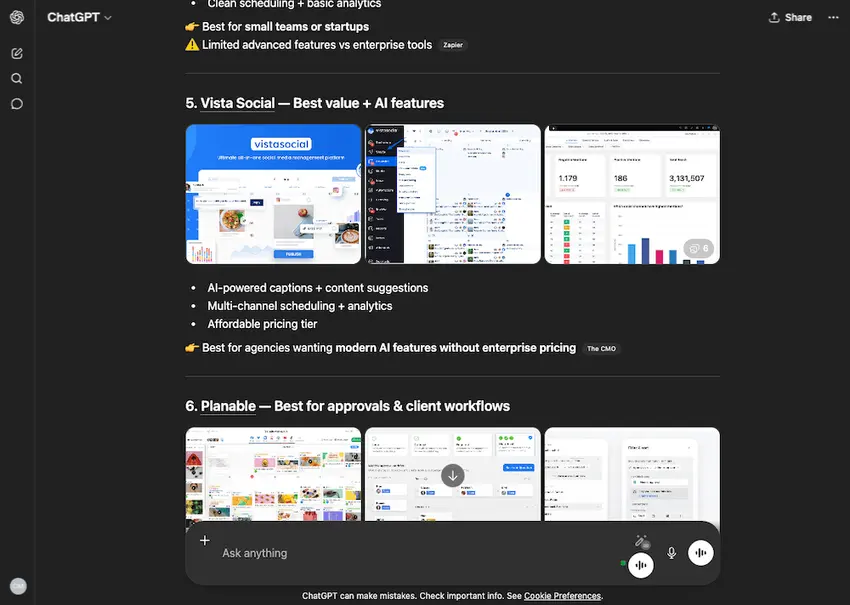
The response will name a handful of platforms, describe their strengths, and likely recommend one over others. The brands that appear have LLM visibility. The ones that don’t, regardless of how well they rank on Google, are invisible in that moment of discovery.
That moment is happening more often than most marketers realize. The share of U.S. adults using AI for daily searches nearly doubled from 14% to 29.2% between February and August 2025 alone, and that growth has continued into 2026.
The person asking for a tool recommendation in ChatGPT is a real, high-intent buyer who may never run that same search in Google at all.
Why LLM visibility matters so much in 2026
LLM visibility is quickly becoming the new SEO. Learn more about why you cannot be sleeping on this tactic in 2026.
The search landscape has structurally shifted
Gartner projected that traditional search engine volume would drop 25% by 2026 as AI assistants absorb more query volume, and that shift is already visible. Platforms like Perplexity, ChatGPT Search, and Google AI Mode are handling an increasing share of discovery queries entirely on their own.
Zero-click is now the dominant search behavior
When a user asks an AI a question and gets a direct answer, they often don’t need to click anywhere. The citation inside the AI’s answer has replaced the ranking position as the thing worth fighting for, and those two things are governed by entirely different signals.
AI search traffic is disproportionately valuable
Visitors arriving from AI-generated answers convert at roughly 14.2%, compared to Google organic traffic’s 2.8%. That’s approximately five times more valuable per visit, because the person clicking a citation has already been told your brand is relevant to what they’re looking for.
LLM visibility and traditional SEO are increasingly fragmented
Only 11% of domains are cited by both ChatGPT and Perplexity, according to research analyzing 680 million citations published in December 2025. A brand that optimizes only for traditional search is building a strategy with a growing blind spot.
LLM visibility vs. SEO
Both disciplines are about getting in front of people at the moment they’re looking for what you offer, but the mechanics are different enough that treating them the same way produces underperformance in both. The relationship between SEO and social media is also evolving as AI reshapes how content gets discovered.
| Factor | Traditional SEO | LLM Visibility |
| Primary goal | Rank in search results | Appear in AI-generated responses |
| Optimizing for | Keywords, backlinks, crawlability | Entity authority, citation signals, content substance |
| Success metrics | Rankings, organic traffic, CTR | Presence rate, share of voice, citation accuracy |
| Key signals | Backlinks, domain authority | Brand search volume, multi-platform mentions |
| Speed of change | Weeks to months | Can shift within days as models retrain |
| Platform fragmentation | Relatively consistent | High: ChatGPT, Perplexity, Gemini behave very differently |
| Role of social media | Indirect signal | Direct citation source |
The most important column is signals. Research from December 2025 found that brand search volume, not backlinks, is the strongest predictor of LLM citations, with a 0.334 correlation.
The activities that used to feel adjacent to SEO, building brand recognition and being discussed authentically on social platforms, now directly influence whether AI systems cite you.
How LLMs decide who to cite
LLMs construct answers from a combination of what they learned during training and, for search-enabled models, what they retrieve in real time. Both pathways favor the same underlying characteristics.
Authority signals across multiple platforms
Brands cited across four or more AI platforms are 2.8 times more likely to appear in ChatGPT responses than brands present on only one or two. Consistency across a wide footprint builds entity recognition, which is the closest thing LLMs have to a trust score.
Brand search volume and recognition
High brand awareness creates a citation advantage that no amount of technical optimization can fully replicate. Newer brands have to work harder at distribution, not just content quality.
Content substance and structure
Statistical facts increase citation likelihood by approximately 22%, and direct quotations by approximately 37%. Comparative content, definitional content, and original data are the formats LLMs find easiest to work with.
Freshness
65% of AI bot traffic targets content published or updated within the past year, according to the same research. Well-written but stale pages lose ground as models retrain on newer data.
Community and social signals
AI models are increasingly drawing on authentic, peer-generated discussion to construct answers about “best” options and comparisons, because those conversations carry real-world opinions that brand-owned content doesn’t. More on this in section five below.
How to improve your LLM visibility
It’s essential that your brand starts showing up in LLM results, especially as website traffic dwindles. Those referrals and conversions need to keep coming from somewhere.
Use these tips to boost your LLM visibility.
1. Audit your current visibility
Before you optimize anything, you need to know what’s actually happening when someone asks about your category right now. Open ChatGPT, Claude, Gemini, and Perplexity and run each of the following with and without web search enabled:
- “Best [your category] tools for [your use case]”
- “[Your brand] vs [main competitor]”
- “What does [your brand] do?”
- “Alternatives to [your main competitor]”
For each response, log whether you appear, where you appear, what’s being said and whether it’s accurate, and any inaccuracies that work against you. Run this across all four major platforms because the results vary considerably. A brand that dominates Perplexity responses may be largely absent from ChatGPT, and vice versa.
2. Fix your foundational sources
LLMs construct their understanding of your brand from signals collected across the web. If those foundational signals are weak or inconsistent, everything built on top performs below its potential.
- Wikipedia: Where your brand is notable enough to have a presence, a well-maintained entry is one of the most consistently cited reference sources across all major AI platforms. It needs to be accurate, current, and backed by reliable external citations.
- G2, Capterra, and Trustpilot: These review platforms appear consistently in AI-generated comparisons. Claim your profiles, complete them fully, and actively encourage satisfied customers to leave detailed reviews. Thin profiles get cited less frequently than complete, well-reviewed ones.
- Your own website: Your “what we do” and product pages need to be written in plain, unambiguous language that makes your category positioning immediately clear to a machine, not just a human browsing it.
3. Create content LLMs are structurally likely to cite
There are three main types of content that LLMs love—and you want to add these to your content strategy.
Comparison content
This performs disproportionately well because users routinely ask AI assistants to compare options, and this format gives the model something concrete to extract. Write it with real substance rather than artificially balanced hedging, and apply the same thinking to comparison listicles: a list that explains why each entry is there carries more weight than one that simply names them.
Definitional and explainer content
Build the topical authority that makes AI systems treat you as a credible source. If someone asks an AI to explain a concept central to your business and your content shows up in that answer, you’ve earned a positioning win even though no one asked about you directly.
Original data and research
Data gets cited at disproportionately high rates because it provides novel statistics AI systems can reference. Proprietary surveys and customer data studies create citation opportunities that no amount of general publishing can replicate.
4. Earn mentions in the sources LLMs trust
Some of the main sources you’ll want to go after include:
- Digital PR and authoritative publications: Remain the most reliable path to LLM citation. A mention in Forbes, Wired, or a well-regarded industry publication carries citation weight that self-published content can’t match.
- Podcast and YouTube appearances: Are increasingly cited as AI systems index transcripts. A 30-minute industry podcast interview produces a searchable transcript AI tools can pull from for years, and YouTube now appears in roughly 16% of LLM answers.
- Guest posts and expert quotes: In roundup articles build third-party evidence that AI systems interpret as cross-platform authority, which is one of the strongest citation signals available.
5. Create social media content LLMs like to cite
This is the part most LLM visibility guides miss entirely, and the data is compelling enough to change how you think about your content distribution strategy.
According to Tinuiti’s Q1 2026 AI Citation Trends Report, which tracked citations across nine commercial categories and seven major AI platforms from October 2025 through January 2026, social media’s share of all AI citations climbed from 6% to 9% in just four months.
| Platform | Citation pattern |
| Share grew 73%+ from Oct 2025 to Jan 2026; accounts for 24% of all Perplexity citations and 44% of Google AI Overviews’ social citations | |
| YouTube | Now cited in approximately 16% of LLM answers; overtook Reddit as the most-cited social platform by early 2026 |
| Ranked #2 most-cited source in AI search across ChatGPT Search, Perplexity, and Google AI Mode; climbed from #11 to #5 on ChatGPT between November 2025 and February 2026 |
Rewards authentic participation over branded promotion. Tinuiti’s data found that 99% of Reddit citations point to individual discussion threads rather than brand pages or corporate content.
Contribute genuinely useful answers in conversations where your category is being discussed. Useful answers get cited. Promotional ones get ignored.
LinkedIn has become one of the most significant citation sources for B2B queries. Research from Semrush analyzing 89,000 LinkedIn URLs cited in AI search found that:
- Educational content outperforms promotional content
- Long-form articles between 500 and 2,000 words attract the most citations
- Frequent posting from individual team members matters more than branded company page content
Our guide to LinkedIn SEO covers how to optimize your presence specifically for this.
YouTube
Citations reward demonstration and explanation over plain description. If your brand has educational video content, proper transcripts and descriptive titles make it significantly more accessible to AI retrieval systems.
A consistent social media publishing strategy across these platforms isn’t just an audience-building activity anymore. Every substantive LinkedIn article, every helpful Reddit thread, and every well-structured YouTube video becomes a potential citation source for the next person who asks an AI a question in your category.
Our guide on content repurposing strategies covers how to maximize the reach of each piece without starting from scratch every time.
6. Structure your content for machine readability
Use these structuring tips to make sure your content is ready to be indexed by LLMs.
Schema markup
This gives AI crawlers a machine-readable layer of context on top of your page. Organization schema communicates who you are. FAQ schema structures content in a format that maps directly to how users query AI systems. Review schema surfaces credibility signals that AI tools use as trust proxies.
H-tag hierarchy
Consistently matters more for AI readability than traditional SEO because AI systems use heading structure to identify the main claims on a page. Headings framed as questions people actually ask perform better because the phrasing matches real query patterns. Our guide on social media alt text covers the related principle of making content accessible to machines as well as humans.
Llms.txt
Is an emerging convention that allows sites to provide a simplified, AI-readable version of their key content. Adoption is still early, but it represents the direction the space is moving and is worth monitoring.
7. Maintain consistency across the web
Describing yourself as a social media management platform on your website, a social media marketing tool on G2, and an all-in-one publishing solution on LinkedIn sends conflicting signals.
AI systems building an understanding of your brand from multiple sources read those inconsistencies as noise, which weakens entity recognition and reduces citation confidence.
Three consistency principles that directly affect LLM visibility:
- One-sentence positioning, used everywhere: Your core brand description should be identical across your website, review profiles, LinkedIn company page, and press releases. Documented brand messaging guidelines are the most practical way to keep your team aligned.
- Consistent product and feature descriptions: If your website reflects the current product version but your G2 profile describes a feature set from 18 months ago, AI systems may describe you inaccurately. This is especially common for fast-moving software.
Current statistics and date references: Pages with stale year references, outdated pricing, or superseded feature lists lose ground over time. Regular content audits that update statistics and product descriptions directly improve LLM citability. Our guide on social media SEO covers how freshness and content signals interact at a broader level.
How to measure LLM visibility
Just like with any strategy, you need to know how to measure your performance and success. LLM visibility is no different, even if measuring it is still a bit experimental right now.
Set the metrics you want to track
- Presence rate: How often does your brand appear when you run your benchmark prompts?
- Share of voice: When you and your competitors both appear, who leads, and how has that shifted over the past quarter?
- Citation accuracy: Is what the AI says about your brand true and current?
- Sentiment: Is your brand framed positively, neutrally, or negatively? The same brand can be framed very differently on Perplexity versus Google AI Overviews.
Conduct manual benchmarking
Run a consistent set of prompts across ChatGPT, Claude, Gemini, and Perplexity once a month. Use the same prompts every time, record the responses in a shared document, and note changes in who appears, what’s said, and how the framing evolves. No tools required, just discipline, and over a few months it builds a genuinely useful picture of whether your efforts are moving anything.
Use tools to help
The leading options in 2026 include:
- Profound for deep citation analysis
- Otterly for lightweight daily monitoring
- AthenaHQ for brand sentiment tracking
- Peec AI for share-of-voice tracking
- Semrush’s AI Visibility Toolkit to get LLM citation tracking alongside traditional SEO metrics
LLM visibility is the new SEO
Someone opens ChatGPT, asks which tools are worth using in your category, and gets a synthesized answer. If your brand isn’t in it, you’re invisible to a high-intent buyer who may never run that same search in Google at all.
The brands building their presence now, through consistent social publishing, strong foundational sources, and a wide citation footprint, are creating an advantage that compounds over time. That’s what this guide is built around, and every tactic in it points toward the same outcome: your brand showing up in the answers that matter, on the platforms where buyers are already looking.
Start with the steps here, build from the foundational sources outward, and put your social media publishing strategy to work across LinkedIn, Reddit, and YouTube.
LLM visibility FAQs
What is LLM visibility?
LLM visibility refers to how prominently your brand appears in the responses generated by AI systems like ChatGPT, Claude, Gemini, and Perplexity when users ask questions related to your category or products. High LLM visibility means your brand is cited accurately and positively. Low LLM visibility means you’re absent or underrepresented, regardless of how you rank in traditional search.
How is LLM visibility different from SEO?
Traditional SEO optimizes for rankings in search results, with backlinks and keyword signals as the primary levers. LLM visibility is driven by entity authority, brand recognition, content substance, and community signals. Brand search volume is now a stronger predictor of LLM citations than backlinks, which means brand-building activities that used to feel separate from SEO now have a direct impact on discoverability.
Does social media content affect LLM visibility?
Yes, and the data is increasingly clear on this. Social media citations climbed to 9% of all AI citations by January 2026 according to Tinuiti’s Q1 2026 report, with Reddit, YouTube, and LinkedIn as the primary platforms driving those citations. Publishing consistent, substantive content on these platforms is now a direct input into LLM visibility.
Try Vista Social for free
A social media management platform that actually helps you grow with easy-to-use content planning, scheduling, engagement and analytics tools.
Get Started NowAbout the Author

Content Writer
Orion loves to write content that refuses to be boring. As part of Vista Social, he helps brands, creators, and agencies stop doom scrolling and start winning with social media. When he's not in front of a keyboard, he's watching films in IMAX with his wife, dissecting football tactics (the European kind), and getting lost in a good book.
Loading related tools...

The most complete social media management platform for teams who demand more.






Tools
PublishingAnalyticsEngagementIntegrations
FacebookInstagramLinkedInRedditSnapchatThreadsTikTokX (Twitter)YouTubeMCPVista Page (link-in-bio)All IntegrationsCopyright © 2026 Vista Social LLC. All Rights Reserved.