

Published on June 30, 2026
10 min to read
How Agencies Use AI to Scale Without Hiring

Summarize with AI

Table of contents
Summarize with AI

ChatGPT

Claude

Perplexity
Share

Vista Social

X (Twitter)


The proposal just came back signed. It’s the client you’ve been chasing for months, the kind of logo that makes the rest of your roster look more serious, and for about ten minutes it feels like a pure win.
Then you look at your team’s week. Everyone is already booked solid, the reporting alone eats every Friday, and there’s no obvious place to slot another full client without something slipping.
So you start drafting a job description, because that’s what you’ve always done when the work outgrows the team. A great hire is one of the best investments an agency can make, but it’s slow and expensive, and most of that first new retainer disappears into the salary.
There’s a quieter move that buys you room before you commit to a salary. A growing number of agencies are leaning on AI to take on the next client without adding headcount, and that’s where this article starts.
Key takeaways
- Scaling without hiring: automate the repeatable execution work so an existing team can carry more accounts, and move the hours you save into strategy and client relationships.
- Workflows to automate first: reporting, publishing and scheduling, first-draft content, alt-text and metadata, and first-pass inbox triage.
- What keeps it safe: AI in one platform with a human approval gate instead of five separate tools and nobody clearly holding the button.
- Why the margin works: a hire adds capacity and cost at the same time, while automation adds capacity while your costs stay roughly flat.
Table of contents
How do agencies scale without hiring?
Agencies scale without hiring by handing the repeatable execution work to AI and keeping their people on the judgment calls. Automate reporting, scheduling, first-draft content, and inbox triage, and the same team carries more accounts while the hours you free up move to strategy and client relationships.
A great hire still adds real capacity. The catch is the timing: you pay the salary from day one, but the new person bills nothing for the weeks it takes to ramp.
That delay is why a new retainer often funds the hire instead of the agency. A few costs stack up before the account is even running smoothly:
- A $3,000-a-month retainer can lose most of its first year to one manager’s salary while they ramp.
- Per-seat tool pricing climbs with every person you add, quietly thinning the margin on every account.
- Client budgets are tighter, so raising retainers to fund a hire is a harder sell than it used to be.
That last point isn’t anecdotal. The Gartner 2025 CMO Spend Survey found 59% of marketing leaders say they have insufficient budget to execute their strategy, and 39% of CMOs plan to cut agency spend.
Often the real gap is hiding in plain sight: a pile of manual work no one has automated yet. Reclaiming those hours first shows you how much capacity you already have before you commit to a salary.
What work is eating up your team’s week?
The hours pushing your team against the ceiling are almost never strategy. They’re mechanical repetition, the same handful of tasks running on a loop across every client:
- Building the same monthly report for the twelfth client, copy-pasting screenshots into a deck.
- Rescheduling a week of posts across six brands by hand.
- Writing the fifth round of first-draft captions from a blank page.
- Answering the same DM questions across a dozen accounts.
Reporting is usually the worst offender, a multi-hour ritual per client per month. It’s also the clearest sign that the bottleneck is busywork, not talent.
Bolting on five separate AI apps to fix it just adds a new tax. Someone still has to stitch them together, re-explain each client’s brand to every tool, and copy-paste between tabs, so the agency ends up managing software instead of clients.
It helps to audit a new client’s accounts up front rather than discover the mess in month two. The agencies that break through move this repeatable work off their people, keep it in one place, and still have a human approving anything that goes live.
What agencies should actually automate (and what to keep human)
The dividing line for any marketing agency automation is simple enough to apply on the fly: automate the high-volume, low-judgment work and keep the judgment with a person.
Five workflows make up most of the repeatable load, and good AI marketing automation gives each one a clear handoff between what AI drafts and what your team owns. Adoption is already widespread, with HubSpot’s State of Marketing 2026 reporting that 86% of marketing teams use AI in at least some of their work, so the question is which tasks to hand over first.
| Task | Old way (manual pain) | What AI does now | Keep human? |
|---|---|---|---|
| Client reporting | Hours per client copy-pasting into a deck | Assembles branded reports and a draft summary | The strategic read |
| Publishing and scheduling | Rescheduling a week across six brands by hand | Bulk schedules with smart timing per account | The calendar strategy |
| First-draft content | Writing round five of captions from scratch | Drafts in each client’s brand voice | Direction and final edit |
| Alt-text and metadata | Skipped because nobody has time | Generates accessible, on-topic descriptions | A quick check |
| Inbox triage | Same questions answered across accounts | Sorts messages and drafts first-pass replies | Sensitive replies and send |
Reporting
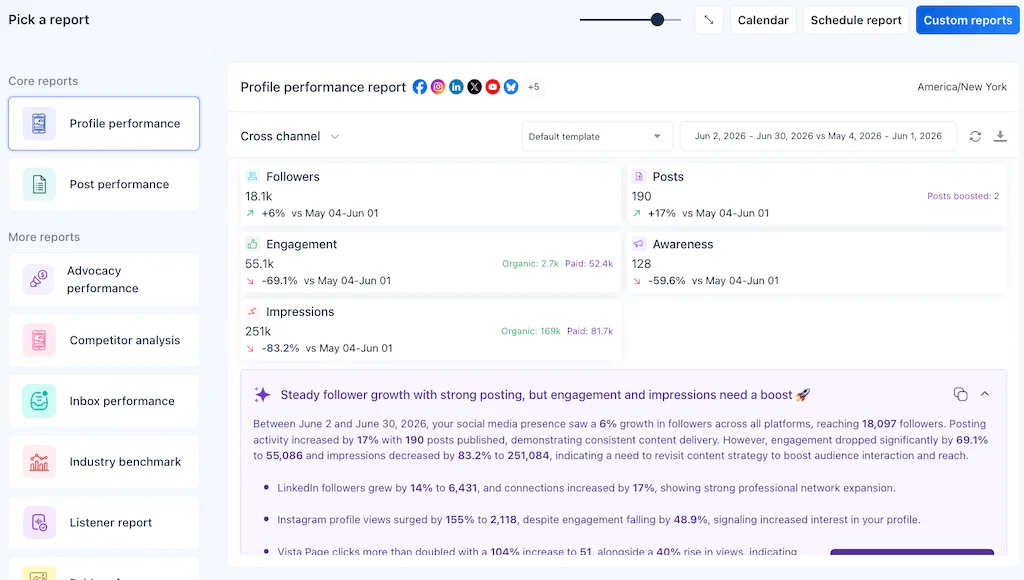
Reporting is the first thing AI should take off your plate, because it’s repetitive and low-judgment until the very last step. AI can pull each client’s numbers, drop them into a branded template, and draft the narrative, so the manager’s job shrinks from building the report to interpreting it.
That interpretation is what clients are really paying for. No one renews over a tidy chart of last month’s reach; they renew because someone told them what the numbers meant and what to do next. Handing the assembly to AI and keeping the read for your team puts senior time where it protects the contract, and you can see how to automate your social workflow end to end.
Publishing and scheduling
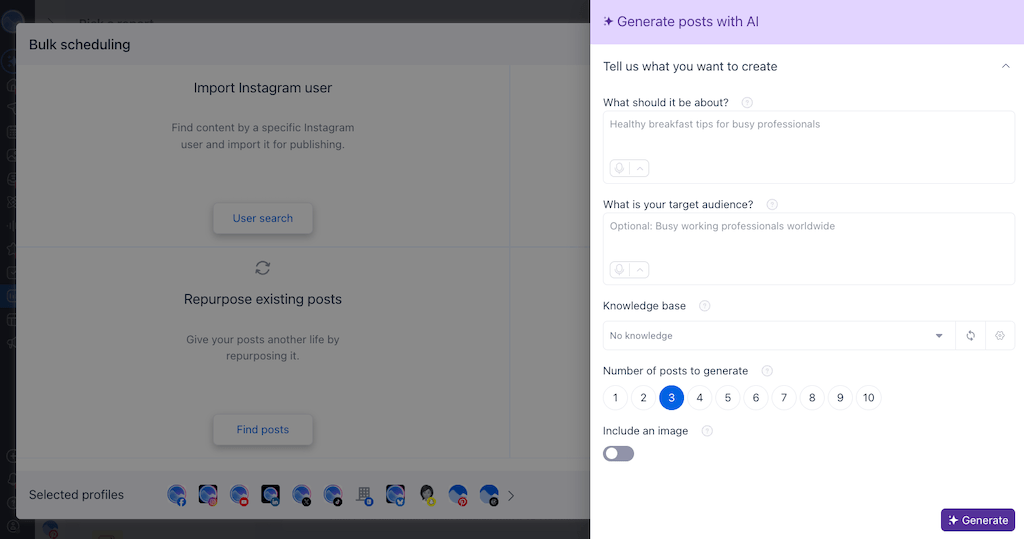
Scheduling is pure logistics, and logistics is what software is for. Bulk scheduling lets you queue a week or a month across every client at once, and smart-timing places each post when that audience is most active, so you stop hand-rescheduling six brands every Monday.
The win compounds the client count. The same workflow that covers three accounts covers thirty with barely more effort.
First-draft content in each client’s brand voice
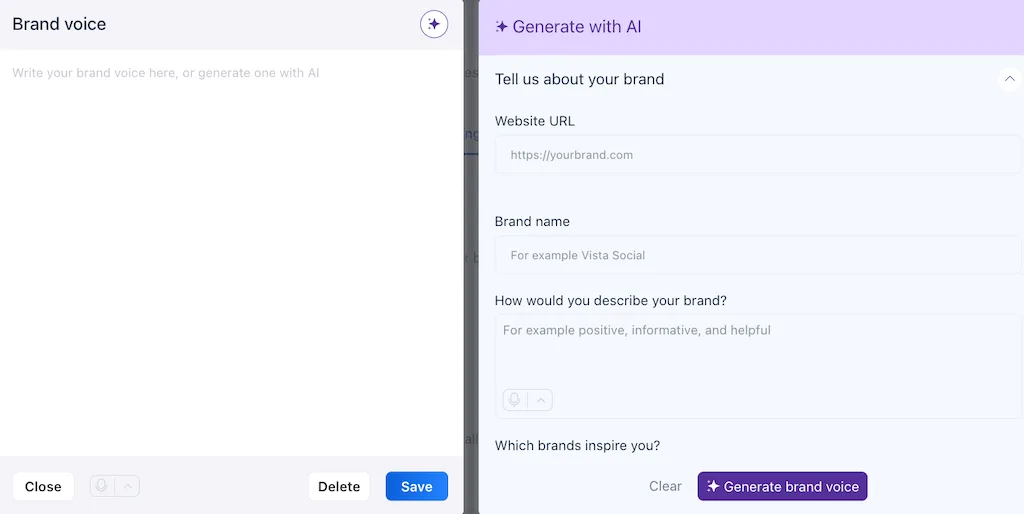
AI gets you to a solid first draft fast, and the manager directs from there. What keeps drafts from sounding generic is grounding, giving the AI each client’s voice, products, and rules before it writes a word, so the output reads like that brand instead of everyone’s brand.
Set up a brand voice per account and the manager refines a draft in minutes instead of staring at a blank page. The AI handles the first pass, the manager shapes the final, and the client’s feed still sounds like the client.
First-pass inbox triage
Across a portfolio, the inbox is a firehose of repeated questions, and most have the same handful of answers. AI can sort messages by intent, flag the ones that need a human now, and draft replies to the routine ones.
Your team reviews and sends instead of typing the same response for the 40th time. The handoff stays the same as everywhere else: AI takes the first pass, a person handles anything sensitive and owns every send.
Why does one platform beat five separate AI tools?
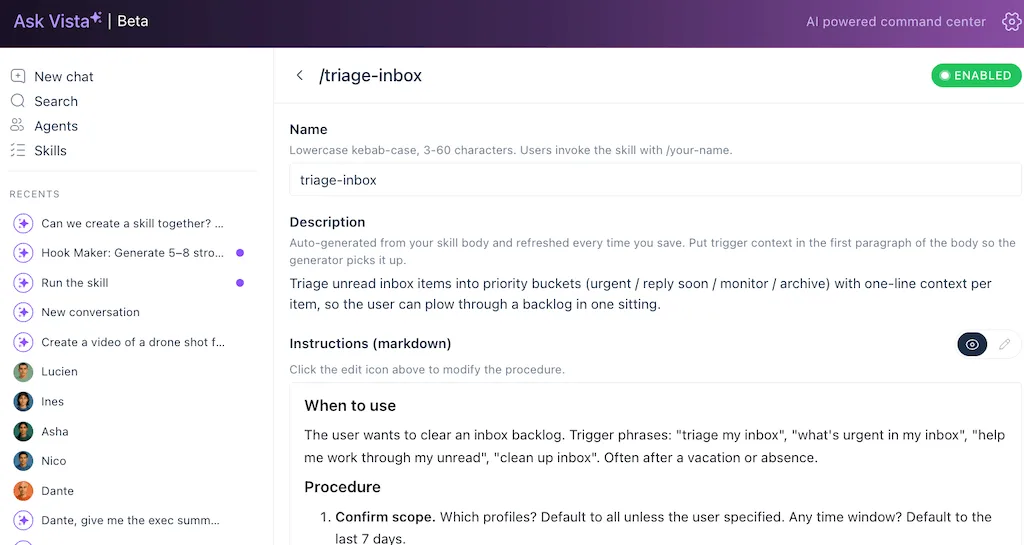
One platform wins because the AI sits inside the accounts where the work already happens, so it acts on your calendar, inbox, and reports without exporting anything. Five disconnected tools just move the work around: someone still has to brief each one, reconcile the output, and switch tabs all day.
It’s the same reason a purpose-built assistant beats a general chatbot. The chatbot is a strong writer with no access to your clients’ live accounts, so it can suggest a caption but not much else:
- A general chatbot can talk about the work but can’t schedule the post, pull the analytics, or triage the inbox.
- AI agents that run the work do it inside the accounts themselves, which is most of why a purpose-built tool wins for agency work.
An approval gate is what makes all of this safe across a roster of clients. The AI gathers information and drafts the work, then a person signs off on anything that is published, sent, or changed, so fast automation never becomes a liability on someone else’s account.
How much capacity does automation free up?
Agency operators who have already made the shift describe it in exactly these terms. As Otis D. Gibson, founder and chief creative officer of Gertrude Inc., put it in Adweek:
“AI will empower our teams to accomplish much more, in much less time, and give them the ultimate bonus: more time to do the things that make them happy, healthy, and full of joy.”
Otis D. Gibson, Gertrude Inc. (Adweek, 2026)
The before-and-after holds up when an agency actually measures it. Rhillane Ayoub, founder of RHILLANE Marketing Digital, documented his team’s numbers after moving reporting and research onto AI:
- Reporting went from two people spending ten hours each every Friday, roughly 80 hours a month, down to about 90 minutes of review per week.
- Brief turnaround dropped from 48 hours to same-day, and his senior strategist went from spending 61% of her time on non-strategic tasks to about 85% on actual strategy.
Your own numbers will differ, but the shape is the same. The math is worth walking through, kept illustrative rather than measured. Say each of the five workflows above gives a manager back two to four hours a week once it leaves their plate:
- Across reporting, scheduling, drafting, alt-text, and triage, that’s a realistic ten to fifteen hours reclaimed per manager every week.
- Put a few managers’ reclaimed hours together and you’ve found most of a new hire’s capacity, without a new hire’s cost.
That range lines up with broader data. HubSpot’s State of Marketing 2026 found roughly a third of marketers save 10 to 14 hours a week with AI, and another third save 15 or more.
The real shift is in how capacity and cost move together. Hiring raises both at once, so margin thins as you grow, while automating the repeatable work lets capacity climb as costs stay roughly flat. The next few clients land on a team that already has room.
Start your free trial and reclaim the hours before you add a salary. No credit card required.
How AI for marketing agencies works in Vista Social
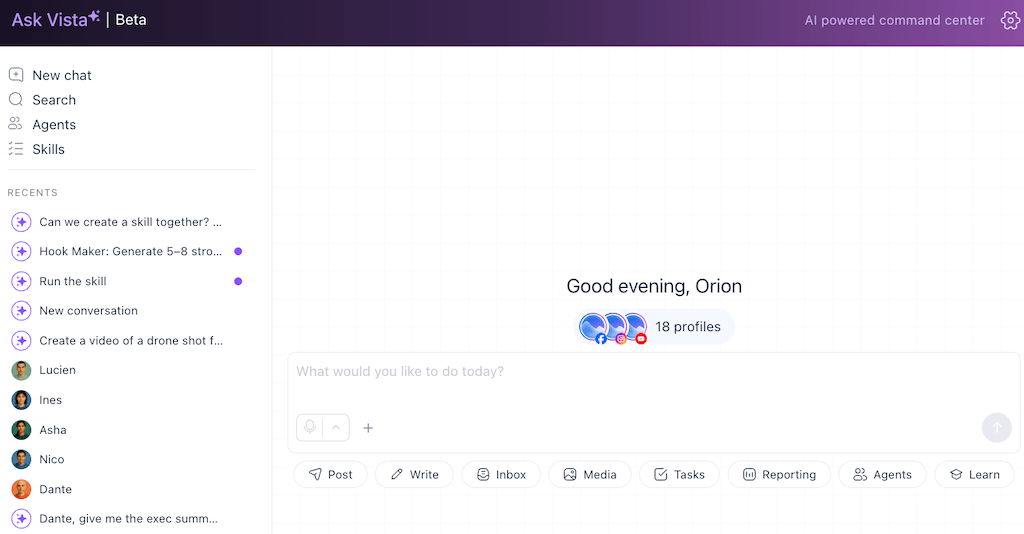
Everything above is the job to be done, and Vista Social is built to do it in one place, with a human approving anything that goes live.
Run the work, not the tools: Vista Social’s AI drafts, schedules, triages, and reports from your prompt and confirms with you before anything is published or sent. You build each client’s brand awareness through the AI Training you set up rather than the tool reading an account on its own, so drafts come back in the right voice and a person still approves them.
Keep every client on-brand: Set up AI Training per client, and the AI-generated captions and replies you prompt for come back in that client’s voice, routed through approval rather than posted blind.
Take reporting off your plate: Automated, branded client reports with AI summaries end the Friday-in-spreadsheets ritual, leaving your team the strategic lead.
Predictable pricing: Avoid the individual nickel-and-diming of traditional software. Vista Social uses clear, tiered packages. You can safely onboard multiple team members and dozens of client profiles without your software bill fluctuating every time you make a change.
See how Vista Social’s AI works across every client account.
When should you still hire?
Hiring is still the right call when the work needs a person, not a process. AI scales execution, but the senior judgment and relationships that justify your rates come from your people, so add a human when:
- The bottleneck is genuinely strategic, not a backlog of repetitive tasks.
- A client needs a dedicated person who knows their business.
- Your creative bar needs another senior brain in the room.
It helps to be honest about quality, too. AI gets you to roughly 80%, and the last 20% stays with your people: the judgment, the brand nuance, the nerve to kill a safe idea. That last 20% is also where the work stops sounding like everyone else’s AI output.
That is the line agencies that win with AI hold onto. Used this way, automation makes an agency more human where it counts. It clears the busywork so your best people spend their time on the work clients actually remember.
How to start scaling your agency without hiring
The next client doesn’t have to trigger a hiring scramble that hands most of the new margin back before the work begins. When the repeatable execution already runs on AI workflows with a human approving the output, you onboard that account onto a system your team already uses.
You don’t have to overhaul everything to feel it. Pick one workflow, start with reporting since it’s the easiest hour to win back, and watch what a few reclaimed hours per manager do over a month.
The agencies that get comfortable with AI early take on their next few clients while everyone else is still writing job descriptions.
Start your free trial and scale your client work without hiring.
Frequently asked questions
Can you really scale a marketing agency without hiring?
Yes, within limits. Automating the repeatable execution work like reporting, scheduling, drafting, and triage lets an existing team carry meaningfully more clients. Hiring is still the answer when the bottleneck is senior strategy, creative judgment, or a relationship that needs a dedicated human.
What agency tasks can AI safely automate?
The mechanical, repeatable ones: client reporting, post scheduling, first-draft captions, image alt text and metadata, and first-pass inbox triage. Keep strategy, final approval, and sensitive client replies human. The rule of thumb is to automate volume and keep judgment.
Will AI replace social media managers?
No. It removes the busywork so managers spend more time on strategy and clients, the work agencies bill a premium for in the first place. The manager directs and approves while the AI drafts, which makes the role more strategic rather than redundant.
How much time can AI save an agency?
Savings are real but vary by team and setup. HubSpot’s 2026 data shows roughly a third of marketers saving 10 to 14 hours a week with AI and another third saving 15 or more. Treat any single percentage-of-tasks-automated claim with skepticism unless it cites a primary source.
Won’t AI make all my clients’ content look generic?
Only if you skip brand grounding and approval. Set a brand voice per client and keep a human approval gate so AI drafts in that client’s voice and the manager directs the final. Generic output is a setup problem, not an AI problem.
Is one AI platform better than several specialized tools?
For most agencies, yes. Disconnected tools create stitching work and force you to re-explain each client’s brand to every app. AI built into the platform where the work already happens, with approval, removes that overhead and keeps everything in one view.
Try Vista Social for free
A social media management platform that actually helps you grow with easy-to-use content planning, scheduling, engagement and analytics tools.
Get Started NowAbout the Author

Content Writer
Orion loves to write content that refuses to be boring. As part of Vista Social, he helps brands, creators, and agencies stop doom scrolling and start winning with social media. When he's not in front of a keyboard, he's watching films in IMAX with his wife, dissecting football tactics (the European kind), and getting lost in a good book.
Loading related tools...

The most complete social media management platform for teams who demand more.






Tools
PublishingAnalyticsEngagementIntegrations
FacebookInstagramLinkedInRedditSnapchatThreadsTikTokX (Twitter)YouTubeMCPVista Page (link-in-bio)All IntegrationsCopyright © 2026 Vista Social LLC. All Rights Reserved.