

Published on May 6, 2026
12 min to read
Agency Social Media Audits: Finding Quick Wins for New Clients

Summarize with AI

Table of contents
Summarize with AI

ChatGPT

Claude

Perplexity
Share

Vista Social

X (Twitter)


As an agency, you have two main priorities: get more clients and do great work so they happily stick around. And having a way to find quick wins that instantly prove your agency’s worth is a win-win all around.
A sharp social media audit is one of the most reliable tools you have for doing this.
Done well, an audit hands the client a few visible improvements before the second invoice clears and surfaces the strategic work that justifies the retainer for the next year.
This guide is built for agencies who need their audit to do real work. We’ll cover why audits matter for retention in 2026, walk through a 30-day audit timeline that fits how agencies actually operate, dig into the findings that produce same-week wins, and show you how to package everything so the client sees the value clearly enough to keep paying for it.
Table of contents
Why agencies need to be running social media audits
Foxwell Digital’s 2026 State of Digital Marketing Agencies report surveyed more than 100 agency owners to see how real agencies are viewing the landscape. And one of their biggest takeaways is that agencies need to make the shift from simple execution to full strategy ownership.
And that’s exactly what starting off with a social media audit can do. As Andrew Foxwell puts it, “Agencies need to reposition from ‘doers’ to decision-makers. The faster they operationalize that, the better their chances to survive and thrive.”
So while most agencies are running audits because the proposal said they would, the ones that are really going to solidify their client-agency relationship—and prove their worth—are running audits because it’s the first step to really owning the strategy and making quick wins that instantly showcase their value.
Audits surface the wins that justify the retainer
In any given client account, there are usually three or four things that could be fixed in an afternoon and would visibly improve performance within a week.
A broken bio link nobody’s caught, a pinned post from 2023 that’s still sitting there, an Instagram action button pointing to a phone number that doesn’t exist anymore, or a dormant Pinterest account that’s somehow ranking better than the active LinkedIn page they actually care about.
Without an audit, these wins stay invisible.
With one, you walk into your second client meeting carrying a shortlist of fixes already implemented and the metrics to show what shifted.
Audits build trust faster than any onboarding doc
Research from Focus Digital’s 2026 agency churn report found that the first 90 days represent peak churn risk across all agency models, with the primary driver being service dissatisfaction rather than price, and for agencies the onboarding period is the first major service touchpoint.
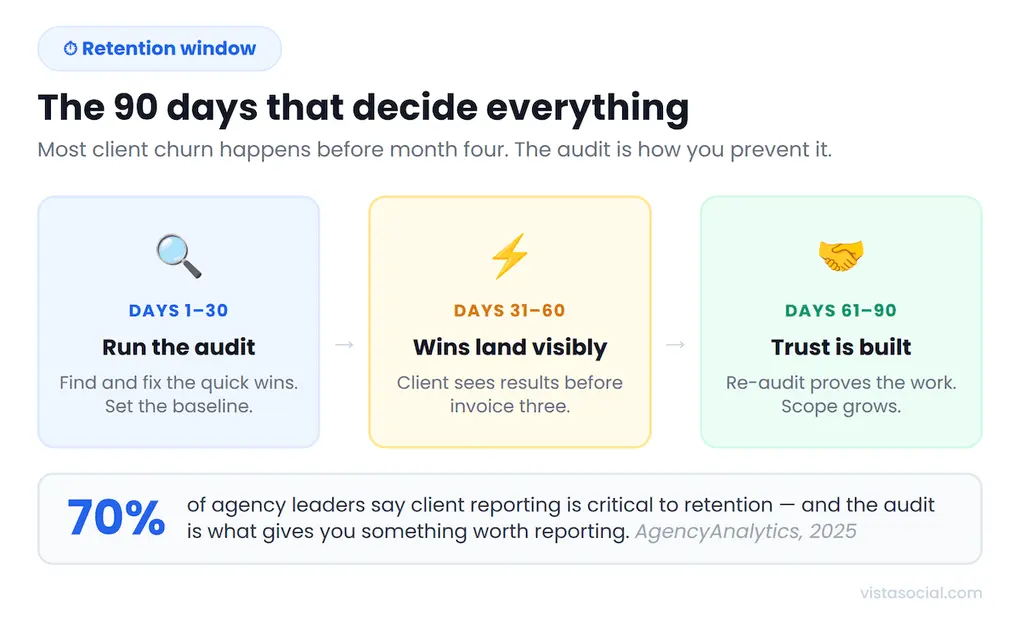
The audit is what makes that touchpoint feel substantive because the client doesn’t just see you taking notes during kickoff calls, they see you telling them things about their own accounts they didn’t know.
Audits get the client ready for your processes
Every agency has its own way of working, refined over years of running engagements, with its own approach to approval workflows, content calendars, posting cadences, brand guidelines, and reporting rhythms. An audit gives you a clean reason to introduce all of it without sounding like you’re imposing structure for its own sake.
“Based on what we found in the audit, here’s the workflow we’d recommend” is a much easier sell than, “Here’s our standard process, please adopt it.”
Audits create natural upsell paths
According to AgencyAnalytics’ 2025 Marketing Agency Benchmarks Report, 70% of agency leaders say client reporting plays a critical role in retention, and agencies that fail to consistently demonstrate value are the first ones put up for review when clients reassess their spend.
When you find gaps that fall outside the original scope, like a Pinterest account that’s never been touched or a TikTok presence that doesn’t yet exist, you’ve got a natural opening for a scope expansion conversation that doesn’t feel like an upsell.
Audits document the starting line
Without baseline numbers you can’t prove progress, which is why tracking the right social media metrics from day one matters so much. Six months into the engagement when leadership asks the client whether the agency is worth the spend, the audit is what lets you answer with data instead of vibes.
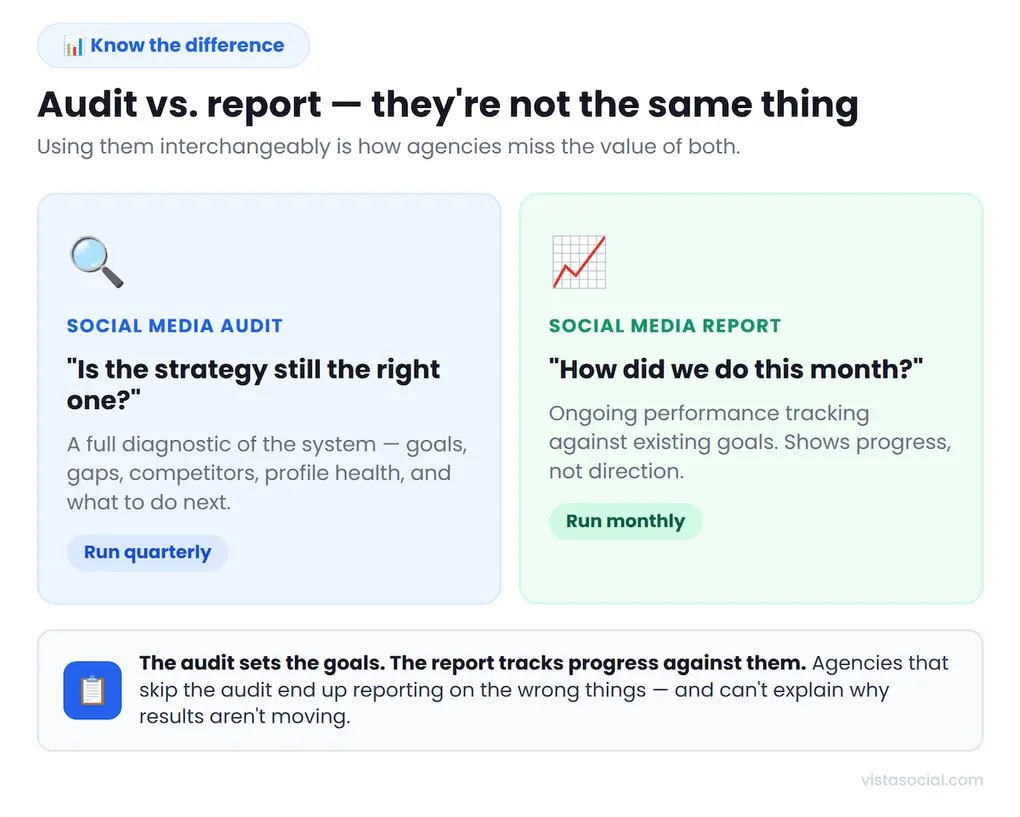
The 90-day re-audit then becomes the proof point, and the cycle keeps generating evidence that the work is paying off.
Audits help you focus on retention over acquisition
Ads agency owner Depesh Mandalia recently wrote about how endlessly chasing more clients isn’t actually the best strategy for agency growth.
In his words, “Growth isn’t about how many clients you have; it’s about how well you serve the ones you do.”
And putting a major emphasis on auditing new clients’ online presences, finding quick wins that will make an immediate impact, and using that to build a solid foundation for managing that client’s social media is the perfect way to serve each client in a way that’s going to make them want to stick around.
Chasing new clients day in and day out is exhausting. You should be focusing on building a foundation with long-term clients, and scaling only as new ones come your way. That’s the real formula for agency growth.
The 30-day agency social media audit process
Audits don’t need to be marathons. Four weeks is the right window for most clients, with each week building on the one before it. Anything shorter and you miss patterns, anything longer and the client starts wondering what they’re paying for.
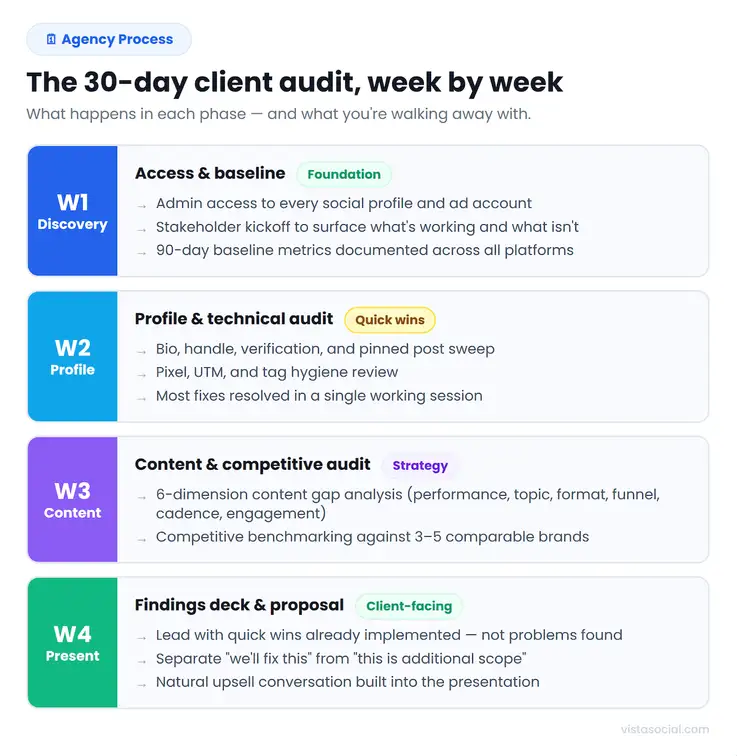
Week 1: Discovery and access
Week one is unglamorous and essential, because the goal is to get every login and piece of brand context you need so the rest of the audit isn’t bottlenecked on the client’s IT person.
You’ll want to gather:
- Admin access to every social profile and ad account
- Native analytics access on each platform
- Brand guidelines, creative assets, and the last two quarterly reports if they exist
- Access to Meta Business Manager, Google Ads, and any third-party tools they’re already using
Run a stakeholder kickoff with whoever will be involved in approvals, but understand the point isn’t to gather requirements yet. The point is to capture what they think is working, what they think is broken, and where the political landmines are buried.
That last one matters more than people admit. If the founder is married to the LinkedIn strategy and you find out in week three that LinkedIn is dead weight, you’ll wish you’d known earlier.
By the end of week one, document baseline metrics for the past 90 days across every platform, covering data like:
- Follower count
- Engagement rate
- Reach
- Top-performing posts
Plus, pay attention to where the client’s audience actually lives versus where they’ve been spending time.
Week 2: Profile and technical audit
Week two is where the quick wins live.
- The profile-by-profile sweep
- The pixel and tag check
- The UTM hygiene review
- The integration audit
Most of what you find here can be fixed in the same working session, giving you instant wins to share with your clients.
The kinds of things that surface in this week tend to be remarkably consistent across clients.
Linktree pages still pointing to last summer’s promo, pixels firing on the wrong event, UTM parameters that are different on every channel because three different people set them up over two years, Instagram action buttons configured for a location that’s since closed, and verification badges the brand qualifies for but never applied to get.
You’re not solving strategy yet—that’s coming. For now, you’re just cleaning up the foundation so the strategic work in weeks three and four has somewhere stable to stand.
Week 3: Content and competitive audit
Week three is where you start to go deeper. You’ll need to conduct a:
- Content gap analysis: Pinpoint topics that your clients aren’t talking about, but competitors are, and that you can tell their audience is interested in
- Performance audit: This is a breakdown of what’s been working and what’s been bleeding budget
- Competitive benchmarking: Compare three to five competitors to your clients to see how they stack up
The competitive piece often gets short-changed because it feels like work that doesn’t directly help the client, but it changes how every finding lands.
When you tell a client their engagement rate is 0.8% on Instagram they nod politely, but when you tell them their engagement rate is 0.8%, the average for their category sits at 1.4%, and their closest competitor is at 2.1%, they actually pay attention.
Week 4: Presentation and proposal
Week four is the deck, the Loom video, or whatever format fits this client’s communication style. You want your audit’s findings to really hit home, and the presentation itself shapes how the client remembers the work.
Build the findings into a tight narrative covering:
- What’s working
- What’s broken
- What you’re going to fix in the next 30 days
- What’s strategic enough to deserve its own scope conversation
Lead with the quick wins you’ve already implemented rather than the problems you’ve found, showing the client that you’re already on top of things. After all, a presentation that opens with “we found these 47 problems” lands very differently from one that opens with “we already fixed these five things and here’s what we’re going after next.”
This is also where you tee up the upsell, but the natural one rather than the hard pitch.
“We noticed your TikTok account hasn’t been posted to in 14 months. That’s outside our current scope, but it’s the platform your competitors are growing fastest on. Want to talk about adding that?” works far better than a separate proposal email a week later.
How to conduct a social media audit for your clients
Three sections matter most. Profile optimization, content gap analysis, and the low-hanging fruit that produces visible wins fast.
Profile optimization opportunities
This is the easiest place to score visible wins in week one. Every platform has a checklist of optimization elements, and most clients have at least three or four sitting broken or unconfigured, so you walk through every active profile platform by platform.
- Bio optimization: Covers whether the value prop is clear in the first line, whether searchable keywords are present, and whether there’s an actual CTA rather than a vague “DM us.” On Instagram you’re checking whether the bio link is going through a UTM-tagged Linktree or directly to a campaign-specific landing page, and on TikTok, whether the link is eligible (meeting the platform’s follower threshold) and being used.
- Visual consistency: Covers profile photo, cover image, Instagram highlights covers, and brand colors. Most agencies don’t realize how often clients have inconsistent versions of their own logo across platforms because different team members uploaded different files at different times.
- Handle alignment: Is where you check whether the brand is @brand everywhere or whether someone has squatted the handle and forced them onto @brand_official. Squatted handles can sometimes be reclaimed through platform support if the brand has trademark documentation, and that’s a quick win agencies miss all the time.
- Verification status: Covers Meta Verified, X Premium, and blue check eligibility on TikTok and YouTube. Some clients qualify and just haven’t applied, and verification is one of those zero-cost trust signals that makes everything else perform a little better.
- Pinned posts and contact info: Are about whether the most valuable evergreen content is pinned and whether book buttons, shop links, and location accuracy are configured properly. A restaurant client with the wrong hours listed is losing covers every weekend without realizing it, and the pinned slot on most accounts is wasted on whatever the founder happened to like recently when it should be working overtime.
Content gap analysis
This is the strategic core of the audit. The profile work is housekeeping, but the content gap is where you actually figure out what the next year of strategy should look like.
A real gap analysis covers six dimensions:
- Performance gap: Which content types are over and underperforming for this specific client (carousels vs. Reels vs. statics vs. Stories)
- Topic gap: What subjects competitors are covering that the client ignores
- Format gap: Missing formats like video, UGC, employee-generated content, carousels, or native LinkedIn newsletters
- Funnel gap: Whether everything is top-of-funnel awareness with no consideration or conversion content
- Cadence gap: Posting frequency against category benchmarks
- Engagement gap: Whether they’re posting but not replying, with DMs going unanswered and comments left to die
A simple framework that works well for presenting this back to the client is a Topic × Format × Funnel Stage matrix, where empty cells are white space and filled cells with poor performance are optimization targets:
| Topic | Format | Funnel Stage | Status |
|---|---|---|---|
| Product education | Reels | Consideration | Missing |
| Customer wins | Carousels | Decision | Underused |
| Industry trends | LinkedIn articles | Awareness | Active, performing |
| Behind the scenes | Stories | Awareness | Missing |
| Comparison content | YouTube | Consideration | Missing |
When the client sees the matrix laid out, the conversation shifts from, “Do we agree there’s a problem?” to, “Which gaps do we close first?”
Finding low-hanging fruit for immediate wins
This is the section that justifies the whole audit. Ranking everything by speed-to-impact is what makes the findings actionable rather than overwhelming.
Same-week wins:
- Pin top-performing evergreen posts that are buried
- Fix broken bio links and add UTMs so traffic from social shows up in analytics
- Repost top historical content into formats that are missing
- Reply to unanswered comments and DMs from the past 30 days
- Turn on action buttons (book, shop, message) wherever the platform offers them
First-month wins:
- Republish best-performing posts as carousels or Reels to extend their reach
- Build three to five visual templates so the brand gets visually consistent immediately
- Set up basic UGC collection through a branded hashtag and repost permissions
- Consolidate DMs and comments into a single social inbox so nothing slips through
First-quarter wins:
- Launch missing formats, where the first Reel for a brand that’s never made one usually outperforms anything they’ve ever posted
- Build out underused platforms that align with the audience
- Set up proper attribution tracking so social media ROI can be measured against business outcomes
- Launch employee advocacy if the brand has the team for it
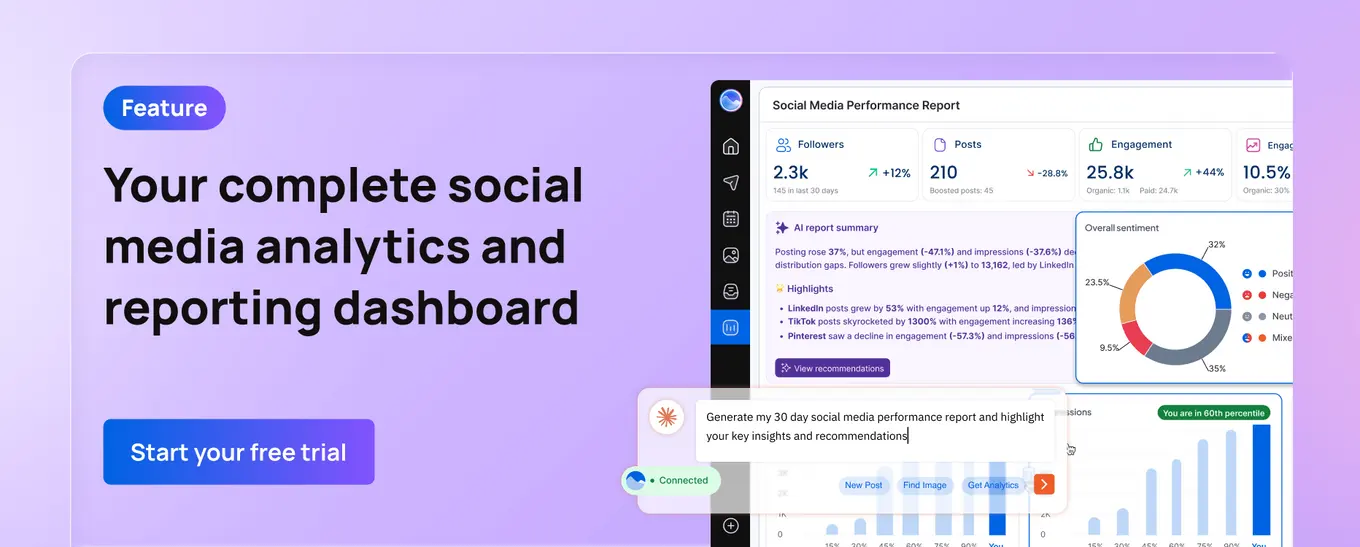
This is also where Vista Social earns its place in the workflow, because running an audit across five client accounts using only native analytics is a slow and brutal process.
Pulling cross-channel performance data, building the post-performance breakdown, and generating a white-labeled findings deck take minutes inside Vista Social’s analytics and reporting tools instead of the half-day it takes to assemble manually.
Common audit mistakes to avoid as an agency
Even agencies that run audits regularly fall into the same traps, and these are the ones that quietly kill audit effectiveness:
- Auditing without baseline goals: “We want to grow Instagram” isn’t a goal, but “we want Instagram to drive 15% of monthly demo requests by Q3” is. You can’t call something a gap if you haven’t established the target, which is why grounding the audit in a documented social media marketing strategy matters from day one.
- Drowning the client in 80 findings instead of 10 priorities: The temptation is to show your work, but the audit should hand the client a tight, prioritized shortlist with everything else going in an appendix nobody opens.
- Skipping competitive context: Internal data without external benchmarks is hard to interpret, because a 1.2% engagement rate could be excellent or terrible depending on the category.
- Not separating “we’ll fix this” from “this is additional scope.” : Ambiguity here means either the client thinks they’re paying extra for things that should be included or you end up doing extra work for free.
- Forgetting to re-audit at 90 days: The original audit is the baseline, and the 90-day re-audit is the proof. Vista Social’s scheduled report builder makes this easier than it used to be, since the same custom report can be regenerated against the new date range automatically.
- Letting findings sit in a deck without a project plan: Every recommendation needs a name attached and a date, otherwise the audit gets bookmarked in a Slack channel somewhere and quietly forgotten.
Try Vista Social for free
A social media management platform that actually helps you grow with easy-to-use content planning, scheduling, engagement and analytics tools.
Get Started NowAbout the Author

Content Writer
Orion loves to write content that refuses to be boring. As part of Vista Social, he helps brands, creators, and agencies stop doom scrolling and start winning with social media. When he's not in front of a keyboard, he's watching films in IMAX with his wife, dissecting football tactics (the European kind), and getting lost in a good book.
Loading related tools...

The most complete social media management platform for teams who demand more.






Tools
PublishingAnalyticsEngagementIntegrations
FacebookInstagramLinkedInRedditSnapchatThreadsTikTokX (Twitter)YouTubeMCPVista Page (link-in-bio)All IntegrationsCopyright © 2026 Vista Social LLC. All Rights Reserved.