

Published on February 17, 2026
13 min to read
The Ultimate Guide to TikTok Advertising (+ Examples)

Summarize with AI

Table of contents
Summarize with AI

ChatGPT

Claude

Perplexity
Share

Vista Social

X (Twitter)


TikTok’s global ad revenue hit an estimated $18.5 billion in 2024. And that figure is projected to have climbed past $33 billion in 2025.
Yet, somehow brands might still be running their TikTok ads the same way they ran their Facebook campaigns from five years ago. Same creative, same targeting logic, and same disappointing results, wondering why it didn’t land.
It’s important to understand that TikTok’s ad ecosystem plays by its own rules.
A polished 30-second spot that performs on Instagram will get scrolled past in half a second on the clock app. The targeting strategy you perfected on Meta? It needs rethinking on a platform where the algorithm rewards how people react to your content over how precisely you defined your audience.
If you’re already using TikTok for business organically, TikTok advertising is the natural next step. That being said, going in unprepared gets expensive fast.
This guide covers every ad format worth knowing, what things actually cost (with real benchmark data), how to launch your first campaign, and what brands like Dove and McDonald’s did to turn ad spend into measurable results.
Table of contents
What is TikTok advertising?
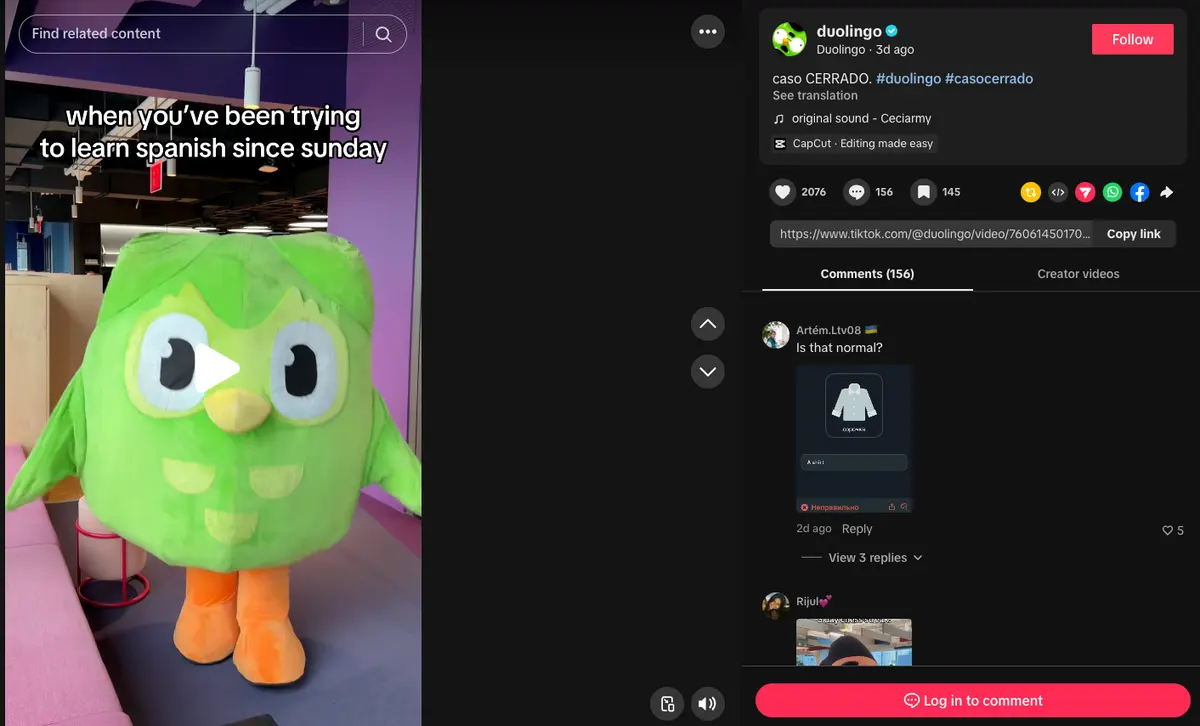
TikTok advertising lets brands pay to place video content in front of targeted audiences through TikTok Ads Manager. Placements range from in-feed videos that blend into the “For You” page to full-screen takeovers that appear the moment someone opens the app.
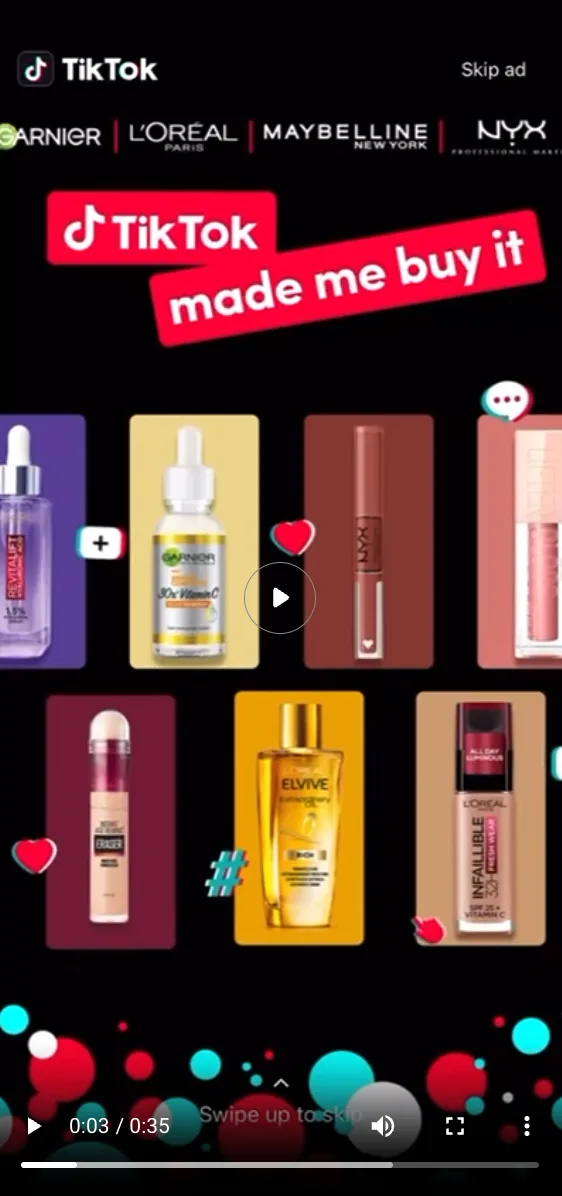
Here’s an example of what you might see on your screen:

What separates TikTok ads from other platforms comes down to format expectations. Everything here is vertical, full-screen, and sound-on. Ads that perform well feel like native content you’d actually want to watch.
TikTok’s 2025 What’s Next Trend Report calls this “Brand Chem,” where brands succeed by collaborating with creators and communities rather than broadcasting at them.
TikTok Ads Manager runs on an auction-based bidding system. Advertisers compete for placements based on a combination of budget, bid, and creative quality.
Campaign objectives are grouped into three categories:
- Awareness (reach)
- Consideration (traffic, video views, community interaction)
- Conversion (app installs, website sales, product purchases)
Why should you advertise on TikTok?
Organic reach on TikTok still outpaces most platforms, so the natural question is: why pay? Because organic alone has a ceiling.
Here’s why your ad budget actually makes sense.
A massive audience that actually pays attention
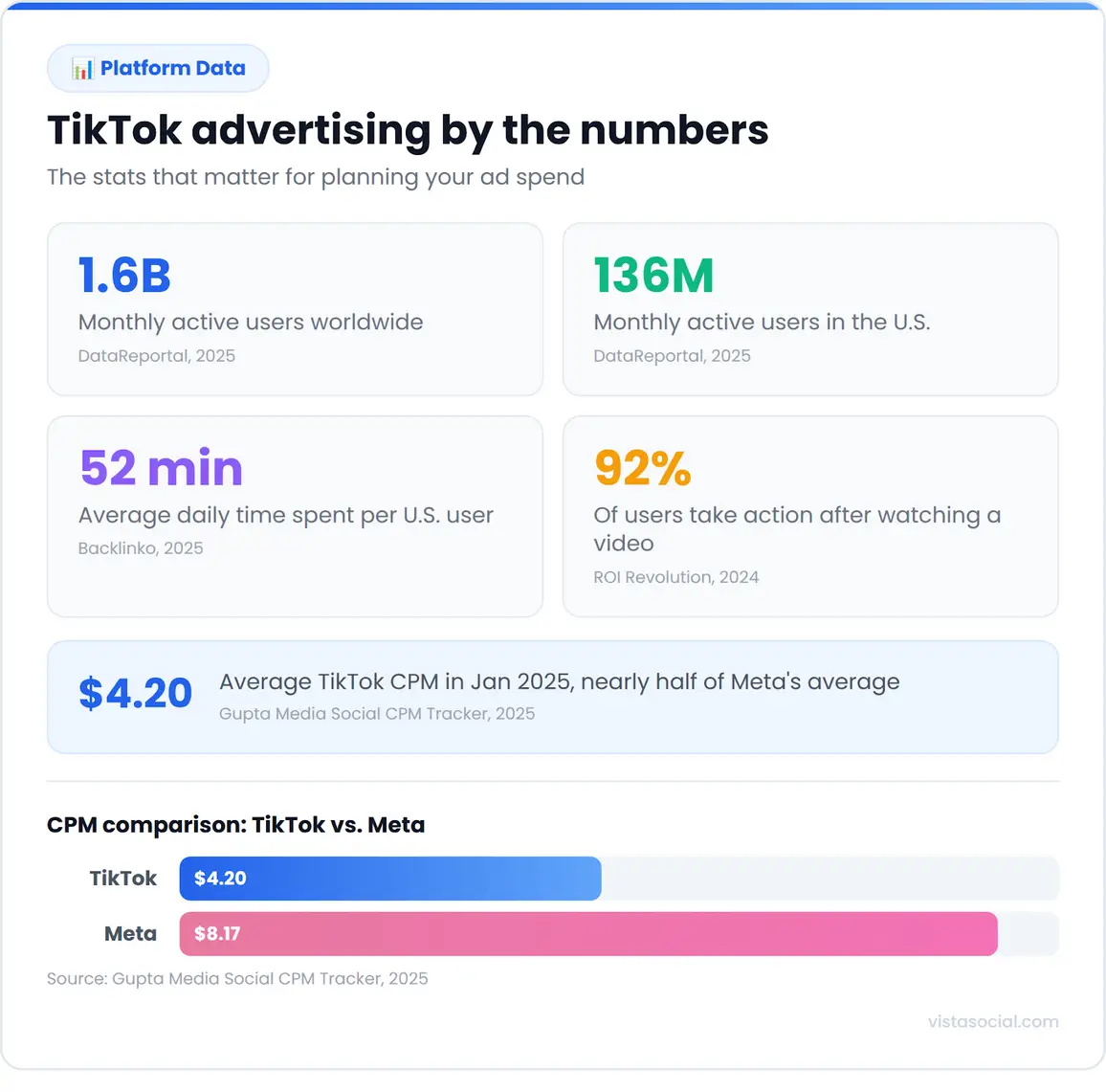
TikTok has roughly 1.6 billion monthly active users worldwide, with an estimated 136 million of those in the United States, according to DataReportal. The average user spends around 52 minutes a day on the app and opens it more than 15 times daily.
For comparison, Instagram users average about 33 minutes. That kind of time and frequency means more opportunities for your ad to connect.
Users discover and act
According to TikTok’s 2025 What’s Next Trend Report, 81% of users say the platform introduces them to new topics and trends they didn’t know they liked. That discovery mindset drives purchases.
Research from ROI Revolution found that 92% of TikTok users take some kind of action after watching a video, and 37% have purchased something they discovered through the app.
Lower entry costs than most alternatives
TikTok’s average CPM in January 2025 was $4.20, according to the Gupta Media Social CPM Tracker. By comparison, Meta’s CPMs regularly land between $8 and $10 depending on format and season.
That gap gives smaller brands room to run real creative tests without blowing through their quarterly budget in a week.
How much does TikTok advertising cost?
Ad costs on TikTok depend on your format, industry, targeting, and competition. Here are the actual benchmarks so you can plan with real numbers.
Average TikTok ad costs
| Metric | Average | Notes |
| CPM (cost per 1,000 impressions) | $4.20 – $6.00+ | Q4 holiday spikes can push CPMs 47% higher than Meta’s equivalent period |
| CPC (cost per click) | $0.20 – $0.75 | Broad targeting tends to lower this |
| Average CPLC (cost per link click) | $0.49 | As of October 2025 |
| Minimum campaign budget | $500 | Lifetime minimum to launch |
| Daily minimum (campaign level) | $50/day | Required for the system to learn |
| Daily minimum (ad group level) | $20/day | Per individual ad group |
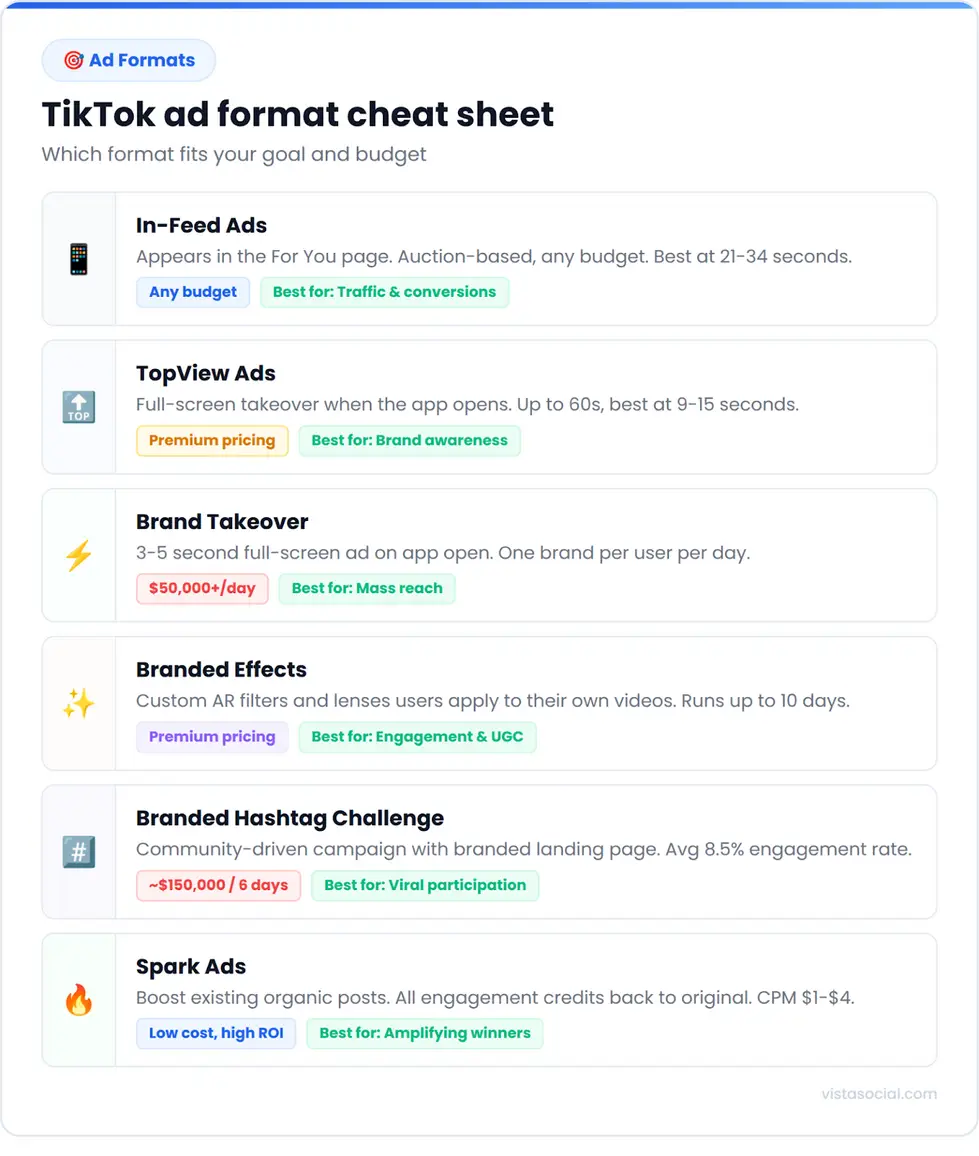
Premium placements work on a different pricing model. Brand takeovers can cost $50,000+ per day, while branded hashtag challenges typically start around $150,000 for a six-day package.
What bidding strategies work best for TikTok ads?
TikTok offers three bidding options:
- Lowest Cost is fully automated and where most advertisers should start
- Cost Cap lets you set a target cost per acquisition; use this after you’ve collected baseline performance data
- Bid Cap gives full manual control, but if you set it too low, your ads won’t deliver
A smart progression: Start with Lowest Cost for three to five days to gather data. Once you know your baseline CPA, shift to Cost Cap. Keep targeting broad early so TikTok has enough signal to optimize.
Types of TikTok ads
Each TikTok ad format serves a different purpose. Here’s what they look like, when they make sense, and what you should expect to spend.
In-feed ads
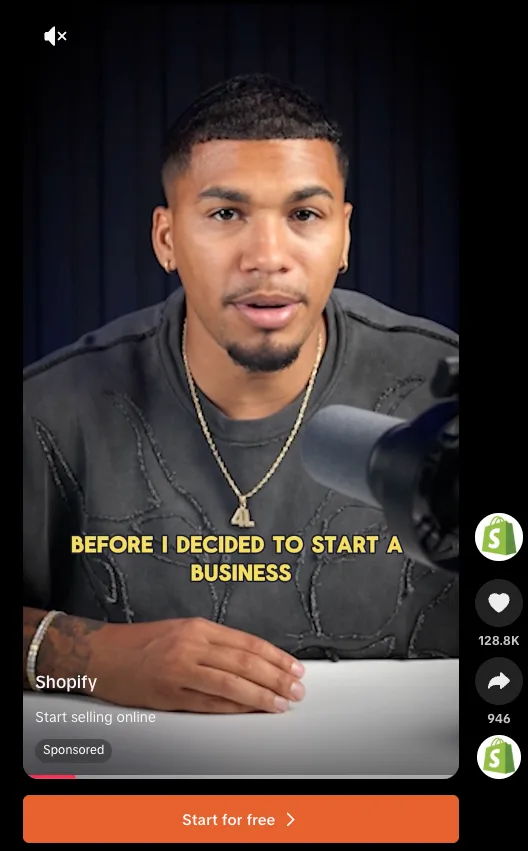
The workhorse format. In-feed ads show up as users scroll the “For You” page, tagged with a subtle “Sponsored” label and a CTA button. People can like, comment, and share them just like organic TikTok videos. These are auction-based, accessible to any budget, and TikTok recommends keeping them between 21 and 34 seconds.
TopView ads
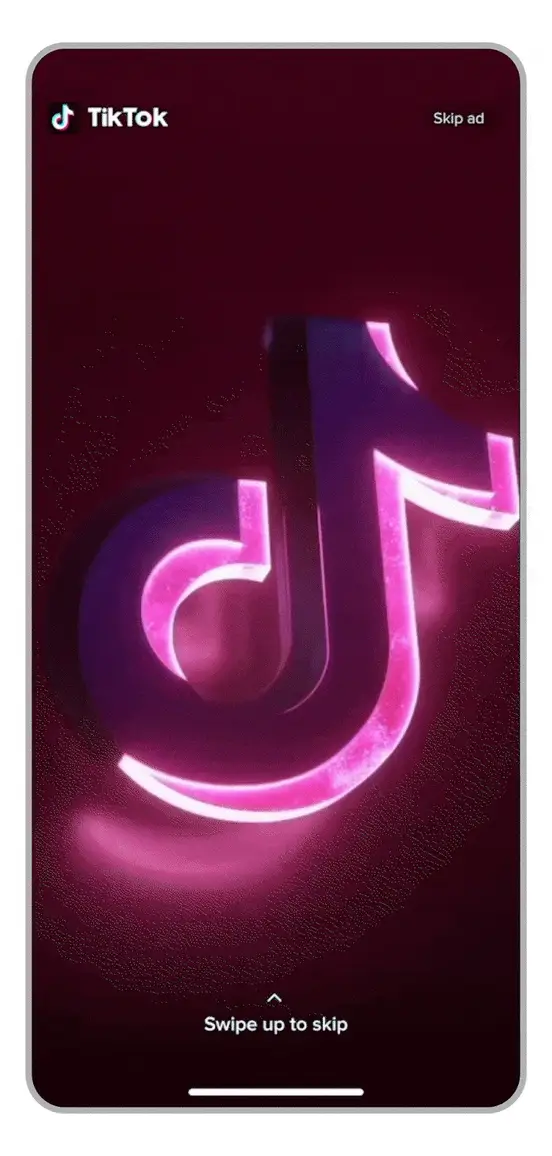
When a user opens TikTok, TopView ads take over the entire screen for a few seconds before transitioning into an interactive in-feed video. They support up to 60 seconds of content, though 9 to 15 seconds performs best.
Brand Takeover ads
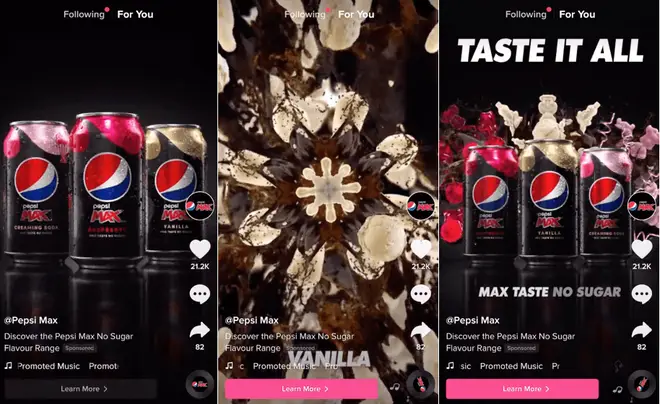
These play the instant someone opens TikTok, lasting 3 to 5 seconds. They can be static images or short clips that link to a landing page. Because each user only sees one Brand Takeover per day, the inventory is limited, which is why they cost $50,000+. Pepsi used this format to reach 2.4 million users and rack up 10 million impressions with a 24% click-through rate in a single day.
Branded Effects ads
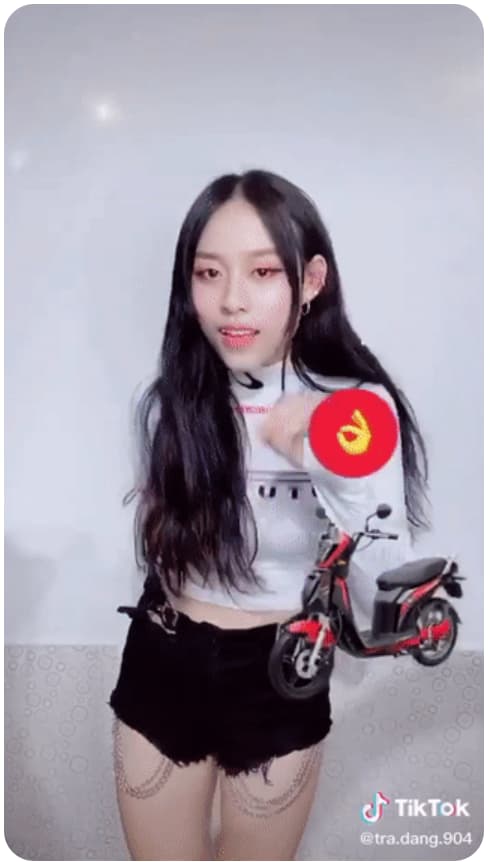
Custom AR filters, stickers, and lenses that users apply to their own videos. Beauty brands use these for virtual try-ons, gaming brands create interactive mini-games, and everyone in between gets creative.
Effects run for up to 10 days and spread organically as users play with them and tag friends. If you’re also going live on TikTok, branded effects can carry over into live sessions for even more engagement.
Branded Hashtag Challenge ads
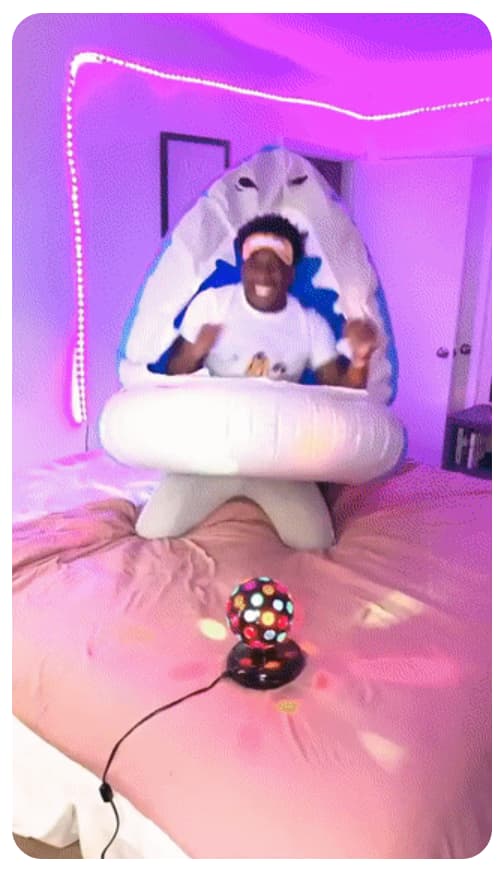
TikTok’s most participatory format. Brands create a hashtag, launch a TikTok challenge, and invite the community to make their own content around it. Tapping the hashtag leads to a branded landing page showcasing the brand’s video alongside user submissions. TikTok reports an average engagement rate of 8.5% for this format.
Spark Ads
The format that quietly outperforms everything else for a lot of brands. Instead of creating new ad content, you boost an existing organic TikTok post, either your own or a creator’s (with their authorization). Every like, comment, share, and follow earned during the promotion gets credited back to the original post.
Your paid spend actively builds your organic presence. Spark Ads typically deliver CPMs between $1 and $4, making them one of the most cost-effective ways to amplify content that’s already working. L’Oréal shipped exclusive gift boxes to 200 creators, then compiled the resulting unboxing videos into a Spark Ads campaign that produced their highest product sell-out on record.
How to get started with TikTok advertising
Ready to start creating your own ads? Follow these steps to create your ad account and run your first campaign.
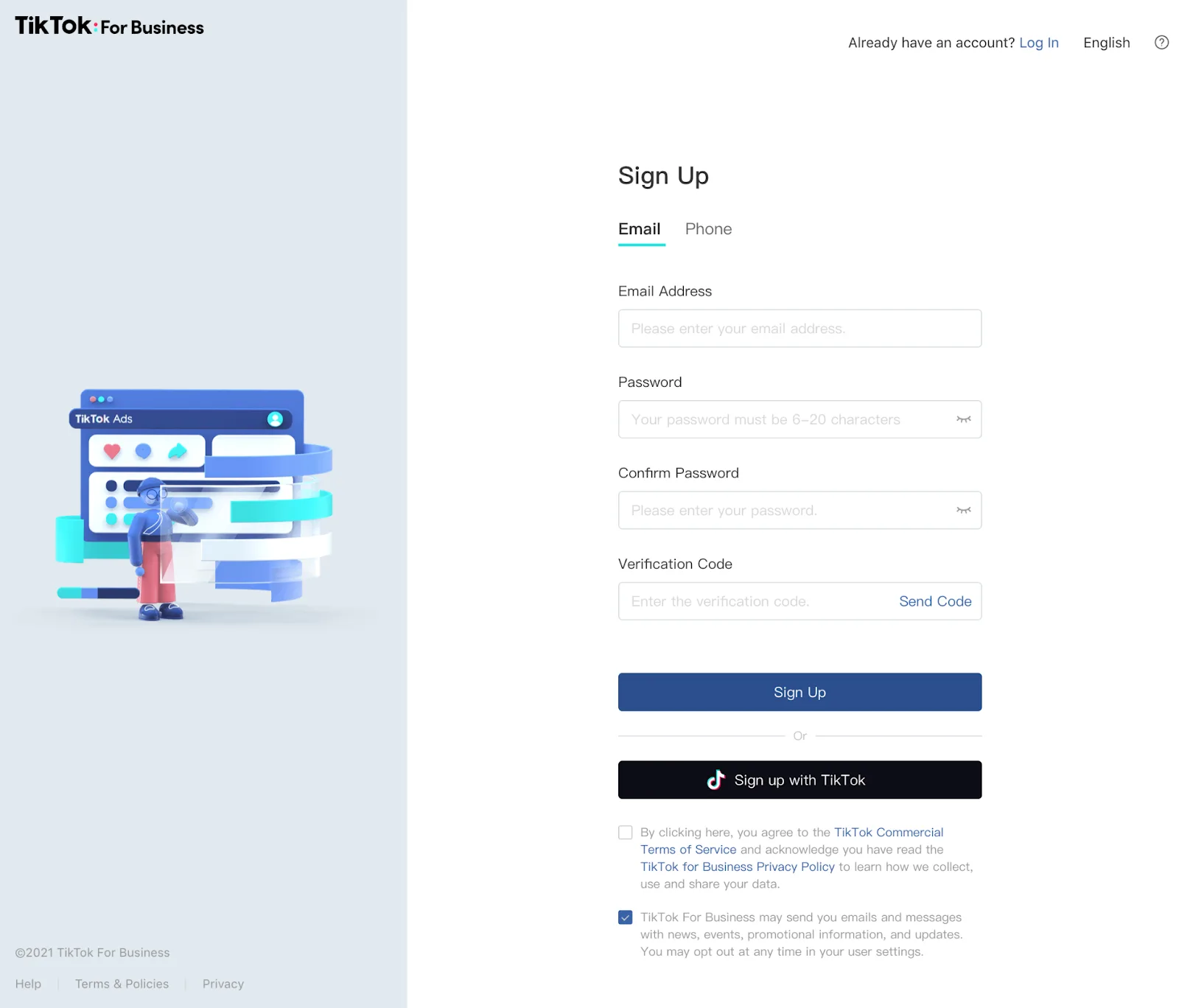
Step 1: Create your TikTok Ads Manager account.
Register at ads.tiktok.com with your business email. You’ll enter your business name, industry, and billing info.
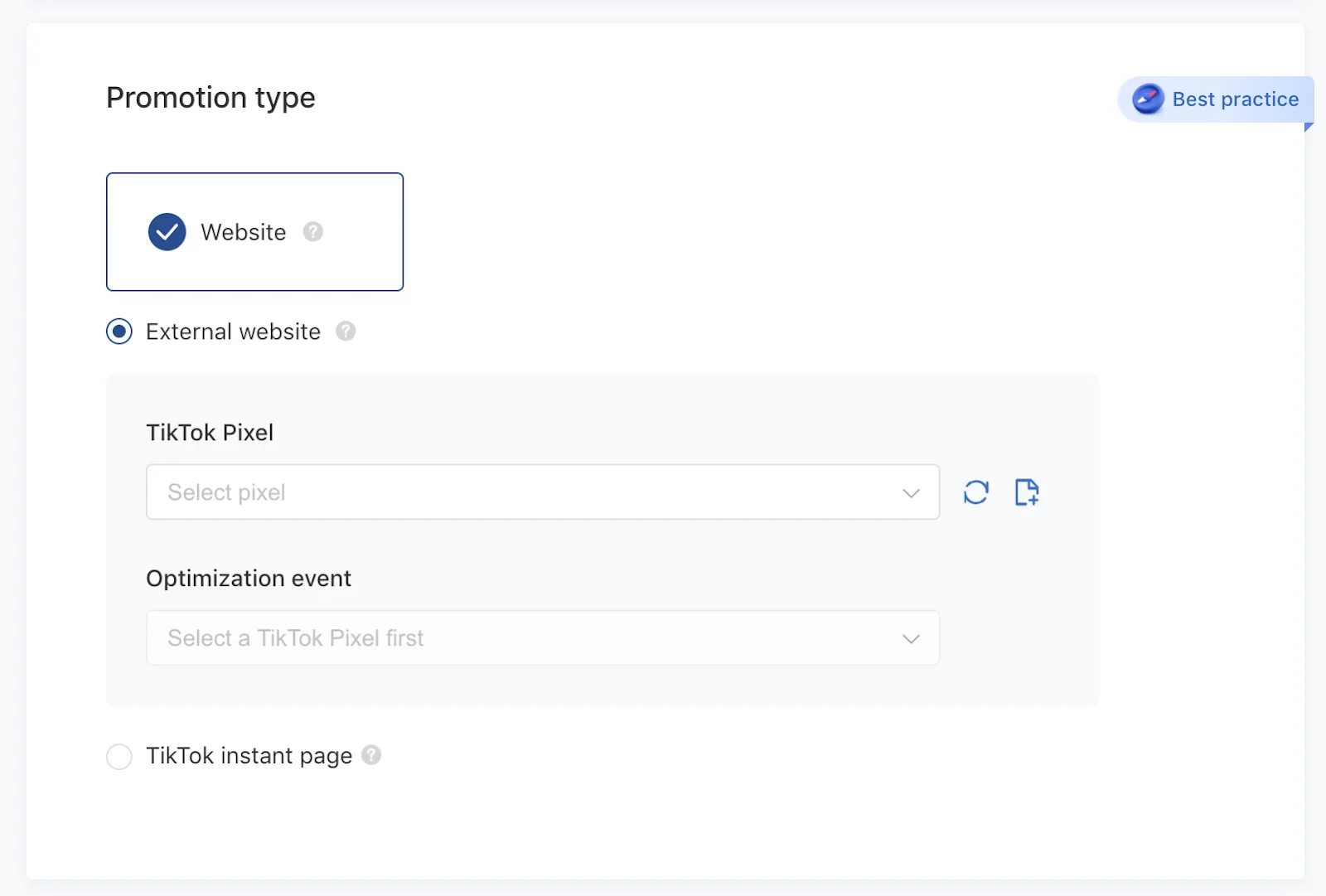
Step 2: Install the TikTok Pixel.
Add the Pixel to your website so TikTok can track actions like purchases and sign-ups. You can install it manually (best option if you have a developer managing your website), through Shopify, or via Google Tag Manager.
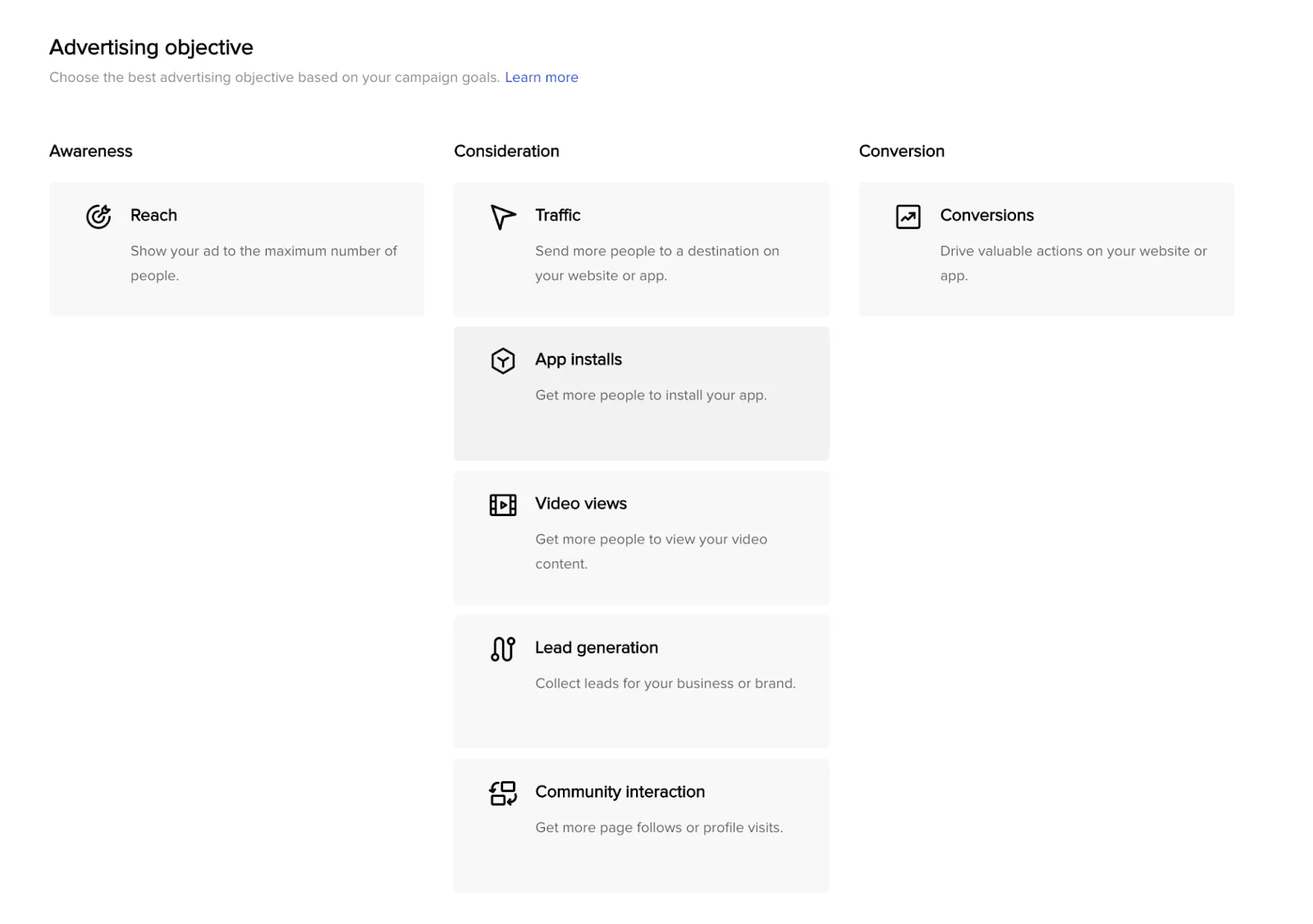
Step 3: Build your campaign.
Pick your objective (awareness, consideration, or conversion) and set your budget ($500 lifetime minimum or $50/day).
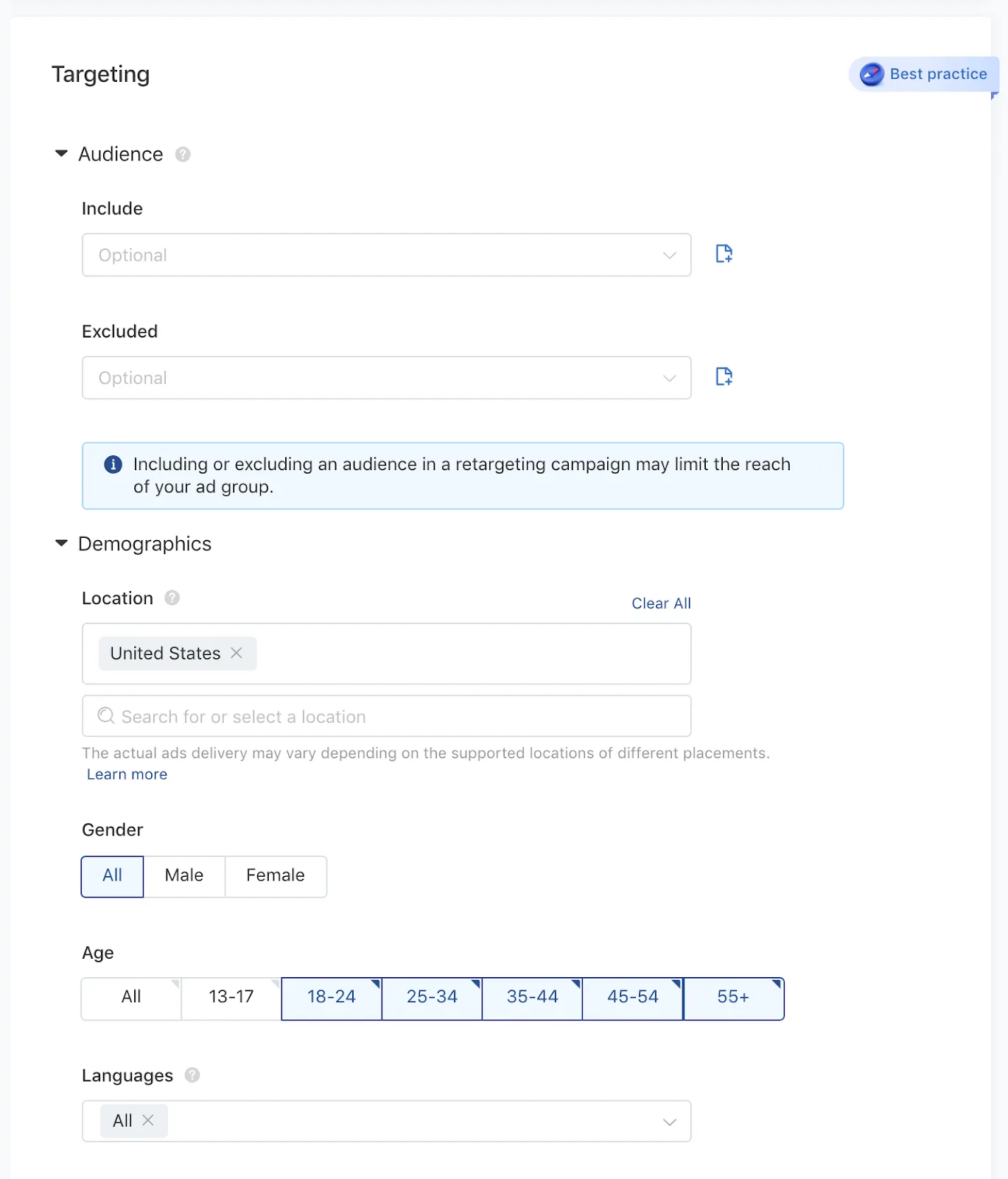
Step 4: Configure your ad group.
Define your audience, placements, schedule, and daily budget ($20/day minimum). Keep targeting broad at the start.
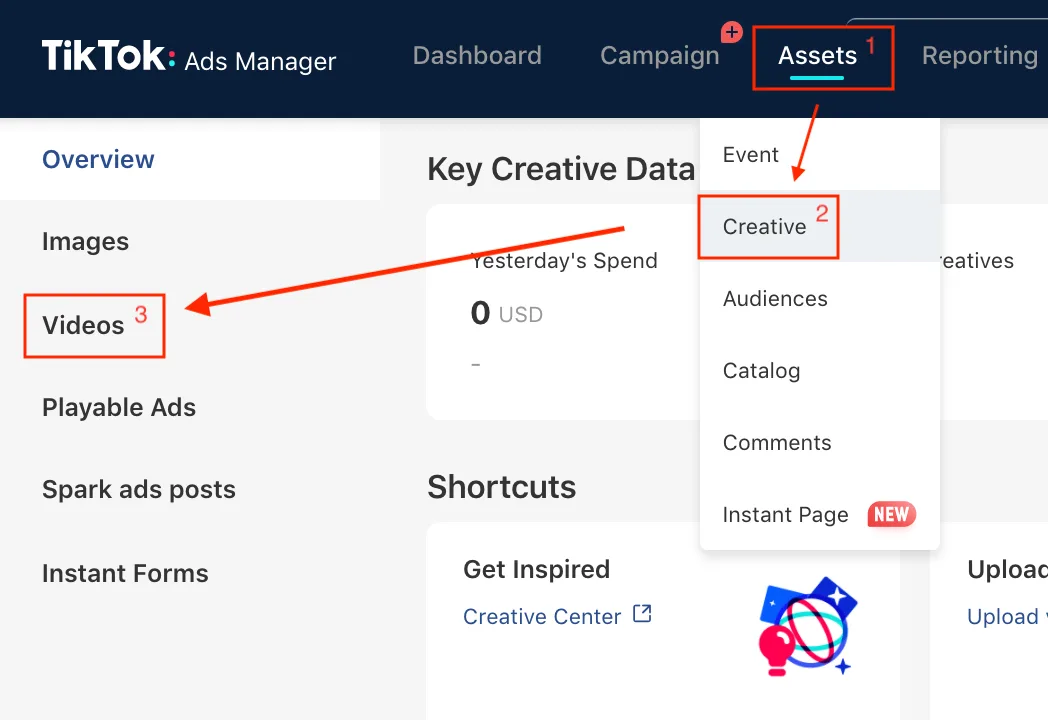
Step 5: Upload your creative.
Add your video, write a caption (12 to 100 characters), and pick a CTA button.
Step 6: Submit and go live.
TikTok reviews ads for policy compliance, usually within 24 hours.
How to manage TikTok advertising with Vista Social
Running ads in TikTok Ads Manager works fine for a single brand. But when you’re managing TikTok alongside five other platforms for multiple clients, jumping between dashboards eats time. Vista Social brings your TikTok advertising workflow into the same place where you handle everything else.
Boost TikTok posts directly from the publisher
When a post starts taking off organically, you want paid spend behind it fast. In Vista Social, you can set up boost configurations (saved targeting, budget, and duration presets) under Publishing Settings > Boost Settings. When scheduling any TikTok post, select a saved boost config on the right-side panel, and Vista Social applies it automatically.
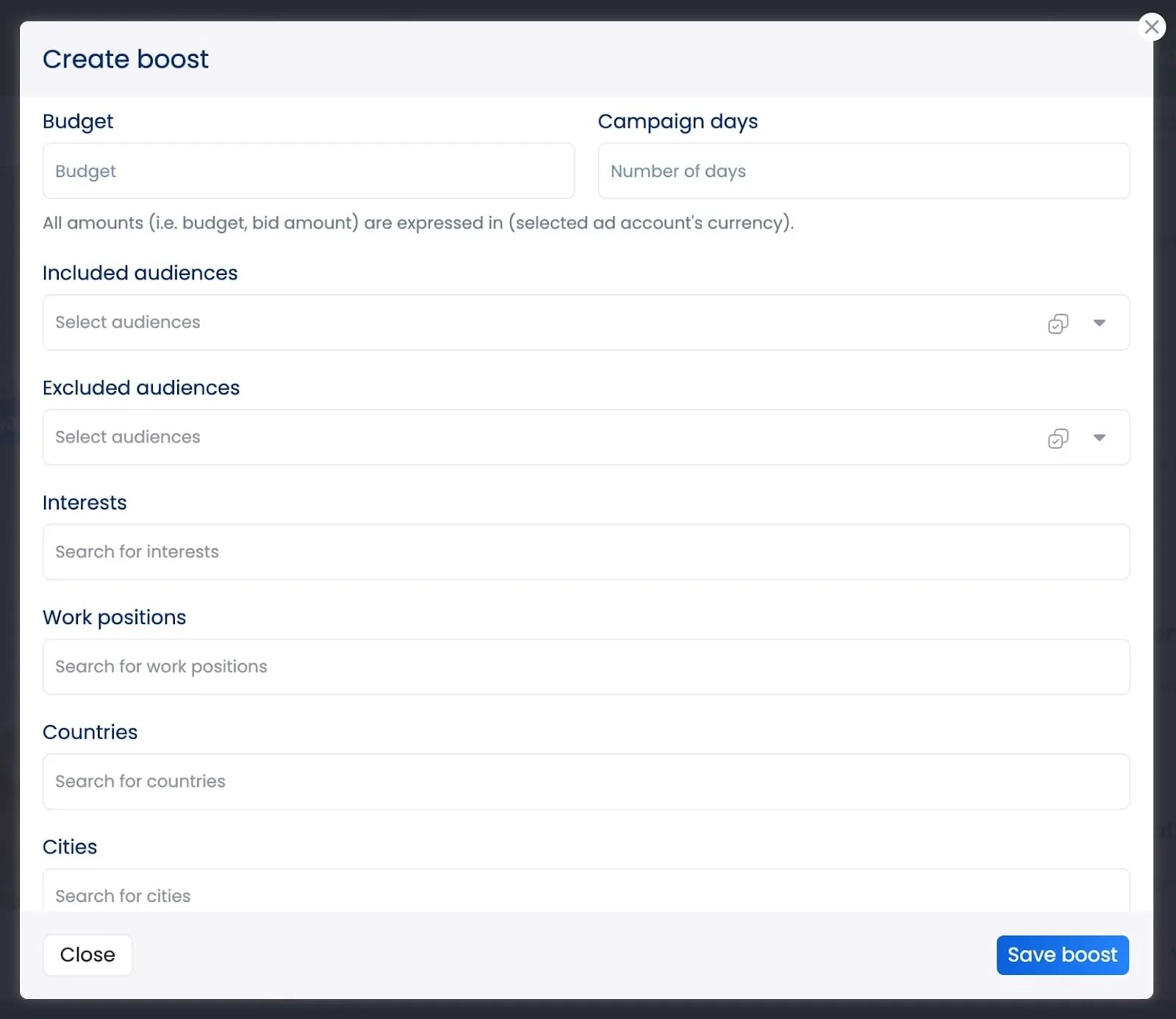
Boosted posts show up on your content calendar marked with a rocket icon, and you can filter your calendar to see only boosted or non-boosted content. That visual distinction is something most platforms don’t offer, and it makes planning your paid vs. organic mix much cleaner.
Compare paid vs. organic performance side by side
Vista Social’s TikTok analytics show side-by-side performance data for boosted and organic posts.
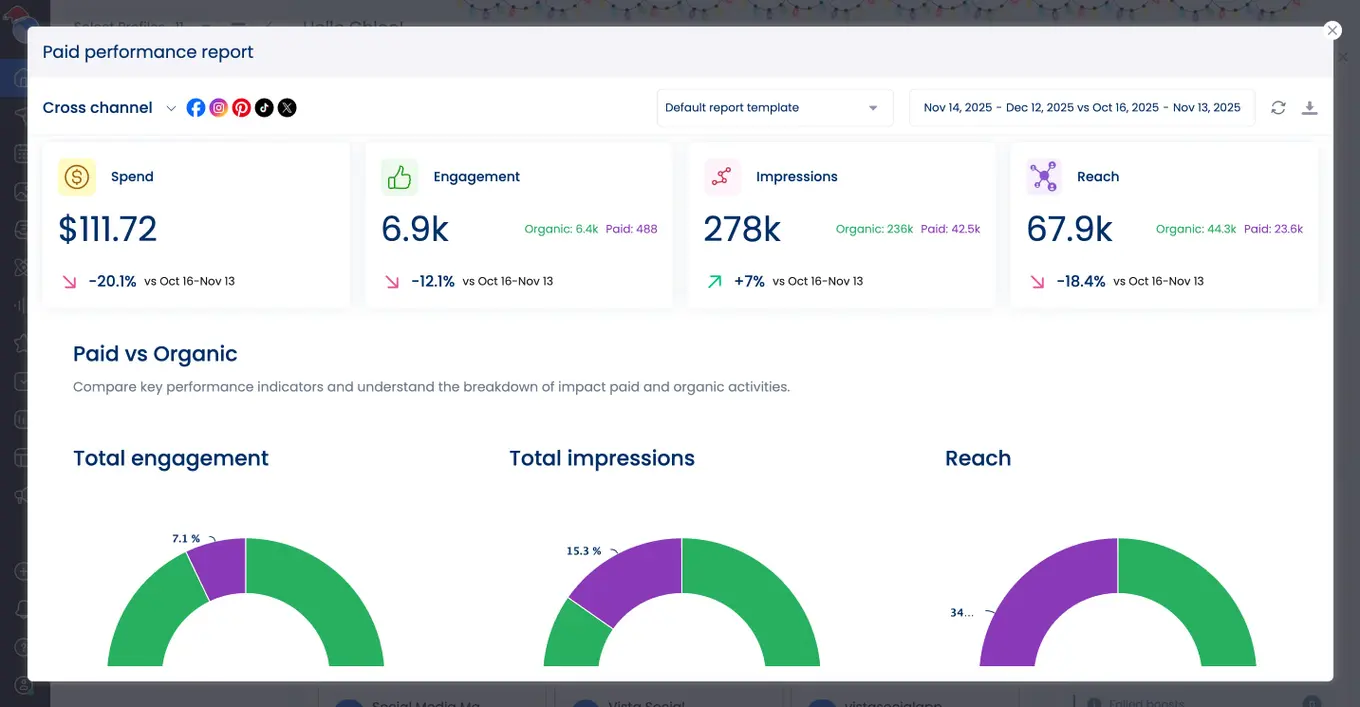
You can see exactly how much extra reach and engagement your paid spend generated compared to posts that ran on their own. For agencies reporting to clients, this is the difference between “we think it’s working” and handing over a report that proves it.
Let the AI assistant write ad-ready captions and find trending audio
Vista Social’s AI Assistant generates captions tailored to your brand voice in seconds. Set your tone, format, and communication style once, and it produces copy that stays consistent across every post. For TikTok ads specifically, this means faster caption testing without writing from scratch each time.
The platform also includes a trending audio library built into the dashboard, so you can browse and apply popular sounds to your videos without switching to TikTok’s Creative Center separately.
Use optimal timing based on your actual audience
Instead of relying on generic “best time to post” articles, Vista Social analyzes your actual audience behavior and recommends posting windows based on when your specific followers are most engaged. For boosted posts, this means your ad spend gets a better starting position from the jump.
Manage your TikTok workflow through AI chat with MCP
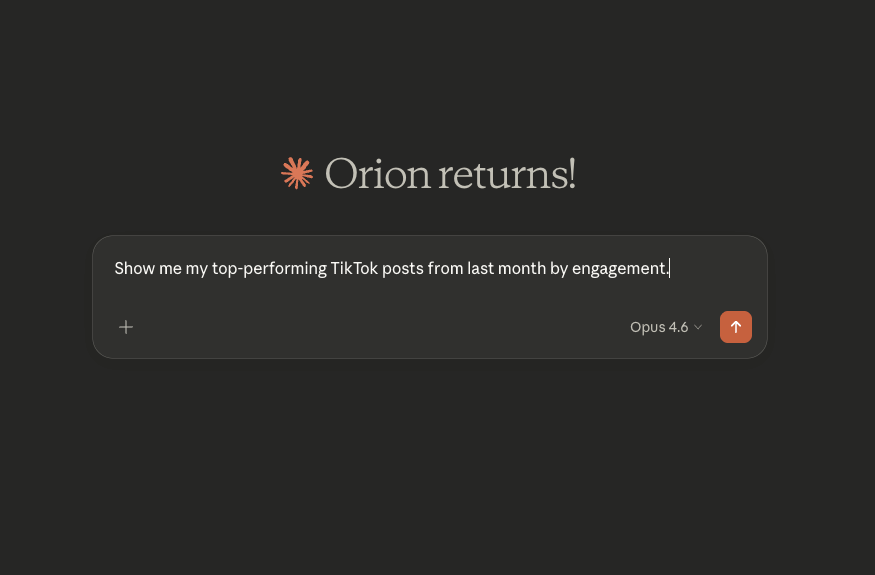
Vista Social supports AI integration through MCP, which connects Vista Social to AI tools like Claude or ChatGPT. Through a natural conversation, you can schedule TikTok posts, pull performance reports, check which posts are generating the most engagement, and email a report to your client. No developer skills required.
Prompt examples that work with Vista Social’s MCP:
- “Schedule a post to my TikTok and Instagram profiles for tomorrow at 10 AM.”
- “Show me my top-performing TikTok posts from last month by engagement.”
- “Pull a performance report for [client name] and email it to them.”
Streamline approvals for ad content
When ad copy and creative need sign-off, Vista Social’s approval workflows route content through review stages with specific team members assigned at each step. This keeps quality consistent across TikTok challenges, boosted posts, and organic content without relying on email chains where things get buried.
7 TikTok advertising best practices
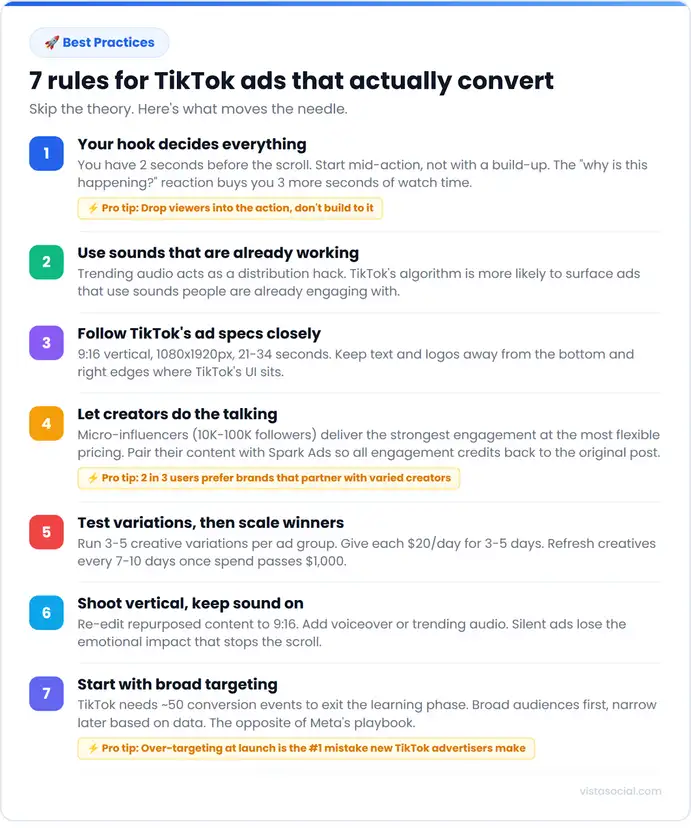
1. Your hook decides everything
Two seconds. That’s how long you have before someone scrolls past. Open with movement, a question that stops the thumb, or a visual that doesn’t make sense until they keep watching.
Here’s a trick the best TikTok advertisers use: Start your ad mid-action.
Don’t build up to the interesting part. Drop the viewer right into it. The “Why is this happening?” reaction buys you three more seconds of watch time, and on TikTok, that’s everything.
2. Use sounds that are already working
Trending sounds on TikTok function as a distribution hack. When your ad uses audio that people are already engaging with, TikTok’s recommendation system is more likely to surface it.
Check TikTok’s Creative Center for what’s trending, or browse Vista Social’s built-in trending audio library without leaving your dashboard.
3. Follow TikTok’s recommended ad specs
Creative that doesn’t meet spec requirements gets rejected or performs poorly. Here’s what TikTok recommends for in-feed video ads:
| Spec | Recommendation |
| Aspect ratio | 9:16 vertical preferred (1:1 and 16:9 also work) |
| Resolution | 1080 x 1920 px recommended, 720 x 1280 px minimum |
| Video length | Up to 10 minutes supported; 21-34 seconds performs best |
| Max file size | 500 MB |
| File formats | .mp4, .mov, .mpeg, .3gp, .avi |
| Minimum bitrate | 516 kbps |
| Caption length | 12-100 characters (links and hashtags not clickable in non-Spark ads) |
4. Let creators do the talking
User-generated content consistently drives better results than polished brand creative on TikTok. Micro-influencers in the 10,000 to 100,000 follower range deliver the strongest engagement at the most flexible pricing.
Pair their content with Spark Ads: The creator makes the video, you put paid spend behind it, and all engagement rolls back to the original post.
5. Test variations, then scale winners
Run 3 to 5 creative variations per ad group, give each at least $20/day for 3 to 5 days, and double down on what gets traction. Refresh your creatives every 7 to 10 days once spend passes $1,000. Ad fatigue sets in faster on TikTok than anywhere else.
6. Shoot vertical, keep sound on
Brands still recycle horizontal video from other platforms, slap black bars on it, and wonder why results are weak. TikTok is built for vertical, full-screen, audio-on content. If you’re repurposing, re-edit to 9:16 and add voiceover or trending audio. Silent ads lose the emotional impact that makes people stop scrolling.
7. Start with broad targeting
Over-targeting at launch starves the system of data. TikTok’s recommendation engine needs roughly 50 conversion events to move past its initial learning phase. Give it broad audiences first, then let it identify your highest-value segments, and narrow down based on what the data tells you.
This is the opposite of how most marketers approach Meta, and it’s one of the most common mistakes new TikTok advertisers make. The algorithm that helps content go viral on TikTok is the same one optimizing your ad delivery.
7 great examples of TikTok advertising
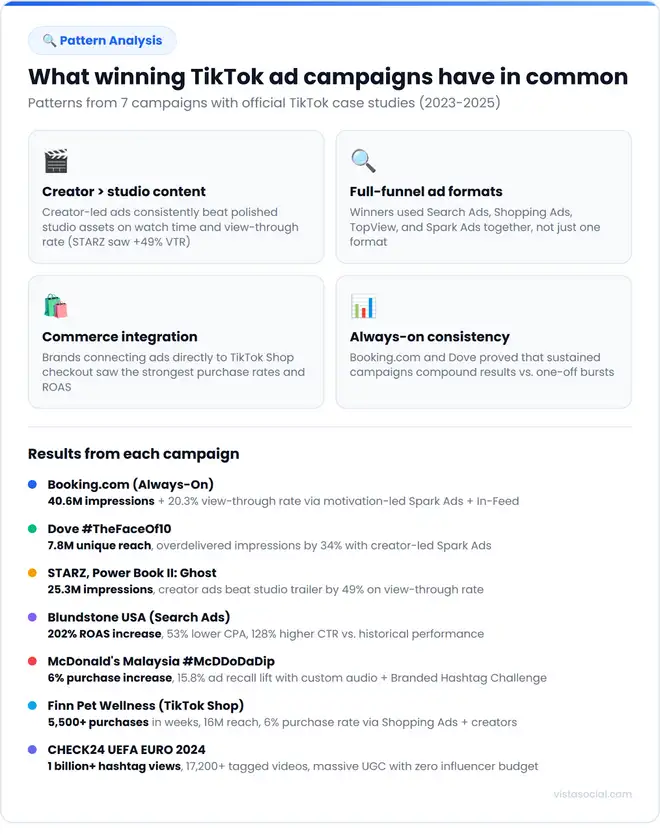
1. Booking.com: Always-on campaign
Most travel brands advertise destinations. Booking.com flipped the script and advertised motivations. Instead of “visit Paris,” they created content around why people travel. Adventure, romance, relaxation, or family bonding. This let them speak to multiple communities at once without feeling generic.
Their always-on strategy combined Spark Ads and In-Feed Ads with trending audio, creative templates, and text-to-speech. They also ran a Genius loyalty program campaign featuring Brooklyn Beckham.
According to TikTok, the always-on campaign hit 40.6 million impressions with a 20.30% six-second view-through rate. The Genius campaign added another 9.36 million impressions and nearly doubled VTR benchmarks, with a 0.67% engagement rate.
2. Dove: #TheFaceOf10
When the “Sephora Kids” trend went viral in early 2024 (girls as young as 10 buying anti-aging serums), Dove didn’t just comment on it. They built a global campaign around it. #TheFaceOf10 featured creators, dermatologists, and Drew Barrymore, all making the same point: a 10-year-old’s face should be covered in glitter and stickers, not retinol.
They boosted creator videos as Spark Ads, keeping the content feeling organic rather than scripted. According to TikTok, the campaign reached 7.8 million unique individuals and overdelivered on planned impressions by 34 percent.
3. STARZ: Power Book II: Ghost Season 4 launch
For the final season premiere of Power Book II: Ghost, STARZ needed to cut through the noise and reach fans who might have drifted away between seasons. They went with TikTok’s highest-impact placement: primetime TopView ads, the first video users see when they open the app.
But instead of running a polished studio trailer, STARZ partnered with comedy and entertainment creators through TikTok Creative Exchange to produce native content that felt like it belonged on the For You page.
According to TikTok, the campaign hit 25.3 million impressions, beating initial goals. The creator videos delivered a 44% increase in average watch time and a 49% higher six-second view-through rate compared to the studio-produced asset.
Commenters noted the ads actually reignited their interest in the show, with some renewing their STARZ subscriptions as a direct result.
4. Blundstone: Search Ads
Most brands use TikTok for awareness. Blundstone USA used it to capture people who were already searching for boots. By running TikTok Search Ads with high-intent keywords and matching them with creative that aligned with what people were actively looking for, they turned the platform into a search-driven performance channel.
They started with a test-and-learn approach, adding new keywords every few days and shifting budget toward top performers. According to TikTok, the results crushed their historical performance: a 128% increase in click-through rate, a 53% reduction in cost per acquisition, and a 202% increase in return on ad spend. “TikTok has quickly become one of the go-to search platforms,” Blundstone’s team said.
5. McDonald’s Malaysia: #McDDoDaDip
McDonald’s launched four limited-edition McNuggets sauces and needed Gen Z to care. They partnered with rapper-producer ALYPH to create a custom 30-second remix, then launched a Branded Hashtag Challenge asking users to create “finger dance” videos while dipping McNuggets.
They tapped 19 TikTok creators and boosted their content through Spark Ads. According to TikTok, the brand had 22M views across the hashtag and 81% conversion in TikTok conversations on McDonald’s chicken nuggets and a 6% increase in chicken nugget sales.
6. Finn: TikTok Shop product ads
Pet wellness brand Finn wanted to expand beyond its existing customer base. Instead of running traditional awareness ads, they went straight to TikTok Shop with Product Shopping Ads that showcased their full catalog to users actively browsing the Shop tab.
They paired this with affiliate creators (everyday pet owners, not mega-influencers) who created authentic product reviews boosted as Video Shopping Ads.
According to TikTok, the campaign reached over 16 million users, Finn’s largest paid audience to date. It drove more than 5,500 TikTok Shop purchases in just a few weeks, with a 6% purchase rate while maintaining strong CPA and ROAS.
7. CHECK24: UEFA EURO 2024
German comparison platform CHECK24 saw an opportunity in Europe’s biggest sporting event. They offered free German national team jerseys to app downloaders and went all-in on TikTok content during the tournament. The team monitored comments in real time and responded to hot topics within minutes, keeping the brand at the center of the fan conversation.
According to TikTok, the #CHECK24 hashtag racked up over 1 billion views, with more than 17,200 videos tagged. After sending out its five millionth jersey, a massive wave of user-generated content flooded the platform, from styling videos and dances to memes.
Add TikTok advertising to your strategy
For teams managing TikTok alongside other platforms, Vista Social keeps everything in one place: scheduling, boosting, TikTok analytics, AI-powered captions, trending audio, approval workflows, and MCP integration for managing your entire social operation through an AI chat.
Start with Vista Social’s TikTok tools and see how much simpler your workflow gets.
TikTok advertising FAQs
Is TikTok advertising worth it?
For most businesses, yes. The combination of 1.6 billion monthly active users, high daily engagement, competitive CPMs compared to Meta, and a recommendation system that rewards creative quality over big budgets makes TikTok one of the strongest advertising platforms right now. The key variable is whether your team can produce content that feels native to TikTok.
What is a good budget for TikTok ads?
TikTok requires $500 minimum per campaign and $20/day per ad group. For real testing, plan $1,000 to $3,000 over your first few weeks. That gives the system enough conversion data to optimize and gives you enough creative variations to identify what resonates. On a tight budget, Spark Ads (CPMs between $1 and $4) let you amplify organic content that’s already proven itself.
How long should a TikTok ad be?
TikTok supports up to 10 minutes, but shorter almost always wins. TikTok recommends 21 to 34 seconds for in-feed placements and 9 to 15 seconds for TopView. The most critical window is the first two seconds.
Can I manage TikTok ads alongside other platforms?
Yes. Tools like Vista Social let you schedule TikTok content, boost posts, compare paid vs. organic performance, and manage approval workflows from one dashboard. With MCP integration, you can even manage your TikTok workflow through a natural AI conversation, which is especially valuable for agencies handling multiple client accounts
Try Vista Social for free
A social media management platform that actually helps you grow with easy-to-use content planning, scheduling, engagement and analytics tools.
Get Started NowAbout the Author

Content Writer
Orion loves to write content that refuses to be boring. As part of Vista Social, he helps brands, creators, and agencies stop doom scrolling and start winning with social media. When he's not in front of a keyboard, he's watching films in IMAX with his wife, dissecting football tactics (the European kind), and getting lost in a good book.
Loading related tools...



Tools
PublishingAnalyticsEngagementIntegrations
FacebookInstagramLinkedInRedditSnapchatThreadsTikTokX (Twitter)YouTubeBlueskyVista Page (link-in-bio)All IntegrationsCopyright © 2026 Vista Social LLC. All Rights Reserved.