

Published on September 24, 2026
10 min to read
How the Threads Algorithm Actually Works in 2026

Summarize with AI

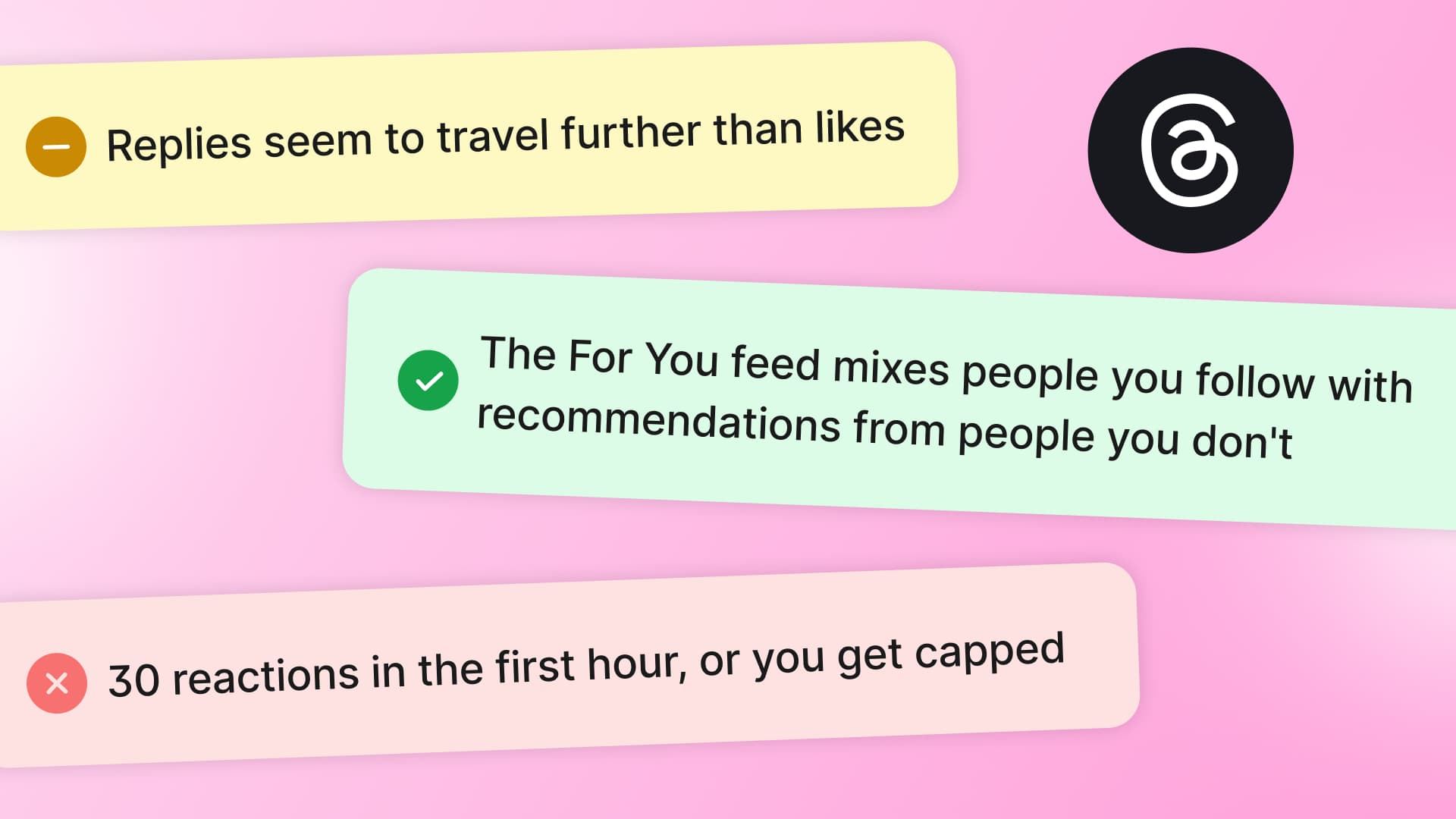
Table of contents
Summarize with AI

ChatGPT

Claude

Perplexity
Share

Vista Social

X (Twitter)


In March 2025, Newsweek saw its highest single day of social referral traffic in five years. The source was surprising. Threads, where Newsweek had about 160,000 followers, was sending more traffic than X, where it had 3.5 million.
Threads referrals had risen twentyfold since January. “Social as an audience driver is back,” Newsweek’s senior vice president of audience development, Jess Awtry, told Digiday.
On Threads, the recommendation feed can matter more than follower count. A post can reach people who have never followed the account. That makes performance volatile. One post reaches 11,000 people. A similar one reaches 340.
The missing explanation has attracted false precision: fixed signal rankings, minute-by-minute deadlines, and exact reply-to-like ratios. Meta has published examples of information its systems may use. It has not published a complete current formula, fixed weights, or a universal first-hour threshold.
This guide separates what Meta has confirmed from what marketers have observed and what the internet invented.
The short version
- Meta describes a personal recommendation system, not a fixed public formula. Its system card names sample inputs and predicted actions. It publishes no weights or guaranteed order.
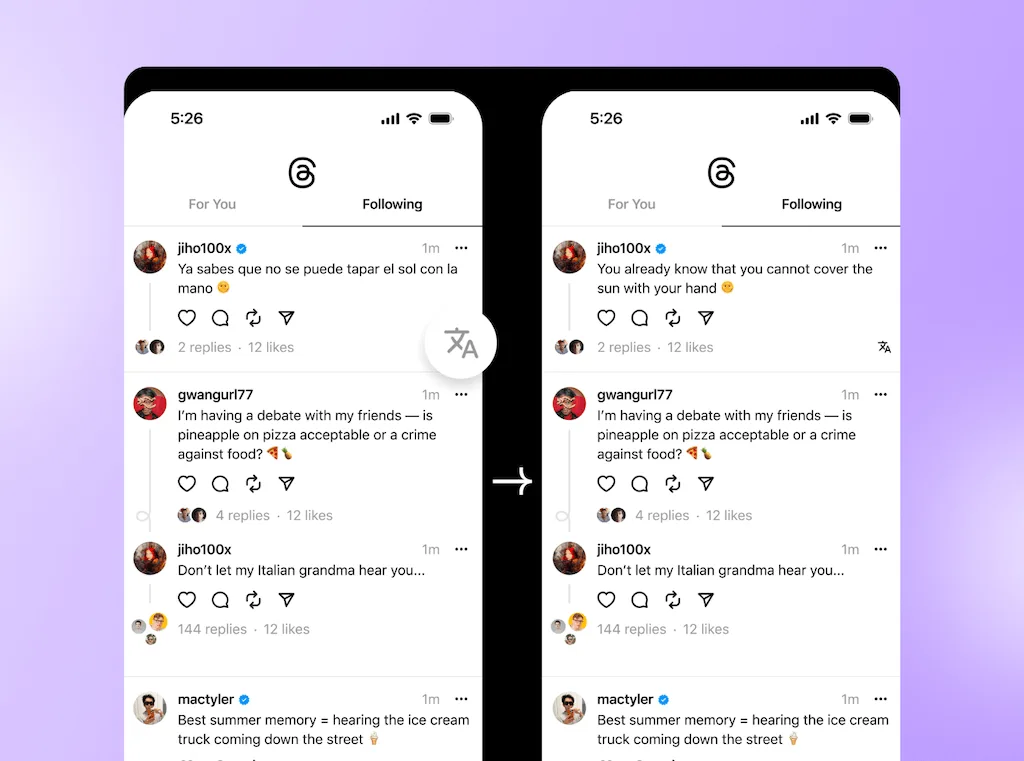
- The For You feed mixes followed accounts with recommendations. The Following feed shows only followed accounts in reverse chronological order.
- Exact timing and weighting claims remain unverified. No public Meta source supports “30 reactions in an hour.” The same applies to “replies count three times more than likes.”
- Marketers still have enough evidence to act. Publish ideas that can sustain a conversation. Make time for replies, then judge posts by views, replies, reposts, and business outcomes.
Table of contents
How does the Threads algorithm work?
The Threads algorithm is the group of AI systems that select and order posts in a person’s For You feed. Meta’s public documentation supports a simple three-part explanation.
- Build the candidate pool. For You can draw from followed accounts and recommend posts from accounts the viewer does not follow.
- Predict what each viewer may do. Meta’s Threads Feed AI system card names actions such as liking, replying, opening a profile, or scrolling past. Inputs can include existing interactions, viewer activity, prior profile visits, and posts already seen.
- Order the feed for that person. Each viewer receives a different result. The Following feed skips recommendation ranking and displays followed accounts in reverse chronological order.
The Following feed announcement confirms the two-feed structure.
| Meta confirms | Meta keeps private |
| For You combines followed accounts and recommendations | The weight assigned to each input |
| Predictions are made for individual viewers | A universal first-hour reach threshold |
| Following is reverse chronological | A permanent ranked list of “top signals” |
| People can tune topics in their feeds | The tests Meta is running at a given moment |
Platform rules also change. In June 2025, Instagram head Adam Mosseri said Meta had worked to rank links properly and that links had performed better for more than a month. Social Media Today reported the update, weakening the old claim that every external link suppresses reach.
Why your Threads views swing from 300 to 11,000
Large post-to-post swings are normal in a recommendation feed. Each post faces a different set of rivals at a different moment.
A follower-led model makes the variance look broken. Meta instead describes predictions made for each viewer.
A topic may fit one group and miss another. It may also face stronger competition or a reader’s request to see less of the subject.
Views answer a narrow question: how much display did this post receive? They do not explain why distribution changed.
Use three comparisons when a post jumps or drops:
- Compare the topic and point of view. Did the stronger post give a defined audience something specific to respond to?
- Compare the conversation. Did people reply, quote, or continue the discussion, and did the account take part?
- Compare the outcome. Did the post earn useful profile visits, site traffic, leads, or customer conversations?
Run the comparison across several weeks. One breakout post is a clue, not a law.
Which Threads ranking claims hold up?
Use three labels when someone presents a new Threads rule: confirmed, observed, or invented. Observed patterns make useful tests, not universal instructions.
| Claim | Status | What the evidence supports |
| For You mixes followed accounts with recommended posts | Confirmed | Meta describes this feed structure directly. |
| Following is reverse chronological | Confirmed | Meta announced a feed limited to followed accounts, ordered by recency. |
| Links are always suppressed | Outdated | Mosseri said in 2025 that Meta had improved link ranking. Results can still vary by post and audience. |
| More posts can increase total reach or referral traffic | Observed | Newsweek and Forbes posted more as referrals rose in early 2025. Other publishers saw no similar lift. |
| The first 30 or 60 minutes determine the final reach | Unverified | Early response is worth watching. Meta has not published a universal cutoff. |
| Replies count three times more than likes | Invented | No public Meta source supports this ratio. |
| Thirty reactions in the first hour unlock wider distribution | Invented | No source or platform documentation supports this threshold. |
| Six signals always rank in one fixed order | Invented | Meta describes multiple inputs and predictions, not a permanent public leaderboard. |
This framework keeps reporting honest. A team can report stronger reach alongside active replies without claiming it reverse-engineered Meta’s system.
Replies are a distribution surface
A useful reply puts the brand inside a conversation people are already reading. It can introduce the account to people beyond its followers without requiring another standalone post.
Vita Coco shows the wider value of replies. The brand commented on creator Romeo Bingham’s viral Dr Pepper jingle video. The reply received more than 63,000 likes and led Vita Coco to become the first brand to partner with Romeo in a paid capacity, according to Little Black Book.

The resulting 2026 campaign helped Vita Coco add 130,000 TikTok followers in one month and generated more than 245 million cumulative impressions, Marketing Brew reported, citing the company.
The example happened on TikTok. It shows how a reply can become media inventory, market research, and relationship building at the same time.
Give the work a boundary. Two reply windows per day are enough for many small teams:
- Spend the first window on responses to your own posts.
- Use the second for relevant conversations started by customers, peers, and creators.
- Escalate questions that need legal, support, or product input, then stop unless a live issue requires attention.
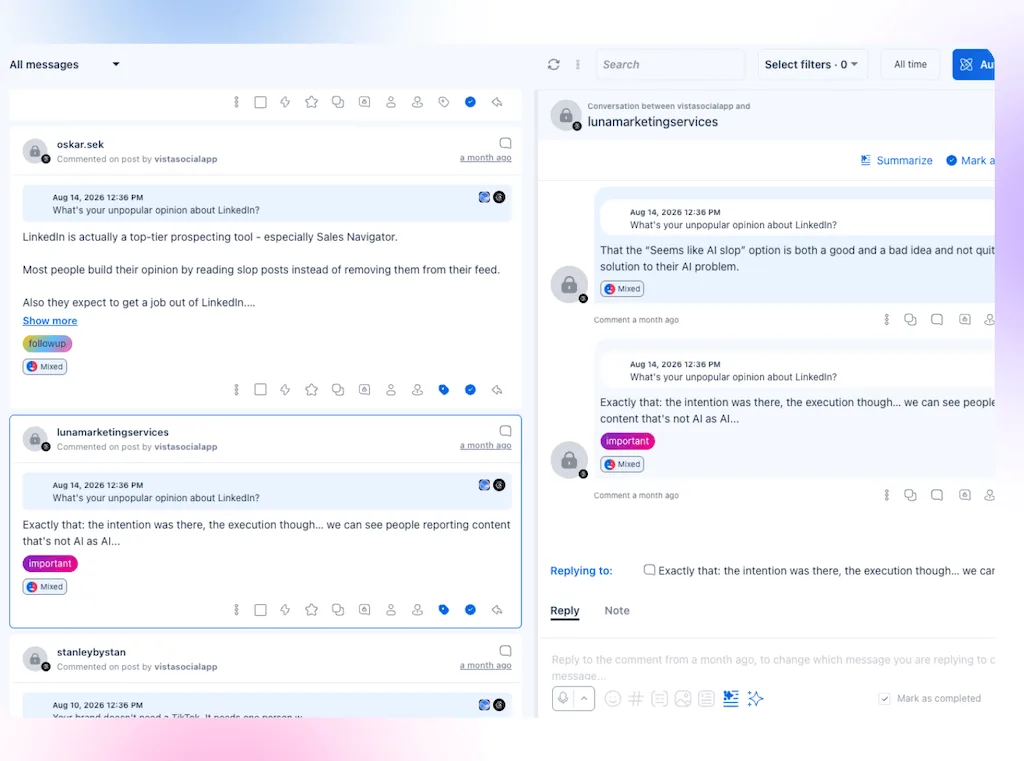
Vista Social can bring supported Threads activity into the same unified inbox used for other networks. That includes mentions, comments, and replies. The routine becomes easier to staff without promising a ranking advantage.
What changed on Threads in 2026?
Threads passed 500 million monthly active users in June 2026, according to Meta. The milestone arrived with more direct feed controls.
| 2026 update | What changed? | What an SMM should do |
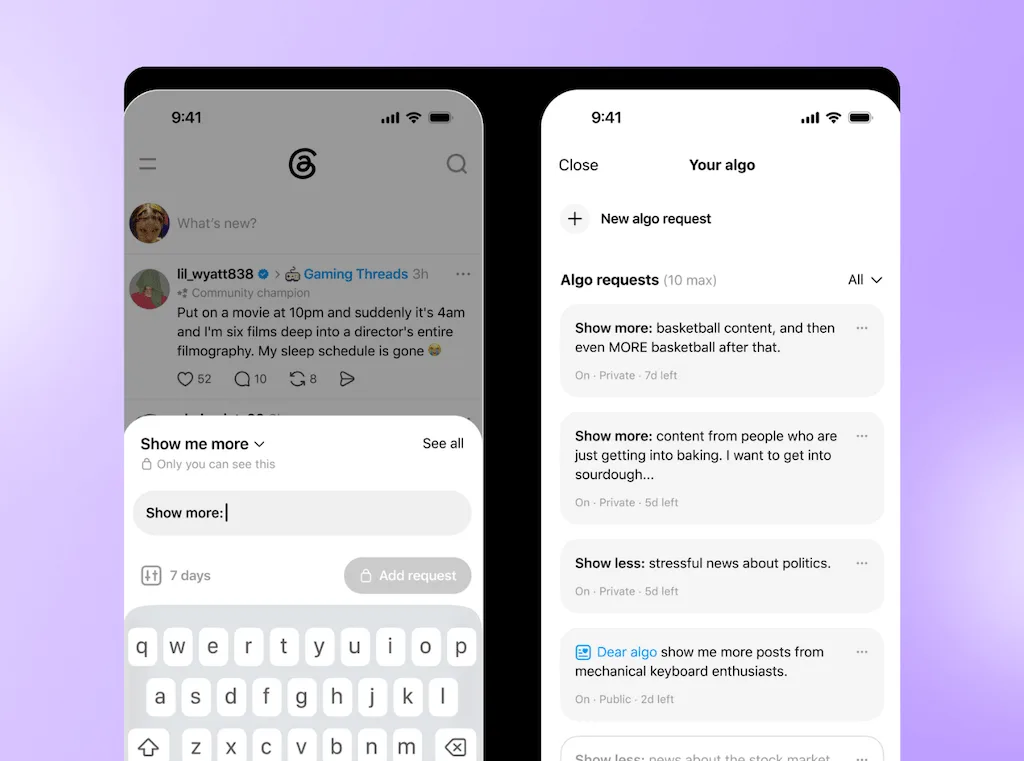
| Dear Algo | A public post requesting more or less of a topic adjusted the feed for a fixed three-day period. | Watch the language people use to describe topics, then make your post specific enough to match a real interest. |
| Your Algo | A private setting let the user choose whether a topic adjustment lasted one, three, or seven days. | Treat sudden reach shifts as a reason to test, not proof that the account was penalized. Marketers cannot see these private choices. |
| Communities | Meta moved Communities out of beta and said community activity was driving growth. | Map recurring content themes to the communities your audience already joins instead of posting broad category commentary. |
| 500 million monthly users | Threads became a scaled network rather than an early experiment. | Give the channel a stated job, owner, reply routine, and review date. |
At launch, Your Algo was rolling out in the United States, Canada, the United Kingdom, Australia, and New Zealand. Recheck regional availability before using it in a client recommendation.
A clear point of view matters more when people can actively request or filter a topic. Generic category posts give them little reason to keep choosing the account.
What should marketers do about the Threads algorithm?
Build an operating rhythm from your own account data instead of secret weights.
Run this 30-minute Threads audit
| Time | Do this | Finish with |
| 0 to 5 minutes | Export or collect your latest 30 Threads posts. Include every post if the account has fewer than 30. | Date, topic, format, views, replies, reposts, and the business outcome available to you. |
| 5 to 10 minutes | Add three manual columns: the post’s conversational job, whether the account joined the replies, and its intended outcome. | Context the raw metrics cannot supply. |
| 10 to 20 minutes | Group similar topics and formats. Compare medians instead of letting one viral post set the average. | Two or three patterns worth testing. |
| 20 to 25 minutes | Write each pattern as an observation, then add a separate hypothesis. | “Posts about X had higher median views” stays separate from “Threads prefers X.” |
| 25 to 30 minutes | Choose one variable for the next two weeks and schedule two daily reply windows. | A dated test with an owner and review point. |
If your tool can export the post data, an AI assistant can speed up the grouping. Give it the data and strict rules so it analyzes the account rather than inventing platform logic.
Give each post a conversational job
Choose one job before writing:
- Ask for a specific experience from a defined group.
- Invite a choice and ask people to explain it.
- Challenge an assumption with evidence the brand can defend.
- Explain a timely change and ask how it affects the reader.
- Share a useful example that gives others something to add.
A focused prompt gives the right person a way into the conversation. Outrage bait and empty one-word questions create activity the team cannot learn from.
Match cadence to team capacity
Forbes more than doubled its Threads cadence between December 2024 and March 2025, reaching at least one post an hour. Its referral traffic from Threads rose 711% year to date during that period, according to Digiday.
That newsroom had a large supply of distinct stories. Threads still represented under 1% of aggregate publisher referral traffic in Chartbeat data, and several publishers saw no major lift.
Increase cadence only when the team has enough ideas and reply capacity. Add one recurring slot for two weeks, compare the medians, and remove it if per-post quality or response coverage falls.
Score reach and value separately
Follower growth remains useful, but it is a lagging account-level measure. It cannot explain one post’s distribution.
| Question | Metric | Decision |
| Did Threads distribute the post? | Views | Compare the median across similar topics and formats. |
| Did the idea start a conversation? | Replies and quotes | Review the substance, not only the count. |
| Did people carry it further? | Reposts | Identify ideas people wanted attached to their own identity. |
| Did the audience move closer to the business? | Profile visits, link traffic, leads, or assisted conversions | Keep the outcome appropriate to the post’s purpose. |
Test one variable at a time
Change the publishing window, topic angle, format, or question style. Keep the other choices stable long enough to read the result. Vista Social’s guide to the best time to post on Threads can structure a timing test, while your account data decides the schedule.
Write down what would change your mind. Revisit “replies help this account” after four weeks of flat results. Vista Social’s guides to building a Threads community and growing Threads followers cover the wider channel strategy.
When Threads is the wrong channel
Threads passed 500 million monthly users, but scale alone does not prove audience fit.Keep the account small or pause it when:
- Customers and industry peers are absent from the conversations you monitor.
- The team cannot respond to questions or route sensitive issues.
- Every post is copied from another network without a Threads-specific reason to exist.
- Compliance rules make timely public conversation impractical.
- The channel produces no useful audience, traffic, research, or relationship signal after a defined test period.
Two useful posts with real follow-through are better than five daily posts left unattended. A dormant profile is also more honest than a busy one with no purpose.
How Vista Social supports a Threads workflow
Vista Social handles the measurable work around Threads without claiming to predict Meta’s ranking.
- Publish from one calendar. Current support covers text, image, video, and mixed-media carousels. A carousel can hold up to 10 items on Professional plans and above.
- Keep up with conversations. Supported mentions, comments, and replies can be handled in the unified inbox alongside other networks.
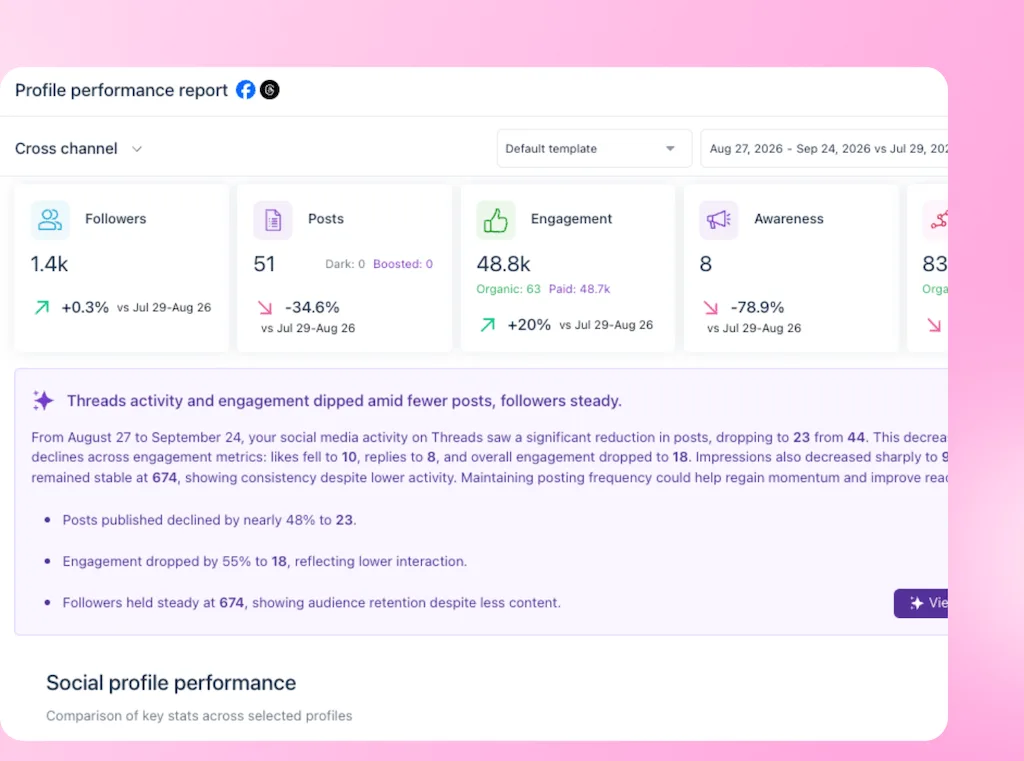
- Report the evidence. Threads reporting includes followers, likes, replies, reposts, and views.
- Control sensitive posts. Current options include reply controls. Country targeting is available on Advanced plans and above.
These capabilities are documented in Vista Social’s Threads publishing guide and organic targeting guide. Sentiment analysis is an Enterprise feature.
Build a Threads strategy on evidence you can defend
Newsweek’s smaller Threads following sent more traffic than its much larger X following in March 2025. The result captures the opportunity and the limit of the platform: recommendation can create reach beyond follower count, but no publisher owns that reach.
Your next move is practical. Pull the latest 30 posts, label what you can observe, choose one variable to test, and put the review date on the calendar. Give replies an owner before adding more posts.
Keep Meta’s statements, your account data, and your hypotheses in separate columns. That discipline will improve the strategy even when the system changes again.
If you want one calendar, inbox, and report for that workflow, try Vista Social free for 14 days.
Frequently asked questions
Does Threads have an algorithm?
Yes. Meta uses machine-learning systems to rank the For You feed, which mixes posts from followed accounts with recommendations. The Following feed contains only followed accounts and displays them in reverse chronological order.
What are the Threads ranking signals?
Meta names examples such as prior interactions, post engagement, and profile activity. It also predicts actions such as liking, replying, opening a profile, or scrolling past. Meta does not publish a full current list, fixed weights, or a universal order.
Does the first hour after posting matter on Threads?
No public Meta source establishes a 30-minute or 60-minute cutoff. Be available for replies after publishing, but treat the first hour as a staffing choice rather than an algorithmic cliff.
Do links hurt reach on Threads?
Meta acknowledged improving link ranking in 2025. Links may still perform differently by account, topic, and audience, but “links are always suppressed” is outdated as a universal rule. Measure link posts against comparable posts from your own account.
How many times a day should a brand post on Threads?
There is no confirmed ideal frequency. Start with a pace your team can support with distinct ideas and replies. Increase one recurring slot at a time and compare per-post and total outcomes.
Does Instagram activity affect Threads reach?
Meta’s system-card examples have included some Instagram-related information, which is possible because the products share account and recommendation infrastructure. That does not prove that Instagram engagement boosts a Threads post. Treat cross-platform effects as account-level observations, not a guaranteed growth tactic.
Try Vista Social for free
A social media management platform that actually helps you grow with easy-to-use content planning, scheduling, engagement and analytics tools.
Get Started NowAbout the Author

Content Writer
Orion loves to write content that refuses to be boring. As part of Vista Social, he helps brands, creators, and agencies stop doom scrolling and start winning with social media. When he's not in front of a keyboard, he's watching films in IMAX with his wife, dissecting football tactics (the European kind), and getting lost in a good book.
Loading related tools...

The most complete social media management platform for teams who demand more.






Tools
PublishingAnalyticsEngagementIntegrations
FacebookInstagramLinkedInRedditSnapchatThreadsTikTokX (Twitter)YouTubeMCPVista Page (link-in-bio)All IntegrationsCopyright © 2026 Vista Social LLC. All Rights Reserved.