

Published on September 12, 2026
10 min to read
Buffer vs. Later vs. Vista Social: Which Social Media Tool Should You Choose in 2026?

Summarize with AI

Table of contents
Summarize with AI

ChatGPT

Claude

Perplexity
Share

Vista Social

X (Twitter)


Updated September 12, 2026
Type “buffer vs later” into Google, and you’ll land on plenty of pages that only cover half the story. Buffer prices by the channel. Later prices by the social set.
Vista Social skips both models. It bundles users and profiles into one flat number instead. That difference shapes almost everything else in this comparison.
Each platform also targets a different kind of user. Buffer built its name on simplicity, while Later built its name on visual Instagram planning. Vista Social, however, built its name on feature depth for growing teams.
In this article:
- Best for simplicity: Buffer’s per-channel pricing and generous free plan make it the easiest entry point for a solo creator
- Best for visual planning: Later’s grid preview and Instagram-first tools are still unmatched for creators who live and die by feed aesthetics
- Best overall depth: Vista Social bundles a unified inbox, DM automations, listening, and white-label reporting into flat tiers instead of selling them separately
- Most important buying check: Price out your actual channel count and team size on all three, since none of them win at every scale
Table of contents
Buffer vs Later vs Vista Social: quick verdict
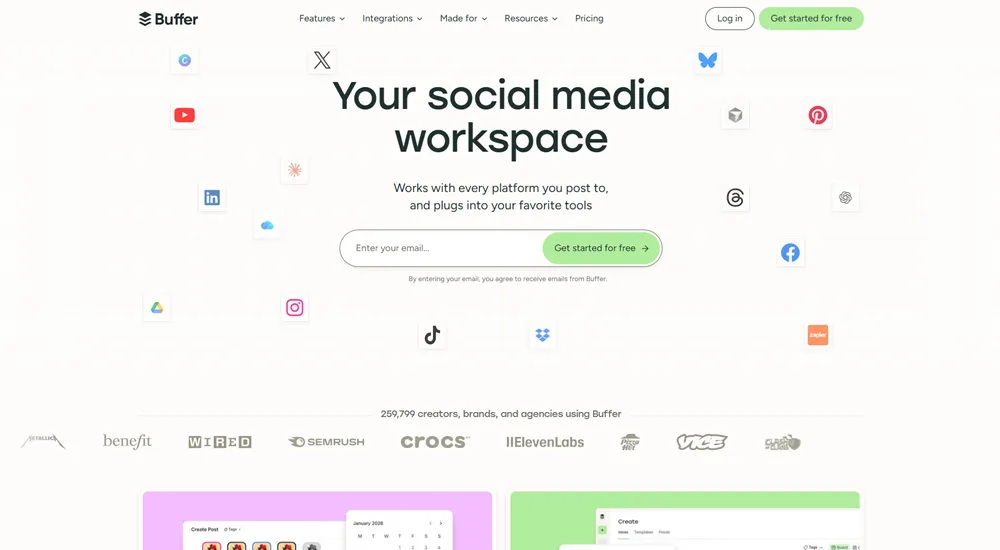
Buffer charges per connected channel, so the bill scales with every account you add. It fits a solo creator or small team that wants simple scheduling without a steep learning curve.

Later, meanwhile, bundles profiles into social sets of eight platforms each. It fits a visual brand or Instagram-first creator who values grid planning over deep engagement tools.
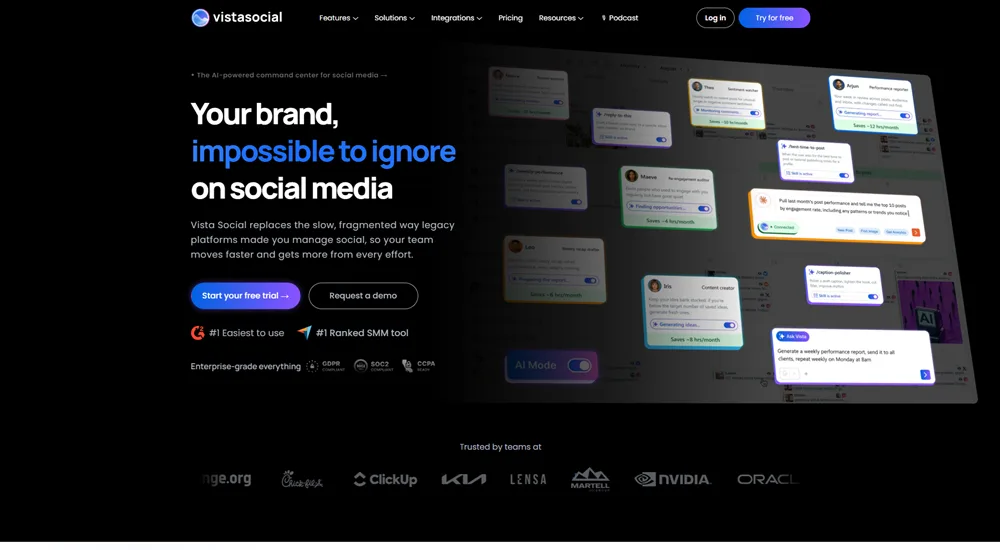
Vista Social takes a third approach. It bundles both users and profiles into flat tiers instead of billing per channel or per set. That fits agencies and growing teams that want an inbox, DM automations, and listening built in from day one.
| Tool | Best fit | Main advantage | Main tradeoff |
|---|---|---|---|
| Buffer | Solo creators and small teams | Simple per-channel pricing, generous free plan | No DM automations, listening, or review management |
| Later | Visual-first Instagram creators | Strong grid planning and visual calendar | No X support, listening limited to Instagram only |
| Vista Social | Agencies and growing teams | Inbox, DM automations, and listening bundled into flat tiers | Costs more than either rival for a very small, single-channel setup |
Buffer vs Later vs Vista Social: pricing comparison
Buffer vs Later vs Vista Social pricing comes down to three different units of measurement. Buffer bills per channel, and Later bills per social set. Vista Social, meanwhile, bills per flat tier that bundles both users and profiles.
| Platform | Entry plan | Mid plan | Top published plan | Trial |
|---|---|---|---|---|
| Buffer | Free: 3 channels, 1 user | Essentials: $6/channel/month, 1 user | Team: $12/channel/month, unlimited users | 14 days on paid plans, no card for Free |
| Later | Starter: $25/month, 1 social set, 1 user | Growth: $50/month, 2 social sets, 2 users | Scale: $110/month, 6 social sets, 4 users | 14 days, card required |
| Vista Social | Professional: $79/month, 2 users, 15 profiles | Advanced: $149/month, 4 users, 30 profiles | Scale: $349/month, 8 users, 70 profiles | 14 days, no card |
Prices and plan limits were checked directly on each platform’s pricing page in September 2026. Later’s social sets each bundle one profile from 8 networks. Extra sets cost $15 a month, and extra users cost $5 a month on Later’s paid plans.
Buffer pricing in 2026
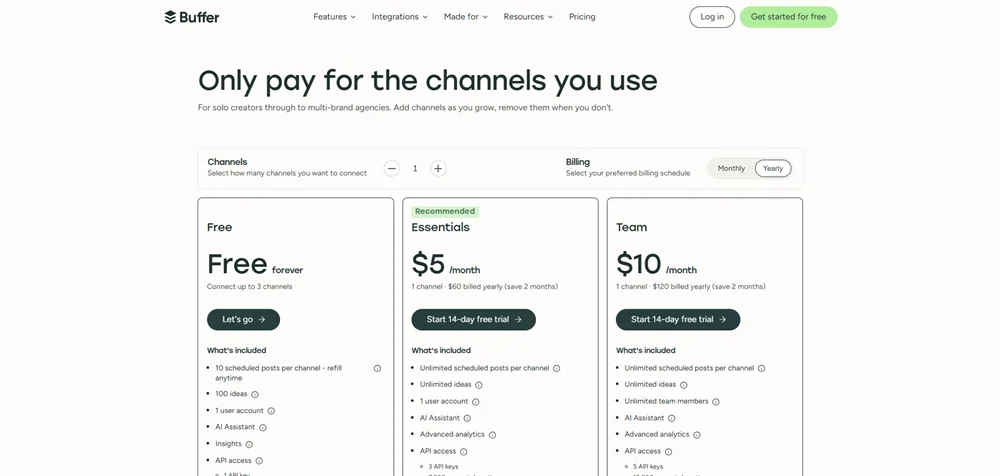
Buffer’s per-channel model charges the same rate no matter how many people touch the account, and Team plans include unlimited users at no extra cost. Channels 1 through 10 bill at the standard rate, and every channel after that costs less.
Later pricing in 2026
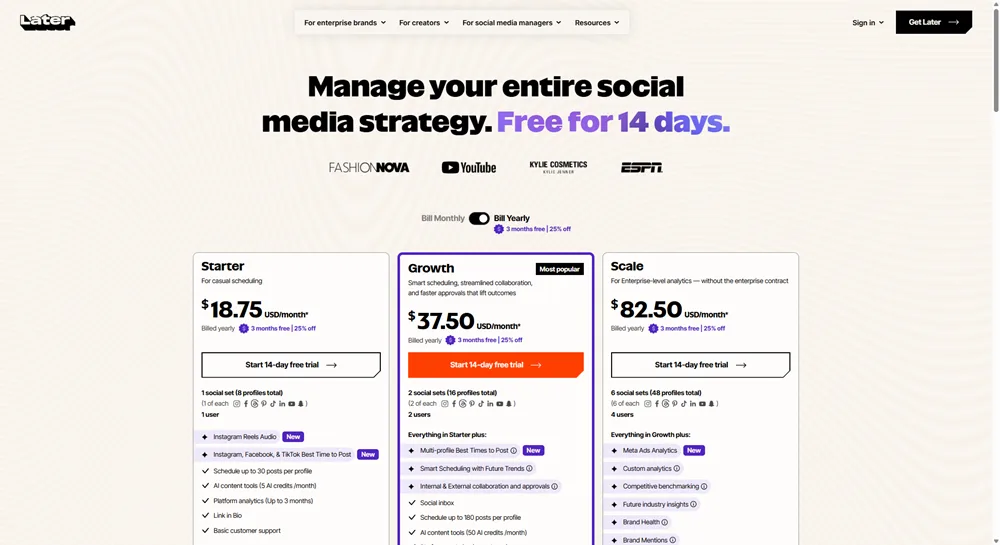
Later’s social sets bundle profiles, not individual channels, so a single brand often needs just one set. A multi-brand team, though, burns through sets fast, since each set covers only 8 profiles total.
Vista Social pricing in 2026
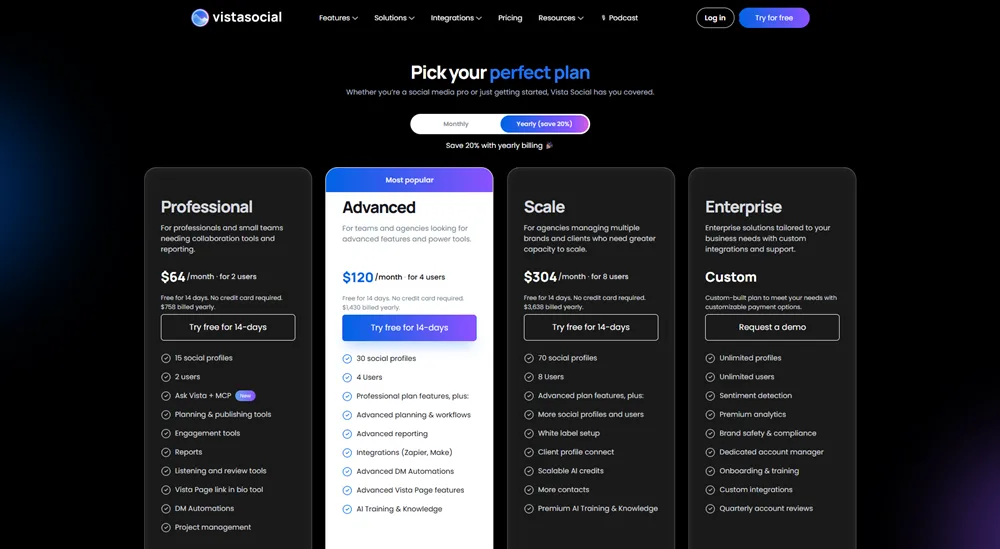
Vista Social bundles a set number of profiles and users into each tier. Professional covers 15 profiles and 2 users for $79 a month. Advanced and Scale scale both numbers up together as a team grows.
What does each tool actually cost as your team grows?
A solo creator managing 5 channels sits comfortably on each platform’s entry tier. A larger team changes the math in different ways for each one.
| Scenario | Buffer | Later | Vista Social |
|---|---|---|---|
| Solo creator, 5 channels | $30/month (Essentials) | $25/month (Starter) | $79/month (Professional) |
| 4-person team, 10 channels | $120/month (Team) | $60/month (Growth + 2 extra users) | $149/month (Advanced) |
Buffer’s bill grows by exactly $12 every time that team connects an 11th channel. Later’s bill jumps by $15 for a new set or $5 for a new user the moment the team outgrows its current tier. Vista Social’s price, by contrast, holds steady until the team needs more than 30 profiles or 4 users, at which point it steps up to the next tier rather than charging per addition.
Publishing and scheduling
Scheduling is the job every one of these tools does well. The differences show up in the details around bulk work and team workflows.
Post limits and bulk scheduling
Buffer allows unlimited scheduled posts on paid plans, plus bulk CSV upload for up to 100 posts at once. Its queue system reorders posts with a simple drag and drop.
Later caps posts per profile by tier: 30 a month on Starter, 180 on Growth, and unlimited on Scale. Vista Social supports unlimited scheduling on every paid tier, with a media library that keeps assets organized across every connected profile.
Content calendar and collaboration
Buffer’s visual calendar shows the queue across channels, with a board view for organizing ideas before they’re scheduled. Later’s calendar goes further for visual planning, with a drag-and-drop grid preview built specifically for Instagram feeds.
Vista Social’s calendar adds custom fields and post comment collaboration. A team can leave feedback directly on a scheduled post instead of switching to Slack or email.
Approval workflows
Approval workflows route a post through review before it publishes, so a manager or client can catch a mistake before it goes live. Buffer only includes this on its Team plan, and Later only includes it from Growth up.
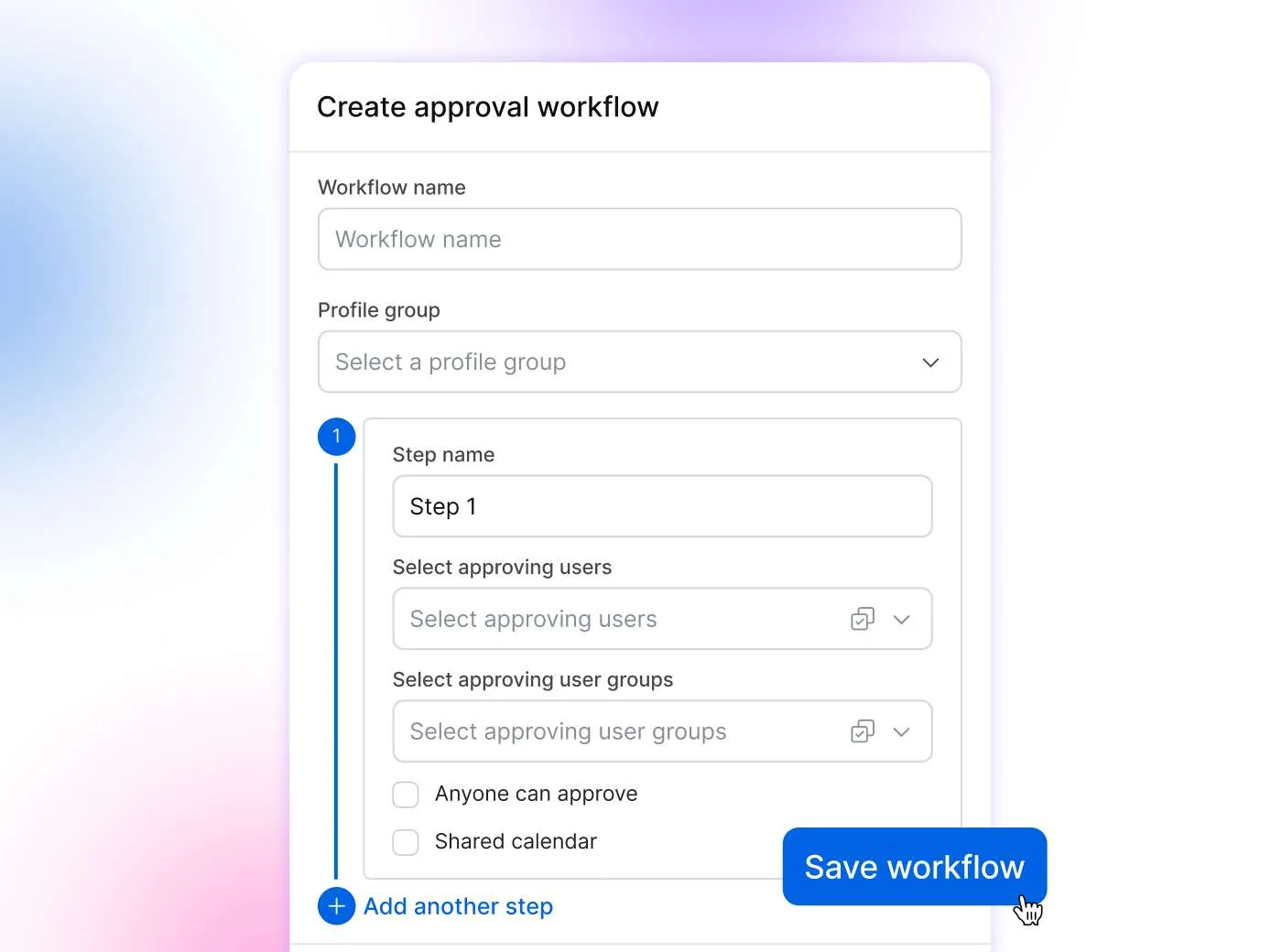
Vista Social splits its workflow into two levels instead. Single-stage approval covers a quick one-person sign-off, and multi-stage approval adds a deeper internal and client review layer.
Analytics and reporting
Posting only gets a team halfway there. Knowing what actually worked matters just as much as getting content out the door.
Built-in analytics
Buffer’s Insights cover follower growth, engagement, and post performance, with a 30-day history on Free and unlimited history on paid plans. Later’s analytics deepen by tier too, running from 3 months of history on Starter up to 2 years on Scale.
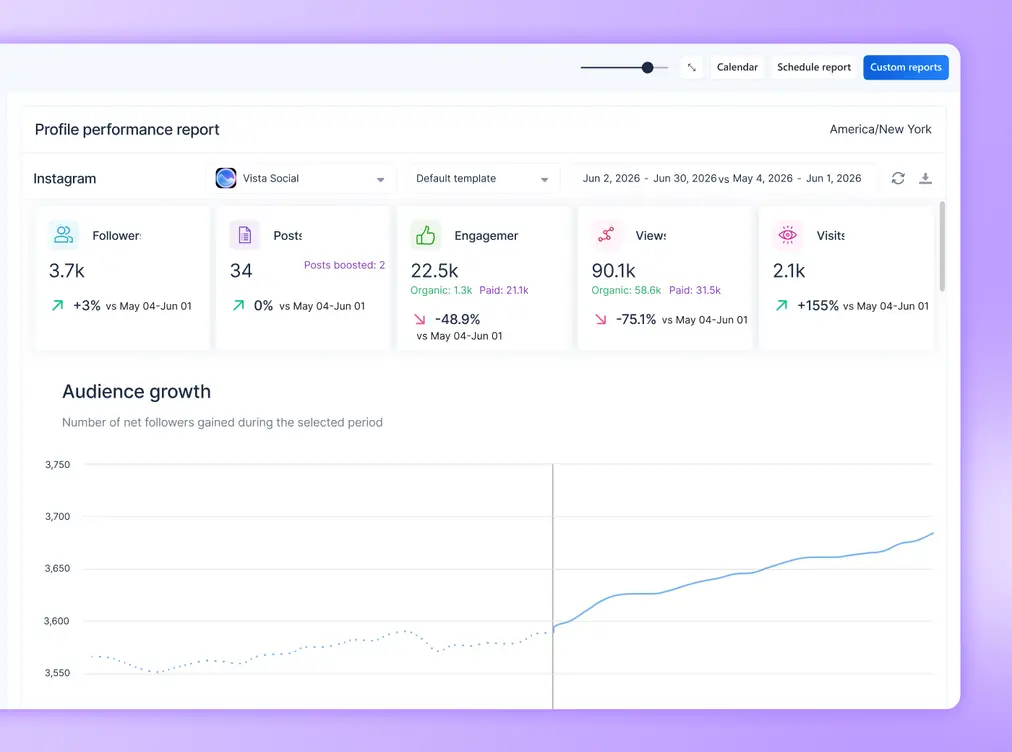
Vista Social includes a full analytics suite on every tier. It covers social performance and post-level breakdowns in one place, with custom and competitor reports on Advanced and up.
Custom reports and white labeling
Buffer’s Team plan adds branded reports, which place a logo and cover page on an exported report but don’t rebrand the platform itself. Later doesn’t offer a comparable branded reporting option on any tier.
Vista Social, however, includes full white-label reports and a rebranded dashboard on its Scale tier at no extra charge. That replaces Vista Social’s own branding entirely with an agency’s logo and colors.
Engagement and social inbox
Publishing content is only half the job. Someone still has to answer every comment and message that comes back afterward.
Comment management and inbox
Buffer’s Community inbox covers comments only, across nearly every connected network, but it doesn’t handle direct messages at all. Later’s Social Inbox, available from Growth up, goes further for Instagram and Facebook specifically, covering both DMs and comments, though TikTok stays comment-only.
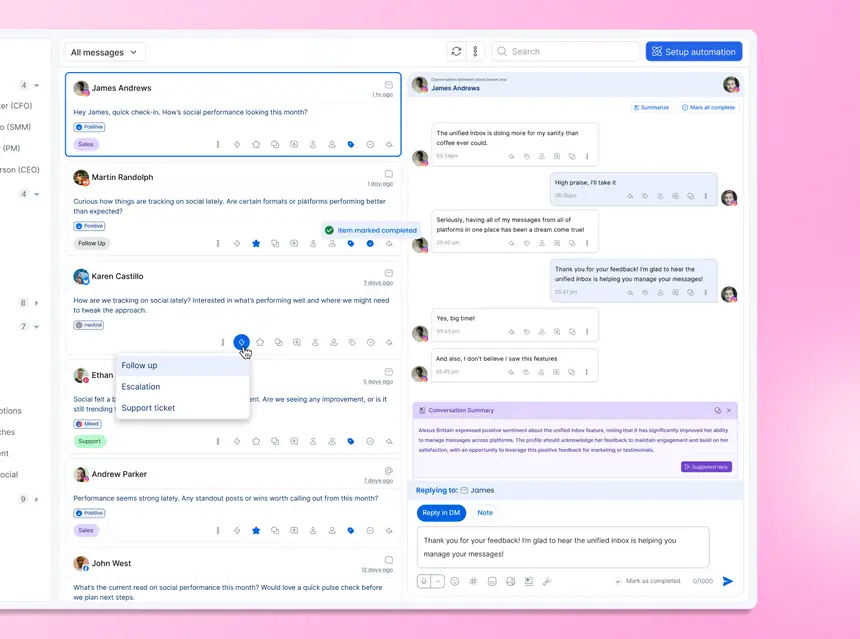
Vista Social includes a unified inbox on every tier, covering DMs and comments together. It’s paired with internal notes, so a team can hand off a conversation without leaving the platform.
DM automations
This is one of the widest gaps in the entire comparison. Neither Buffer nor Later offers any form of automated DM handling, on any plan.
Vista Social includes DM automations on every paid tier. A team can set up automatic replies that route leads and answer FAQs based on keywords across Facebook, Instagram, and TikTok.
AI tools
Every platform in this comparison leans on AI now. However, the depth and the limits vary a lot once you look past the marketing page.
AI content generation
Buffer’s AI Assistant runs unlimited on every plan, including Free, and handles captions, ideas, and repurposing. It’s a genuinely strong offering for a tool built around simplicity.
Later meters its AI instead, with just 5 credits a month on Starter and up to 100 on Scale. Ask Vista goes further than either: it’s a conversational AI command center with access to more than 50 tools spanning publishing, analytics, the inbox, and reporting.
AI depth and usage limits
Buffer’s AI stays inside the content-creation flow, with no option to train it on brand-specific facts. Later’s credit system, similarly, caps usage rather than deepening what the AI actually knows about a brand.
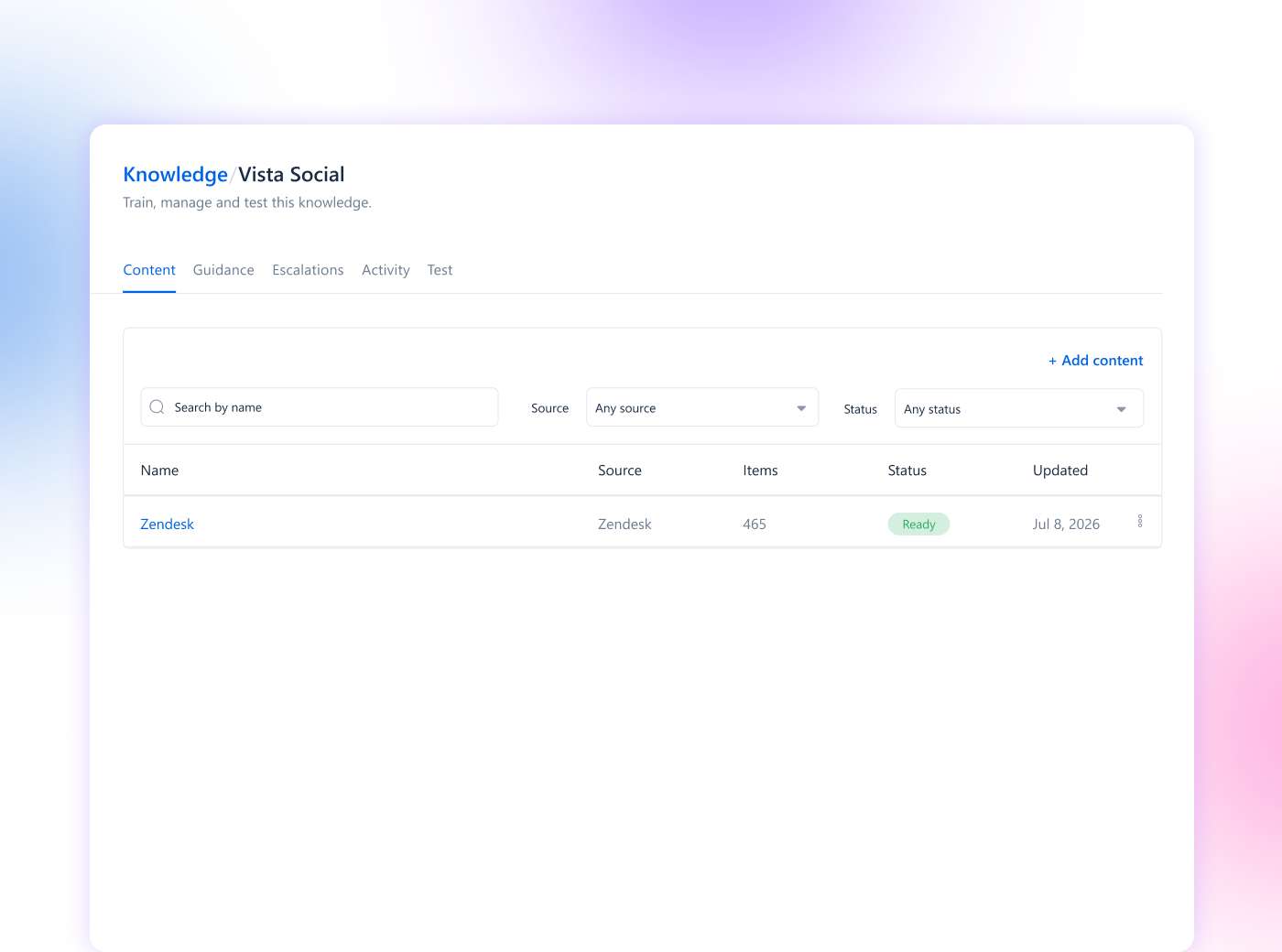
Vista Social’s AI Training and Knowledge, on Advanced and up, lets a team feed the AI real brand facts and past content. Replies and drafts stay accurate and on-brand automatically instead of sounding generic.
Additional features
A few extra features separate these tools further. That matters especially for anyone managing more than a single brand.
| Feature | Buffer | Later | Vista Social |
|---|---|---|---|
| Review management | Not offered | Not offered | Yes, expands by tier |
| Link in bio | Yes, all plans | Yes, all plans | Yes, all paid plans |
| Employee advocacy | Not offered | Not offered | Included |
Review management
Neither Buffer nor Later builds review management into any plan. Vista Social’s review management covers Facebook and Google Business Profile out of the box, extending to Yelp, TripAdvisor, OpenTable, Trustpilot, App Store, and Google Play for brands that need wider coverage.
Link in bio
All three platforms include a link-in-bio tool. Buffer’s Start Page and Later’s Linkin.bio both cover the basics well, with Later’s version adding shoppable feed links and multi-item banners.
Vista Page, Vista Social’s version, adds custom domains and payment or calendar integrations. That’s on top of the standard link-in-bio setup most tools offer.
Employee advocacy
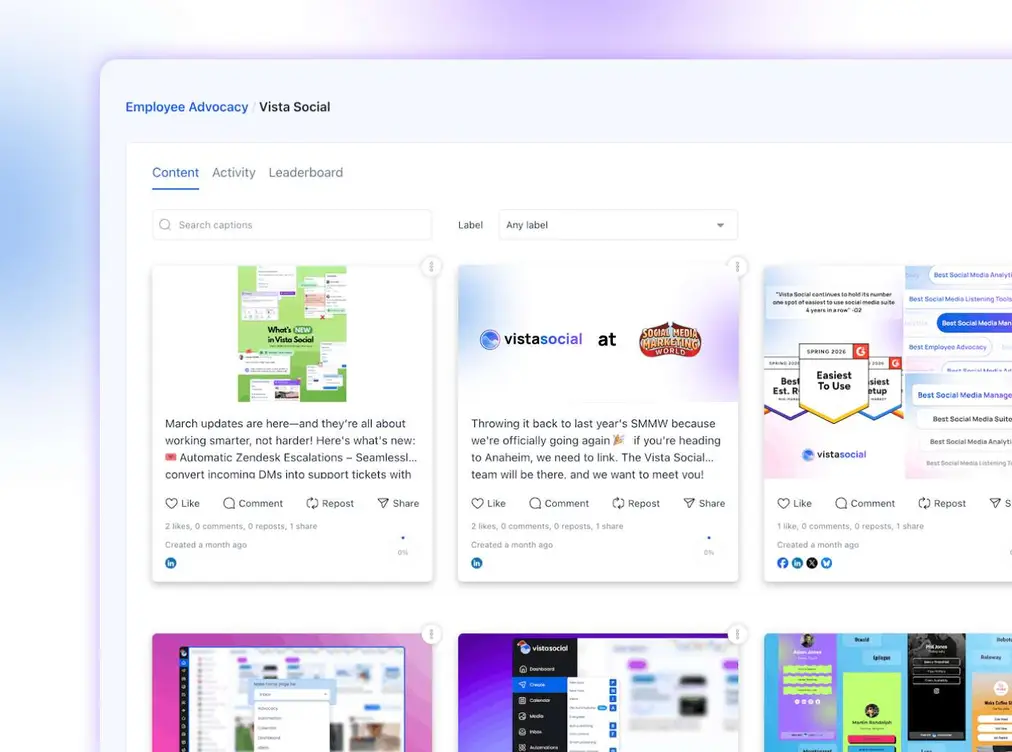
Neither Buffer nor Later offers a dedicated employee advocacy feature on any plan. Vista Social includes it as an add-on across every tier, free to try with a small number of advocates and priced publicly once a team wants to scale it up.
Who should choose Buffer?
Buffer fits a solo creator or small team that wants simple scheduling without a steep learning curve. Its free plan is genuinely usable, and the AI Assistant runs unlimited even without paying anything.
Agencies managing a large portfolio of client accounts also do well on Buffer, since the per-channel model charges the same whether those channels belong to one brand or fifteen. The tradeoff shows up once a team wants more than scheduling and comment replies.
Buffer also stands out for teams already living inside other tools. Its integrations cover Zapier, Make, n8n, and a hosted MCP server that lets Claude, ChatGPT, or Cursor manage a queue directly. AI replies that learn a brand’s voice add another layer most simple schedulers skip entirely.
Best for: Solo creators and small teams that want affordable, straightforward scheduling and don’t need an inbox or listening tools.
Who should choose Later?
Later fits a visual brand or Instagram-first creator who cares more about grid aesthetics than deep engagement tools. Its drag-and-drop planner is still the strongest in this comparison for that specific use case.
Later also makes sense for a team that doesn’t post to X, since that gap won’t matter if the strategy never touched the platform in the first place. Teams that need broader listening or a deeper inbox, though, will hit Later’s ceiling fast.
Later’s content discovery tools are also a real advantage for visual brands. Search and collect features pull user-generated content by hashtag, profile, or mention, and built-in media editing handles crops, filters, and Reels audio without leaving the app. Platform-specific best-time-to-post AI and Meta Ads Analytics on Scale round out a toolkit built specifically for Instagram-first marketing.
Best for: Instagram-focused creators and visual brands that don’t need X support or broad social listening.
Frequently asked questions
Buffer vs Later vs Vista Social: what does each one cost?
Buffer charges $6 to $12 per channel per month, plus a free plan for up to 3 channels. Later charges $25 to $110 a month across three tiers, based on social sets rather than individual channels. Vista Social charges a flat $79 to $349 a month per tier, bundling both users and profiles instead of charging per channel or per set.
Which tool is best for solo creators vs teams vs agencies?
Buffer fits a solo creator best, thanks to its free plan and simple per-channel pricing. Later fits a visual, Instagram-first creator or small brand. Vista Social fits agencies and growing teams that need an inbox, DM automations, and review management bundled into one price.
Does Later still support X (Twitter)?
No. Later dropped X support in 2025, and it isn’t included on any current plan. Both Buffer and Vista Social still support X.
Which tool has a social inbox and DM automations?
All three include some form of engagement tool. Buffer’s Community inbox covers comments only, with no DM handling.
Later’s Social Inbox, from Growth up, covers DMs and comments for Instagram and Facebook. Only Vista Social includes DM automations, letting a team set up automatic replies on every paid tier.
Which tool includes social listening?
Buffer doesn’t offer social listening on any plan. Later limits it to Instagram only, on its Scale tier, tracking up to 30 keywords over a 7-day window. Vista Social includes listening for a brand’s own profiles free on every plan, with a paid add-on for broader web and news listening.
Try Vista Social for free
A social media management platform that actually helps you grow with easy-to-use content planning, scheduling, engagement and analytics tools.
Get Started NowAbout the Author

Content Writer
Russell Tan is a content marketing specialist with over 7 years of experience creating content across gaming, healthcare, outdoor hospitality, and travel—because sticking to just one industry would’ve been boring. Outside of her current role as marketing specialist for Vista Social, Russell is busy plotting epic action-fantasy worlds, chasing adrenaline rushes (skydiving is next, maybe?), or racking up way too many hours in her favorite games.
Loading related tools...

The most complete social media management platform for teams who demand more.






Tools
PublishingAnalyticsEngagementIntegrations
FacebookInstagramLinkedInRedditSnapchatThreadsTikTokX (Twitter)YouTubeMCPVista Page (link-in-bio)All IntegrationsCopyright © 2026 Vista Social LLC. All Rights Reserved.
Social listening
Social listening splits these three platforms more than anything else in this comparison. Buffer has no social listening feature at all, on any plan.
Later’s Brand Mentions tool lives on Scale only, and it’s limited to Instagram, tracking up to 30 keywords over a rolling 7-day window. That’s useful for a narrow use case, but it’s a long way from broad listening.
Vista Social, by contrast, tracks a brand’s own connected profiles for mentions and sentiment by default, on every tier. Extending that social listening across the wider social web, news, and blogs is available as an add-on for brands that want to follow industry conversations too.