

Published on August 17, 2026
10 min to read
Social Media Management API: Cost, Access, and Limits

Summarize with AI

Table of contents
Summarize with AI

ChatGPT

Claude

Perplexity
Share

Vista Social

X (Twitter)


Your team has approved a post inside its own content system. The caption, asset, review notes, and final sign-off are ready. Because the social work is done, the post should reach the right network without another round of copying and pasting.
That handoff can be handled by an API, short for application programming interface. An API is a connection that lets two pieces of software exchange information or trigger an action. In this example, the company’s content system could tell Vista Social to schedule the approved post.
The technical team may then discover that API access has its own buying process. Vista Social’s social media management API is a paid add-on, and an account representative turns on access. The API docs are public, while the account team shares the price and terms directly.
Approved content can then move from the system your team already uses to the right social profiles. The API matters because publishing depends on it, even when access is sold separately.
The short version
- Dashboard pricing came first: Social platforms were packaged around the dashboard, seats, and profiles. API access came later, so vendors often handle it as a separate purchase.
- Vista follows that model: API access is a paid add-on, while an account rep handles pricing and setup.
- Test access matters: If the API is essential to your workflow, confirm the price and terms before your team commits. Ask for limits and test access in the same conversation.
- Start with the easiest route: An SMM should begin with Ask Vista. Use MCP when you work through ChatGPT or Claude, while the API fits software that needs a fixed connection.
Table of contents
What does social media API access cost?
You may hear a technical buyer say that a social platform is part of the company’s infrastructure. In plain English, another business system now depends on it to publish content or return data. If the connection stops working, part of the company’s normal process stops too.
That level of dependence changes what the company is buying. The price covers the connection, while the vendor keeps it available and secure. The vendor also manages the automated traffic sent through it.
You still may not get one public number because a vendor can package access in several ways. It can bundle the API into a plan, sell it as an add-on, or quote it through a custom agreement. Confirm the model before development begins.
| Packaging model | What the buyer can see early | What needs confirming |
|---|---|---|
| Bundled access | API appears in the public plan or feature list | Available actions, usage limits, and whether testing is included |
| Paid add-on | Core platform price may be public | Add-on price, minimum contract, included usage, and how long setup takes |
| Higher-tier access | The required subscription is visible | Whether that plan includes the security and support the build needs |
| Custom agreement | The vendor can shape support around the use case | The full quote, renewal terms, allowed usage, and what changes the price |
Vista Social sits in the paid-add-on row. Our pricing page lists dashboard plans and several integrations, while an account rep handles API pricing and access setup.
Private API pricing can reflect the work behind the connection. The vendor has to control access and protect the service from high automated use. One piece of software can send far more requests than a team working through the dashboard by hand.
If the API will decide whether the product fits, ask for its price early. Request test access while you evaluate the calendar and reports. That gives your technical team time to confirm every required action before the buying decision is final.
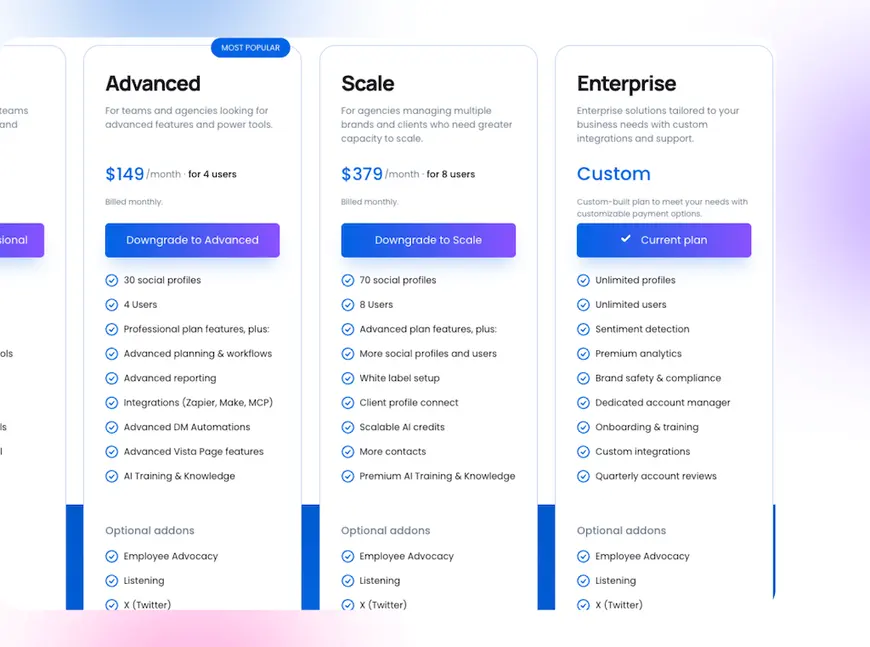
Compare the API price and minimum commitment with the main subscription. A low dashboard price doesn’t tell you much when your company’s workflow depends on a separately priced connection.
What can a social media management API do?
A social media management API can only perform the actions the vendor has made available. Those actions appear in the documentation as endpoints. An endpoint is one doorway into the platform, such as scheduling a post or retrieving comments.
List the actions your social team completes every week, then match each one to a documented endpoint. Keep any action that isn’t listed in a separate workflow until the vendor confirms support.
Vista Social’s public docs make that boundary visible:
- Profile data: Owned social profile data that maps to the Social Media Performance report.
- Post data: Published-post data that maps to the Post Performance report.
- Comments: Comment data and its related details.
- Scheduling: Post scheduling for profiles connected to your Vista Social account.
- Paid data: Paid or ad-account data is excluded.
- X data: Data from X is excluded.
Those exclusions can change the build. A company that wants organic and paid results in the same report will need another source for its advertising data. A workflow built around X also needs a different route, even if the company uses Vista Social for other networks.
Zapier and Make are also options for simpler automations between common tools. Vista Social’s Zapier guide and Make guide confirm that those integrations don’t need the API add-on on qualifying plans. Their actions and limits differ from the full API, so check whether they cover the task you want to remove from the SMM’s day.
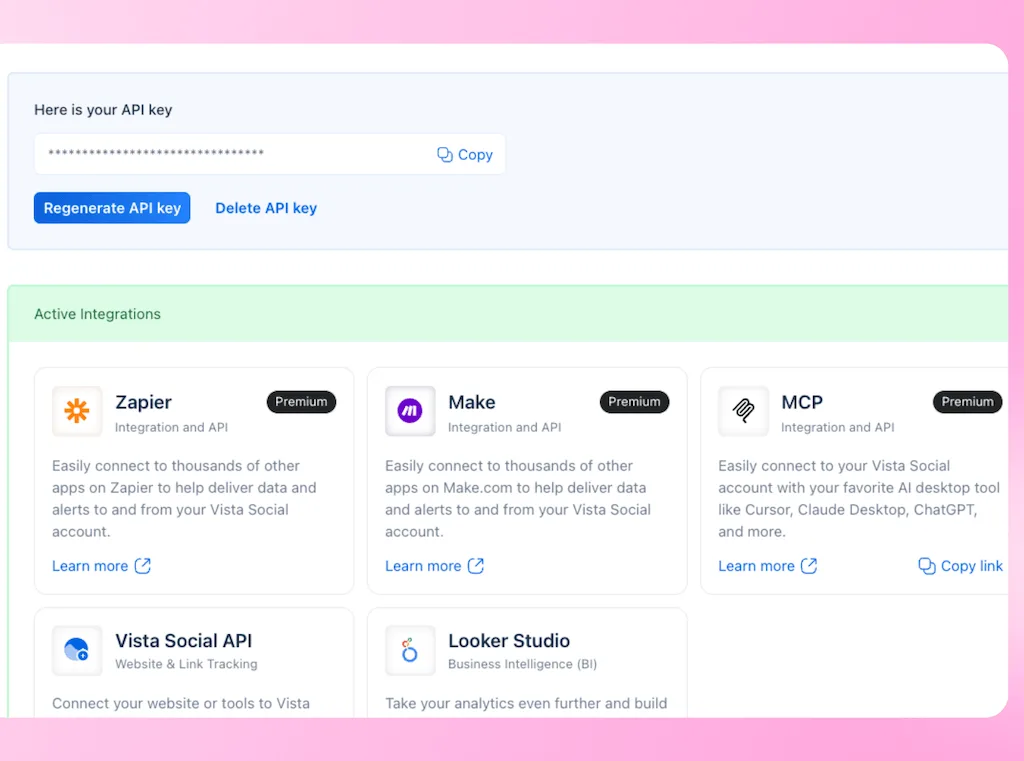
Try the nontechnical route before commissioning a custom build. Ask Vista Social to complete one real task, such as publishing a post or checking the inbox. Then see whether the built-in experience covers the job.
Should an SMM use Ask Vista, MCP, or the API?
For an SMM, Ask Vista is the best place to start. It lets you request publishing, reporting, inbox, and other social tasks in plain language inside Vista Social, so there’s no code or separate connection to configure.
Choose MCP when you prefer to work in an outside AI assistant such as ChatGPT or Claude. Choose the API when the task starts inside your company’s software and must run the same way every time, without a person typing the request.
| Start here | Choose it when | What it means for an SMM |
|---|---|---|
| Ask Vista | You want to work inside Vista Social | Ask for a result in plain English, review the work, and approve any public action |
| Vista Social MCP | You already work in ChatGPT or Claude | Your preferred AI assistant can use permitted Vista Social tools without a custom integration |
| Vista Social API | Your company has software that must connect directly | Developers build and maintain a fixed connection between that system and Vista Social |
Vista Social’s Ask Vista experience goes beyond a single chat request. A repeated task can become an Agent that runs on a schedule and reports back, while public actions remain behind your approval. Skills also give that Agent a reusable method for completing the job.
If you want to stay in ChatGPT or Claude, our MCP guide explains the connection in plain language. The experience is similar, but the request begins in your chosen AI assistant instead of the Vista Social dashboard.
When an SMM asks AI to create or review content, brand context still matters. AI Training & Knowledge lets the team supply approved material, while the SMM keeps responsibility for judgment and final approval.
The direct API remains useful for a narrower case. A company may need its own software to schedule approved posts or retrieve social data in a predictable format, and that process has no chat box or AI assistant at the start.
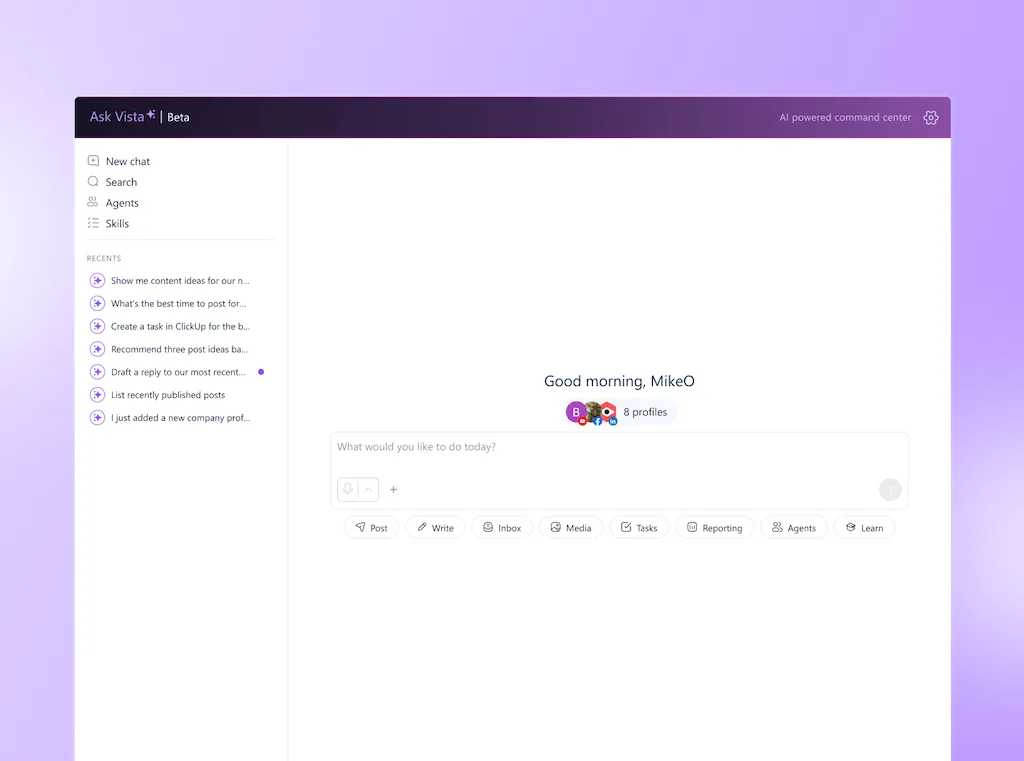
Run one real task through Ask Vista before you involve engineering. If the request works in chat, keep it there or turn repeated work over to an Agent. You can then avoid paying for a custom connection the team doesn’t need.
What should you ask before you build on someone else’s platform?
Ask these questions before development starts, while the buying team can still change direction. Once client deadlines depend on the integration, revisions become harder.
- What is the complete API price in writing?
Include the base plan, add-on, minimum contract, included usage, extra charges, support, and renewal conditions. - Can we test before committing?
Ask for a sandbox, which is a safe test version, or request limited access to a real account. Then confirm that the test behaves like the paid setup. - Which actions and exclusions apply?
List every action the workflow needs, including the social networks, data, media formats, and approval states involved. - How much automated activity is allowed?
Rate limits control how many requests the software can send within a set time. Ask what happens during a busy burst and how the connection should retry a failed request. - How will we hear about changes?
Ask how much warning the vendor gives before it retires an older version. Also confirm where developers receive those notices. - What happens if our plan changes?
Get a clear answer for downgrades, cancellations, account suspension, access keys being disabled, and data access after the contract ends.
Building a direct connection to each social network gives your company more control, but it also creates more upkeep. Your developers become responsible for access keys, media rules, permission reviews, version changes, failed posts, and support.
A unified API hands much of that upkeep to one vendor, which means fewer separate connections to maintain. The arrangement works when its coverage and terms are clear enough for both the social and technical teams to trust.
Choose the simplest connection that does the job
An SMM who wants to publish, report, check the inbox, or set up repeated work shouldn’t have to begin with API documentation. Start with Ask Vista inside the platform, then use MCP if your team prefers ChatGPT or Claude. Both routes let you describe the work in normal language and keep a person in control of public actions.
Bring in the social media management API when the work must begin inside company software and run in a fixed format. At that point, get the full price in writing and confirm every required action before another line of integration code is written.
Start with one job in Ask Vista, then add technical complexity only when the workflow proves it needs it. The SMM gets a faster route to the result, while developers avoid building a connection for work the platform can already complete.
Frequently asked questions
Do I need API access to automate social publishing?
Not always. Ask Vista, MCP, Zapier, or Make may cover the task without a custom build. A direct API helps when company software must control the instruction, returned data, and errors.
What happens if a vendor changes its API?
Your developers may need to update the connection before an older version is retired. Ask how the vendor announces changes, how much warning it gives, and who answers technical questions.
Can the API post to X?
It depends on the provider and its current X access. Vista Social’s public API docs exclude X data, so confirm the available publishing and reporting actions before you build.
Is building our own social media integration cheaper?
It may look cheaper because the first calculation covers only the build. Also count secure access, network changes, testing, failed posts, and developer support before comparing it with a unified API.
Who owns the data pulled through a social API?
Ownership and permitted use depend on the vendor terms and the social network’s rules. Have legal or procurement review how your system can retain, delete, export, and reuse stored data.
Does MCP replace a social media API?
For many SMM-led workflows, MCP removes the need for a custom API integration because the work begins with a plain-language request. A direct API still matters when company software runs a fixed process on its own. Ask Vista is the easiest starting point for that conversational approach inside Vista Social.
Can I get a sandbox before buying API access?
Ask the vendor because a separate test version isn’t always available. If it doesn’t offer one, request limited access and agree on a small test plan for sign-in, required actions, usage limits, and failed requests.
Try Vista Social for free
A social media management platform that actually helps you grow with easy-to-use content planning, scheduling, engagement and analytics tools.
Get Started NowAbout the Author

Content Writer
Orion loves to write content that refuses to be boring. As part of Vista Social, he helps brands, creators, and agencies stop doom scrolling and start winning with social media. When he's not in front of a keyboard, he's watching films in IMAX with his wife, dissecting football tactics (the European kind), and getting lost in a good book.
Loading related tools...

The most complete social media management platform for teams who demand more.






Tools
PublishingAnalyticsEngagementIntegrations
FacebookInstagramLinkedInRedditSnapchatThreadsTikTokX (Twitter)YouTubeMCPVista Page (link-in-bio)All IntegrationsCopyright © 2026 Vista Social LLC. All Rights Reserved.