


Buffer vs Hootsuite (2026): Which Social Media Tool Is Actually Worth It?
August 27, 2026
10 min read

Summarize with AI

Table of contents
Share

Vista Social

X (Twitter)


Updated August 27, 2026
Social media has become a supermajority activity: 5.66 billion people, or 68.7% of the world’s population, use it today, according to Meltwater and We Are Social’s Digital 2026 report. That growth means more channels, more content, and more pressure on the tools you use to manage it.
Buffer and Hootsuite are two of the most established names in social media management, but they solve very different versions of the job. We compared both against a third option, Vista Social, to see which platform actually earns its price tag in 2026.
In this article:
- Best overall value: Vista Social bundles publishing, engagement, DM automations, social listening, and reporting into flat pricing tiers
- Lowest entry price: Buffer starts at $5 per channel per month, which works well for a solo creator managing just a few accounts
- Best for enterprise depth: Hootsuite offers mature analytics, listening, and governance tools, but its per-user pricing adds up fast for any team bigger than one person
- Most important buying check: Compare the plan that actually fits your team size and profile count, not just each platform’s starting price
Table of contents
Buffer vs Hootsuite: quick verdict
Buffer is the simplest, most affordable way to schedule posts for a solo creator or small team. It doesn’t try to be more than a scheduling tool, which keeps the interface easy to pick up and the price low.
Hootsuite offers more depth than Buffer, with analytics, listening, and governance built for larger organizations. That depth costs more, since Hootsuite charges per user and locks its best features behind its priciest tiers.
Vista Social is worth a serious look if you want agency-grade features like DM automations, social listening, and unlimited scheduling without enterprise pricing. It bundles most of what Hootsuite reserves for Advanced or Enterprise into its base plans instead.
| Tool | Best fit | Main advantage | Main tradeoff |
| Buffer | Solo creators and small teams | Simple, low-cost entry point | Approvals and a full inbox only unlock on Team |
| Hootsuite | Large enterprises with budget to match | Deep analytics, listening, and governance | Every seat added raises the price |
| Vista Social | Agencies and multi-brand teams | Broad feature set bundled into flat tiers | Bigger teams need to move up a tier for more seats |
Pricing comparison
Price is usually the first filter people apply, and it’s where these three platforms diverge the most. Buffer bills per social channel, Hootsuite bills per user, and Vista Social bills per plan tier with a set number of profiles and users included.
| Platform | Entry plan | Mid-tier plans | Largest public plan | Trial |
| Buffer | Essentials: $5/channel/month billed annually, unlimited posts | Team: $10/channel/month billed annually, unlimited members and approvals | No dedicated top tier; volume discounts apply past 10 channels | None (permanent free plan for up to 3 channels) |
| Hootsuite | Standard: $99/user/month, 10 accounts | Professional: $199/user/month. Advanced: $399/user/month | Enterprise: custom pricing | 14 days |
| Vista Social | Professional: $79/month, 2 users, 15 profiles | Advanced: $149/month, 4 users, 30 profiles | Scale: $349/month, 8 users, 70 profiles. Enterprise: custom pricing | 14 days, no card |
Prices and plan limits were checked directly on each platform’s pricing page in August 2026. Hootsuite doesn’t publish exact Enterprise pricing, so treat that figure as a starting point for a sales conversation.
Buffer pricing in 2026
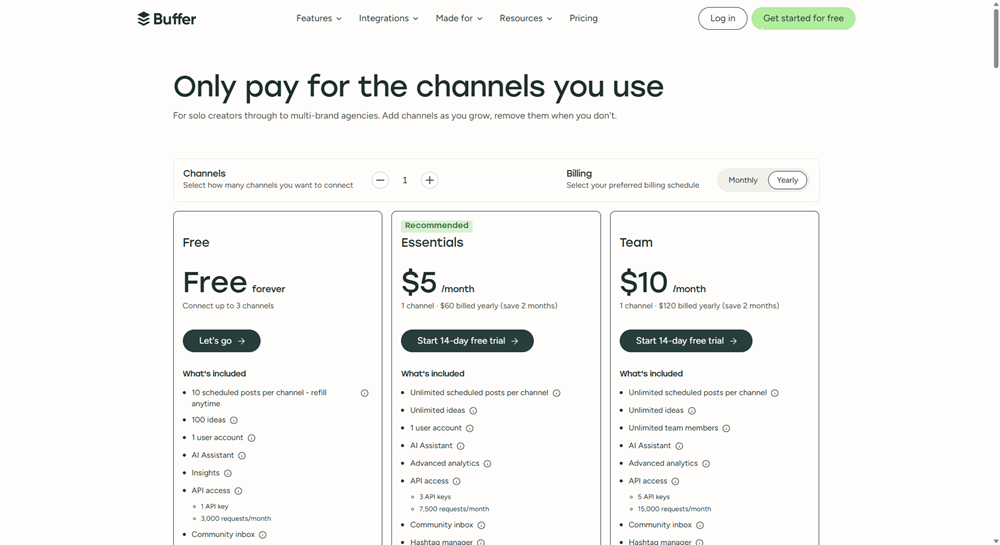
Buffer removed its dedicated Agency plan in November 2025 and now offers volume discounts instead. The standard rate applies to your first 10 channels, then a lower rate kicks in per channel after that.
Hootsuite pricing in 2026
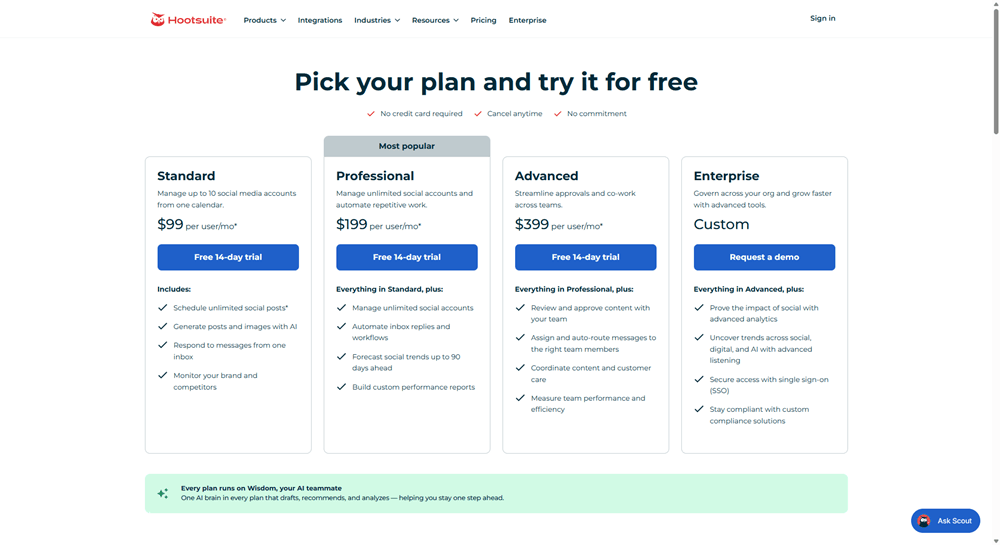
Hootsuite’s per-user model punishes team growth more than the other two, since every added seat multiplies the bill instead of adding to a flat rate. Automations and approvals also live on higher tiers, so the base seat price doesn’t include them.
Vista Social pricing in 2026
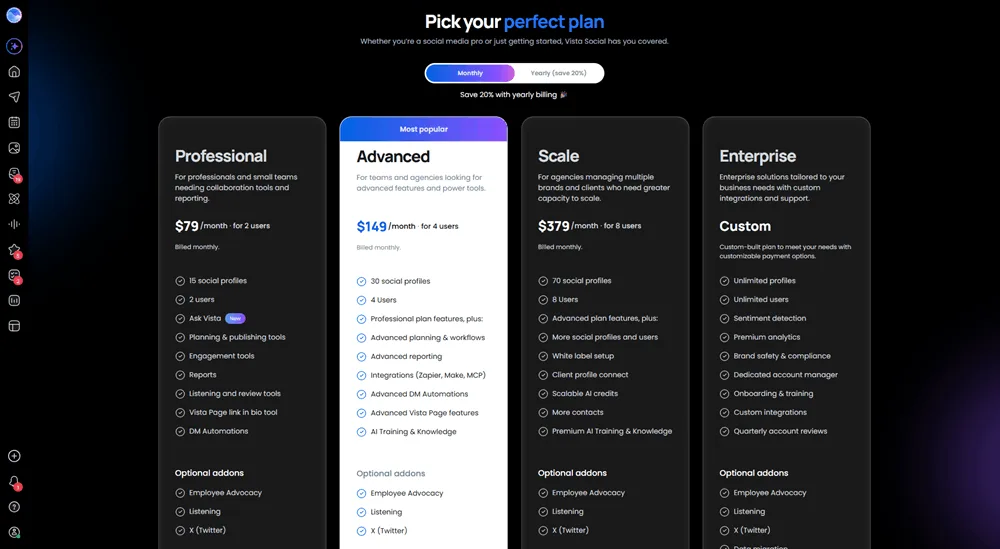
Vista Social’s tiers scale users and profiles together, so upgrading a plan unlocks room for both a bigger team and more accounts in the same move. That’s different from Buffer and Hootsuite, where growing your team and growing your account count are two separate costs.
What does each platform cost as your team grows?
| Team size | Buffer | Hootsuite Standard | Vista Social |
| 1 user | $5/channel (Essentials) | $99/month, 10 accounts | $79/month, 15 profiles and 2 seats included |
| 3 users | $10/channel (Team) | $297/month, 10 accounts | $149/month, 30 profiles and 4 seats included |
| 5 users | $10/channel (Team) | $495/month, 10 accounts | $349/month, 70 profiles and 8 seats included |
| 8 users | $10/channel (Team) | $792/month, 10 accounts | $349/month, 70 profiles and 8 seats included |
Buffer’s price barely moves with headcount since it bills by channel, not by seat: five people managing 10 channels on Team costs the same as two people managing those same 10 channels. Hootsuite tells a different story, since that same 10-account limit costs $99 at one seat and climbs to $792 at eight. Vista Social holds steady at $349 for a team of up to eight, with 70 profiles included at that price.
Ease of use and interface
A cluttered dashboard slows down your whole week. Here’s how each platform handles day-to-day navigation.
Buffer’s interface is clean and minimal. It’s built around a simple queue system, which makes it easy to pick up for creators who don’t want a learning curve.
Hootsuite packs in a lot of functionality, but that comes at the cost of simplicity. Managing multiple accounts through its stream-based layout can feel dense, especially for new users.
Vista Social uses a visual, drag-and-drop calendar with a media library built in. Teams managing several client accounts tend to find it faster to navigate day to day than Hootsuite’s stream view.
Publishing and scheduling
Scheduling is the core job of any social media tool, so the differences here matter more than they might seem. Small gaps in post limits or calendar flexibility add up fast once you’re managing more than one account.
Scheduling limits and queue systems
Buffer’s free plan caps you at 10 scheduled posts per channel at a time. Once you’re on a paid plan, that limit disappears, but Buffer’s fair use policy still caps things at 5,000 posts per channel.
Hootsuite’s Standard plan allows unlimited scheduling across up to 10 accounts. That cap sits on accounts, not posts, so the number of profiles you connect matters more than how often you post.
Vista Social offers unlimited scheduling on every paid tier, with no per-post cap listed in its plan details. The only real ceiling is the number of profiles your plan includes.
Content calendar and visual planning
Buffer’s calendar is functional but plain. It shows your queue clearly without much visual styling beyond a basic grid.
Hootsuite’s calendar is denser, showing multiple account streams at once. That density helps when you’re monitoring a lot of accounts, but it takes longer to scan for a single post.
Vista Social leans into visual planning with drag-and-drop rescheduling and post previews. Those previews mimic how content will actually look once published, which cuts down on formatting surprises after a post goes live.
AI content generation
All three platforms now build AI tools into their publishing workflow, treating it as core rather than an add-on:
- Buffer includes its AI Assistant on every plan, including Free, with unlimited use for captions and content ideas
- Hootsuite’s Wisdom AI drafts captions and images and runs on every plan
- Vista Social includes AI credits on every plan (1,000/month on Professional, scaling up through higher tiers) for both caption generation and AI-assisted replies
The real difference is how deep the training goes. Vista Social’s AI Training and Knowledge feature lets teams feed the AI brand-specific context so replies and captions sound less generic, a step Buffer and Hootsuite don’t offer at comparable pricing.
Analytics and reporting
Posting only gets you halfway. Knowing what worked matters just as much, and that’s where budget tiers start to matter.
Built-in analytics
Buffer’s Free plan shows only basic metrics. A full performance overview and custom analytics unlock once you move to Essentials or Team.
Hootsuite’s analytics deepen significantly from Professional up, adding trend forecasting and broader benchmarking. Its most advanced reporting, though, sits behind Enterprise pricing.
Vista Social includes real-time reporting and custom report building starting on its entry-level Professional plan. You don’t need to move up a tier just to get past basic post counts.
Custom reports and client reporting
Buffer’s branded reports, your logo and a cover page, only appear on its Team plan. Lower tiers export data without that client-facing polish.
Hootsuite includes custom reports starting on Professional, but its public plans don’t offer a comparable white-label package for agencies. What you get is customizable data, not a branded client deliverable.
Vista Social includes white label reporting starting on its Scale plan, aimed squarely at agencies managing several client accounts at once. That covers branded PDFs and dashboard access, not just exported numbers.
Engagement and social inbox
Replying to comments and DMs eats up more time than most people expect, so inbox tools matter just as much as scheduling tools. A slow or scattered inbox means missed messages, and missed messages mean lost customers.
Inbox capabilities
Buffer’s community tools cover the basics: replying to comments and turning them into new post ideas. It’s not built as a deep engagement platform.
Hootsuite’s inbox pulls messages from multiple platforms into one place, though managing a high volume there can feel slow. Automated replies help, but only from Professional up.
Vista Social’s unified inbox supports team assignments and message labeling on every plan, which helps split engagement work across a team without duplicate replies. Conversations can also be filtered by Profile Groups, useful for agencies juggling several clients.
DM automations
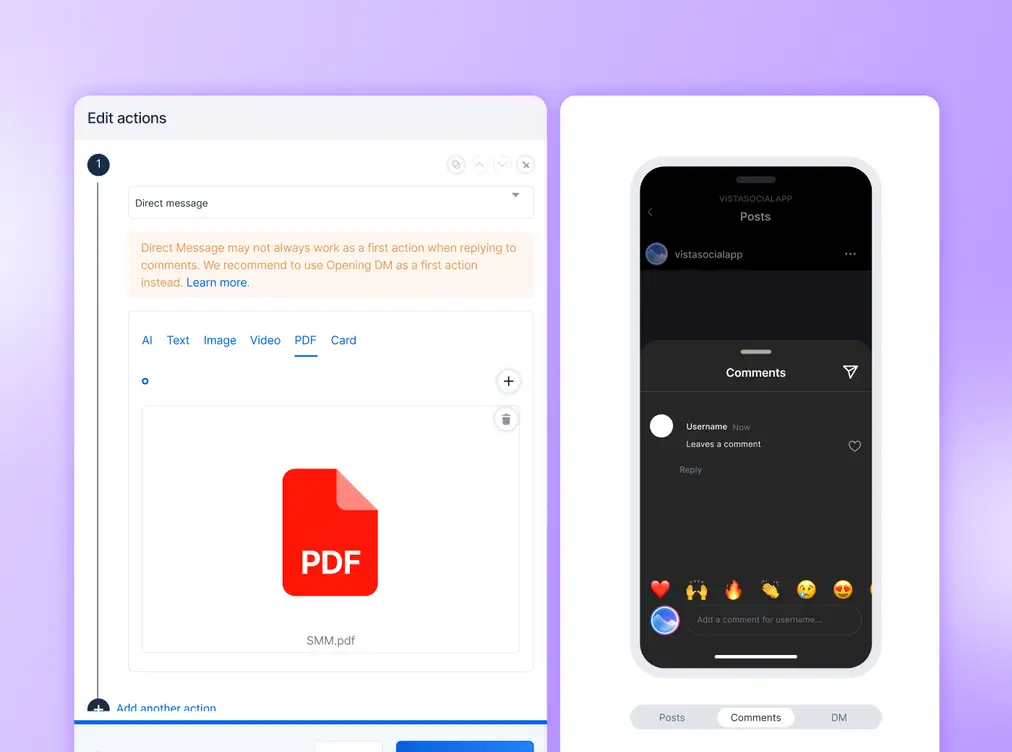
This is one of the widest gaps between the three tools. Neither Buffer nor Hootsuite offers dedicated DM automation at any price point. Vista Social includes DM automations from its Professional plan onward, letting teams set up automatic replies to comments and messages based on keywords, useful for lead capture or answering repetitive questions without a person watching the inbox all day.
Platform support
Where your audience actually lives should shape which tool you pick. A platform with the deepest feature set still falls short if it doesn’t support the network your audience uses most.
Supported networks
| Network | Buffer | Hootsuite | Vista Social |
| Yes | Yes | Yes | |
| Yes | Yes | Yes | |
| Yes | Yes | Yes | |
| X | Yes | Yes | Yes |
| Yes | Yes | Yes | |
| YouTube | Yes | Yes | Yes |
| TikTok | No | Yes | Yes |
| Threads | Yes | Yes | Yes |
| Bluesky | Yes | Yes | Yes |
| Google Business Profile | Yes | No | Yes |
| No | No | Yes | |
| Snapchat | No | No | Yes |
| Tumblr | No | No | Yes |
| Mastodon | Yes | No | No |
Team collaboration
If more than one person touches your social accounts, workflow tools stop being optional. Without approvals and clear roles, mistakes slip through and nobody’s sure who signed off on what.
Approval workflows
Buffer only offers approval workflows on its Team plan. Lower tiers have no review step at all before a post goes out.
Hootsuite gates content approvals behind its Advanced plan at $399 a user per month. That’s the highest-priced tier of the three tools for this one feature.
Vista Social includes single-stage approval workflows starting on Professional, with multi-stage approvals on higher tiers. Smaller teams get sign-off structure without paying enterprise prices for it.
User roles and permissions
Buffer’s Team plan supports unlimited members with custom access controls. That access comes bundled once you’re on Team, with no extra per-seat charge.
Hootsuite offers role-based permissions across its paid tiers, but each one is priced per seat. Adding a role for a new reviewer means adding a full-priced user.
Vista Social includes two users on Professional and scales up through each tier, with custom roles and permissions built in from the start. Growing past your plan’s seat count means moving up a tier rather than paying per person.
Additional features
A few extra features sit outside core scheduling and engagement, but they’re worth knowing about before you commit to a plan. They often matter more once you’re a few months into a subscription.
| Feature | Buffer | Hootsuite | Vista Social |
| Social listening | No | Standard+ (Lumen), deeper on Enterprise | Free for own profiles on every plan; add-on for wider listening |
| Review management | No | No | Professional+ |
| Link in bio | Included on every plan (Start Page) | No | Included on every plan (Vista Page) |
Social listening
Buffer doesn’t offer social listening. You’d need a separate tool if brand or industry tracking matters to you.
Hootsuite includes basic Lumen listening starting on Standard, with deeper listening reserved for Enterprise. That’s a big price jump for more depth.
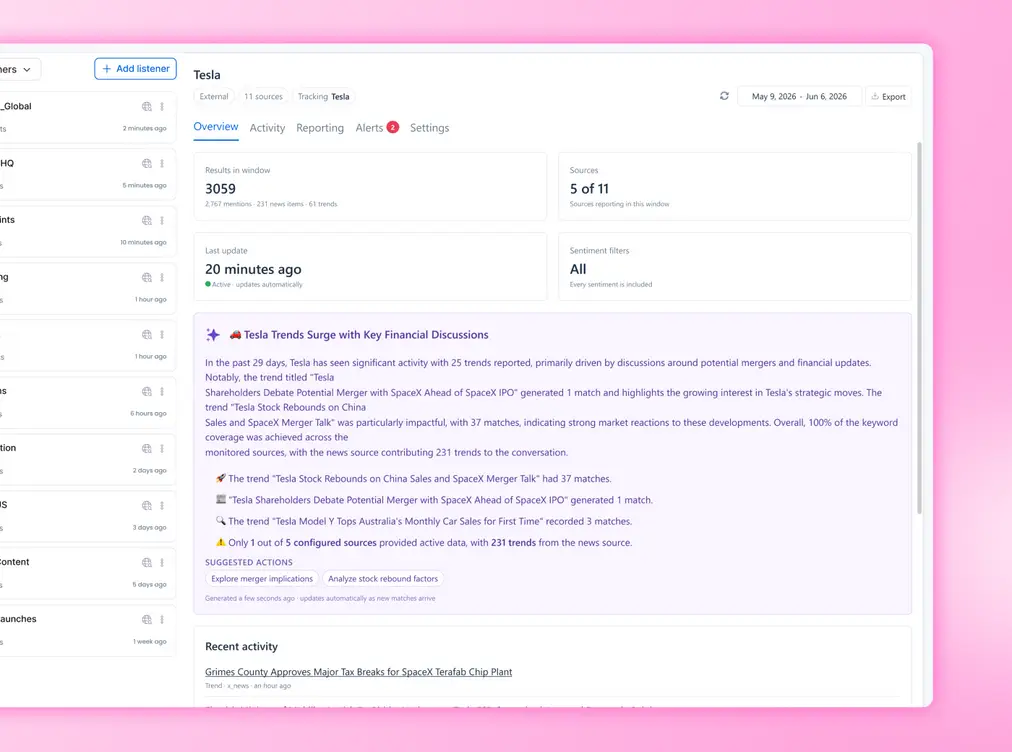
Vista Social includes free social listening for your own connected profiles on every plan. An optional $75-a-month add-on extends that to the wider social web, news, and blogs.
Review management
Neither Buffer nor Hootsuite includes review management as a core feature at standard pricing tiers. If reviews matter to your business, you’d need a separate tool for either platform.
Vista Social includes review monitoring for Facebook and Google Business on its Professional plan. That coverage expands to Yelp, TripAdvisor, OpenTable, Trustpilot, and app store reviews on Advanced and up.
Link in bio
Buffer includes its Start Page tool on every plan, including Free. There’s no extra cost or tier requirement to unlock it.
Hootsuite doesn’t offer a dedicated link-in-bio tool at all. That’s a gap if your team currently relies on a separate app for it.
Vista Social includes Vista Page on every plan too, with custom domain support on Advanced and above. Like Buffer, there’s no extra charge to turn it on at the base tier.
Who should choose Buffer?
Buffer fits solo creators, freelancers, and small businesses who mainly need a clean way to queue and publish content. If you’re not managing client approvals or deep analytics, Buffer’s simplicity and per-channel pricing keep costs predictable as you grow slowly.
Best for: Solo creators and small teams that want simple scheduling without a learning curve.
Who should choose Hootsuite?
Hootsuite makes sense for larger organizations that need deep integrations, advanced analytics, and enterprise-grade governance, and that have the budget to match. If your team is small, its per-user pricing model works against you.
Best for: Large enterprises with the budget for per-seat pricing and complex, multi-channel operations.
Frequently asked questions
How much does Buffer cost vs Hootsuite?
Buffer starts at $5 per channel per month on its Essentials plan (billed annually). Hootsuite starts at $99 per user per month on its Standard plan. Buffer is cheaper for a small number of channels, but Hootsuite’s per-user model can become more cost-effective for one person managing many accounts.
Which tool is better for solo creators?
Buffer is generally the better fit for solo creators, thanks to its simple queue system and per-channel pricing that stays low without a team involved. Its minimal interface also means less time learning the tool and more time actually posting.
Which tool is better for teams?
For teams that need approval workflows and shared inboxes without enterprise pricing, Vista Social tends to offer more for the money than either Buffer vs Hootsuite at comparable price points. Both features come standard on its entry-level plan instead of requiring an upgrade.
Does Buffer have a social inbox?
Buffer has basic community tools for replying to comments, but it’s not built as a full engagement inbox the way Hootsuite and Vista Social are. If your strategy depends heavily on DMs or real-time replies, Buffer alone probably won’t cover it.
Does Hootsuite have a free plan?
No. Hootsuite offers a 14-day free trial but no permanent free plan. Buffer and Vista Social both offer free trials, but only Buffer has a permanent free plan for up to 3 channels.
About the Author

Content Writer
Russell Tan is a content marketing specialist with over 7 years of experience creating content across gaming, healthcare, outdoor hospitality, and travel—because sticking to just one industry would’ve been boring. Outside of her current role as marketing specialist for Vista Social, Russell is busy plotting epic action-fantasy worlds, chasing adrenaline rushes (skydiving is next, maybe?), or racking up way too many hours in her favorite games.