

Published on July 1, 2026
7 min to read
Will AI Replace Social Media Managers? An Honest Answer

Summarize with AI

Table of contents
Summarize with AI

ChatGPT

Claude

Perplexity
Share

Vista Social

X (Twitter)


You’ve watched AI write captions in seconds. You’ve seen it generate images, draft replies, and pull reports that used to take an afternoon. If a quiet worry has been creeping in, you’re not imagining it. That worry deserves a straight answer, not a pep talk.
So here it is. No, AI will not replace social media managers. But that “no” comes with a catch that actually matters. The social media managers who use AI will replace the ones who don’t, because a manager who directs AI well simply outproduces and outthinks one who doesn’t.
The fear was never really about a robot taking your chair. It’s that your job description is shifting, since AI is steadily taking over the logistics, piece by piece. What’s left leans harder on the judgment calls only you can make, and meeting that shift head on is the best thing you can do for your career.
Table of contents
Why the role survives
AI is good at producing options. It’s not good at deciding which option is right for your brand, your audience, and this exact moment. That gap is where social media managers live now, and it isn’t closing anytime soon. Here’s where the human side of the job still holds:
- Taste and brand judgment: AI can generate ten versions of a caption in seconds. Picking the one that actually fits your brand’s voice today, or knowing when a joke will land instead of backfire, takes a person who’s been paying attention. That call still needs someone willing to stand behind it.
- Relationships and community: A real conversation with a creator, a partner, or an upset follower takes more than a well-formatted reply. It takes reading tone, remembering history, and knowing when to break from the script entirely. Trust comes from those moments, and no amount of output can fake it.
- Strategy and context: AI can optimize toward a goal you give it, but setting that goal is still on you. Your budget trade-offs, your leadership’s priorities, and why last quarter’s campaign actually mattered to the business all live in your head, not in a prompt.
- Accountability: When a post goes wrong or a campaign underperforms, someone has to own it, explain it, and fix it. That someone sits in the meeting with your CEO, answers the hard questions, and carries the outcome. AI was never going to be in that room.
- Creativity with intent: AI remixes what already exists, built from patterns in its training data. A bold idea that breaks the pattern on purpose, the kind that actually moves culture, takes someone who understands why it will work before it’s obvious.
None of this means the job stays the same. It just means the parts of the job that made you good at it are turning into the whole job.
What’s actually changing
Picture a Monday morning two years ago. You’d open six tabs before your coffee finished brewing: yesterday’s comments, the analytics dashboard, the content calendar, and whatever needed putting out first. By the time you’d pulled last week’s numbers into a report, half your morning was already gone.
That same Monday looks different for managers who’ve handed the logistics to AI. These are the tasks worth delegating first:
- Reporting and pulling weekly or monthly numbers
- Drafting comment and DM replies for you to approve
- Scanning for trends before they peak
- Scheduling and queueing content
- Writing first-draft captions
- Repurposing old content into new formats
- Monitoring accounts overnight
Vista Social’s breakdown of how social media managers use AI walks through what that handoff actually looks like day to day.
This is delegation, not loss, the same shift that happened when scheduling tools replaced posting content by hand. So what’s actually left once the logistics move out? The part that pays the bills anyway:
- Taste and brand judgment
- Strategy and business context
- Community relationships
- Original creative work
- Cross-team influence
- Knowing which numbers actually matter
Research backs this up. A recent analysis of over a billion job ads worldwide found something telling. The new tasks being added to AI-exposed roles are two and a half times more likely to rely on skills like empathy, judgment, and creativity, compared to the tasks AI is taking over. In other words, the roles most touched by AI are being rebuilt around the parts a person is actually good at, not phased out.
That same research found something worth sitting with if job security is on your mind. Companies making the biggest productivity gains from AI are raising wages and headcount faster than companies barely using it. AI adoption tends to lead to different jobs, not fewer of them, and early adopters tend to come out ahead.
How to get ahead of it
Getting ahead has less to do with mastering every AI tool that launches this year and more to do with building a few habits that compound over time. Start here:
- Direct AI instead of just prompting it: There’s a real difference between typing “write me a caption” and giving AI real brand context and a clear goal. That skill is closer to editing than typing, and it’s what separates people getting generic output from people getting expert output.
- Start with one small agent: Trying to hand off your entire workflow at once is a good way to lose trust in the tools fast. Pick one repetitive task instead, like comment triage or a morning performance recap. Vista Social’s guide on how to deploy three agents in fifteen minutes is a reasonable place to start.
- Use AI for analysis and ideation too: Ask it to spot patterns in your engagement data, or to push back on a content idea before you commit hours to it. That’s where a lot of the real time savings live, beyond just faster first drafts.
- Protect the time you get back: An hour saved on reporting only helps if you actually spend it on strategy or relationships. Otherwise it quietly disappears back into busywork.
- Show leadership the output gain: If AI helped you deliver more content or better campaign results, say so directly, not just how many hours it saved. That’s the case that gets you more resources instead of a smaller team.
Once you’re ready to build repeatable processes, the explainer on AI skills can help. It covers how to save your team’s specific way of doing things, so AI doesn’t need re-briefing every time, which turns a one-off time save into a permanent one.
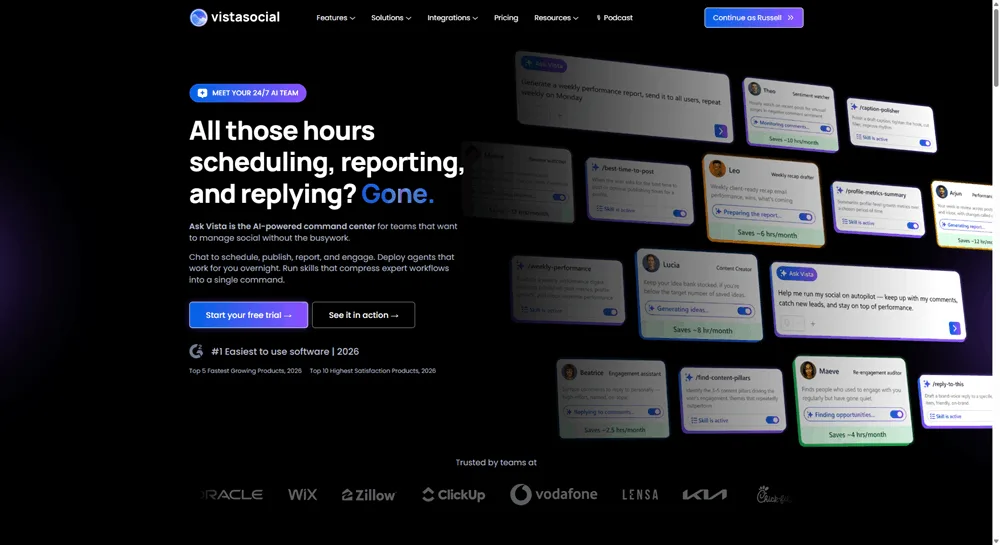
This is also where a platform built for the job actually matters. Ask Vista, Vista Social’s built-in AI assistant, handles reporting, drafting, and monitoring in one place, instead of five disconnected tools. AI does the repetitive labor, and you’re still the one deciding what actually goes live.
A note for leaders
If you manage a team of managers, this argument matters even more. AI doesn’t mean your social team can shrink while doing the same work. It means the same team can do far more, and do it better, if you let them.
Cutting headcount and expecting AI to quietly fill the gap misreads what AI is actually good at. AI absorbs logistics, not judgment, and judgment is what keeps a brand out of trouble and ahead of its competitors.
Vista Social’s library of ready-made agents is built for exactly this. A team of five can scope agents by client or channel, so nobody’s rebuilding the same automation from scratch every time a new account comes in.
A recent survey of over 1,500 marketers found something striking. 61% believe marketing is going through its biggest disruption in twenty years because of AI. That disruption is real, so it’s a reason to invest in your team’s AI fluency rather than assume the team itself is optional.
Frequently asked questions
Will AI replace social media managers?
No, but it will replace social media managers who don’t use AI. AI is taking over logistics like reporting, scheduling, and first drafts, while judgment, strategy, and relationships stay firmly human.
What parts of a social media manager’s job can AI do?
AI can handle reporting, comment triage drafts, trend scanning, scheduling, first-draft captions, repurposing old content, and overnight monitoring. These are the repetitive, high-volume tasks that used to eat up most of the day.
What can’t AI do in social media management?
AI can’t set your strategy, own accountability for results, or build real trust with your community. Brand judgment, original creative direction, and cross-team influence still need a person behind them.
How can social media managers stay relevant with AI?
Learn to direct AI with clear context instead of vague prompts, and start small with one agent or workflow. Use the time you save on strategy and relationships, and show leadership the output gains, not just the hours saved.
Will companies cut social media teams because of AI?
Some might try, but it usually backfires because AI handles logistics, not judgment. The smarter move is using AI to help the same team do more, not to justify a smaller one.
What skills should social media managers learn for an AI future?
Focus on directing AI well and interpreting data instead of just collecting it. Also strengthen the human skills AI can’t replicate, like brand judgment, storytelling, and community relationships. AI fluency itself is becoming a core skill of the role.
Try Vista Social for free
A social media management platform that actually helps you grow with easy-to-use content planning, scheduling, engagement and analytics tools.
Get Started NowAbout the Author

Content Writer
Russell Tan is a content marketing specialist with over 7 years of experience creating content across gaming, healthcare, outdoor hospitality, and travel—because sticking to just one industry would’ve been boring. Outside of her current role as marketing specialist for Vista Social, Russell is busy plotting epic action-fantasy worlds, chasing adrenaline rushes (skydiving is next, maybe?), or racking up way too many hours in her favorite games.
Loading related tools...

The most complete social media management platform for teams who demand more.






Tools
PublishingAnalyticsEngagementIntegrations
FacebookInstagramLinkedInRedditSnapchatThreadsTikTokX (Twitter)YouTubeMCPVista Page (link-in-bio)All IntegrationsCopyright © 2026 Vista Social LLC. All Rights Reserved.