

Published on July 10, 2026
10 min to read
Before You Hire, Try Social Media Automation

Summarize with AI

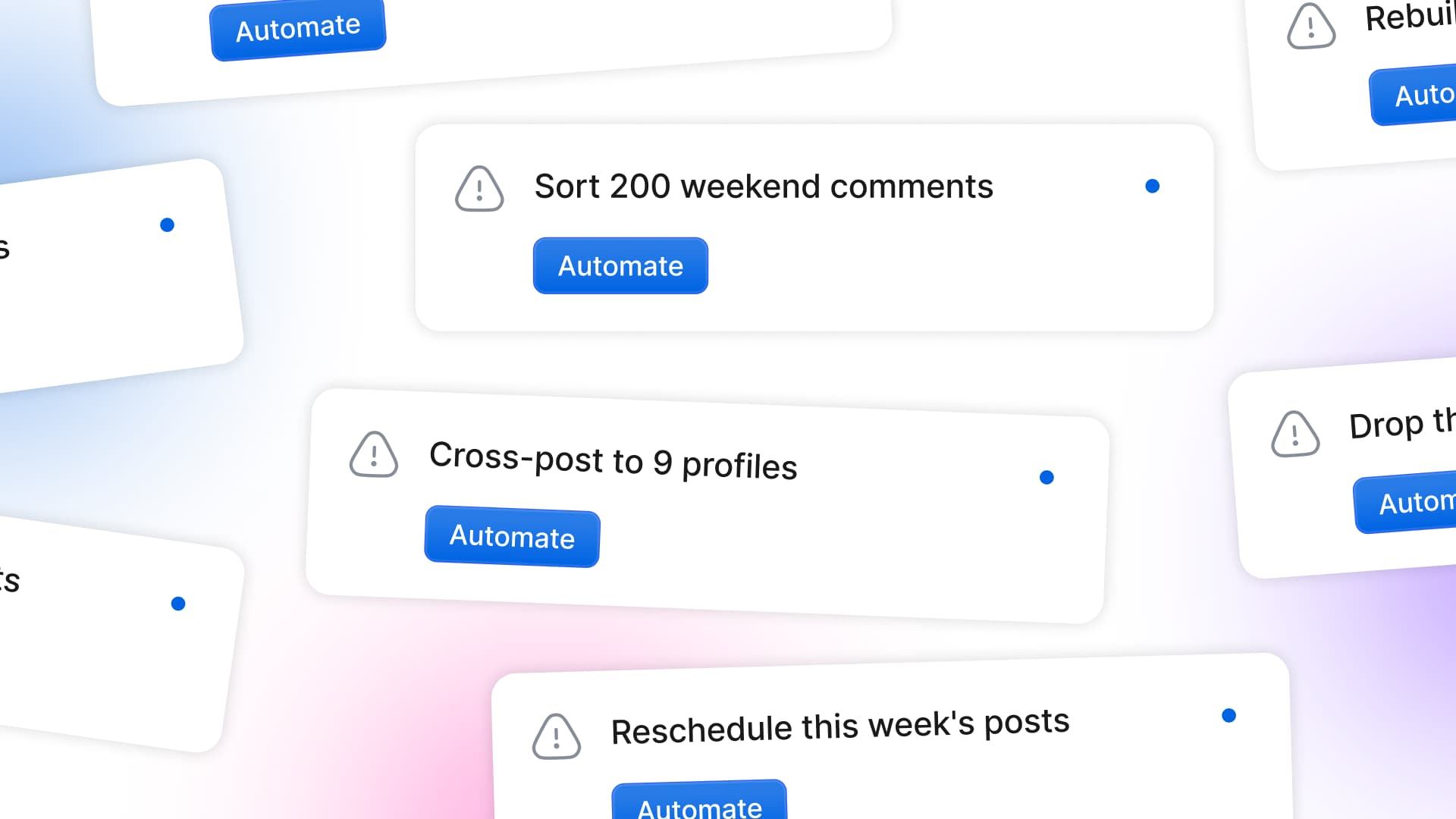
Table of contents
Summarize with AI

ChatGPT

Claude

Perplexity
Share

Vista Social

X (Twitter)


There’s a moment a lot of marketing leads know well: the job description template is open on your screen, half filled in, because the team is underwater and hiring feels like the responsible move. It started on Friday, with your best social manager saying she couldn’t keep up and needed another person. You believe her, so here you are on Monday, writing the role.
Before you finish it, watch where her morning actually goes. By 8:40 she’s rescheduling last week’s evergreen across nine profiles. At 9:15 she’s rebuilding the leadership report. Then by 10:00 she’s clearing 200 weekend comments that mostly ask what your hours are. It’s nearly 11 before she touches anything that actually needs her.
She isn’t buried because she’s short a teammate. She’s buried because the best hours of her day go to work that follows a rule anything could follow, and a second hire just puts two people on that treadmill.
So the useful question isn’t who else can help her; it’s how to stop this reaching her at all. Hand the recurring grind to social media automation and the manager you have gets her mornings back. It’s worth trying before you write that job description.
The short version:
- It’s not a headcount gap: Most “we need another hire” pressure comes from recurring, rule-based execution, not from a shortage of strategic thinkers.
- A second hire inherits the grind: A new person spends most of their week on that same recurring work, so the backlog returns and the salary is permanent.
- Sort before you staff: Split tasks into “automate” (rule-based) and “keep human” (judgment), then automate the first bucket to free the people you have.
- The case is measurable: Scheduled AI agents run the grind on a cadence and report the hours they hand back, so you walk into the next capacity talk with a number.
Table of contents
Why another hire won’t clear the backlog on its own
A new hire rarely clears the backlog, because the backlog is made of repeatable work, and a new person does repeatable work too. Hire anyway, and three months of ramp later you have a fifth person on the same recurring tasks the other four were drowning in. You didn’t change the work but added a second pair of hands to a pile that refills itself every week.
The reason this keeps happening is baked into how teams usually structure these roles. When a social media team gets stretched, the reflex is to add a seat per pain point, and each new seat lands on the same daily grind on day one:
- The strategist you hire still ends up rescheduling posts and pulling the same weekly numbers, because someone has to.
- The copywriter you hire spends a chunk of the week dropping first comments and tagging content instead of writing.
- The community manager you hire inherits the 200-message weekend inbox, most of it questions a rule could answer.
The seat changes, but the grind on day one doesn’t, so the real question behind social media team structure isn’t which seat to add. It’s work that never needed a seat. Answer that and the hours come back to the team you already trust, instead of transferring to a new hire.
What’s actually eating your team’s week
Look at where your team’s week actually goes and you’ll find a short list of tasks that all follow a knowable rule. Name them out loud and the pattern jumps out. Almost none need a human decision:
- Scheduling and cross-posting: The same post, reshaped for nine profiles, over and over.
- Rebuilding the weekly report: The same numbers are pulled into the same template every Monday.
- The first comment: Dropped under every launch, by hand, every single time.
- Tagging and metadata: Quiet housekeeping that no one notices until it’s missing.
- Sorting the inbox: Reading 200 messages just to find the ten that actually need a reply.
Try the split on your own week. How much of it is a real decision, like what campaign to run or what to say to an upset customer, and how much is executing a rule you already know? Tally it honestly and the rule-based side runs away with the hours. That work isn’t hard, it’s endless, and because it lands every day, it feels like a staffing problem when it isn’t one.
The wish to hand this off is widespread. In Adobe’s 2025 creators survey, 51% of creators said they want agentic AI to automate repetitive tasks, ahead of brainstorming at 50% and performance insights at 44%. The work people most want off their plate is this exact grind.
So map the repeatable workflow behind all of this before you touch a tool, because you can only automate a task you can write down as a rule. On paper, the pure-execution work stops hiding inside “we’re just busy.”
Should you add a role or a system?
Before you open that role, sort every recurring task into two buckets. Automate the work that follows a knowable rule and needs no judgment. Keep human the work that needs judgment, voice, or a relationship. Then ask whether the human bucket is genuinely full enough to justify a hire, because more often than not, it was the automated bucket doing the drowning.
| Automate (rule-based) | Keep human (judgment, voice, relationship) |
|---|---|
| Scheduling and cross-posting | Strategy and campaign calls |
| The first comment under a launch | Creative concepting and copy voice |
| Tagging and metadata | Sensitive or high-stakes replies |
| Recurring performance reports | Final approval on anything that publishes |
| Inbox triage by intent | The relationship with a valued customer |
| Turning a detected trend into a draft | The judgment call on whether to post at all |
The left column is volume; the right column is value. When a team says it’s buried, it’s almost always under the left, while the right keeps getting pushed to an afternoon that never arrives.
This is the same split Dickie Bush, founder of the writing program Ship 30 for 30, points to when he describes how the most productive people operate. His argument is that the difference isn’t hours or raw talent, but where the hours get spent. Which is the call you make when you decide what to automate and what to keep human:
“They don’t have more time, more energy, or more intelligence. Instead, their efforts are always put toward the highest leverage work.”
— Dickie Bush, dickiebush.com
Read against the two columns, his point is the case for clearing the left one first. Handing off the rule-based work doesn’t shrink your team; it moves their effort to the highest-leverage column, so the same people finally spend the day on the work you needed.
The real cost of one more hire
Money is where this decision gets real. Before you commit to the salary, be honest about what it really costs to hire a social media manager, because the paycheck is only the visible part. Recruiting time, three months of ramp, management overhead, and churn risk all sit on top of it.
None of that spend actually buys you less grind. It buys one more person to carry it on a payroll line that runs in busy season and slow, and the recurring work stays manual either way.
| Adding a hire for the grind | Automating the grind instead |
|---|---|
| A permanent salary that climbs each year | A flat, predictable tool cost |
| Six weeks to hire, three months to ramp | One scheduled automation live this week |
| The recurring work stays manual | The recurring work runs on a cadence |
| Onboarding, PTO cover, churn risk | No headcount to manage or backfill |
This isn’t an argument that people cost too much. Good people are the whole reason the work is worth doing. It’s that you want their salary buying strategic work and creativity, not another quarter of dropping the first comment by hand.
What social media automation runs
So what can you hand off today? The recurring, rule-based jobs go to an agent, while approvals and sensitive replies stay with your team. The split looks like this:
- Scheduling and cross-posting: The agent publishes on your cadence across every profile.
- The first comment: Dropped automatically under each launch, so no one has to remember.
- Inbox triage by intent: Weekend messages sorted so a person only sees the ones that need one.
- Recurring reports: Assembled on schedule from the same numbers you pull by hand today.
- Tagging and metadata: The quiet housekeeping applied at upload, every time.
- Trend-to-draft: A detected trend turned into a starting draft for a human to shape.
If handing this work to software still feels early, the numbers say otherwise. In Salesforce’s State of Marketing 2026, 75% of marketers have already adopted AI in some form. Automating the recurring parts of the job is how most marketing teams already work, not a bet on the edge.
The direction of travel is just as telling. In the same report, 81% of marketers say they’d trust AI to respond to customers, the kind of hands-on work teams were wary of handing over a year ago.
Think of these as jobs to be done, not features. A scheduled agent rebuilds your Monday report, notes the hours it hands back, and waits for your sign-off before it sends. Each one was a task, never a decision, which is why an agent can carry it and a person can stay out of it.
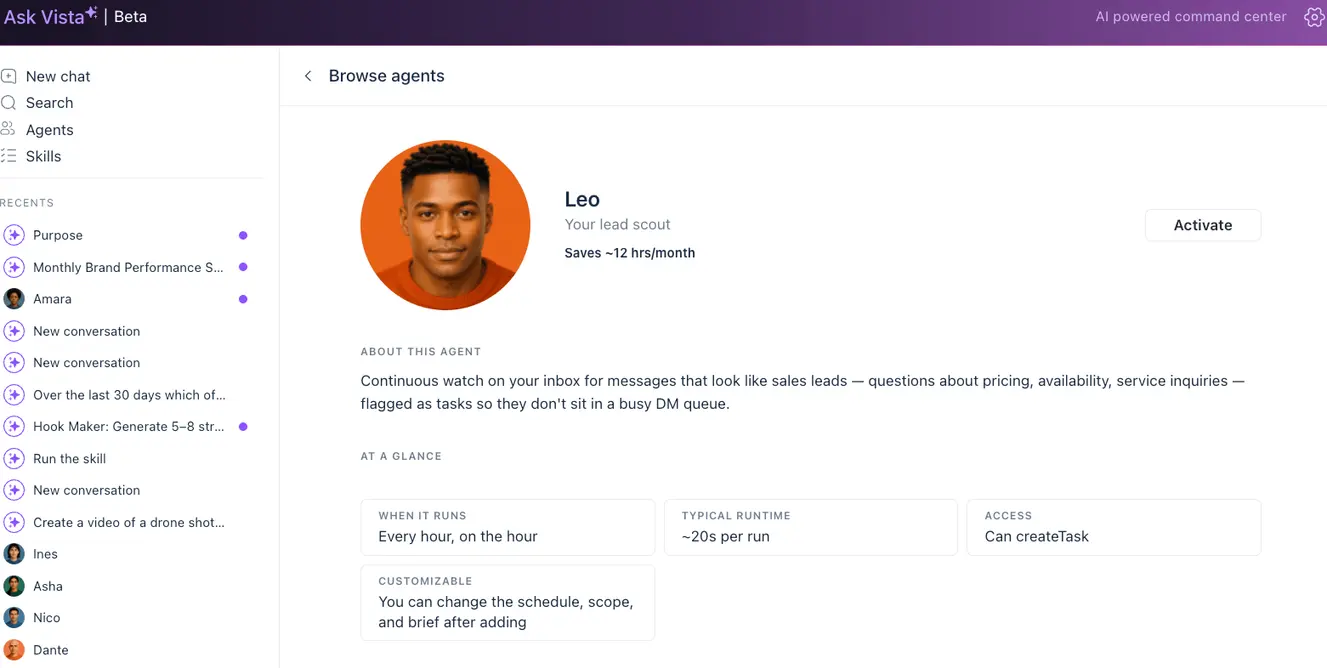
One honest distinction matters here. The account-aware scheduled agents that run recurring work with approval are a different thing from an in-composer caption assistant that helps you draft in the moment. The agents run on a schedule, read the account, and confirm before they publish, so a person stays on the hook for anything live.
From here it gets practical. Decide which tasks are safe to automate, then set up the one that eats the most hours first. That’s usually the weekly report, so it’s worth learning how to automate the weekly report so it sends itself before anything else.
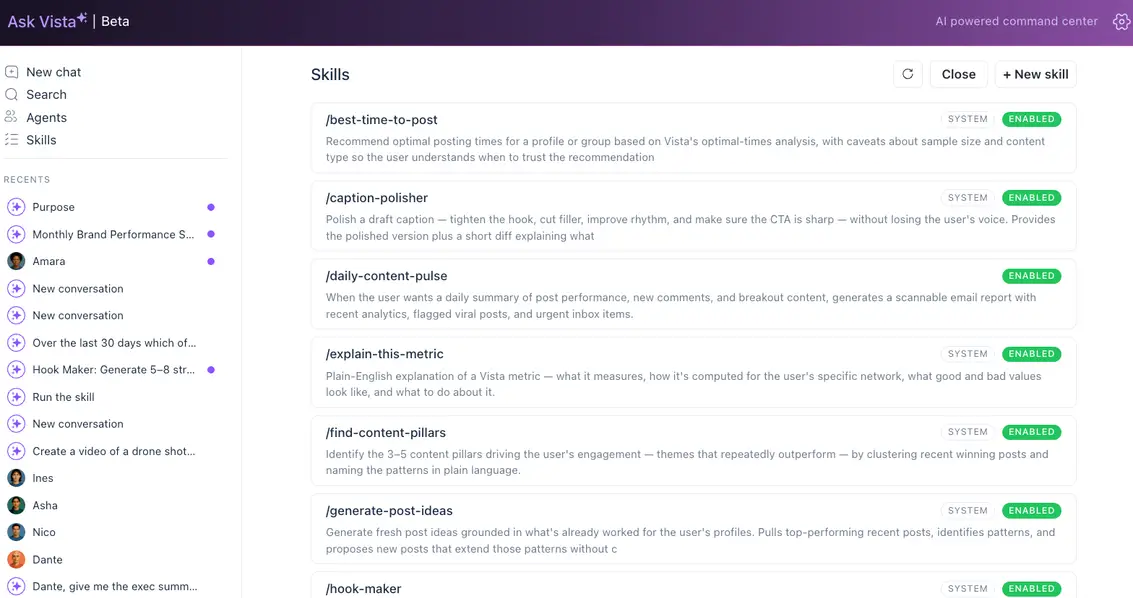
You can hand the recurring grind to a scheduled agent that reports the hours it gives back and confirms before it publishes. Try Vista Social.
Proof: how one agency scaled without hiring
Diane Freeman ran Bee Seen Social Media & Marketing on a patchwork of stitched-together tools. Every basic task took longer than it should: scheduling a post, reformatting it for the next platform, dropping the first comment. The manual load capped how many clients she could take.
She was standing at the exact fork this article describes: grow the team or change the work. She chose to change the work, consolidating onto one platform and automating the repeatable pieces (first-comment and first-like automation, content reuse, and cross-platform scheduling) so the mechanical grind ran itself.
Inside roughly six months, with the headline lift landing in the first 30 days or so, Bee Seen reported a 200% increase in client engagement growth. Diane took on more clients without the proportional hiring the old manual process would have forced. She cleared the backlog by freeing herself from the grind, no second hire required.
When you should still hire
Hire when the judgment, creative, or relationship bucket is the one overflowing. Automation won’t fix that, and pretending it will would be dishonest. Some social work is too nuanced or high-stakes to hand to a machine, and a real strategist is the right answer.
A hire earns their salary when the creative pipeline is the bottleneck, when strategy is thin because nobody has the hours to think, or when you’re entering a new market that needs a dedicated human owner. If that expansion also requires a legal presence, choosing the right entity structure matters, since a branch and a subsidiary come with different operational and legal implications. Those are capacity problems in the human column, where people belong.
If you automate the rule-based grind and your strategist is still underwater on strategy and creative, that’s a real headcount case, and you should make it with confidence. The goal was never to avoid hiring, only to avoid hiring a strategist for a machine’s job.
How to start this week
You don’t need a big-bang rollout. You need one automation running by Friday with a number attached. These five steps get you there:
- Audit the recurring tasks: For one week, have the team log what repeats: the reschedules, the report, the first comment, the triage. Write each down as a rule.
- Sort them into the two buckets: Rule-based and no judgment goes in automate. Judgment, voice, or relationship goes into keep-human. Be honest about the line.
- Pick the top three from the automated bucket: Choose the three that cost the most hours, not the easiest ones. The report is usually one of them.
- Set up one scheduled automation: A single task, on a cadence, with a human approval step before anything publishes or sends.
- Measure the hours saved: Record how long the task took by hand versus now. That number is the case you bring to your VP, not a job description.
Do this and the next capacity conversation changes shape. You walk in with a measured hours-saved figure and a short list of work that still needs a person, not a job description and hope.
Set up your first scheduled automation and let it report the hours it gives back. Start with Vista Social.
Frequently asked questions
Should I hire another social media manager or automate the work?
Automate first. Most backlog is recurring, rules-based execution a scheduled automation can handle. Hire only when the judgment, creative, or relationship work is what’s overflowing, because a new hire spends most of their week on the same grind you already have.
What social media tasks can be automated?
Scheduling and cross-posting, the first comment; tagging and metadata; recurring performance reports; inbox triage by intent; and turning a detected trend into a draft. Keep final approvals and sensitive replies human, so a person still signs off on anything high-stakes.
How do I scale a social media team without hiring?
Offload the recurring execution to scheduled automations that report the hours they save, then redeploy the people you already have onto strategy and creative. You get the strategic capacity you were trying to buy without adding a permanent salary line.
How much does another social media hire cost versus a tool?
A hire is a permanent salary that still leaves the grind manual, plus recruiting, ramp, and management overhead on top. A flat-rate tool with automation returns your team’s hours without a permanent headcount line, at a fixed cost that does not climb every year the way payroll does.
Can AI actually run recurring social media work reliably?
Yes, within limits. Modern scheduled AI agents run defined tasks on a cadence and confirm before publishing, so a human still approves anything high-stakes. They’re built for the mechanical grind, not judgment calls, which is exactly where you want the line.
Try Vista Social for free
A social media management platform that actually helps you grow with easy-to-use content planning, scheduling, engagement and analytics tools.
Get Started NowAbout the Author

Content Writer
Orion loves to write content that refuses to be boring. As part of Vista Social, he helps brands, creators, and agencies stop doom scrolling and start winning with social media. When he's not in front of a keyboard, he's watching films in IMAX with his wife, dissecting football tactics (the European kind), and getting lost in a good book.
Loading related tools...

The most complete social media management platform for teams who demand more.






Tools
PublishingAnalyticsEngagementIntegrations
FacebookInstagramLinkedInRedditSnapchatThreadsTikTokX (Twitter)YouTubeMCPVista Page (link-in-bio)All IntegrationsCopyright © 2026 Vista Social LLC. All Rights Reserved.