


8 Employee Advocacy Tools for Multi-Brand Teams
November 26, 2026
9 min read

Summarize with AI

Table of contents
Share

Vista Social

X (Twitter)


Your employee advocacy program can look healthy until you ask which brand it is helping. People are sharing, the leaderboard is busy, and the reach number keeps growing, but one imprint’s content is appearing in another’s feed, and the quarterly report still needs rebuilding by hand.
When you compare employee advocacy tools, those are the problems worth bringing into the demo. A smooth sharing experience matters, but it won’t tell you whether each brand can keep its own rules or whether the numbers will survive a question from finance.
Use this shortlist to pick two or three options, then run the five tests below with your operator and the people responsible for security and AI policy.
Table of contents
Build your shortlist
These are different reasons to evaluate a tool, not a ranking from best to worst. The final column names the buying decision to settle.
| Tool | Shortlist when you need | Main decision |
|---|---|---|
| Vista Social | Advocacy connected to approved brand publishing | Native reports cover one program, not a multi-program rollup. |
| EveryoneSocial | Group-level curation and local moderators | Does delegated moderation give each brand enough independence? |
| DSMN8 | A dedicated advocacy operation organized by groups and teams | Is a separate content-library workflow right for your team? |
| Employee Advocacy by Sprout Social | Advocacy alongside an existing Sprout operation | Do the advocacy app’s own controls meet your requirements? |
| Parliament by Hootsuite | Topic-based distribution within Hootsuite’s wider operation | Do open and closed topics match your brand boundaries? |
| Oktopost | B2B advocacy organized through boards and performance analysis | Can the proposed setup connect activity to your agreed outcomes? |
| Haiilo Advocacy | Group administration delegated to local leaders | Can local and company-level access reflect your structure? |
| Poppulo Experience Platform | Advocacy within a broader employee-communications program | Do you need the wider scope as well as social sharing? |
What employee advocacy tools do
An employee advocacy tool gives employees approved brand content to share or engage with through their own social profiles and helps managers measure that activity.
For a publishing group with eleven imprints, the challenge isn’t supplying more posts. Editors may work across brands, copy rules may differ, and leadership still needs comparable results. A shared feed alone doesn’t solve that.
LinkedIn began retiring its My Company tab, Employee Advocacy tab, and curator role in November 2024. When replacing that workflow, evaluate the new tool’s distribution, permissions, and reporting rather than assuming they work the same way.
8 employee advocacy tools to compare
Each overview separates strengths, documented trade-offs, and questions to verify. Where the reviewed evidence doesn’t establish a drawback, we haven’t invented one to fill the list.
1. Vista Social
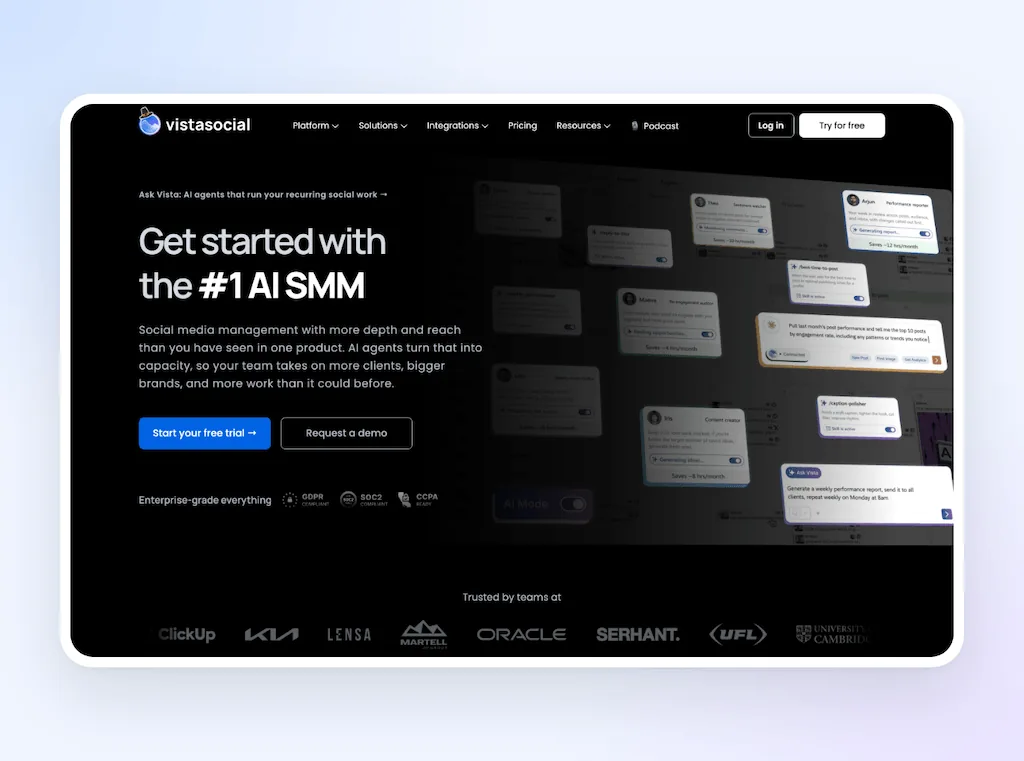
Shortlist Vista Social’s employee advocacy software when you want brand publishing, advocacy, and AI-assisted program management working together. You can take content your team already prepared and put it in front of the right advocates, with separate rules for each brand.
Strengths
- Connected publishing and advocacy: Add content from the composer when scheduling, after publication, or as advocacy-only posts. Your team doesn’t have to rebuild every approved item in a separate library.
- Multi-brand flexibility: Each profile group has its own program, members, and settings. When a profile belongs to several groups, you can choose which group’s program gets a published post, provided the post was published from one profile group and that group has a live program. This lets executive and brand content reach the same advocates.
- Brand-specific AI and copy controls: Set editing rules, invitation restrictions, and join approval per program. Admins can separately disable AI captions, images, and video for advocates when the brand’s policy calls for it.
- Ask Vista takes action: Review program performance, prepare published posts as advocacy drafts, manage program content, invite advocates or resend invitations, and create or update competitions. Chat changes come with a confirmation step, so the manager reviews what will happen.
- Agents cover weekly upkeep: Content refill adds up to three recent posts per network straight to each program without a confirmation step and can’t take any other action. The health check changes nothing, and outreach emails its drafts only to the manager, never to advocates. Agents require Advanced or above and use AI credits; configure their authorized scope before enabling recurring work.
- Participation tools beyond reminders: Email, Slack, and in-app notifications help advocates find content. Competitions have their own dates and scoring weights, with reach excluded from the default leaderboard score, so a large following needn’t decide the winner.
Trade-offs
- No native multi-program reporting rollup: Reports cover one program at a time, including in custom reports. If leadership requires a built-in combined report across programs, that requirement is not met. However, for more customizability, you can ask Vista for those kinds of reports.
- Identity and notification gaps: No SCIM or HR-system sync, and advocacy notifications do not go to Microsoft Teams currently.
Departure check: Removing an advocate revokes program access and cancels their pending scheduled shares in that program. Deleting the whole program does not cancel those shares, so use the appropriate departure process.
Price: An add-on for any plan, free to try with three advocates, then $199 a month for 25 employees. Check current pricing before purchasing.
2. EveryoneSocial
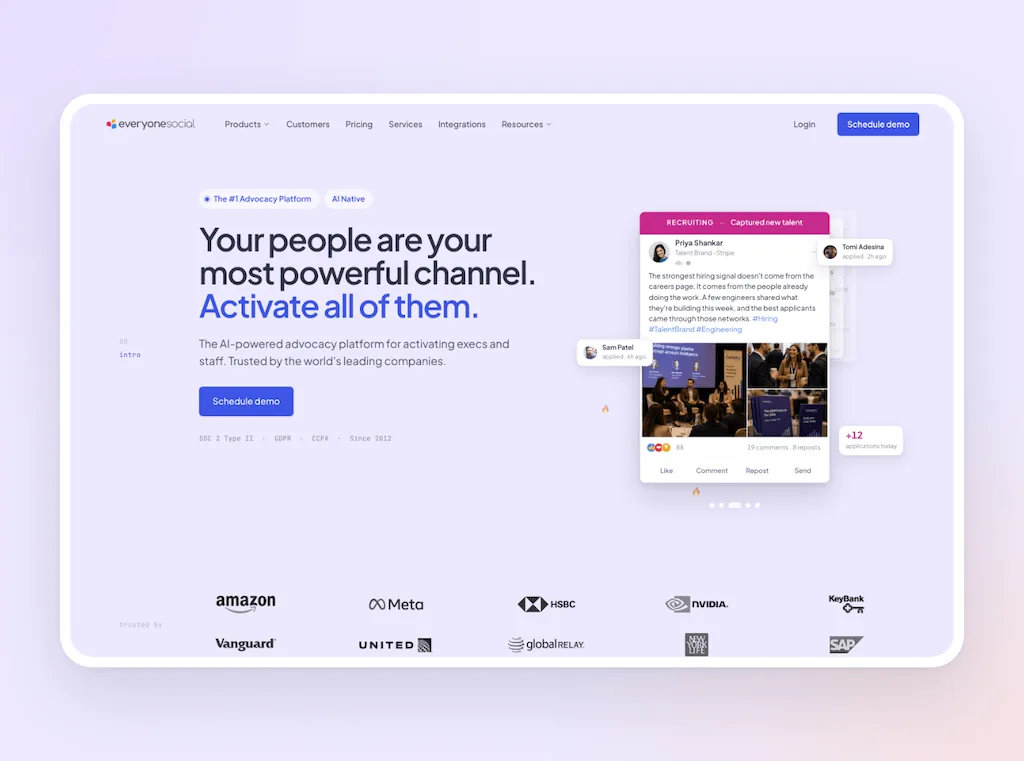
Shortlist EveryoneSocial when local curators need authority over their own brand’s content without receiving account-wide administration.
Strengths
- Local moderation: Assign moderators to individual groups without giving them account-wide administration. They can review, schedule, and publish within their assigned group.
- Copy and activity controls: Share-copy settings cover editing, disclosures, and expiry. Group, user, and post reports help identify participation gaps.
Trade-offs
- Support-assisted deletion: Suspension blocks workspace access, but permanent user deletion is a separate support process. That adds a dependency if IT expects administrators to complete departures themselves.
3. DSMN8
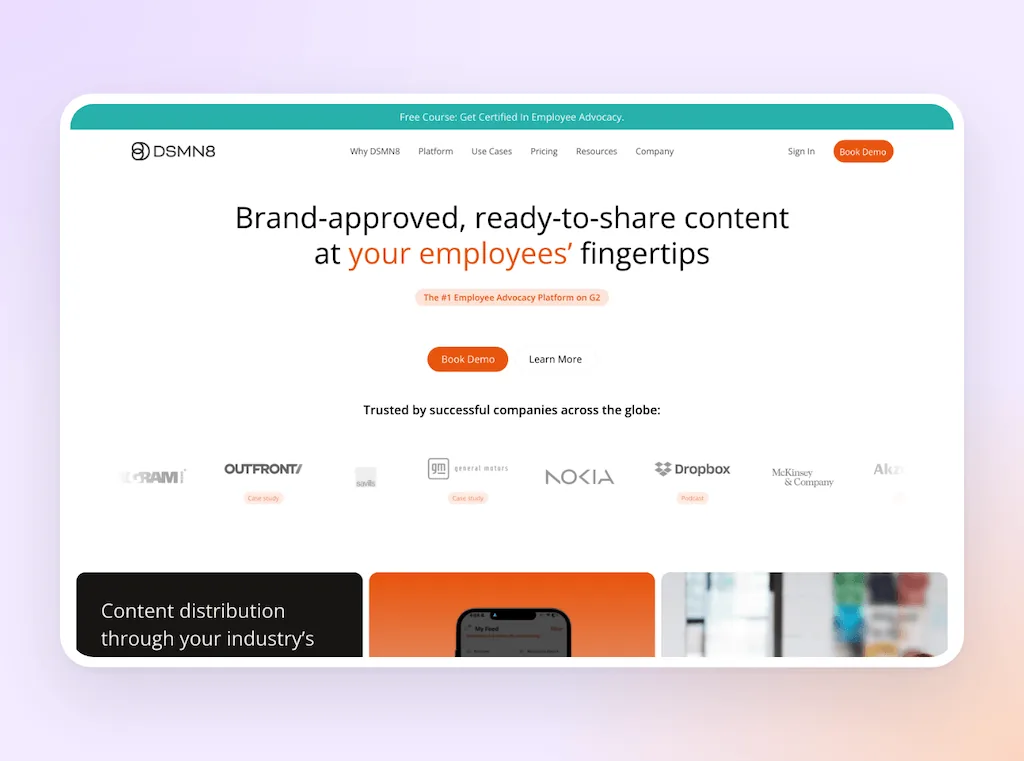
Shortlist DSMN8 when you want a dedicated advocacy operation, with someone responsible for keeping employees supplied with relevant content and improving participation.
Strengths
- Dedicated program structure: Groups and teams direct approved library content to relevant employees, with reporting at program, group, team, and individual levels.
- Workplace distribution: Slack and Teams integrations help employees discover content without relying only on visits to the advocacy library.
Trade-offs
- A separate content workflow: If brand posts originate in another publishing tool, account for supplying and maintaining the advocacy library. Weigh that handoff against the benefit of a dedicated program workspace.
4. Employee Advocacy by Sprout Social
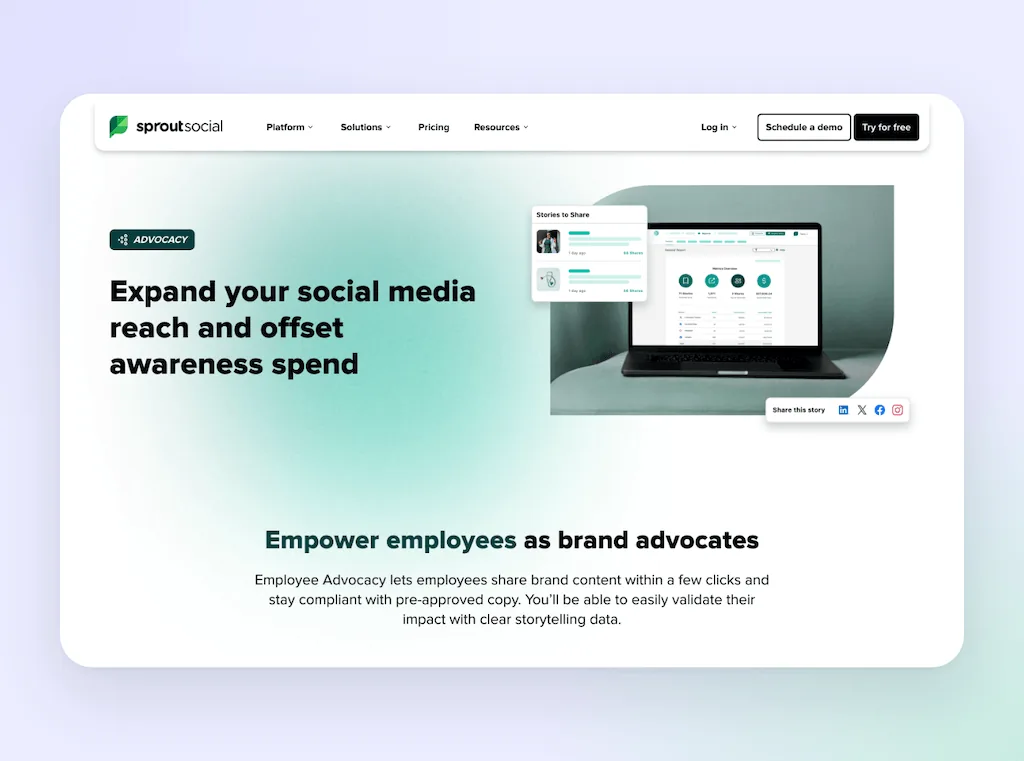
Shortlist Sprout’s advocacy product when you already run social in Sprout and want to evaluate advocacy alongside that operation.
Strengths
- Structured content review: Reader, Contributor, Manager, and Admin roles support distinct responsibilities, while suggested content can enter review.
- Targeting and identity: Teams support targeted distribution and team-level user reporting. Advocacy SSO and just-in-time provisioning are documented, with new users initially receiving Reader permissions.
Trade-offs
- Distinct advocacy application: Advocacy has its own application and administration workflow. Existing use of Sprout does not mean all advocacy work happens in the main social interface.
5. Parliament by Hootsuite
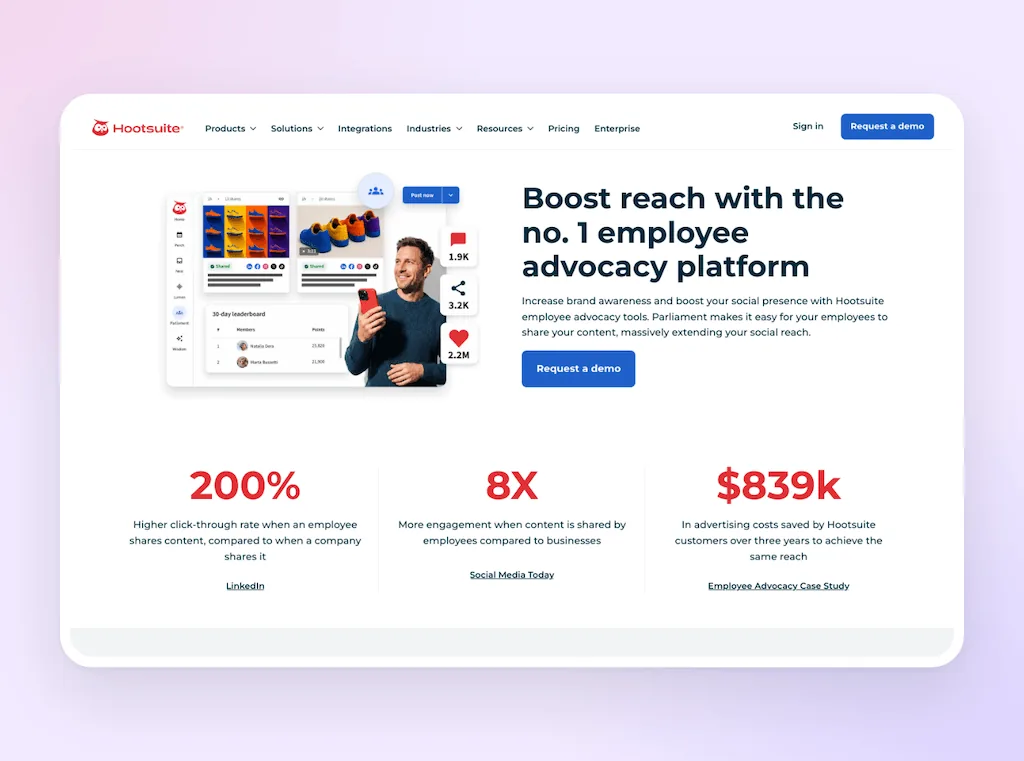
Shortlist Parliament, formerly Amplify, when topic-based content distribution fits your employee program and you want to evaluate it within Hootsuite’s wider operation.
Strengths
- Topic-based distribution: Open and closed topics organize approved content for different employee audiences within Hootsuite’s wider operation.
- Multiple sharing paths: Web, mobile, and Slack paths support sharing, with reporting on participation, shares, clicks, and content performance.
Trade-offs
- Overlapping topic audiences: A post assigned to several topics can reach a wider set of advocates. That behavior needs care when topics represent brands with restricted audiences.
6. Oktopost
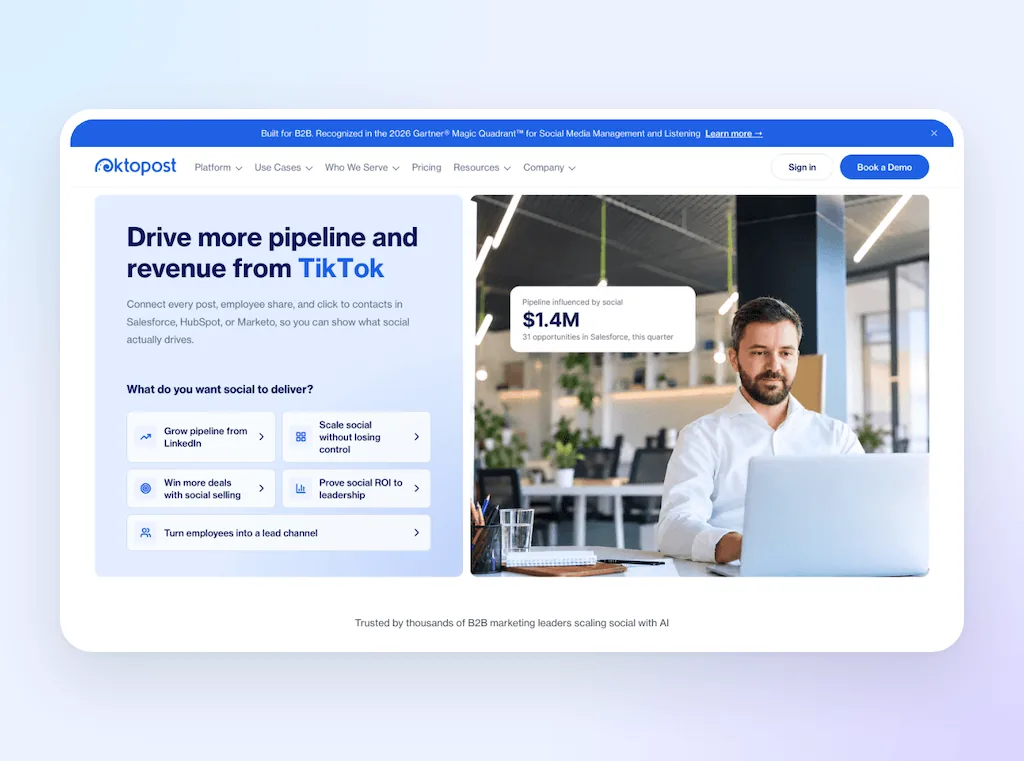
Shortlist Oktopost when your B2B advocacy evaluation needs to connect employee activity with the social performance and business outcomes you report.
Strengths
- B2B program organization: Boards, topics, stories, and advocates provide a structure for examining a brand or business division’s activity.
- Performance context: Documented interfaces include story approval status, membership, and advocate activity, while advocate-facing analytics show results from shared content.
Trade-offs
- Board-by-board data extraction: If you build your own reporting integration, detailed advocate filters such as role, participation, and leaderboard are scoped to one board in the API. A cross-brand analysis therefore needs board-level requests and reconciliation.
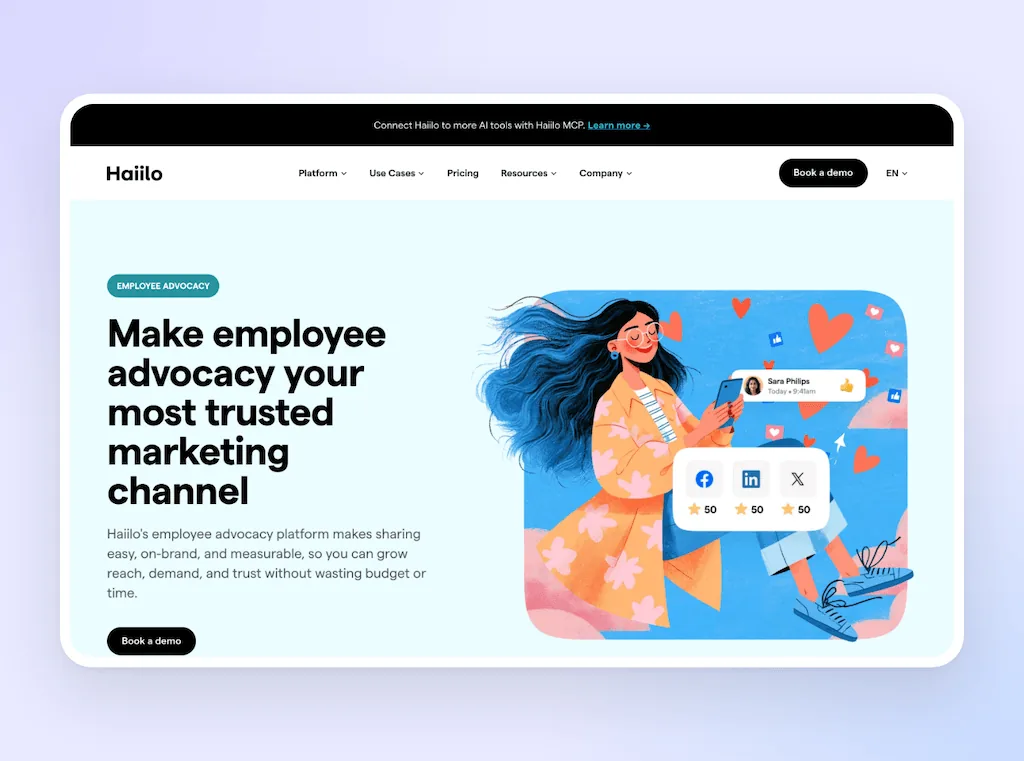
7. Haiilo Advocacy
Shortlist Haiilo when regional or brand leaders should run their own programs while a central team retains company-level oversight.
Strengths
- Delegated administration: Group Admins manage their group’s users, channels, settings, and analytics, while Company Admins retain broader authority.
- Cross-group controls: Intergroup-access settings provide a specific control to evaluate when brands should not browse each other’s content.
Trade-offs
- One home group per user: Employees can belong to only one group, although permitted cross-group channel access can expose other brands’ content. Shared employees therefore need an access design rather than membership in several brand groups.
- Groups cannot be retired directly: Created groups cannot be deleted or archived. If brands frequently merge or close, plan how to handle their groups and content before building the structure.
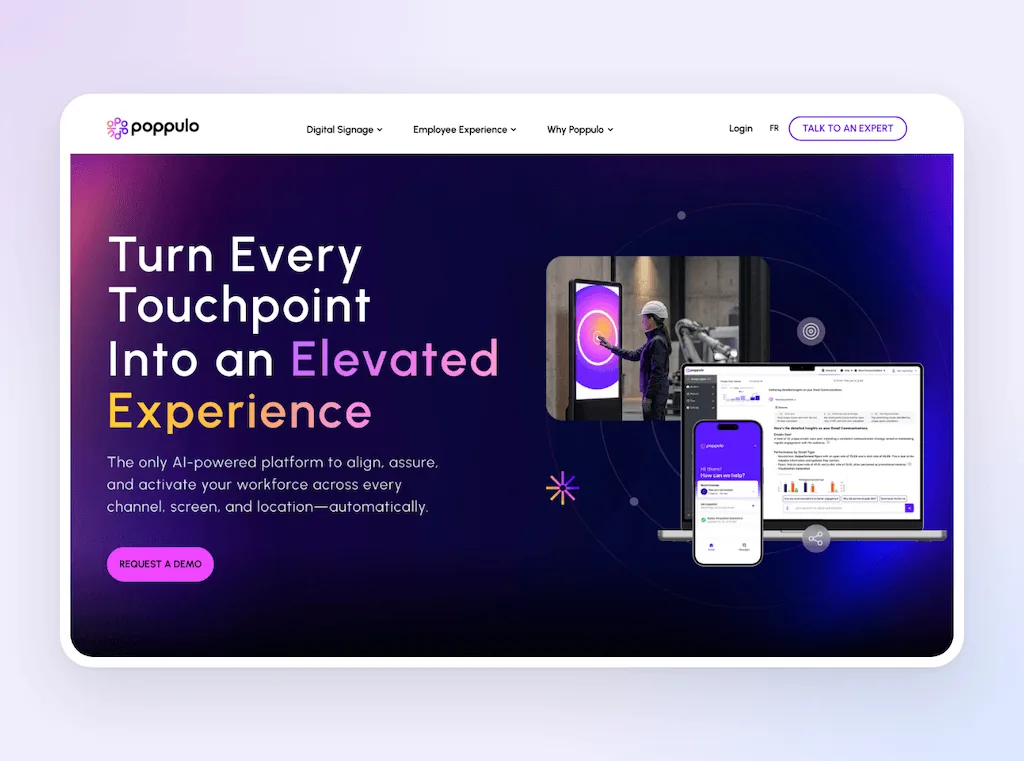
8. Poppulo Experience Platform
Shortlist Poppulo, formerly Sociabble, when advocacy is part of a wider employee-communications program rather than a standalone social-sharing project.
Strengths
- Broader employee reach: Advocacy can sit alongside internal distribution, mobile access, and recognition rather than operating as a standalone marketing library.
- Audience organization: Targeted groups and content permissions support managing different employee audiences within the wider communications program.
Trade-offs
- Broader operating scope: Internal distribution, recognition, and advocacy share the wider platform proposition. If your brief is limited to social sharing, weigh that breadth against the administration you actually want to take on.
Five tests for your finalists
Use the same two brands and one sensitive post in every demo. It’s easier to spot a meaningful difference when vendors aren’t solving different examples.
1. Separate the brands
Open Brand A as its manager and as an advocate, then try to access Brand B. Include one employee who legitimately belongs to both.
Pass: Content visibility and management permissions follow membership, not just a feed filter.
2. Try changing approved copy
Edit the caption, link, and media on the sensitive post, including with AI suggestions. Follow any required review using our approval workflow guide.
Pass: The offered version and permitted edits match your policy. Remember that no sharing tool stops an employee writing independently in a native app.
3. Complete a first share
Follow the invitation, profile connection, notification, and share on a supported device. If mobile sharing is a requirement, have the vendor demonstrate the current advocate experience on a phone. Define pilot participation as invited advocates completing an agreed action divided by invited advocates, and count sharing separately from likes.
Pass: You can locate where someone stopped and provide the right advocate training, rather than sending everyone another reminder.
4. Rebuild a reporting number
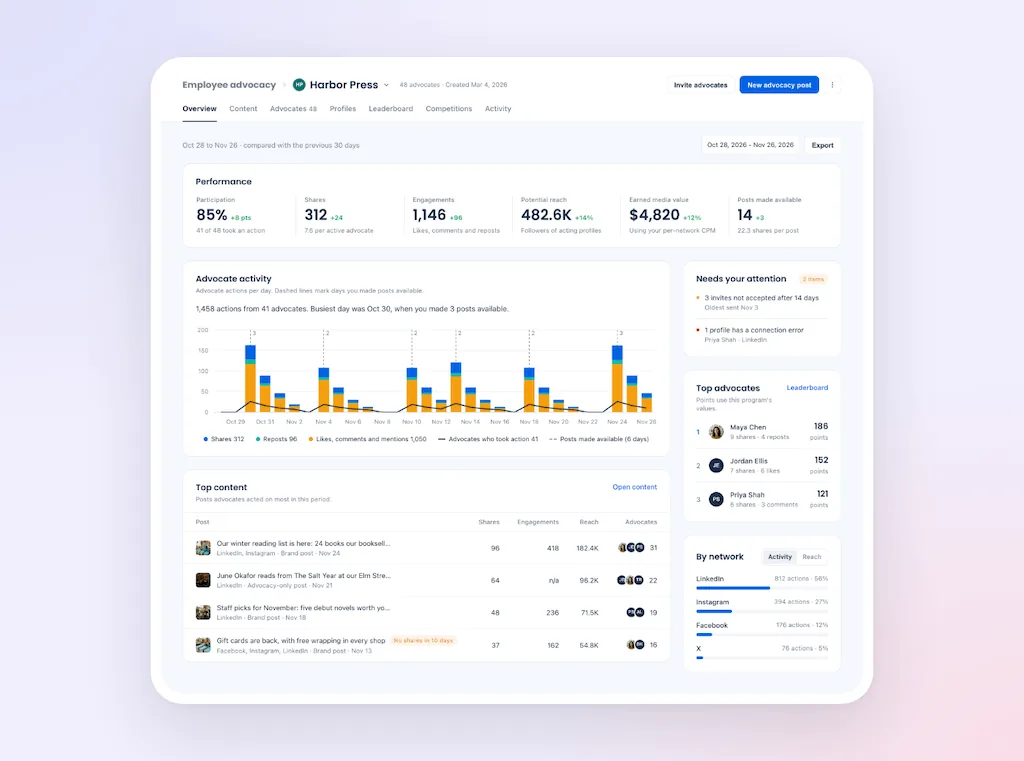
Separate recorded actions, follower-based audience estimates, observed impressions, clicks, and business outcomes. Earned media value (EMV) is a modeled paid-media equivalent, not revenue or money saved.
For example, Vista Social sums follower counts associated with recorded actions and applies each network’s configured cost per 1,000 for EMV. One 10,000-follower profile liking, commenting, and sharing can contribute 30,000 to its reach estimate, not 30,000 verified viewers.
Pass: You can reproduce the formula and explain audience overlap and reporting scope. Our measurement guide covers the wider scorecard.
5. Remove a test advocate
Check access from an already-open session, pending shares, connected profiles, and retained records. Test advocate identity controls, not only administrator SSO.
Pass: You have a named departure owner and know what removal stops, preserves, or leaves for follow-up.
Use AI for one reviewed handoff
Once you have approved content, Ask Vista can help turn it into advocacy material without rebuilding the post. Its advocacy tools are also available through MCP, which connects an approved AI assistant to Vista Social under your permissions. Outside Ask Vista, the connected assistant asks for approval in its own conversation.
Review the program, selected posts, and draft status before confirming, then inspect the saved result. The manager keeps the content decision; this workflow doesn’t supply a separate editorial approval chain or remove advocates.
For recurring upkeep, the agent guide covers the weekly options and their availability. Keep those choices separate from proving this first handoff.
Before the purchase
- Security and retention: Request security documentation, processing terms, data locations, deletion rules, and export options.
- Advocate identity: Establish SSO, provisioning, and departure behavior for employees, not just administrators. Label unverified requirements as unverified.
- AI handling: Confirm what employee and content data reaches AI services, retention and training terms, access scopes, and who reviews changes.
- Approved integrations: Validate your identity provider, collaboration channels, and approved AI tools. Where MCP is offered, check the actual advocacy actions and permission boundaries, not just connector availability.
Choose the right fit for your brand
Start with two or three tools that match how your team works. Look for clear brand permissions, an easy sharing experience for employees, and reports you can explain to leadership. Use the same tests for each tool so the differences are easier to see.
Want to see how Vista Social could fit your advocacy program? Book a demo and explore it with us.
Frequently asked questions
Which employee advocacy tool is best for multiple brands?
Choose by the work: brand-content handoffs, delegated curation, dedicated participation management, or wider employee communications. Then apply the same access, editing, sharing, reporting, and removal tests to your finalists.
Do you need a dedicated advocacy platform?
Not always. An integrated option can suit advocacy built around approved brand posts; a dedicated platform deserves evaluation when program administration is a separate operation. Neither category guarantees the identity controls or reporting you need.
Does earned media value prove ROI?
No. EMV estimates a media equivalent using a vendor’s formula. Keep it separate from measured clicks, qualified inquiries, hires, or revenue.
Can one platform keep several brands separate?
Programs, groups, boards, and teams can organize brands, but their names don’t prove access separation. Test the advocate and local-manager views, then check whether reporting uses the same boundaries.
About the Author

Content Writer
Orion loves to write content that refuses to be boring. As part of Vista Social, he helps brands, creators, and agencies stop doom scrolling and start winning with social media. When he's not in front of a keyboard, he's watching films in IMAX with his wife, dissecting football tactics (the European kind), and getting lost in a good book.