


Published on July 15, 2026
9 min to read
Vanity Metrics vs What Actually Proves Social ROI

Summarize with AI

Table of contents
Summarize with AI

ChatGPT

Claude

Perplexity
Share

Vista Social

X (Twitter)


In May 2019, an influencer with 2.6 million followers launched a clothing line. She needed to sell 36 shirts to make the first production run. She couldn’t, and she had to pull the brand. Every one of those followers counted as a win on somebody’s report, and that’s the trouble with vanity metrics.
She had 2.6 million followers, and not three dozen of them would buy a t-shirt. The story went around because it was funny, but it should have been terrifying.
Followers, likes, reach, and the one that sounds smartest of all, engagement rate, all photograph beautifully and pay almost nothing. Engagement rate especially gets a pass, because it has a formula, and a formula feels like science.
A formula creates the appearance of proof, even though it isn’t proof at all. That’s the disguise vanity metrics wear, a lab coat they never earned.
- Vanity metrics measure activity, like likes, followers, and impressions. Actionable metrics measure outcomes, like conversions, click-through rate, and cost per acquisition
- Engagement rate is a useful diagnostic, but reporting it as ROI is the trap
- 63% of CMOs now face rising CFO pressure to prove marketing’s value, and activity charts don’t survive that room
- Rebuild your monthly report around three or four outcome metrics you can pull this quarter
Table of contents
What are vanity metrics?
Vanity metrics are numbers that measure activity. Likes, followers, and impressions all fall into this group. They look impressive on a slide, but they don’t show whether the business grew.
There’s a simple test that separates vanity metrics from real ones. Ask whether a change in the number forces a decision. If your follower count doubles and nothing else changes, that number was never doing any work. It was decoration.
A metric earns its place one way: a change in it either forces a decision or shows up in revenue. If it can double while the business stays flat, it’s decoration, no matter how good the formula looks.
Vanity metrics earned their bad reputation honestly. They’re the easiest numbers to inflate and the hardest to connect to a dollar. A bot-heavy follower list still counts as followers. A caption that baits a comment still counts as engagement. None of that tells you whether your business is healthier than it was last month.
Is engagement rate a vanity metric?
Yes and no, and the distinction matters. Engagement rate is a real diagnostic, not a business outcome, and it becomes vanity the moment you report it like one.
The formula is simple. Take your total engagements, divide by your impressions or reach, and multiply by 100. That gives you a clean percentage with decimal places, the kind of number that makes your report look analytical instead of like a scrapbook of likes.
But that feeling of measurement is exactly the disguise. A percent tells you how much activity happened, not what that activity did for the business.
Picture the Monday meeting. Engagement rate is up 40 basis points, reach is up, saves are up, and you feel good walking in. Then someone asks the question the chart can’t answer. How many customers did we get? The numbers that looked like proof five minutes ago are suddenly a list of things that aren’t customers. You start explaining that engagement is a leading indicator, and you can hear yourself losing the room.
The metric didn’t fail you in that meeting. It failed you weeks earlier, when you decided it would be the headline.
None of this means engagement rate is useless. It’s a genuine signal of whether your content is landing with the people who see it. If you want how to read your engagement rate honestly, the benchmarks are worth knowing. What it can’t do is stand in for revenue.
Why the disguise costs you
Trusting the disguise has a real cost, and it’s bigger than one awkward meeting. That clothing line proved it. Big numbers coexisted with zero business result, and everyone half-knew it before it happened. Followers, likes, and impressions, the classic vanity metrics, are the easiest numbers to inflate and the least attached to money.
The pressure to get this right is climbing fast. 63% of CMOs report increased pressure from their CFO to prove marketing’s value, up from 52% two years earlier. The finance side of your company has stopped taking engagement rate at face value, even if your report hasn’t caught up yet.
Robert Rose, chief strategy advisor at the Content Marketing Institute, has been tracking this shift in a series on content measurement. He put it plainly in a recent piece:
AI has induced hyperinflation in the currency of attention. Environmental conditions have changed so fundamentally that our old metrics fail to predict performance.
He’s writing about content marketing, but the point lands just as hard on social. This goes beyond taste. It’s a budget-defense risk, and a social manager who keeps leading with engagement rate is bringing a scrapbook to a meeting about money. Report activity as if it were an outcome long enough, and when budgets tighten, social becomes the easiest line to cut, because nobody in the room can point to what it actually bought.
When “vanity” metrics are actually the right call
Context decides whether a metric is vanity, and that’s worth saying plainly. If your goal really is reach, some of these numbers become your real KPIs.
Say you’re running a pure awareness campaign. Maybe you’re launching a new product line, or you’re a new brand building recognition from zero. In that case, reach and follower growth aren’t decoration. They’re the goal you set out to hit, and reporting on them honestly is the right call.
The same goes for a brand that’s pre-revenue and building an audience on purpose. Chasing conversions before you have a warm audience to convert puts the cart before the horse. A newly launched product line with no existing audience needs recognition before it needs a conversion funnel, and reach is the honest way to track that first stage.
Certain metrics aren’t always garbage. What matters is whether the metric matches the goal you actually set. Engagement rate reported against an awareness goal is a fair read. Engagement rate reported as proof of ROI against a revenue goal is the trap. Know which game you’re playing before you decide which scoreboard to trust.
What to measure instead
A short list of outcome metrics can answer what activity metrics can’t. It just takes picking the right handful and reporting them consistently.
Focus on three or four numbers that tie directly to the business. Conversions or leads from social, click-through rate to your site, cost per acquisition, and a share of voice number tied to a specific goal cover most of what leadership actually wants to know. Here’s how the swap looks in practice.
| Vanity metrics | Actionable metric | Why it matters |
| Followers | Conversions or leads from social | Ties activity to pipeline |
| Likes | Click-through rate to your site | Shows real interest, not a passing tap |
| Impressions | Cost per acquisition | Shows what each new customer actually costs |
| Reach | Share of voice tied to a goal | Ties visibility to a business outcome |
Build your next report around four lines instead of a wall of vanity metrics. Pull these each period, and you’ll have an answer ready the next time someone asks what social actually did:
- Conversions or leads generated from social this period
- Click-through rate to your website
- Cost per acquisition from social channels
- Revenue attributed where you can track it, or share of voice tied to your stated goal
For a deeper walkthrough of the full attribution setup, the full walkthrough on measuring social media ROI covers the framework end to end. If you’re reporting to a CMO or a client who wants the business case spelled out, reporting the metrics that actually matter to a CMO breaks down how to frame each number for that audience.
If rebuilding your report from scratch feels like a lot, that’s the point where a tool should carry the load instead of you. Build a report that answers the ROI question with a platform that pulls outcome metrics and diagnostics into the same view, no manual exports required.
How to pull outcome metrics without a data team
You don’t need a data science team for this, and you don’t need perfect attribution either. Attribution for social is genuinely messy, and pretending otherwise sets you up to fail your own report.
Start with UTM-tagged links on everything you post. That alone lets you see which posts actually drove a visit, a signup, or a sale, instead of guessing from engagement alone. Keep your naming consistent across campaigns so the data stays usable six months from now, not just this week. Pair that with your platform’s native conversion tracking, and you’ll have a real, if imperfect, picture of what’s working.
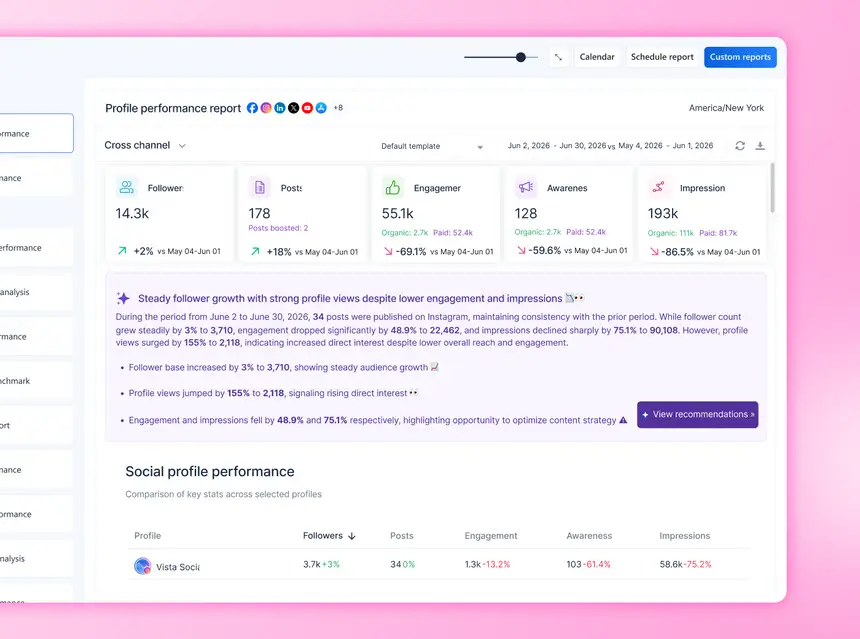
The goal is a dashboard that puts outcome metrics next to the diagnostics, not one that replaces engagement rate with a different single number to obsess over instead. Vista Social’s custom report builder does this by showing engagement rate as one column beside the numbers leadership actually asks about, so the two live on the same page instead of in separate decks.
Reports can run and send themselves on a set schedule, so the Monday deck stops eating your morning. When the report lands, an AI-generated summary writes the plain-language takeaway for you, turning a data dump into something a busy executive can scan in five minutes. If you’re reporting to clients or a leadership team that wants your own branding on it, white-label reporting keeps the polish without extra work.
This won’t hand you perfect ROI math. It hands you a report that makes the honest version of your numbers easy to build and easy to defend. If you want the full setup, build a dashboard that shows outcomes, not just activity walks through it. Ready to put it into practice? Build a report that answers the ROI question with a 14-day free trial. No credit card required.
Send a report that skips the vanity metrics
That Monday meeting doesn’t have to end the same way. You used to walk in with reach, likes, and an engagement rate that looked great on a slide, and you left explaining why none of it was revenue.
Next time, hand up four lines instead. Conversions, click-through rate, cost per acquisition, and revenue where you can track it. That’s an answer to the ROI question, not a bigger chart.
Engagement rate can stay in your report. It’s a fine diagnostic, and there’s nothing wrong with knowing your content resonates. Just stop asking it to do a job it was never built for. The lab coat looked convincing, but there was never a business outcome underneath it.
Frequently asked questions
What are vanity metrics in social media?
Vanity metrics are numbers that measure activity, not outcomes. Likes, followers, impressions, and reach all fall into this category. They look impressive, but they don’t show whether the business grew. The test is simple: any metric that can double while revenue stays flat belongs in the vanity metrics category.
Is engagement rate a vanity metric?
It’s a useful diagnostic of whether your content resonates with the people who see it, but it isn’t a business outcome. It becomes one of the vanity metrics the moment you report it as proof of ROI.
What are examples of actionable metrics?
Conversions or leads from social, click-through rate to your site, cost per acquisition, and share of voice tied to a specific goal. Each one, when it moves, tells you to do something.
What should I report to my boss instead of likes and followers?
Send a short outcome view: conversions from social, click-through to your site, cost per acquisition, and revenue attributed where you can track it. Put diagnostics like reach and engagement rate underneath as context, not the headline.
Are vanity metrics ever useful?
Yes. For a pure awareness campaign or an audience-building push, reach and follower growth can be legitimate KPIs. The rule is to match the metric to the goal, not to ban certain metrics outright.
Why do vanity metrics matter less to leadership?
Because they don’t connect to revenue, and finance is under growing pressure to justify every dollar. 63% of CMOs report rising CFO pressure to prove marketing’s value. Activity charts don’t survive that scrutiny.
Try Vista Social for free
A social media management platform that actually helps you grow with easy-to-use content planning, scheduling, engagement and analytics tools.
Get Started NowAbout the Author

Content Writer
Russell Tan is a content marketing specialist with over 7 years of experience creating content across gaming, healthcare, outdoor hospitality, and travel—because sticking to just one industry would’ve been boring. Outside of her current role as marketing specialist for Vista Social, Russell is busy plotting epic action-fantasy worlds, chasing adrenaline rushes (skydiving is next, maybe?), or racking up way too many hours in her favorite games.