


Published on June 19, 2026
13 min to read
Social SEO in 2026: A Playbook for Search, Social, and AI Answers

Summarize with AI

Table of contents
Summarize with AI

ChatGPT

Claude

Perplexity
Share

Vista Social

X (Twitter)


A prospect wants a project management tool. Two years ago she would have typed “best project management software” into Google and skimmed a few blue links.
This week she opened TikTok, searched the same thing, and watched three people who use these tools talk through the trade-offs. Then she opened ChatGPT and asked which one fit a five-person team that lives in Slack.
She bought one of the two names the chatbot brought up. She never saw a search ad, and she never visited the winner’s homepage until after she had decided.
That buyer is the reason “rank on Google” has stopped being the whole job. Discovery now spreads across TikTok search, YouTube, Instagram, Reddit threads, and a growing set of AI answer engines that read all of it and hand back one confident reply.
This playbook is the response to that shift. By the end you will have a clear, step-by-step system for getting your social content found in social search and surfaced inside AI answers. That way the people researching you can find you where they now look.
Table of contents
Why this matters now
The behavior has already moved, and the data backs it up. According to DataReportal’s Digital 2025 report, half of all adult social media users now visit social platforms to learn more about brands.
Instagram leads, with 62.3% of its adult users researching brands there, followed by Facebook at 52.5% and TikTok at 51.5%. Meanwhile, no single channel introduces brands to more than about a third of adult internet users, with even search engines cited by only 32.8%.
Discovery is no longer one bar. It is spread thin across a dozen surfaces, and many of those surfaces are social.
That spread changes the math of where your effort should go. Pouring everything into ranking one page on Google means competing hard for a slice of attention that keeps shrinking, while the surfaces your buyers actually browse sit unattended.
The AI layer is moving just as fast. People ask a chatbot for a recommendation and trust the names that come back, and those answers tend to surface what many independent sources already agree on.
This is already mainstream behavior and not a fringe habit. The 2025 Edelman Trust Barometer found that among the 55% of people who use generative AI platforms, 91% use them for shopping in some way, including researching brands and comparing products.
Edelman’s own takeaway is blunt: brands need to move from SEO to GEO, because what shows up in an AI answer is shaped by reputation, relevance, and credibility you earn, not buy. So the brand mentioned across plenty of credible places becomes the brand the model repeats. That is the whole game, and it rewards presence over tricks.
One more shift changes how you write. People ask AI tools longer, more specific, interrogative questions than they ever typed into Google.
Not “running shoes” but “best running shoe for a 45-year-old on their feet all day with a busy family.” Your content gets found when it answers questions in that natural, specific shape, which is the shape a good caption or FAQ already takes.
A quick word on tone is worth adding here. The brands good at this do not sound like they are optimizing, they sound like a knowledgeable person answering a real question, and that is the point. Write the way you would explain the thing to a curious friend, then make sure the searchable phrase is in there, and you have satisfied the human, the platform, and the model in one pass.
The playbook
Seven steps, in order. Each one stands on its own, and together they make you findable across social search and AI answers. Work them top to bottom the first time, then keep them as a checklist you run on every post.
Step 1: Do keyword research where your buyers search
Start by learning the exact phrases your audience types into the search bar inside each platform. They tend to differ from traditional search engines. TikTok’s search suggestions, YouTube’s autocomplete, and Instagram’s search all hint at real demand. They reward plain, spoken language over marketing speak.
Here is how to do it. Type a seed topic into the search bar on TikTok, YouTube, and Instagram, and write down every autocomplete suggestion. Note the questions people ask in comments under the top videos. Group the phrases into the handful of themes your content should own.
Pay special attention to phrasing nobody is answering well yet. A suggestion that keeps appearing but returns weak, off-topic videos is an open lane. Being the clear answer is far easier than fighting for a crowded term.
Here’s how to know it’s done well: You have a short list of real, in-platform search phrases in your audience’s own words. You can see which ones nobody is answering clearly yet.
The Vista Social fast path: Use social listening to watch what your audience and competitors are saying and searching, so your keyword list comes from real conversations rather than guesses.

Step 2: Write captions and titles that answer a real question
Treat the first line of every caption and every video title as a search result, because that is what it becomes. Lead with the phrase someone would search. Then deliver the answer fast so both a human and a crawler can tell what the post is about.
A title like “3 project tools for small teams (honest pros and cons)” tells a searcher and an AI exactly what they will get. A clever title that hides the topic might earn a smile, but it disappears in search. Write the searchable version first, then add the personality.
Here is the same post, weak then optimized, so the difference is concrete:
| Weak caption | Search-optimized caption |
| “Game-changer alert. The tool our whole team is obsessed with. Link in bio.” Nothing here tells a person or a crawler what it is or who it is for. | “The best project management tool for a small remote team (honest pros and cons). We tested three for a five-person team that lives in Slack, here is what won.” The search phrase is right up front, and the post still has a point of view. |
Same energy, but only one of them gets found when someone searches “project tool for small teams.”
Here’s how to know it’s done well: a stranger reading only your title or first caption line knows precisely what question the post answers.
The Vista Social fast path: draft and refine those first lines with AI content creation tools built into the composer, so you can write the searchable version and the on-brand version side by side.

Step 3: Optimize the parts of a post that platforms read
Every platform reads more than your video. It reads the on-screen text, the spoken words, the alt text, the hashtags, and the pinned comment. Each one is a chance to reinforce the topic.
Fill them in deliberately instead of leaving them blank.
- On-screen text and captions: put your key phrase in the first few seconds of on-screen text, since platforms read it and many viewers watch on mute.
- Spoken keywords: say the search phrase out loud in the video, because auto-captions become searchable text.
- Alt text: describe the image in plain language with the topic included, which helps both accessibility and search.
- Hashtags: use a few specific, topical tags over a pile of broad ones, so the post is filed under the right subject.
- Pinned comment: add a short text summary or the question answered, giving crawlers clean text to index.
None of this takes long once it is a habit, and the payoff compounds. Each filled field is another way the same post can be found, so a single video can surface for several different searches instead of just one.
Here’s how to know it’s done well: none of these fields is empty, and each one repeats the core topic in natural language rather than keyword soup.
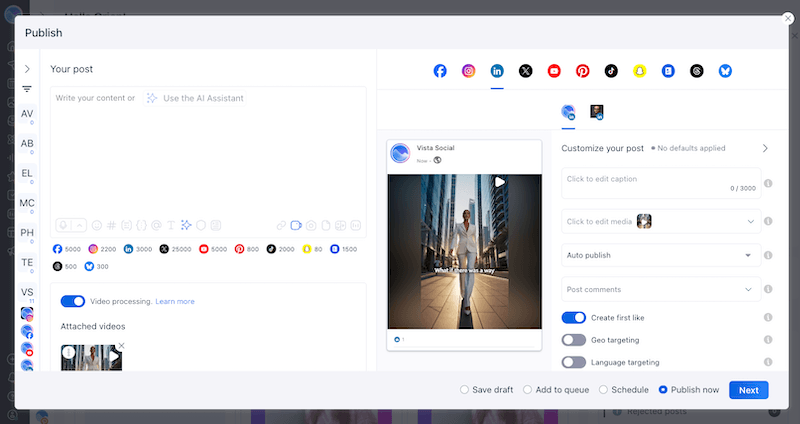
The Vista Social fast path: the short-form video workflow lets you set captions, alt text, and the first comment as you schedule, so optimization happens once, at publish.
Step 4: Build topic depth, not one-off posts
Search engines and AI both trust a brand that covers a topic thoroughly. Cluster your content instead of posting one orphan video per idea. Pick a few core topics you want to be known for. Publish a steady run of posts that answer the related questions around each one.
Depth signals expertise in a way a single viral hit never does. When a model sees you answer the beginner question, the comparison question, and the edge-case question on the same theme, you become the obvious source to cite.
Here’s how to know it’s done well: for each core topic, a curious person could follow your posts from “what is this” all the way to “which option is right for me” without leaving your account.
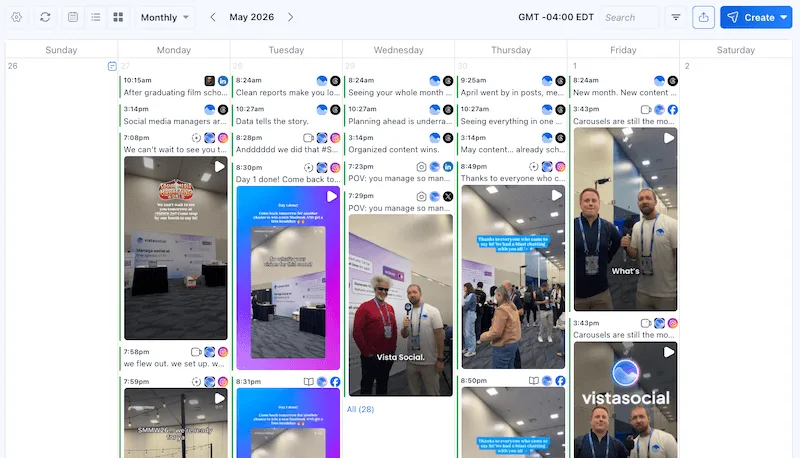
The Vista Social fast path: plan those clusters with a social media management calendar, so related posts ship on a rhythm instead of at random.
Step 5: Earn mentions in the places AI reads
AI answers lean on what credible sources already say about you. Being named in the right places matters as much as your own posts. Reddit threads, YouTube reviews from other creators, roundups, and community Q&A are all sources an answer engine weighs when it decides who to mention.
You earn those mentions the slow way: by being useful in communities where your buyers gather, by giving creators something worth talking about, and by showing up often enough that your name keeps coming up.
You can make a post searchable, but you cannot make a model name you, so you build the broad presence that makes naming you the natural choice.
Here’s how to know it’s done well: when you search your category in a few AI tools, your brand surfaces in the conversation, even in places you did not publish.
The Vista Social fast path: track where your brand gets mentioned by monitoring brand mentions, so you can spot the threads and creators worth engaging while the conversation is live.

Step 6: Make a strong FAQ and pin it everywhere
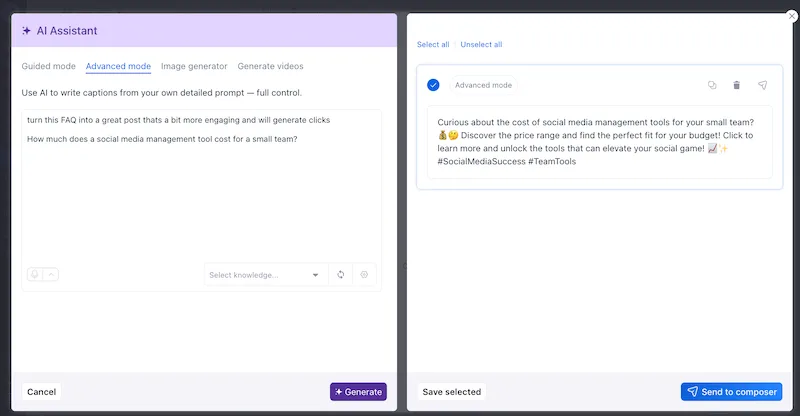
AI answer engines reward a clean question-and-answer, so give them one. Build a short FAQ of the real questions people ask about your category. Answer each in two to four plain sentences, and reuse those answers in captions, pinned comments, and your profile.
Match the specific way people ask. “How much does X cost for a small team” beats “pricing,” because it mirrors the interrogative question someone types into a chatbot.
Answer it directly in the first sentence, then add a little context.
Here’s how to know it’s done well: each answer reads like a complete, quotable reply on its own, with no setup required to make sense of it.
The Vista Social fast path: turn those answers into a steady stream of posts with AI social media assistant, so one FAQ becomes a month of searchable, snippet-ready content.
Step 7: Measure what gets found, then double down
Treat discovery as something you can read and improve, not a mystery. Watch which posts pull search traffic, which phrases keep surfacing in your reach, and which topics compound over weeks, then make more of what works.
Post-publish numbers are a rear-view mirror for engagement, but for search they are a map. A video that keeps gaining views months later is telling you a search demand exists, so answer the next ten questions around it.
Here’s how to know it’s done well: you can name your top three discovery topics from the data, and next month’s plan leans into them on purpose.
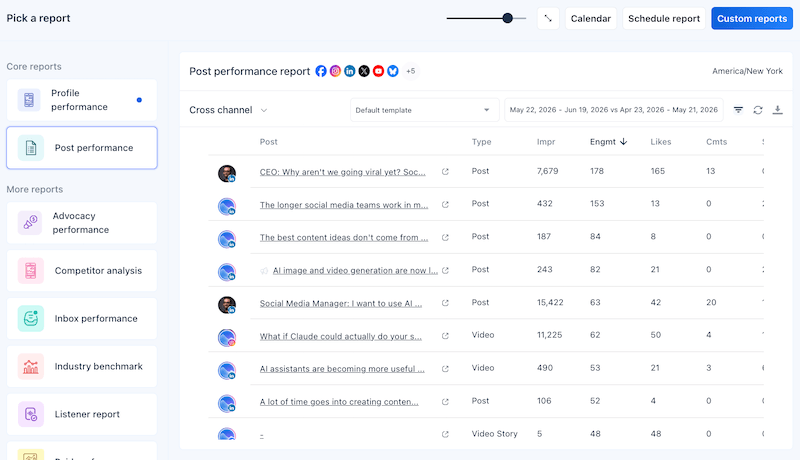
The Vista Social fast path: use social media analytics to see which content keeps earning reach over time, so you invest in the topics that compound.
Common mistakes and honest guardrails
A few things trip people up, and a couple are easy to rush rather than things anyone deliberately skips.
- Chasing tricks instead of presence. There is no keyword density hack that makes an AI cite you. Broad, honest presence is the work, so spend your energy there.
- Leaving the readable fields blank. Alt text, captions, and pinned comments are easy to under-do when you are moving fast, and they are what platforms read.
- Stuffing keywords. Repeating a phrase ten times reads as spam to humans and models alike. Say it once, clearly, in natural language.
- Expecting overnight results. Social SEO compounds, so judge it over months, not days. The payoff is durable once it lands.
- Optimizing for robots over readers. If a human would not enjoy the post, the search win will not last. Write for the person first, every time.
Conclusion
The buyer who opened TikTok and asked a chatbot instead of scrolling Google is the new normal. She is deciding between brands in places your old SEO plan never reached.
Social SEO is how you show up there. Research the search engine inside each platform and write content that answers a real question. Fill in the fields the platforms read, build genuine depth, and earn the mentions that make an AI name you. Do that consistently and discovery stops being something that happens to you.
You do not need a trick. You need to be the obvious, well-sourced answer in enough places that the model, and the buyer, cannot leave you out. Start finding and answering the searches your buyers are running, with Vista Social, free.
Try Vista Social for free
A social media management platform that actually helps you grow with easy-to-use content planning, scheduling, engagement and analytics tools.
Get Started NowAbout the Author

Content Writer
Orion loves to write content that refuses to be boring. As part of Vista Social, he helps brands, creators, and agencies stop doom scrolling and start winning with social media. When he's not in front of a keyboard, he's watching films in IMAX with his wife, dissecting football tactics (the European kind), and getting lost in a good book.