


The Complete Social Media Demographics Guide for 2026
April 24, 2026
9 min read

Summarize with AI


Table of contents
Share

Vista Social

X (Twitter)


Choosing the right platform for your brand isn’t about guessing. It’s about knowing exactly where your audience spends their time and how they behave when they get there.
But here’s the challenge: demographics shift every year. The audience that dominated one platform a couple of years ago may have migrated somewhere else by now.
Age groups grow, gender splits change, and emerging platforms pull attention away from established ones. If you’re still running your strategy based on outdated assumptions, you’re spending time and budget reaching people who aren’t there.
This guide breaks down the latest demographic data for every major social media platform. Use it to match your content, targeting, and ad spend to the people you actually want to reach.
Table of contents
General social media demographics
Before diving into individual platforms, it helps to understand the full picture. Social media isn’t a niche activity reserved for younger generations. It’s become the default way most of the world communicates, discovers products, and consumes content.
Here are the top-level numbers from DataReportal’s latest global social media overview:
- 5.79 billion people use social media worldwide, representing about 69.9% of the global population
- The average user actively visits 6.5 different platforms each month
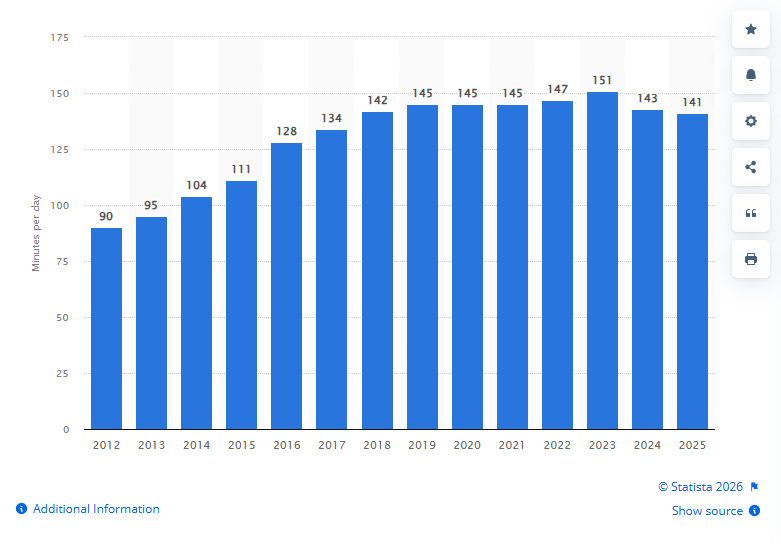
- People spend an average of 2 hours and 21 minutes per day on social media
- The global gender split is 54.6% male and 45.4% female, though this varies dramatically by platform and region
That last point matters more than it might seem. Platforms like Pinterest skew heavily female, while Reddit and X/Twitter lean male. These differences should shape where you invest your time and budget for a social media marketing strategy.
There’s also a clear generational divide in how people use these platforms.
According to Statista Consumer Insights, Gen Z gravitates toward Instagram, YouTube, and TikTok, with usage rates between 79% and 91% for those three platforms. Facebook still reaches 77% of Gen Z, but it ranks fourth behind visual-first platforms. Gen Z also tends to spread their attention across more platforms than older generations, which means your strategy can’t rely on a single channel to reach younger audiences.

Facebook demographics
Facebook remains the largest social media platform in the world. It’s still the default for reaching broad, cross-generational audiences, especially millennials, Gen X, and older adults.
Here’s how Facebook’s audience breaks down:
- 3.07 billion monthly active users globally
- The largest age group is 25 to 34 year olds, making up about 24% of the total user base; the 35 to 44 bracket follows closely behind
- Teens and young adults under 25 represent a shrinking share, as many gravitate toward TikTok and Instagram
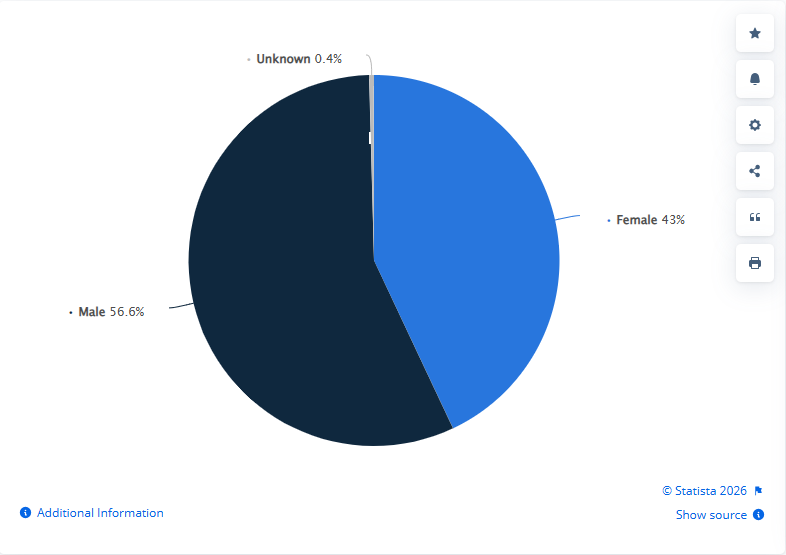
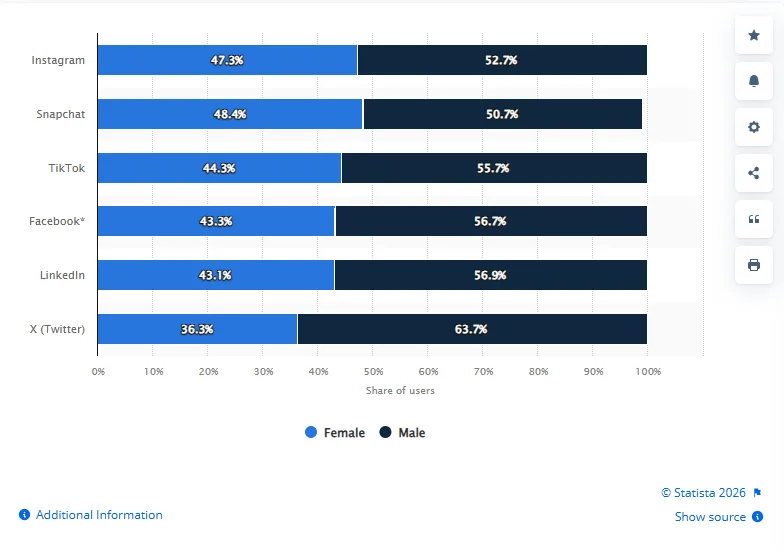
- Globally, the audience skews 56.6% male and 43% female; in the United States, though, the divide is much closer to even
- India leads with 400+ million users, followed by the United States (195+ million) and Indonesia (120+ million)
Facebook’s core strength is its sheer reach among working-age adults. If your audience falls between 25 and 55 and you need a platform with massive scale, Facebook still delivers. The platform also continues to grow in Sub-Saharan Africa and Southeast Asia, even as growth has plateaued in North America and Western Europe.
Instagram demographics
Instagram has evolved into one of the most commercially valuable platforms online. Its audience skews younger than Facebook, making it a go-to for brands targeting millennials and Gen Z.
The numbers worth knowing:
- 3 billion monthly active users worldwide, as announced by Meta CEO Mark Zuckerberg in September 2025
- Users aged 18 to 34 make up about 63% of the global audience; the 25 to 34 bracket is the single largest group at 33.3%, followed by 18 to 24 year olds at 29.7%
- Gender is nearly balanced globally at 50.6% male and 49.4% female
- India has the most Instagram users at 473+ million, with the United States (180+ million) and Brazil (147+ million) rounding out the top three
Regional gender variations are worth tracking if you run geo-targeted campaigns. Content that resonates with a predominantly female U.S. audience may need a different angle for India’s male-majority Instagram base. Reels have also become the dominant content format, generating significantly higher engagement than static feed posts.
TikTok demographics
TikTok isn’t just a Gen Z playground anymore. The “TikTok is just for teens” narrative is outdated by several years, and the data proves it.
Here’s where things stand:
- Approximately 1.59 billion monthly active users worldwide as of February 2025, with some industry estimates placing the current figure closer to 1.9 billion
- The largest age group is 18 to 24 year olds at roughly 36%, followed by the 25 to 34 bracket at about 32%
- The fastest-growing segment is users aged 35 and older, who now collectively make up about 32% of the platform
- Globally, TikTok skews roughly 57% female and 43% male
- Indonesia leads with 165 million users, followed by the United States at 170 million and Brazil
For brands evaluating where to invest, TikTok isn’t optional if your target audience includes anyone under 45. The platform’s strength lies in discovery. Nearly half of Gen Z users turn to TikTok for product discovery, making it a powerful top-of-funnel channel when paired with a strong content plan.
LinkedIn demographics
LinkedIn is the undisputed leader for professional networking and B2B marketing. Its audience is career-focused, high-earning, and well-educated compared to other platforms.
Here’s a breakdown of who’s on LinkedIn:
- Over 1 billion total members worldwide
- The largest age group is 25 to 34 year olds at about 33.4% of users; the 18 to 24 bracket follows at roughly 20.5%
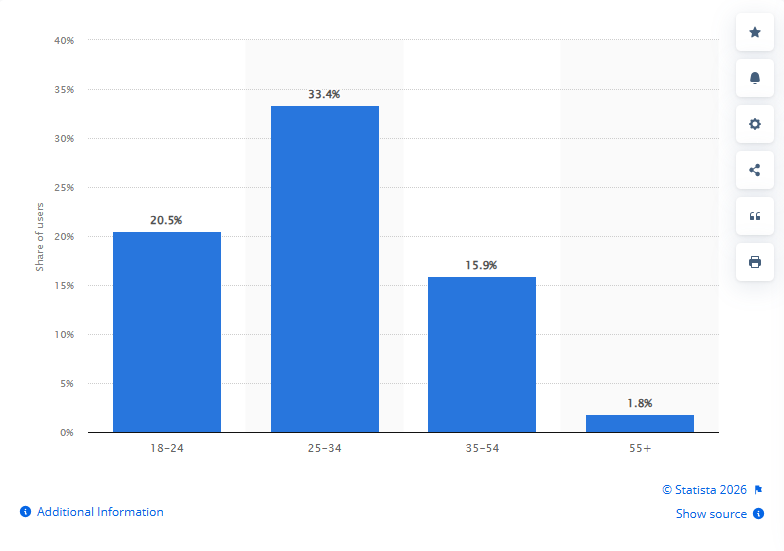
- Users over 55 account for just 1.8%, making LinkedIn one of the most age-concentrated platforms on this list
- Men make up 56.8% of users globally, and women 43.2%; in North America, the gap is narrower and approaching 50/50
- The United States has the most members at 230+ million, followed by India (130+ million) and Brazil (71+ million)
If your brand targets decision-makers, B2B buyers, or working professionals, LinkedIn deserves a central role in your strategy. Running a social media audit to evaluate your current LinkedIn presence can reveal quick wins.
X/Twitter demographics
X (formerly Twitter) remains a hub for real-time conversation, news, and commentary. Its audience is smaller than most competitors but distinct in its composition and behavior.
The key stats to know:
- The largest age group is 25 to 34 year olds at about 37.5%, and the 18 to 24 bracket adds another 32%; together, these two groups account for nearly 70% of the audience
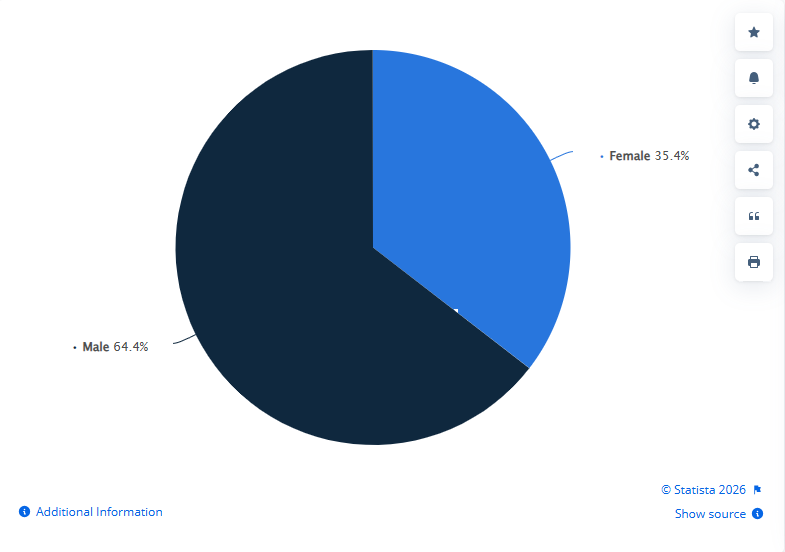
- X has one of the widest gender gaps among major platforms, with roughly 60.9% male users and 39.1% female users
- The United States is the largest market at about 104 million users, with Japan second at over 70 million
The male skew makes X particularly effective for brands in tech, finance, sports, and politics. The platform is also shifting toward short-form video, with a growing share of users engaging most with video content rather than text posts.
Pinterest demographics
Pinterest operates differently from most social platforms. It functions more like a visual search engine than a social feed, and its users show up with buying intent, not just browsing habits.
Here’s who’s using it:
- 619 million monthly active users globally as of Q4 2025, up from 600 million the previous quarter
- Pinterest has the most female-skewed audience of any major platform at roughly 70% female and 22% male. The remainder identify as other or unspecified
- Women aged 25 to 34 are the single largest demographic group at about 20.4% of the total audience
- Users under 35 account for more than half of the total audience
For brands in lifestyle, fashion, home decor, beauty, and food, Pinterest offers a uniquely motivated audience. About 96% of top searches on Pinterest are unbranded, meaning your content can reach people before they’ve formed a brand preference.
YouTube demographics
YouTube is the second-largest social platform globally and the go-to destination for online video. Unlike most other platforms on this list, YouTube doesn’t skew toward any single age group. Its reach spans generations.
The data:
- Approximately 2.53 billion monthly active users
- The largest age group is 25 to 34 year olds, but no single bracket dominates; usage stays strong across all groups from teens to adults over 55
- The audience is roughly 54% male and 46% female globally
That balanced gender split and wide age range make YouTube one of the most versatile platforms for any type of brand. It’s also the number one platform for tutorials, product reviews, and educational content, which gives it real power at the consideration stage of the buyer journey.
Threads demographics
Threads, Meta’s text-based platform launched in 2023, has grown faster than most people expected. It’s still evolving, but the audience is already large enough to pay attention to.
What we know so far:
- 400+ million monthly active users and over 137 million daily active users, according to Meta’s most recent earnings reporting
- The largest age group is 25 to 34 year olds, followed by 18 to 24 year olds and 35 to 44 year olds
- Threads skews male at roughly 57% male and 43% female. This tilt likely reflects early migration from X, where the male majority is even more pronounced
- The top markets include the United States, Taiwan, India, Japan, and Brazil
Threads is still finding its identity as a platform. For brands already active on Instagram, it offers a natural extension for text-based conversations and community building. Engagement metrics are climbing, and as the platform matures, these demographics will continue to shift.
Bluesky demographics
Bluesky is the newest and smallest platform on this list. The decentralized social network is still niche compared to the others, but it’s been growing fast.
The early demographic picture:
- Roughly 43.5 million registered users as of April 2026, with an estimated 3.5 million daily active users
- About 31.55% of traffic comes from users aged 18 to 24, with another 26.09% from the 25 to 34 group
- The gender split is one of the most male-heavy among major social networks at 61.94% male and 38.06% female
- The United States accounts for over 50% of web traffic, with Japan and Brazil as the next largest markets
Bluesky isn’t a mass-reach platform yet, but for brands targeting younger, tech-forward audiences who value transparency and open platforms, it’s worth monitoring. If your social media statistics tracking includes emerging platforms, Bluesky belongs on your radar.
Reddit demographics
Reddit has quietly become one of the most influential platforms online. It doesn’t operate like a traditional social network. Instead, it works more like a massive forum where communities drive conversations, product research, and cultural trends.
The demographic breakdown:
- Weekly active users reached 471.6 million in Q4 2025, with daily active users hitting 121.4 million
- In the United States, Reddit is most popular among 18 to 29 year olds, with roughly 48% of that age group using the platform; usage drops steadily with age
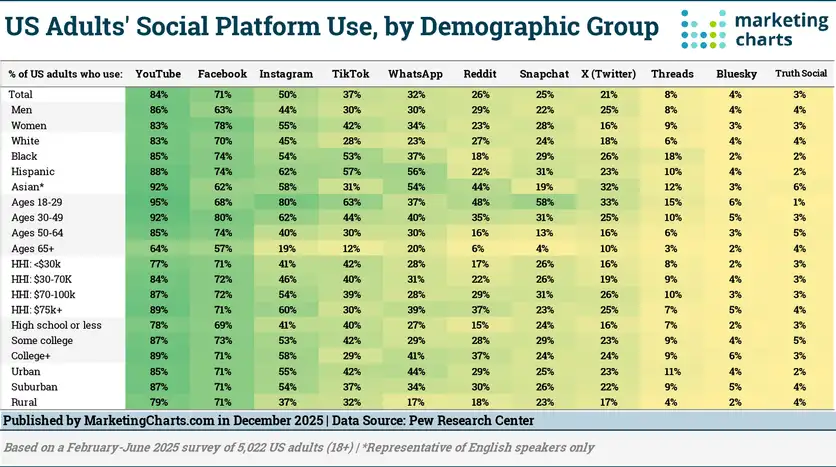
- Men are more likely to use Reddit than women, though the U.S. gender gap has narrowed significantly in recent years
For marketers, Reddit stands out because users actively seek product recommendations and honest reviews. The platform’s community-driven format creates a level of trust that’s hard to replicate on traditional social networks.
About the Author

Content Writer
Russell Tan is a content marketing specialist with over 7 years of experience creating content across gaming, healthcare, outdoor hospitality, and travel—because sticking to just one industry would’ve been boring. Outside of her current role as marketing specialist for Vista Social, Russell is busy plotting epic action-fantasy worlds, chasing adrenaline rushes (skydiving is next, maybe?), or racking up way too many hours in her favorite games.
Social media demographics FAQs
What are social media demographics?
They’re the characteristics that describe who’s actually using each platform. That includes things like age, gender, income, education level, and location. Instead of just telling you how many people are on a platform, demographics tell you who those people are, which helps you figure out if a given platform is the right fit for your brand.
What do social media demographics tell you?
Demographics show you where your ideal customers are spending their time and what the audience looks like on each platform. They help you spot patterns, like whether a platform attracts more men or women, which age groups show up most often, and which regions drive the most traffic. With that information, you can tailor your messaging, pick the right content formats, and make better decisions about where to spend your ad budget.
Why do you need to know each social platform’s demographics?
Because each platform attracts a different audience. Posting the same content everywhere without knowing who’s on the other side wastes time and money. When you understand a platform’s demographics, you can create content that actually resonates with the people seeing it. You can also stop investing in platforms where your audience barely shows up, and put those resources toward channels that drive real results instead.