

Published on May 21, 2026
10 min to read
Social Media Crisis Management: How to Protect Your Brand When Things Go Wrong

Summarize with AI

Table of contents
Summarize with AI

ChatGPT

Claude

Perplexity
Share

Vista Social

X (Twitter)


On July 16, 2025, a Coldplay concert kiss cam turned a relatively obscure data company called Astronomer into one of the most-searched brands on the internet overnight.
The footage of CEO Andy Byron and Chief People Officer Kristin Cabot ducking away from a stadium screen spread across TikTok, X, and Instagram within hours. Deepfake resignation videos followed, fake press releases circulated, and by the time Astronomer issued its first official statement, the internet had already written three versions of the story for them.
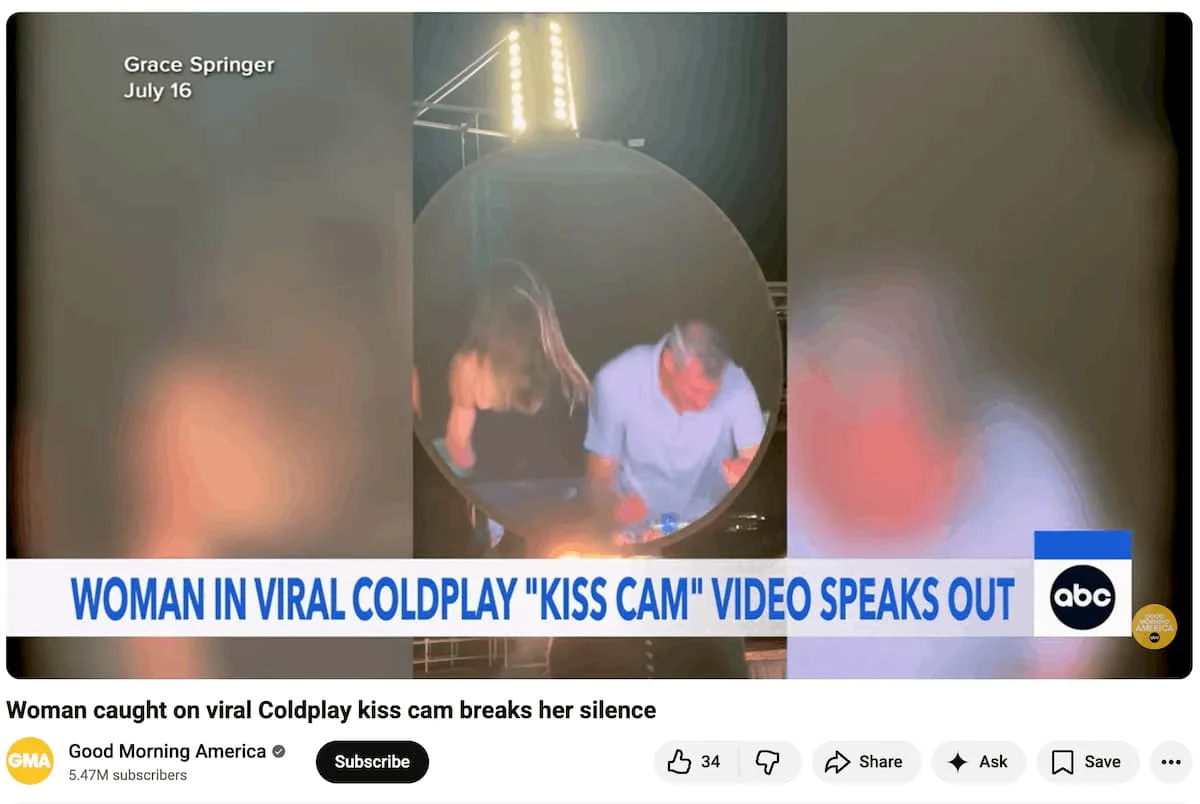
This is what’s called a major social media crisis. And while we must all hope that our brands don’t face an issue quite of this magnitude, it’s important to have a plan in place for handling viral negative attention.
That’s what this guide is about. We’ll cover what actually qualifies as a social media crisis, the most common types, how to build a response plan before you need it, and what to do in the moments when things are actively on fire. If you’re an SMM, agency manager, or brand marketer who’s ever thought “we should probably have a crisis plan,” consider this your starting point.
Table of contents
What is a social media crisis?
A social media crisis is a significant shift in online conversation that threatens your brand’s reputation, business operations, or customer trust, and it’s moving fast enough that a standard response won’t contain it.
The key word is significant. One unhappy customer leaving a bad review isn’t a crisis, but a product recall that gets picked up by three news outlets and starts trending on X absolutely is.
Understanding the difference matters because the response to each is completely different, and treating a negative comment like a five-alarm fire will exhaust your team just as quickly as actually having one.
Social media crisis vs. a negative comment
The line between a complaint and a crisis comes down to four things:
| Signal | Complaint | Crisis |
|---|---|---|
| Volume | Isolated, low engagement | Sustained, growing fast |
| Velocity | Slow or stagnant | Spreading across platforms rapidly |
| Media pickup | None | Journalists, newsletters, creators amplifying |
| Sentiment spread | Contained to one thread | Hashtags, duets, quote tweets are gaining traction |
A single negative comment with 12 likes is a complaint. That same complaint shared by an influencer with 800,000 followers, picked up by a marketing newsletter, and spawning a hashtag by Tuesday is a crisis.
The speed at which sentiment is moving, and whether it’s pulling in outside amplifiers, is what separates something you can respond to calmly from something that needs your full crisis protocol.
Common types of social media crises
Crises don’t come in one flavor, and your response needs to match the type:
- Insensitive content: A post, ad, or comment from the brand (or someone representing it) that reads as offensive, tone-deaf, or culturally unaware
- Product or service failure: A defect, outage, or quality issue that’s visible enough to generate sustained public complaint
- Data breach or security issue: Customer data compromised, account hacked, or security failure made public
- Employee or leadership misconduct: Internal behavior that becomes a public reputational issue
- External events requiring a response: A global or national event that creates pressure for the brand to say something, or to stop saying things entirely
Why social media crisis management matters
The case for having a plan isn’t complicated, but the numbers make it harder to ignore.
PwC’s Global Crisis and Resilience Survey tells us that 96% of companies have experienced a major crisis over the past five years, and 83% expect one within the next two, yet fewer than half have a fully tested crisis communications plan in place. That gap between expectation and preparation is exactly where reputations get damaged most.
And according to Emplifi’s 2025 Social Pulse report, 70% of consumers say they’ll abandon a brand after just two negative experiences, and 32% expect a DM response within one hour. During a crisis, when your inbox is full of frustrated people and sentiment is moving fast, those expectations don’t pause to give you time to think.
What separates the brands that weather crises well from the ones that don’t tends to come down to how prepared, how fast, and how tonally accurate their response is.
Astronomer’s Gwyneth Paltrow campaign, produced with Ryan Reynolds’ Maximum Effort agency in the wake of the kiss cam scandal, generated 36.5 million views and shifted public sentiment to 50% positive, a turnaround that happened because the team had a clear sense of who was authorized to act and what the brand stood for, rather than scrambling to figure both out in real time.

How to build a social media crisis management plan
Follow these steps to put together a social media crisis management plan that ensures your team is ready for (hopefully) whatever comes your way.
Assemble your crisis response team
Every crisis plan starts with people. Before anything else, you need to know who is authorized to do what when things go sideways.
Your core team should cover these five roles:
| Role | Responsibility |
|---|---|
| Social media manager | Monitors channels, manages platform responses |
| PR/comms lead | Drafts official statements, handles media inquiries |
| Legal advisor | Reviews all messaging before it goes external |
| HR representative | Involved when crisis involves people or conduct |
| Senior executive/spokesperson | Makes final calls, goes on record when needed |
There are two things that commonly get overlooked here.
First, assign a clear backup for each role, because during a real crisis people are on holiday, phones die, and flights get delayed.
Second, decide in advance who the designated spokesperson is for different crisis types. For example, a product failure might call for the head of customer experience, while a leadership misconduct issue warrants the CEO or interim CEO front and center.
Mapping that out before anything happens removes one critical decision from a moment when decisions are already hard.
Define your crisis severity levels
Not every negative comment needs the CEO on the phone. A simple severity framework means your team knows when to escalate and when to handle it themselves:
- Level 1: Isolated negative comments or complaints, no media pickup, low volume. Monitor and respond through standard community management.
- Level 2: Sustained negative sentiment, notable engagement on complaints, or minor media pickup. Notify crisis team leads, prepare holding statements, and review all scheduled content.
- Level 3: Rapid spread across platforms, media coverage, brand hashtag trending, or potential legal or safety implications. Full crisis protocol activated, all scheduled content paused, and an official response required.
This framework is especially useful for agencies managing multiple client accounts, where a Level 1 issue for a brand in a low-visibility category might be a Level 2 for a brand with a large following or a history of public scrutiny.
Severity thresholds should be calibrated per client rather than applied uniformly across the portfolio. Tying this framework into a broader set of brand safety guidelines for each client is one of the most practical ways to make sure everyone on the account team is operating from the same playbook.
Set up social listening and monitoring
You cannot manage a crisis you don’t see coming. Social listening analytics is what gives you the early warning, and for most brands the first sign of trouble isn’t a viral post, it’s a small cluster of negative mentions that starts growing faster than usual.
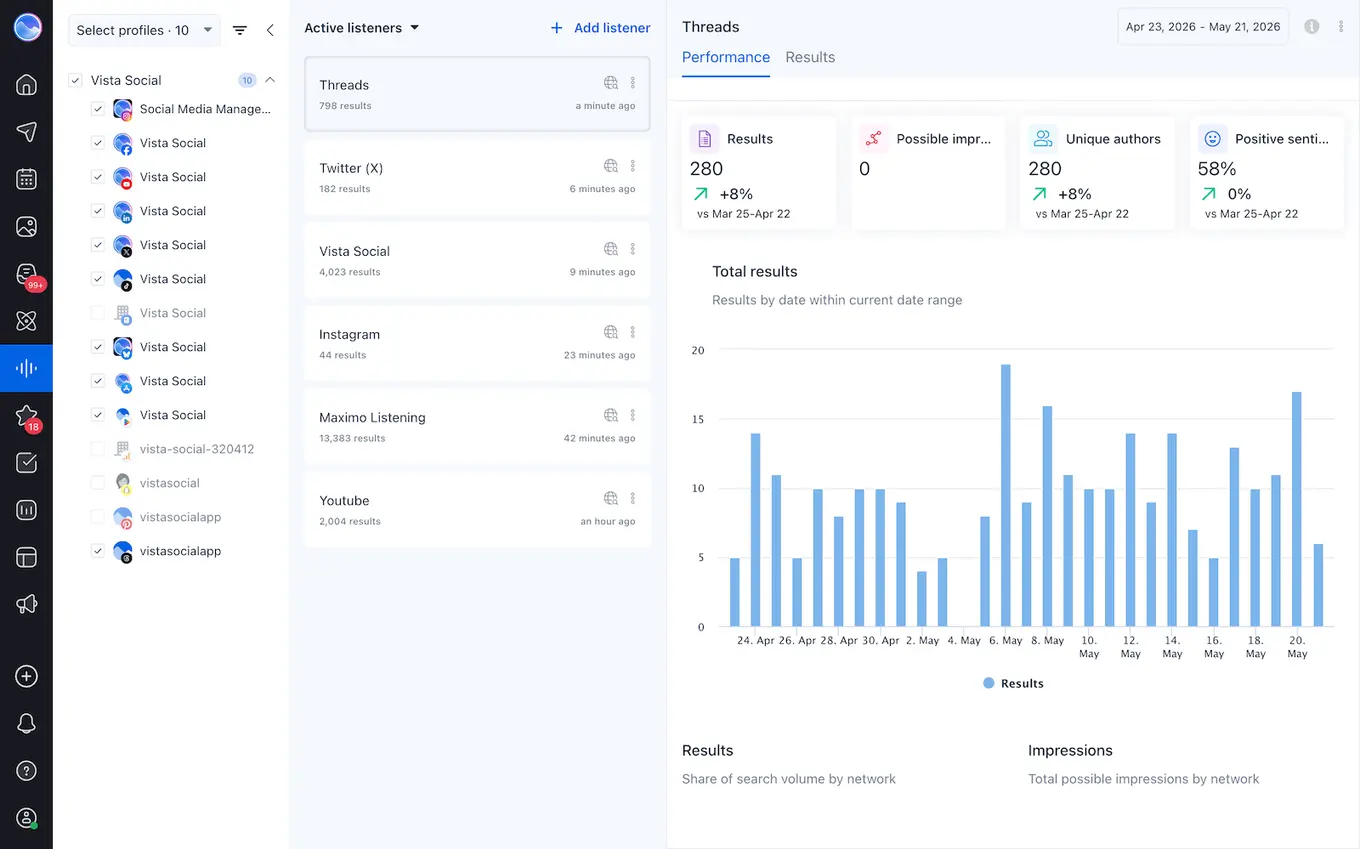
What you’re monitoring matters as much as the fact that you’re monitoring. Here’s what should be on your radar at all times:
- Brand mentions and branded hashtags across every platform, including ones you’re less active on
- Competitor mentions, because a crisis that hits a peer brand in your category can generate spillover conversation about yours
- Sentiment trend lines, not just volume, because a sudden shift from neutral to negative at 3 AM is just as significant as a high-volume spike at noon
- Unbranded industry keywords relevant to your product or category
- News and media mentions that might surface before the social conversation does
Social media brand monitoring tools track mentions, sentiment shifts, and engagement spikes across platforms in real time, so your team can catch a conversation gaining momentum before it’s trending.
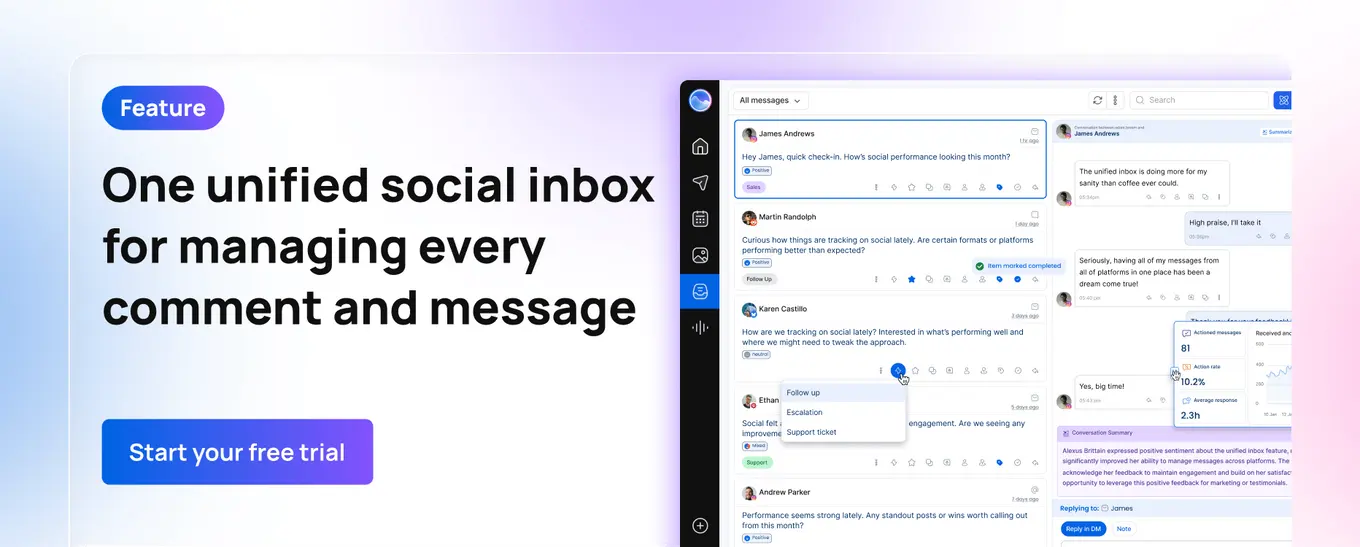
Vista Social’s unified inbox consolidates comments, DMs, and mentions from every platform in one place, which means nothing falls through the cracks when volume spikes suddenly, and for agencies managing multiple clients that centralized visibility is what makes a fast, organized response possible across an entire portfolio rather than a scramble through six native apps.
Prepare response templates in advance
Nobody makes their best creative decisions under pressure. Pre-written holding statements, acknowledgment posts, and empathy-first response templates mean your team isn’t drafting from scratch when things are already moving fast.
Prepare templates for the most likely crisis types you’ll face:
- Insensitive content apology
- Product failure acknowledgment
- Service outage update
- Data breach or security communication
- Leadership or conduct issue statement
A holding statement doesn’t need to say everything, it just needs to say something. “We’re aware of this situation and are looking into it urgently. We’ll share more information as soon as we have it” is enough to show you’re present while the full response gets approved.
Have all templates reviewed by legal and leadership before you ever need them, because the goal is a pre-approved structure your team can customize quickly rather than a canned response you paste verbatim.
Know when to pause scheduled content
This is the one most brands miss, and it’s one of the most visible mistakes you can make during a crisis. Posting a cheerful product promotion while your mentions are full of genuinely frustrated people signals either that you’re not paying attention or that you don’t care, and neither reading is good.
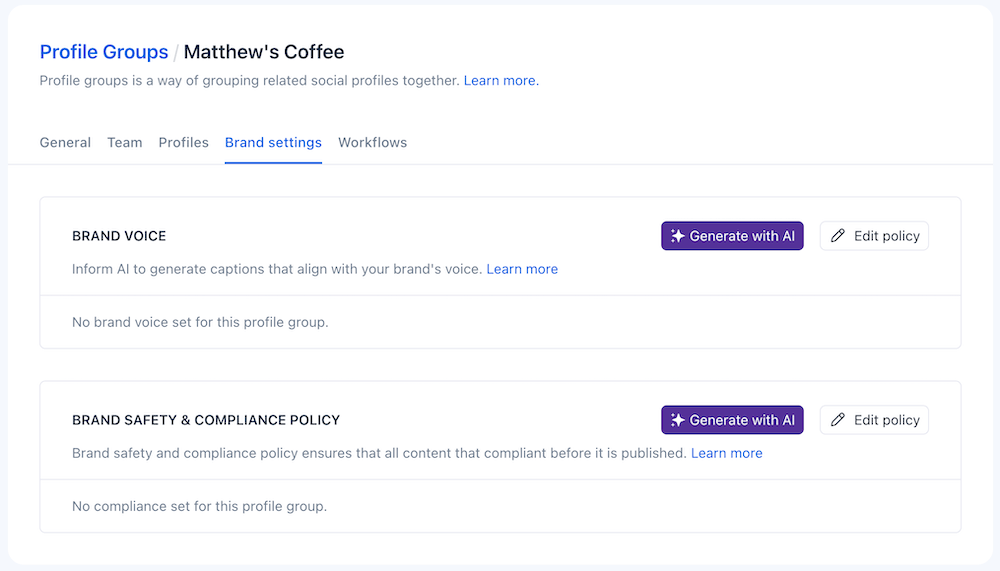
When a crisis is escalating, pause all scheduled content immediately. Vista Social’s publishing tools let you review and hold queued posts across every platform from a single dashboard, so you’re not logging into four different native tools trying to stop a scheduled carousel from going live at the worst possible moment.
Once the situation is under control, you can make a deliberate call about when to resume and with what tone.
How to respond when a crisis hits
Even with the best plan, the moment a real crisis lands it will feel messier than anything you prepared for. Here’s what the first few hours should look like.
Acknowledge quickly, even without all the answers
The silence in the Astronomer case cost them early ground. The gap between the kiss cam moment going viral and their first official statement allowed deepfake videos to spread widely and be mistaken for real statements, so even a brief acknowledgment within a few hours goes a long way toward preventing the narrative from being written entirely by other people before you’ve had a chance to say anything yourself.
Assess the situation before committing to a full response
Take stock of what’s actually happening before deciding on a position: how fast is it spreading, which platforms are driving it, and is there media coverage yet? Understanding the full scope first means your response is proportional and measured, rather than reactive to the worst-case read of a situation that may still be developing.
Communicate on the right channels
Respond where the crisis is happening, because if it started on TikTok your initial response should live there too, not just in a press release on your website that nobody searching the hashtag will find. Cross-channel consistency matters just as much, since a statement on one platform that contradicts another quickly becomes its own problem.
Keep your internal team aligned throughout
Use Vista Social’s approval workflows to make sure every external response has the right sign-off before it goes out. In fast-moving situations the temptation is to post first and ask forgiveness later, but the wrong tone or an inaccurate detail posted under pressure can extend a crisis significantly, and in regulated industries it can create legal exposure too.
Document everything as you go
Screenshot, log timestamps, and record every response and decision, because you’ll need this for the post-crisis review and in serious situations potentially for legal purposes as well. Assign someone specifically to documentation during the active phase so it doesn’t fall through the cracks while everyone else is focused on the response itself.
After the crisis: What to do next
Most crisis guides end when the fire is out. This is where the actually useful part begins.
Within 48 hours of resolution, run a post-crisis debrief covering the full timeline. What was the first indicator? When did it escalate? how long it take to go from detection to first response? and what decisions made under pressure would you handle differently next time?
Good social media crisis management is built on iteration, and that debrief while the experience is still fresh is what turns a single incident into institutional knowledge.
Vista Social’s reporting tools let you track how sentiment shifted, how reach and engagement changed across the affected period, and what inbox volume looked like at each stage, giving you data to share with leadership and a clear benchmark for the next time something happens.
Then update the plan. Every crisis reveals something the plan didn’t account for, so add the scenario to the severity framework if it wasn’t there, adjust the response templates based on what actually worked, update team contacts if roles changed, and flag any tools or workflows that slowed you down.
Long-term, crisis management sits inside a broader commitment to online reputation management, and the lessons from each incident should feed back into how you monitor, how you prepare, and how you communicate proactively before any crisis shows up.
Try Vista Social free and give your team the monitoring, inbox, and publishing tools to catch a crisis early and respond with confidence.
Try Vista Social for free
A social media management platform that actually helps you grow with easy-to-use content planning, scheduling, engagement and analytics tools.
Get Started NowAbout the Author

Content Writer
Orion loves to write content that refuses to be boring. As part of Vista Social, he helps brands, creators, and agencies stop doom scrolling and start winning with social media. When he's not in front of a keyboard, he's watching films in IMAX with his wife, dissecting football tactics (the European kind), and getting lost in a good book.
Loading related tools...

The most complete social media management platform for teams who demand more.






Tools
PublishingAnalyticsEngagementIntegrations
FacebookInstagramLinkedInRedditSnapchatThreadsTikTokX (Twitter)YouTubeMCPVista Page (link-in-bio)All IntegrationsCopyright © 2026 Vista Social LLC. All Rights Reserved.
Social media crisis management FAQs
What is a social media crisis?
A social media crisis is a fast-moving shift in online conversation that threatens a brand’s reputation or customer trust. It differs from standard negative feedback in its speed, volume, and potential to pull in media or large amplifiers.
How quickly should a brand respond to a social media crisis?
As fast as possible. Even a brief holding statement buys time while the full response gets approved, and it stops other people from filling the silence with their own version of the story.
What’s the difference between a social media crisis and a PR crisis?
A PR crisis is broader, often involving media, investors, or regulators. A social media crisis is specifically platform-driven and usually moves faster. Most modern PR crises have a social dimension, which is why both plans should be developed together.
How can I tell if a negative comment is turning into a crisis?
Watch velocity, not just volume. If a complaint is being amplified by large accounts, picked up by media, or spawning its own hashtag, escalate. The question isn’t how many people have seen it yet, it’s how fast that number is growing.