

Published on May 19, 2026
12 min to read
What is Founder-Led Marketing + How to Build Your Strategy

Summarize with AI

Table of contents
Summarize with AI

ChatGPT

Claude

Perplexity
Share

Vista Social

X (Twitter)


When Jess Cook took the VP of Marketing role at Vector, she made a decision that shaped the entire company’s growth model: She and the founders would show up on LinkedIn every week, consistently, as a way to reach their target audience.
As she told Vista Social’s Beyond Social podcast, Vector spent roughly $40,000 on ads for all of 2025—but their biggest lead source was actually organic LinkedIn. “If we turned that off tomorrow, I think we would die out,” she said.
With the right strategy in place, you can see these kinds of results for your own business. But you need to put a major emphasis on founder-led marketing content—and that comes with its own set of challenges.
This guide covers what founder-led marketing actually is, why it works when it works, why it fails when it fails, and the operational architecture that makes it sustainable—rather than a strategy that burns out after six months.
Table of contents
What is founder-led marketing?
Founder-led marketing is a growth strategy in which the founder or CEO becomes the primary voice of the brand on social media, in content, at events, and across any channel where authentic human connection outperforms polished brand communication.
It’s also worth being clear about what it isn’t.
- Founder-led marketing is not the same as occasional posting, where a founder shares a company announcement once a month and calls it a social strategy
- It’s also not the same as personal branding, which is primarily about building the founder’s career reputation independent of the company
- It’s also not the same as thought leadership as a general concept, which can be executed by any expert in an organization
Founder-led marketing is specifically the strategic decision to make the founder’s authentic voice the primary trust-building mechanism for the business, with the infrastructure to sustain that over time.
Why founder-led marketing works
Don’t just take our (or Jess’s!) word for it. Let’s dive into a few reasons that showcase just why founder-led marketing can be such a powerful strategy—especially for B2B or SaaS brands.
People trust people more than they trust brands
According to research done by Reddit and SurveyMonkey, 73% of B2B decision-makers trust peer recommendations above vendor websites, search engines, and review sites.
Brand pages, no matter how well-crafted, are recognized as marketing. A founder’s post feels like a person talking, and that difference in perception translates directly into a return that brand content struggles to replicate.
Founder content reaches audiences the brand account can’t
LinkedIn’s algorithm distributes personal profile content significantly more broadly than company page content because the platform is built around professional relationships rather than brand broadcasting.
A founder with 5,000 genuine connections in their target market will reach more relevant people with a single authentic post than the company’s brand page will reach with a paid campaign.
That organic reach compounds over time as the founder’s network grows and their content gets reshared into networks the company has no other access to.
It compresses the sales cycle
There’s a practical consequence to this that shows up in hiring as much as in sales. In her conversation with Vista Social, Jess Cook described how Vector’s CEO Josh brought her on specifically because she arrived with an existing LinkedIn audience, and that same criterion now shapes how the company evaluates candidates more broadly.
When a founder’s content builds genuine familiarity over months, the people who eventually reach out have already done most of their own evaluation before a single conversation happens.
It also works for recruitment and investor relations, not just customers
Founder-led marketing’s secondary benefits are underappreciated. A founder who is visibly thoughtful about their industry attracts candidates who already believe in what the company is building.
It also attracts investors who have been following the founder’s thinking before any formal pitch is even made. The trust premium that makes founder content effective for customer acquisition works identically across every other stakeholder audience.
It’s one of the few strategies that scales with authenticity
Most marketing gets less authentic as a company scales. Founder-led marketing gets more powerful, because the founder’s earned credibility and the size of their audience grow simultaneously. A founder with two years of consistent content has built something that a new competitor cannot replicate quickly, regardless of budget.
Why founder-led marketing fails
The same qualities that make founder-led marketing powerful are the ones that cause it to collapse when the execution doesn’t match the theory.
The founder doesn’t actually have time
Most founders have thirty minutes here and there between the main day-to-day tasks that come with running a business. When the content cadence relies entirely on the founder’s unscheduled time, it slips to once a month, then once a quarter, then stops entirely. The audience that was building disperses, and the effort required to rebuild it is significantly higher than the effort required to maintain it.
The brand becomes hostage to the founder
If eighty percent of your inbound leads trace back to the founder’s content, the business has a concentration risk most founders don’t notice until it’s exposed. What happens when the founder takes sabbatical, has a personal emergency, or simply hits a creative wall?
The pipeline doesn’t pause. The audience that built up doesn’t wait. The trust gets concentrated in one voice, and the brand struggles to function independently of that single person. This is the failure mode that makes founder-led marketing a liability as the company scales, rather than an asset.
Ghostwritten content kills the authenticity that made it work
The fastest way to destroy a founder’s content brand is to have someone else write it badly. Audiences on LinkedIn and X/Twitter are sophisticated enough to detect a shift in voice, and once they detect it, the trust premium collapses.
The content keeps shipping, but the engagement rate drops, the DMs stop, and the organic reach shrinks. The founder’s name is still on the posts, but the founder is no longer in them.
There’s a difference between operational support for founder content and full ghostwriting, and most content teams don’t draw that line clearly enough.
The founder optimizes for vanity metrics instead of pipeline
Likes and follower count feel good. But they don’t pay the bills. Founder-led marketing fails when the measurement framework doesn’t connect audience-building activity to business outcomes.
For example, a founder who has accumulated 100,000 LinkedIn followers but cannot point to a single closed deal attributed to their content has built a personal brand, not a marketing channel. The strategy needs accountability metrics from the start, not just reach and engagement.
How to build a founder-led marketing strategy
Ready to create your brand’s founder-led content strategy? Follow along with these steps to get started.
Create a content sourcing system rather than a content calendar
Founder-led marketing strategies often fail not because the founder stops wanting to create content, but because they run out of things to say. A strict content calendar makes this worse by treating content as a production problem rather than a capture problem.
The better approach is building a system that continuously captures the founder’s existing thinking and converts it into content. This looks like:
- A weekly thirty-minute recorded conversation between the founder and a content lead, where the recording becomes the raw material for that week’s posts
- A voice memo habit where the founder captures a thought in ninety seconds while walking or driving, and that memo becomes a post draft
- The founder forwarding interesting customer messages, investor questions, and internal Slack threads to the content lead, each of which is a potential post prompt
- Customer-facing meetings screened for content moments: the question a prospect asks three times in a row is a post waiting to be written
As Jess Cook laid out in her interview, her team’s system centers on a thirty-minute founder conversation every two weeks, with questions anchored to whatever is actually happening in the business at that moment. The transcript goes into a Claude project built on each founder’s historical posts, which generates a handful of drafts the founders then work from rather than starting cold.
Use AI to accelerate, not to replace
AI belongs in founder-led marketing at the production layer, not the creation layer. Specifically:
- Turning a twenty-minute conversation transcript into five post drafts in the founder’s actual voice
- Converting one long-form post into a LinkedIn carousel script, an X thread, and a short-form video outline
- Generating three hook variations of a post the founder already wrote, so the founder can choose the angle rather than invent one
- Pulling eight quotable lines from a podcast episode the founder recorded
Vista Social’s AI Assistant handles caption variations, hashtag suggestions, and content reformatting across platforms. The AI Knowledge feature goes a step further, training the AI on the founder’s existing body of content so that generated drafts start from the founder’s actual voice patterns rather than from a generic template.
You can also take advantage of our MCP capabilities to manage your full founder-led content strategy right inside Claude.

Implement an amplification strategy with your team
The founder’s content reaches the founder’s network. Team amplification extends that reach into networks the founder doesn’t have direct access to, with each team member’s reshare adding credibility because it comes from a real person with their own professional reputation attached.
The amplification model that works looks like this:
The founder posts the original content, and team members reshare strategically based on relevance to their function. So for example:
- Customer success reshares founder posts about customer outcomes
- Engineering leads reshare posts about product and technical direction
- The head of sales reshares content that supports active deals
Not every team member reshares every post, and the resharing should feel natural to each person’s professional identity rather than coordinated and obvious.
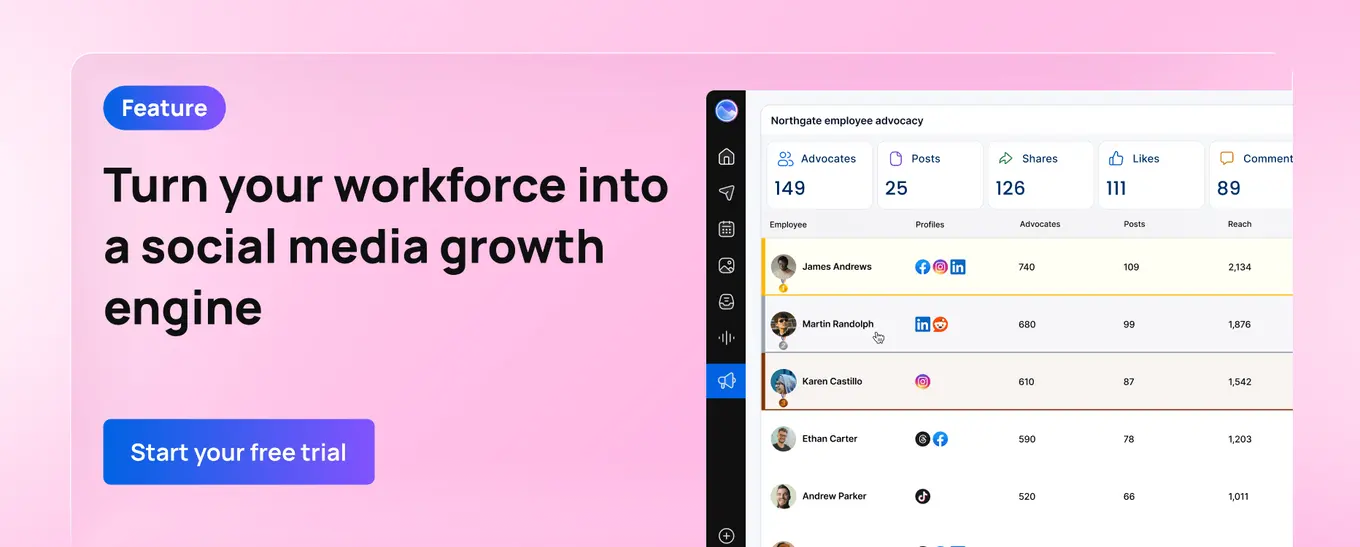
Vista Social’s employee advocacy functionality makes this operationally simple: the founder’s content surfaces in a feed that team members can reshare with one click, with optional pre-written captions they can adapt.
Employee advocacy is free for up to three advocates, making it accessible for early-stage companies where the team is small but the amplification network matters. Over time, team members who reshare founder content regularly tend to develop their own posting voices, building a distributed brand presence that extends well beyond the founder alone.
Create a repeatable content process
The content process needs to be documented clearly enough that it runs without constant founder oversight. The key role assignments are:
- Who drafts: The content lead, working from the founder’s raw material (recordings, voice memos, forwarded messages), with AI assistance for initial structuring
- Who edits: The content lead only, not the founder. Founders who edit their own drafts tend to remove the rough edges that made the content feel authentic
- Who approves: The founder, same day. Three-day approval cycles kill the timing that makes founder content feel current and responsive
- Who publishes: Either the founder directly or the content lead using the founder’s profile access. Vista Social’s personal profile management supports LinkedIn personal profile scheduling, which is genuinely rare among social media tools
- Who responds to comments: The founder for the first twenty-four hours after posting. The comment section in the first day is where the reach multiplier lives, and founder responses drive significantly more algorithmic distribution than no response
- Who reports: The marketing lead, monthly, with the specific metrics covered in the next section
How to measure founder-led marketing
Founder-led marketing’s ROI is real but doesn’t appear in standard MQL reports. The metrics that actually indicate whether it’s working are:
- Follower growth among target ICP job titles: LinkedIn’s analytics let you segment follower growth by job title and company size. Growing followers among your actual buyers is a fundamentally different signal than growing total follower count
- Post engagement rate among target accounts: If the founder’s content is resonating with the right people rather than just their college roommates, this shows up in who is commenting and sharing
- Inbound DM volume: Unsolicited messages from relevant prospects are often the earliest and most honest signal that the founder’s content is working
- Newsletter and podcast subscription growth if the founder runs either, tracked against posting cadence to identify which content types drive the most subscriptions
- Branded search volume for the founder’s name plus the company name: As the founder’s audience grows, so does the number of people searching to learn more
- Direct traffic to the company website: Founder content that generates genuine interest creates a direct traffic lift that shows up in analytics without UTM tracking
- Social-attributed pipeline tracked in the CRM: Demo requests, trial signups, and deals where the contact specifically references founder content should be tagged and tracked
- Demo requests citing founder content: “I saw your post about X” in the first sales call is the most direct ROI signal available, and it should be captured systematically in the CRM notes
With Vista Social, users get access to LinkedIn analytics for personal profiles—something many other SMM tools don’t offer—which helps teams track follower growth over time, post engagement rate, and members reached. These metrics give the marketing team the data needed to report monthly without manually compiling numbers from multiple platform dashboards.
Real founder-led marketing examples worth studying
Before you dump a bunch of time into a founder-led marketing strategy that misses the mark, let’s look at a few real-life founders posting on LinkedIn and generating great results.
Melanie Perkins, CEO @ Canva
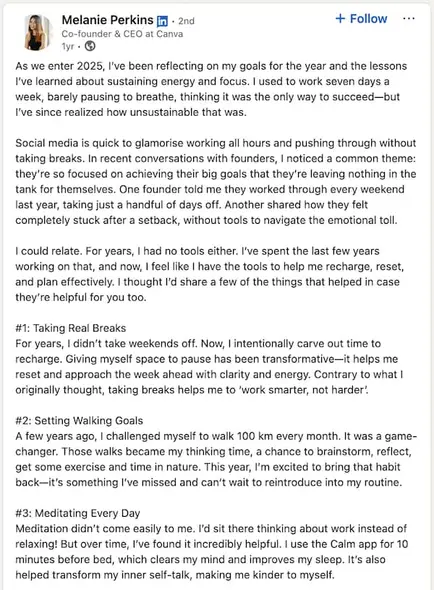
Perkins has shared the story of being rejected by over 100 investors with unusual candor, including specifics about the emotional reality of those rejections. At a company now valued at $42 billion, she continues sharing founder-stage vulnerability in a way that feels genuine rather than retrospectively curated.
Her 2025 LinkedIn post reflecting on Canva’s journey is a strong example of transparency about the difficult parts of building something at scale, not just the success metrics.
Justin Welsh, Angel Investor & Solopreneur
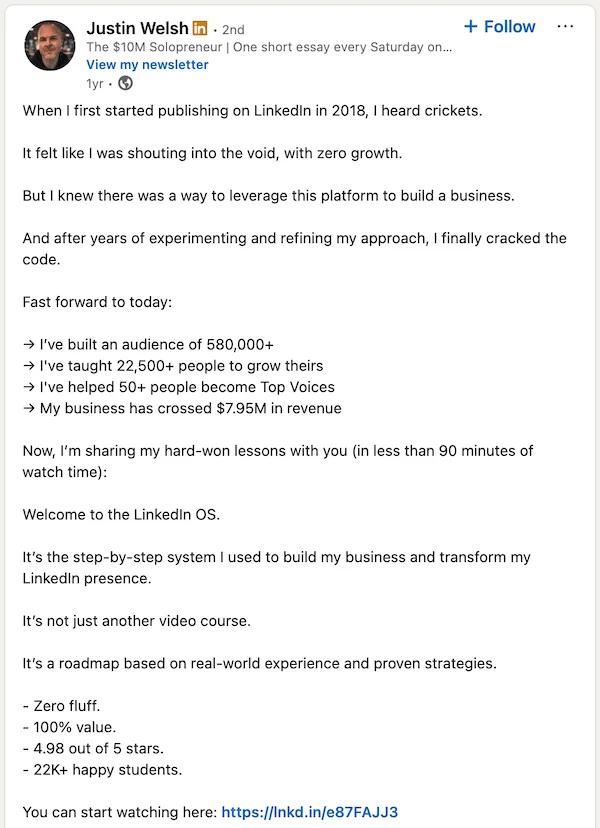
Justin Welsh presents the canonical case study for one-person founder-led marketing. Welsh built a seven-figure solo business primarily through LinkedIn content, with no team, no paid distribution, and no product launches.
His LinkedIn Operating System post is a strong example of the educational, framework-driven content that consistently drives high engagement and shares. His approach demonstrates that founder-led marketing works at any business scale, not just venture-backed companies with marketing teams.
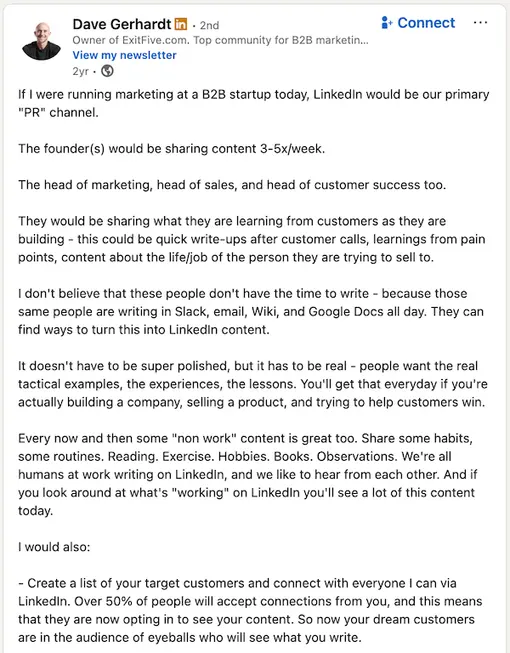
Dave Gerhardt, Owner @ Exit Five
Gerhardt built a community and media brand by being consistently and unapologetically opinionated about B2B marketing.
His post on why he would make LinkedIn the primary PR channel for any B2B startup today generated 320 comments and is a direct example of the kind of point-of-view content that drives founder-led reach. His voice is specific enough that you’d recognize a Dave Gerhardt post without seeing his name on it, which is the goal of founder-led marketing done well.
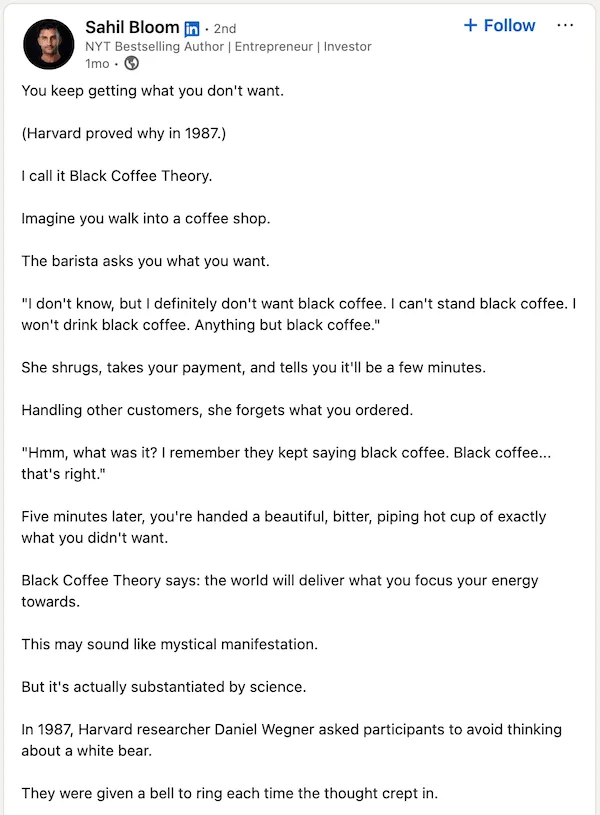
Sahil Bloom, Entrepreneur & Investor
Sahil started posting about finance and investing, built an audience of millions, and used that platform to launch a newsletter, a book, and a broader content business.
His profile shows the compounding result of giving away your best ideas publicly and consistently over years. His case demonstrates that founder-led content works as a business model itself, not just as a distribution channel for a software product.
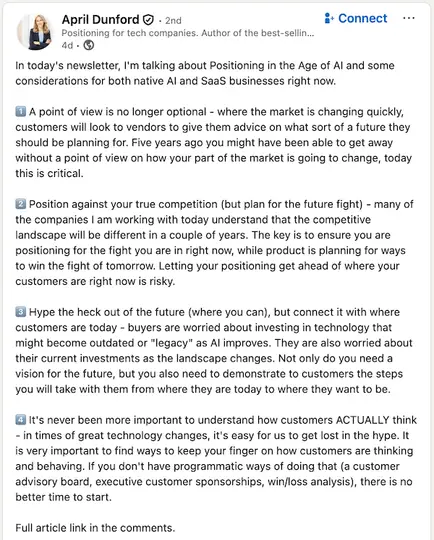
April Dunford, Founder @ Ambient Strategy
Built a positioning consultancy primarily through long-form content about positioning strategy, which led directly to a book deal and speaking engagements at major conferences.
Her profile demonstrates that founder-led marketing works even in highly technical, narrow categories where the audience is small but extremely high-value. The depth of her content is the differentiator, not the volume.
Create your founder-led marketing strategy today
Founder-led marketing works. The evidence is in the results companies like Vector have achieved and the audiences founders like Justin Welsh and April Dunford have built. But the path from “the founder should post more” to a genuine pipeline channel requires more architecture than most advice acknowledges.
The operational piece is where most founders get stuck and where the right tools make the difference between a strategy that sustains and one that burns out. Vista Social supports LinkedIn personal profile scheduling and analytics, multi-network publishing, approval workflows that keep the team in sync, and a link-in-bio page that gives the founder a single destination for inquiries.
Give Vista Social’s employee advocacy tools a go and see how the amplification layer turns a founder’s content into a company-wide signal rather than a single voice posting into the void.
Founder-led marketing FAQs
Is founder-led marketing scalable?
Yes, with the right architecture, but not without it. The failure mode for most founder-led marketing programs isn’t that the strategy stops working. It’s that the operational setup that made it possible breaks down as the founder’s responsibilities grow. The companies that scale founder-led marketing successfully do so by building systems that reduce the founder’s time burden while maintaining the authenticity that makes the content effective.
How much time should a founder spend on marketing?
For most early to growth-stage companies, thirty to sixty minutes per day of founder content time, spread across three to five posts per week, is enough to build a meaningful audience and pipeline over six to twelve months. The key is consistency over intensity. A founder who posts three times per week for two years builds something that a founder who posts daily for three months then stops cannot replicate.
What’s the difference between founder-led marketing and personal branding?
Personal branding is primarily about building the individual’s professional reputation and career options, often independent of any specific company. Founder-led marketing is specifically about using the founder’s authentic voice as the primary trust-building and demand-generation mechanism for the business. They overlap significantly, but personal branding serves the founder first, while founder-led marketing serves the company’s growth goals first. The distinction matters because it determines what you measure and how you evaluate success.
Should every founder do founder-led marketing?
No. Founder-led marketing requires genuine consistency, a point of view worth sharing, and the organizational support to make it sustainable. A founder who is deeply introverted, whose category doesn’t lend itself to public commentary, or who genuinely cannot carve out the time to maintain a posting cadence will produce better results by investing that energy elsewhere. What every founder should do is honestly evaluate whether they have the combination of perspective, availability, and organizational support that makes founder-led marketing viable before committing to it as a primary channel.
Try Vista Social for free
A social media management platform that actually helps you grow with easy-to-use content planning, scheduling, engagement and analytics tools.
Get Started NowAbout the Author

Content Writer
Orion loves to write content that refuses to be boring. As part of Vista Social, he helps brands, creators, and agencies stop doom scrolling and start winning with social media. When he's not in front of a keyboard, he's watching films in IMAX with his wife, dissecting football tactics (the European kind), and getting lost in a good book.
Loading related tools...

The most complete social media management platform for teams who demand more.






Tools
PublishingAnalyticsEngagementIntegrations
FacebookInstagramLinkedInRedditSnapchatThreadsTikTokX (Twitter)YouTubeMCPVista Page (link-in-bio)All IntegrationsCopyright © 2026 Vista Social LLC. All Rights Reserved.