

Published on February 19, 2026
25 min to read
AI Social Listening: What It Is, Tips, and Tools

Summarize with AI

Table of contents
Summarize with AI

ChatGPT

Claude

Perplexity
Share

Vista Social

X (Twitter)


Right now, while you’re reading this, someone is talking about your brand on a Reddit thread you’d never think to search, in a TikTok comment section three videos deep, or in a Facebook group your target customers treat like a trusted inner circle. They’re recommending you, comparing you to competitors, or asking if you’re worth their money, and most of what they say will never reach your inbox.
Traditional social monitoring wasn’t built to catch any of that. It’s good at tracking your tagged mentions and handling what lands directly in front of you, but it has no view into the wider conversation happening across the internet every single day. That’s not a minor gap to quietly tolerate. It’s the difference between actually knowing your audience and only knowing the small fraction of them who chose to get your attention.
AI social listening changes what you can see and act on. It doesn’t do the same monitoring job faster. It does, however, process unstructured conversation at a scale no human team could manage, classify sentiment, connect patterns, and surface the insights that actually inform decisions.
The social media managers and brands getting real value from it are working with a fundamentally different quality of information than teams still running basic monitoring. This guide covers what that looks like, how it works, and how to use it.
Table of contents
What is AI social listening?
Social listening is the practice of tracking online conversations about your brand, competitors, and industry topics across social networks, forums, news sites, and the web. That includes conversations where you’re tagged and the far larger number where you aren’t. AI social listening takes that foundation and layers machine learning, natural language processing (NLP), and sentiment analysis on top of it.
Instead of dumping raw data into a feed your team has to interpret manually, AI models process it at scale, read context and emotion, identify patterns, and surface only what actually needs attention.A lot of teams confuse social monitoring with social listening. The difference matters more than most people realize:
A lot of teams confuse social monitoring with social listening. The difference matters more than most people realize:
| Social monitoring | AI social listening | |
| What it tracks | Direct tags, mentions, DMs, and comments | Untagged brand conversations, competitor mentions, industry topics, and owned profiles |
| How it processes data | Manual review or keyword rules | NLP, sentiment classification, and trend detection |
| Output | Raw mention feed | Filtered patterns, sentiment trends, and audience insights |
| Best for | Responding to what’s already in front of you | Informing strategy before and after the fact |
| Team effort | High: someone has to read everything | Low: AI filters and surfaces what matters |
The practical gap is significant. Monitoring tells you someone complained. Listening tells you a wave of complaints is building before it reaches critical mass.
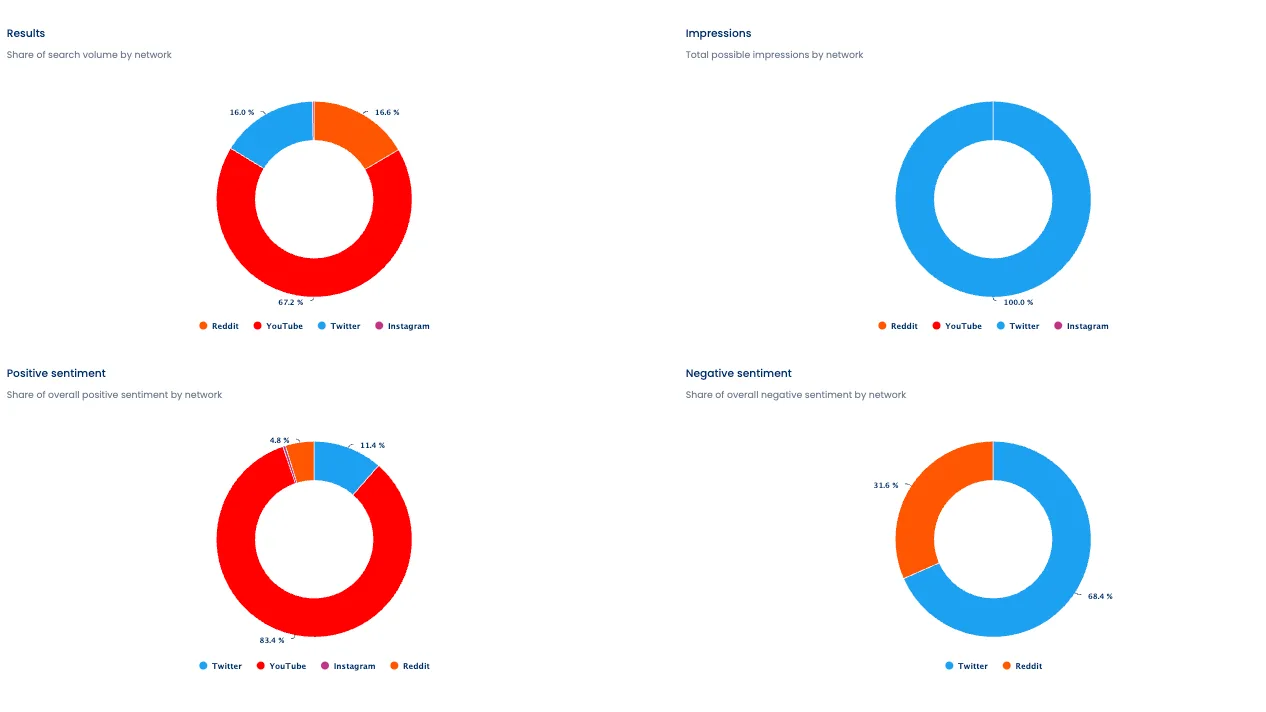
The global social media listening market was valued at $9.15 billion in 2024 and is projected to grow at a 14.3% CAGR through 2030, according to Grand View Research. That growth reflects how many marketers have seen what this data can do when AI handles the interpretation.
AI social listening tips and best practices
Having the tool is step one. Knowing how to use it so the insights change what your team does is the part most guides skip over.
These tips cover setup, platform selection, how to read your data over time, and how to get the most out of Vista Social’s specific features, including the MCP integration that most users haven’t touched yet.
Monitor the right keywords
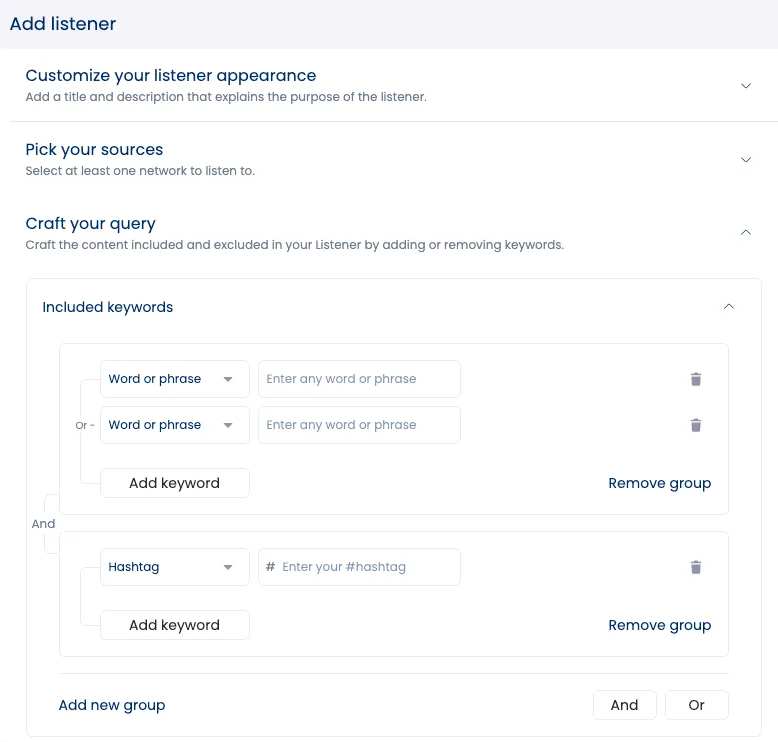
The biggest setup mistake is starting with too narrow a keyword list. Brand name and product names are obvious, but the most valuable intelligence lives in two other tiers that most teams skip.
- Tier 1 (Brand and product terms): Your brand name, product names, taglines, and common misspellings. People misspell your name and still talk about you. Track those variations.
- Tier 2 (Competitive and comparative terms): Competitor brand names, “vs [your brand],” “alternative to [competitor],” and “[competitor] problem.” This is where people in decision mode are actively comparing their options.
- Tier 3 (Category and problem terms): The pain points your product solves, the questions your audience asks before they know your brand exists, and the topics driving conversation in your space. This is discovery-stage intelligence, and it’s consistently the most underused tier.
Use your exclusion keyword filters aggressively. If your brand name overlaps with something unrelated, those exclusions will save your team hours of irrelevant results every week.
Choose the platforms that matter most for your audience
Not every platform is relevant to every brand, and trying to listen everywhere at once creates noise rather than signal. The right starting point is understanding where your audience actually has unfiltered conversations. Reddit is consistently underestimated.
Subreddits built around specific industries or product categories are where people say things they’d never post publicly, and a brand ignoring that is leaving its most honest feedback unread. Threads works well for real-time consumer sentiment, and LinkedIn for B2B conversations that happen openly.
Your social media listening platform selection should match where your specific audience is candid, not where they’re performative.
Track patterns and sentiment over time, not just snapshots
A single mention is a data point. A trend line across 30 days is intelligence. The real value of social listening analytics compounds when you review data longitudinally and look for directional signals rather than reacting to individual posts.
Set a regular cadence: Weekly at minimum, daily during campaigns and launches.
Worth asking each time:
- Is overall brand sentiment moving up or down versus last week?
- Which topics are climbing in negative mentions?
- What themes appear most in the content getting the most reach?
Those patterns are what you bring to leadership and strategy sessions. Trend data with directional signals is what turns listening into something that actually changes decisions.
Use Vista Social for smarter listening
Vista Social’s social listening feature goes well beyond tracking tagged mentions. You can monitor across 10+ sources simultaneously, including social networks, news outlets, review platforms, and web content, with automatic sentiment detection applied to every mention that comes in.
Setting up a listener takes about three minutes:
- Go to Listening and click Add Listener
- Choose Internal (your own profiles) or External (across the web and social networks)
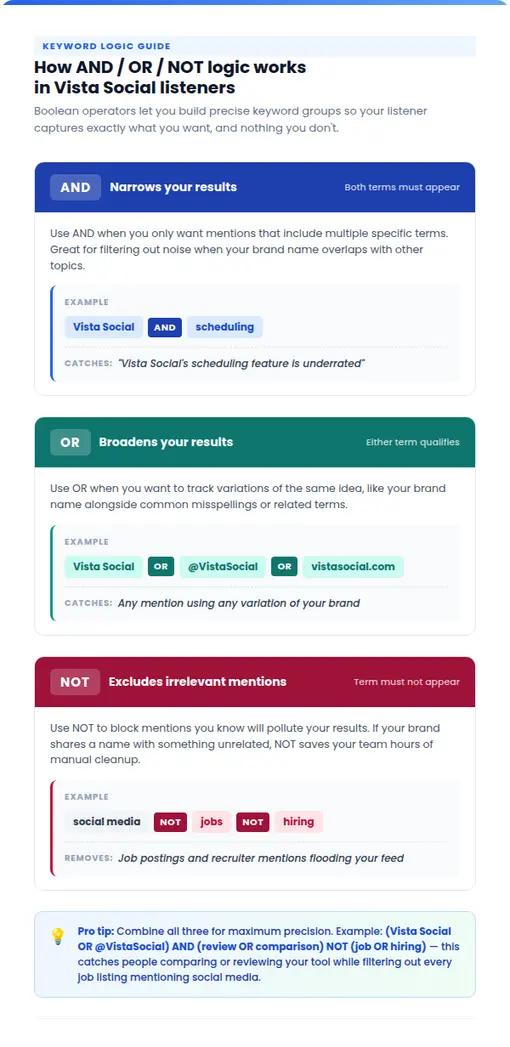
- Build your keyword groups using AND/OR logic (see the infographic below for how this works)
- Add exclusion terms to filter out irrelevant noise
- Apply filters for sentiment, location, source, or language
You can run multiple listeners simultaneously. A smart setup has at least three running at once: one for your brand, one for each key competitor, and one for your category keywords.
What you get from each listener:
- Every mention tagged with sentiment (positive, negative, mixed, or neutral) based on conversational context, not just keywords
- Mention volume over time, which works as a real-time brand awareness signal you can tie to campaign timelines
- Inbox sentiment filtering so your community manager sees urgent conversations first, not buried after 200 neutral posts
- Listener performance reports covering volume trends, sentiment breakdowns, and source analysis in a client-ready format
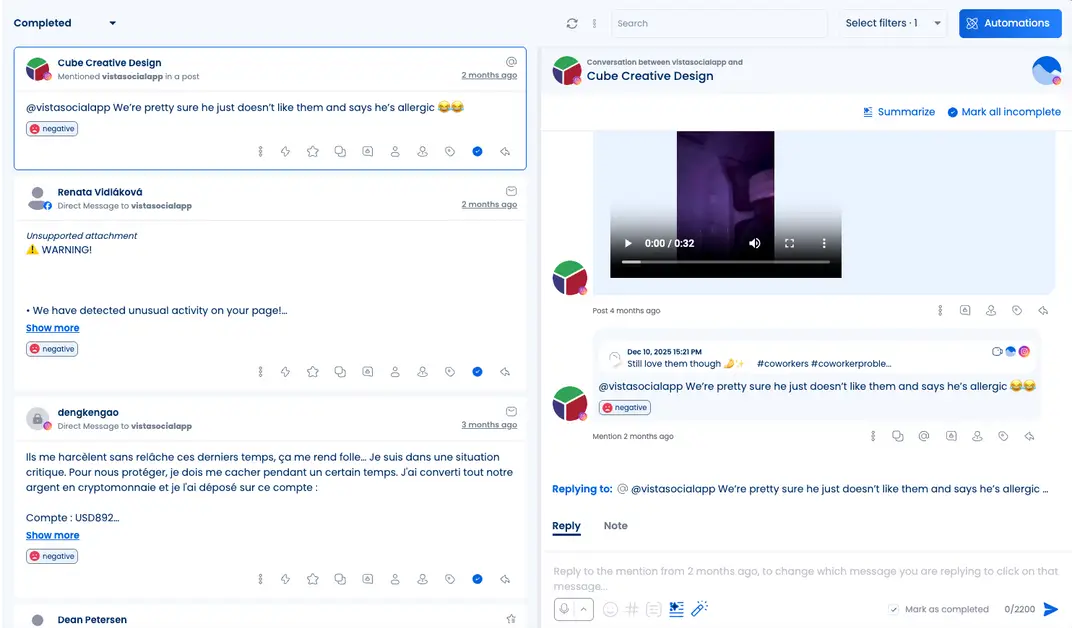
Sentiment detection runs automatically on the Enterprise plan. Vista Social’s pricing page has a full feature comparison across plans.
Use Vista Social’s MCP to analyze your listening results in plain language
What’s your Social Listening Maturity Score?
Answer 8 quick questions about how your team currently handles social listening. Get a personalized score and a clear next-step plan.
Ready to level up your listening setup?
Vista Social’s social listening feature gives you everything in this quiz — keyword listeners, sentiment detection, competitor monitoring, and MCP-powered AI analysis — in one platform.
Start your free 14-day trialVista Social’s MCP (Model Context Protocol) server connects your account directly to AI tools like Claude or ChatGPT. Think of it as a translator between your Vista Social data and the AI tool you’re already using every day.
Instead of exporting reports and interpreting data separately, you ask questions about your listening results in plain language and get answers back in the same conversation.
How to connect:
- Go to Settings > Account Settings > Integrations
- Copy your MCP URL
- Paste it into Claude Desktop or ChatGPT
- For Claude: Add “Using Vista Social” to the start of each prompt
- For ChatGPT: Select Vista Social from the connected apps dropdown
No developer required. Here’s what real-world use looks like across five common scenarios.
Scenario 1: You’ve had a rough week and can’t pinpoint why
Complaints feel higher than usual, but scrolling the inbox gives you nothing clear. Try:
“Using Vista Social, pull my listening data from the last 30 days and summarize the top five recurring themes in negative mentions. What complaints come up most often?”
You get a theme-based breakdown in seconds. If shipping delays appear in 40% of negative mentions and returns in 25%, that’s a brief your ops team can take action on today.
Scenario 2: A competitor is having a bad week and you want to know why
Your sales team keeps hearing anecdotal complaints about a competitor. Before your next positioning conversation:
“Using Vista Social, show me listening data for [Competitor Name] over the last two weeks. What topics appear most in their negative mentions? What are people saying they wish was different?”
Real public conversation, formatted as usable intelligence for your content, product, and sales teams.
Scenario 3: Your client wants to know if the campaign moved the needle
The campaign wrapped, and the client wants proof it did something beyond engagement:
“Using Vista Social, compare my brand mention volume and average sentiment this week versus two weeks before our campaign launched. What changed?”
One prompt can give you an instant read on whether the campaign drove more conversation, whether it was more positive, and where the biggest shifts happened.
Scenario 4: You suspect a crisis is building but you’re not sure
Something feels off. Notification volume is slightly higher. Before you spend an hour refreshing:
“Using Vista Social, are there any unusual spikes in negative sentiment in the last 48 hours? What are the mentions about, and where are they coming from?”
Pick up patterns and block the noise. There’s more value in seeing where something could potentially go wrong than trying to do damage control afterwards.
Scenario 5: You need next month’s content calendar backed by data
Instead of pitching based on what performed last quarter:
“Using Vista Social, what topics related to [your industry keyword] are generating the most conversation this month? What questions keep coming up?”
You walk into content planning with actual data on what your audience is actively discussing right now.
Top AI social listening tools
Not every social listening tool is built for the same job. Some are built for day-to-day social media management, others for enterprise research teams with dedicated analysts and six-figure budgets.
Here’s how the main options in this space compare and who each one actually makes sense for.
Vista Social
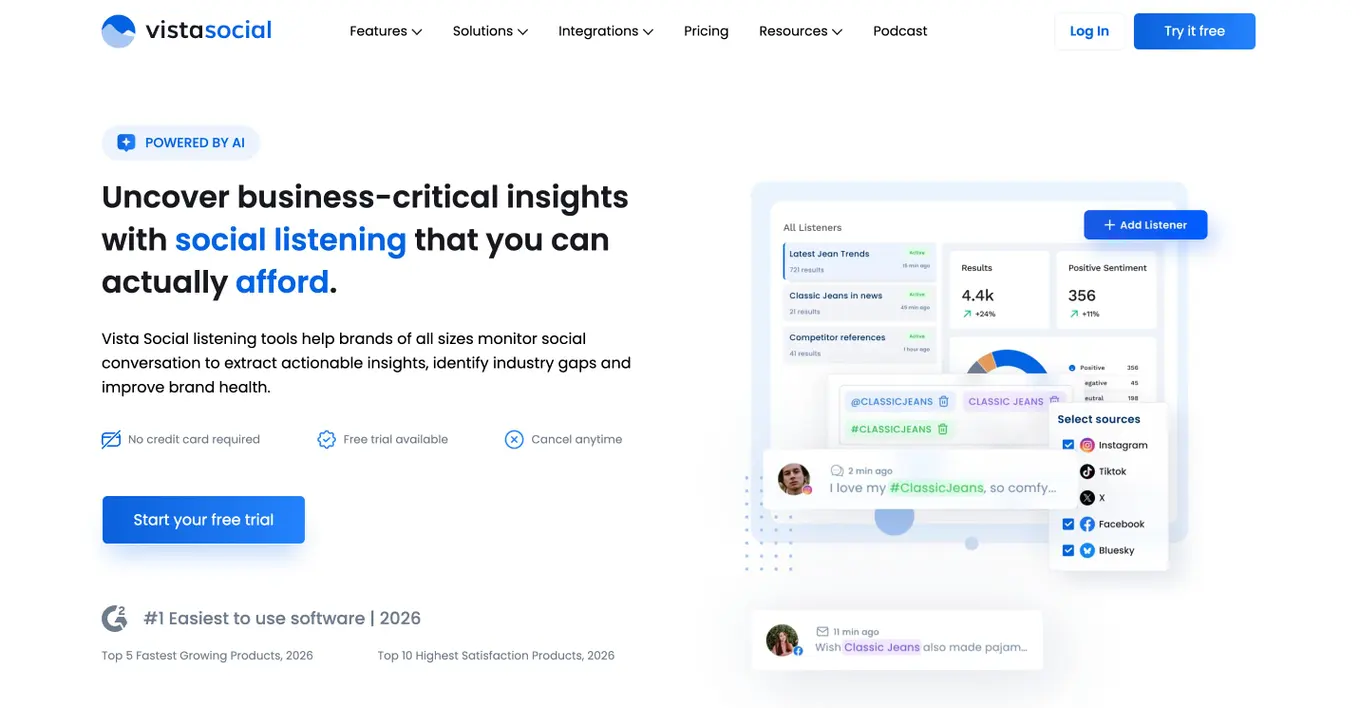
Vista Social is a full social media management platform built for social media managers, agencies, and brands that want every tool in one place.
Social listening for agencies and in-house teams is built directly into the platform alongside publishing, scheduling, analytics, engagement, review management, and employee advocacy. You don’t need a separate listening tool bolted onto a separate publishing tool. It’s all one system.
Where Vista Social stands out is the combination of breadth and accessibility. You get enterprise-level listening capabilities, including competitor monitoring, MCP-powered AI querying, and automated sentiment detection.
Key social listening features:
- External monitoring across social networks, news outlets, review platforms, forums, and web content
- Automatic sentiment detection on every mention (positive, negative, mixed, or neutral) using context-aware AI
- Multiple simultaneous listeners so you can track your brand, competitors, and category keywords at the same time
- Listener performance reports with mention volume trends, sentiment breakdowns, and source analysis in a client-ready format
- Inbox sentiment filtering so your community team sees urgent conversations first
- Instagram hashtag tracking
- Threads and Bluesky support
- MCP integration for querying your listening data in plain language directly inside Claude or ChatGPT
- Real-time brand awareness signals tied to campaign timelines
Pricing:
- Professional: $64/month + $99 social listening add-on
- Advanced: $120/month + $99 social listening add-on
- Scale: $304/month + $99 social listening add-on
- Enterprise: Custom pricing
Full plan comparison at vistasocial.com/pricing.
Best for: Social media managers, agencies, and growing brands who want social listening built into the same platform they use to publish, engage, and report, without enterprise pricing.
Talkwalker
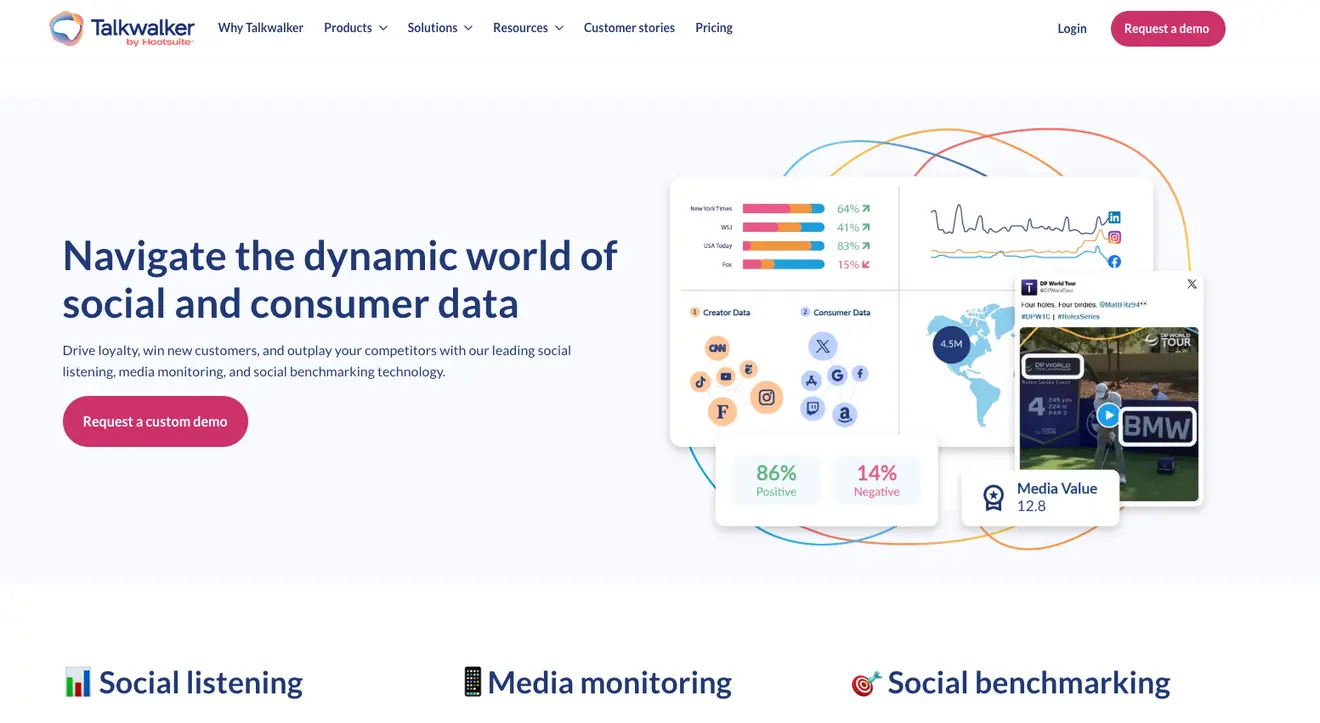
Talkwalker, now part of Hootsuite following a 2024 acquisition, is an enterprise-grade listening and consumer intelligence platform that monitors across 150+ million sources.
Its defining capability is visual listening: it tracks logo appearances in images and video content, not just text mentions.
Key social listening features:
- 150+ million source coverage across social, news, blogs, forums, and broadcast media
- Visual and video listening with AI-powered logo and image recognition
- Blue Silk AI for automated trend detection and insight summarization
- Social benchmarking for competitive performance comparison
- Influencer identification and campaign tracking
Brandwatch
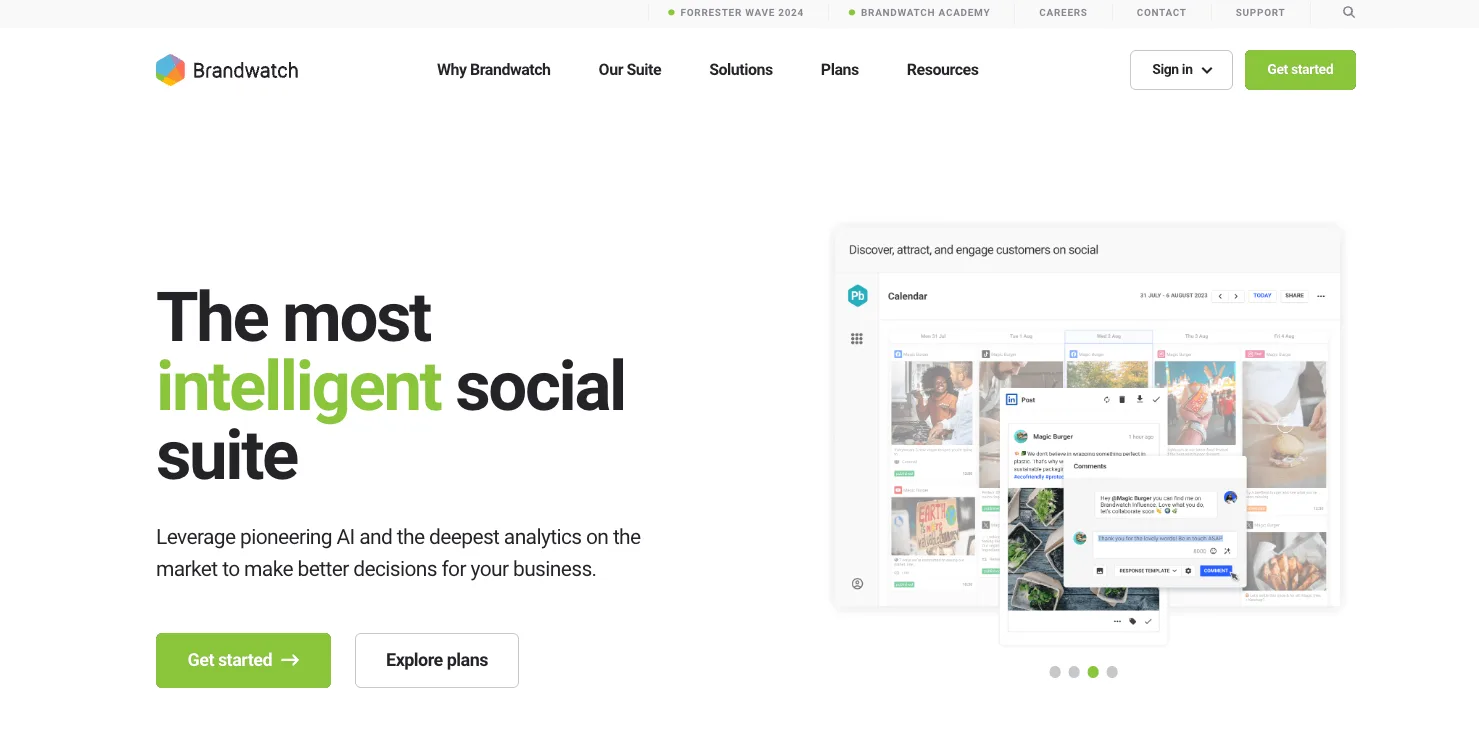
Brandwatch is one of the most established names in consumer intelligence. It offers access to deep historical data going back years, advanced boolean query building for complex research setups, and strong audience segmentation tools.
Its AI summarization layer helps teams synthesize high volumes of mentions into readable reports. The platform is oriented toward research-grade analysis.
Key social listening features:
- Extensive historical data access for longitudinal brand and market research
- AI-powered summarization of high-volume mention feeds
- Competitive benchmarking across brands and industries
- Crisis and brand reputation monitoring with real-time alerts
- Integration with the broader Cision PR and influencer management suite
Sprout Social
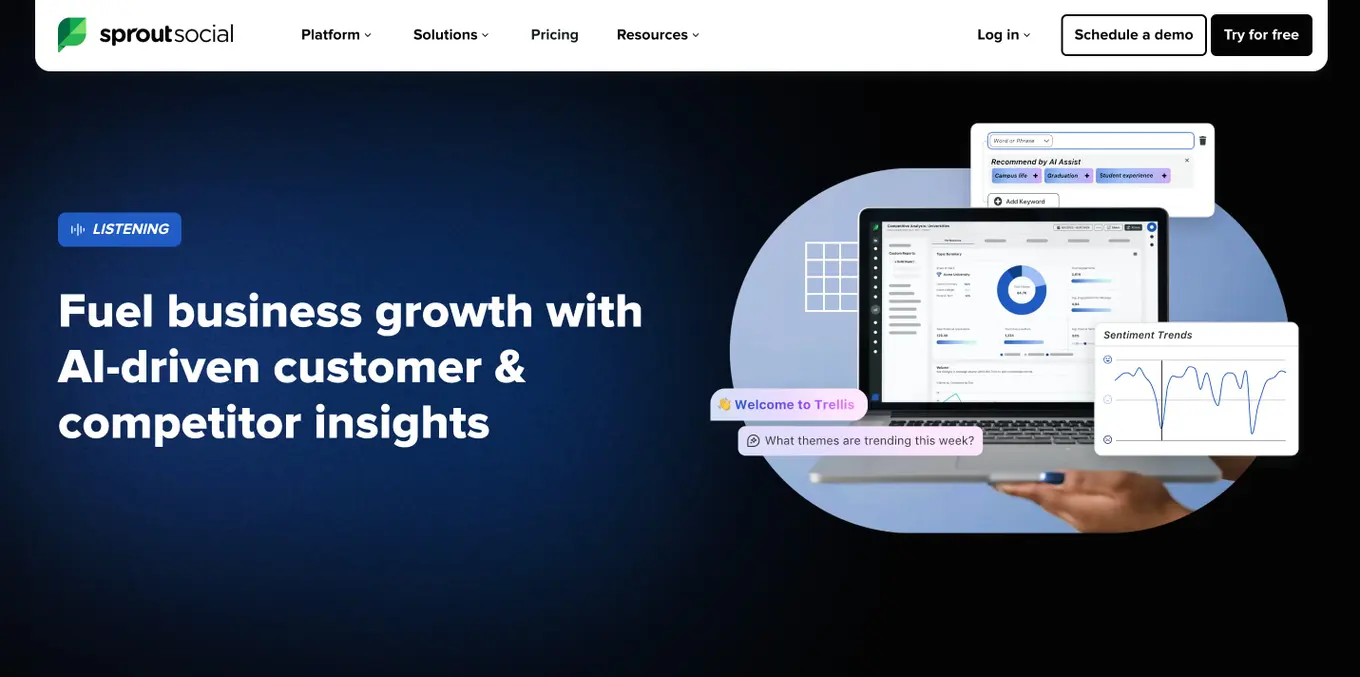
Sprout Social is a well-established social media management platform with a strong reputation for analytics and reporting. Its listening capability is vast and powerful.
The platform’s AI agent, Trellis, launched in late 2025 and is designed to turn social listening data into predictive business intelligence for enterprise teams.
It also integrates with Salesforce, Adobe, and Tableau for teams that need listening data feeding into broader business dashboards.
Key social listening features:
- Monitoring across social networks, forums, and web content with AI-powered query building
- Trend detection and volume spike alerts for early crisis detection
- Competitive analysis with side-by-side performance comparisons across brands
- ChatGPT integration for AI-assisted content planning and listening analysis
- Real-time social alerts via email, Slack, or Teams
Try Vista Social for free
A social media management platform that actually helps you grow with easy-to-use content planning, scheduling, engagement and analytics tools.
Get Started NowAbout the Author

Content Writer
Orion loves to write content that refuses to be boring. As part of Vista Social, he helps brands, creators, and agencies stop doom scrolling and start winning with social media. When he's not in front of a keyboard, he's watching films in IMAX with his wife, dissecting football tactics (the European kind), and getting lost in a good book.
Loading related tools...




Tools
PublishingAnalyticsEngagementIntegrations
FacebookInstagramLinkedInRedditSnapchatThreadsTikTokX (Twitter)YouTubeBlueskyVista Page (link-in-bio)All IntegrationsCopyright © 2026 Vista Social LLC. All Rights Reserved.