Running social listening for one brand is manageable. You know the brand inside out, you’ve set up the queries carefully, and when something surfaces, you know exactly who needs to see it.
But as the client roster grows, that same setup starts working against you. Fifteen clients across a dozen verticals can quickly lead to hundreds of daily alerts. And if you have no clear process for managing those, you’ll end up with listeners that haven’t been reviewed in months and conversations gaining momentum that nobody catches until the client forwards a screenshot asking why you didn’t flag it first.
There’s a difference between simply having a listening tool and running an effective listening program. The agencies that offer the latter have built something repeatable:
A framework for what to set up per client
A process for routing what comes in
A clear path from raw data to actionable insights
This guide covers all of that. We’ll walk through the four listeners every client account should have, how to keep a multi-client monitoring setup from becoming noise, and how to turn what you’re collecting into strategic value your clients can actually feel.
Table of contents
Why social listening is the agency’s most underrated growth lever
Social listening is a critical part of any social media strategy, but many agencies are nowhere close to getting the full value out of it. The programs that do deliver tend to share a few traits worth understanding before getting into the mechanics.
It keeps clients happier, longer
Reach, impressions, follower growth, and engagement rate. These are the metrics most agencies report on, and clients have seen enough of them to know they don’t always translate to business results. What does translate is strategic insight, the kind that comes from knowing what a client’s customers are saying when nobody thinks the brand is listening.
When your agency can walk into a quarterly review and say “here’s what your audience is worried about, here’s what they’re saying about your competitors, and here’s what we’d do about it,” that’s a very different conversation from presenting a slide deck of social numbers. It’s the kind of conversation that grows scope.
It compounds across clients
Every listening program you run adds to your agency’s institutional knowledge. Patterns you pick up from a fintech client teach you something about how consumers in that category think and talk. Trends you catch for a CPG brand can surface opportunities you bring to a prospect pitching in the same space. Over time, that accumulated listening data becomes genuine category expertise that competitors without a systematic approach simply don’t have.
It’s the cheapest pitch differentiator available
Walking into a new business meeting with five real insights about the prospect’s brand, pulled in the 15 minutes before the call, is a fundamentally different kind of pitch than a deck full of case studies. It signals that your agency is already paying attention, and it sets a tone for the relationship before the contract is even signed.
Social listening vs. social monitoring
It’s worth separating these two things clearly, because conflating them is one of the main reasons listening programs go unused.
Social monitoring is reactive. Someone mentions the brand, you see it, and you respond or escalate. It lives in the community management workflow and the inbox, and it’s focused on what’s happening right now.
Social listening is analytical. It’s the process of looking across all the conversations happening around a brand, a category, or a competitor over time and finding the patterns that inform strategy. It lives with the strategist, feeds into planning, and operates on a longer time horizon than a single mention.
Give this table a quick review to understand more about the differences between the two:
Feature
Social monitoring
Social listening
Nature
Reactive
Analytical
Core question
Someone mentioned us. What do we do?
What are people saying about this category, and what does it mean for our strategy?
Owned by
Community manager
Strategist
Sits in
The inbox
The monthly insight workflow
Output
Responses and escalations
Insights and recommendations
Agencies need both, but they should operate separately. When listening data gets mixed into the community management queue, it either gets ignored or it creates noise that slows down reactive work. Keep the workflows distinct, and both get the attention they deserve.
The agency social listening framework: 4 listeners every client should have
In Vista Social, a Listener is a custom stream you set up to track specific keywords, hashtags, and phrases across your chosen sources. You can run internal listeners (within your clients’ connected social profiles) and external listeners (across social networks, the web, and news sites). Each listener can track across multiple sources simultaneously.
For every client, your default setup should include four listeners. This framework gives you full coverage without overcomplicating the configuration.
Listener 1: Brand monitor
What to track:
The client’s brand name, including common misspellings and abbreviations
Branded hashtags
Key product and service names
Executive names where the individual has public visibility
Why it matters for the agency: Most brand mentions happen without a tag. People talk about brands in captions, in comments, in reviews, and the brand’s social team never sees them because they’re only watching notifications.
The brand listener catches all of it, builds the sentiment baseline you need for trend reporting, and gives the client a view of how they’re perceived that native tools simply don’t provide.
In Vista Social, conversations pulled through your listener are automatically tagged with a sentiment indicator (positive, negative, mixed, or neutral), and you can filter by sentiment, language, and location to narrow your analysis further.
Listener 2: Competitor monitor
What to track:
Two to four named competitors and their key products
Competitor executives and spokespeople
Active campaign keywords you’re tracking
Competitor branded hashtags
Why it matters for the agency: Competitive intelligence is one of the most direct paths to growing a client relationship. When you can show a client that a competitor’s campaign is generating meaningfully more positive sentiment or that their latest product launch is being received poorly in ways the client could capitalize on, you’ve shifted from reporting on the past to shaping what comes next. That’s the strategic layer that turns a social retainer into something worth expanding.
Vista Social’s competitor analysis report lets you pull this data into a shareable, white-labeled format so the insight lands clearly in a client presentation rather than sitting in a raw data export.
Listener 3: Category and topic monitor
What to track:
Industry keywords and category-specific language
Recurring pain points and questions from customers in the space
Emerging trend terms showing up in the client’s vertical
Relevant community hashtags and forum threads
Why it matters for the agency: This is the listener that surfaces the opportunities the client doesn’t yet know about. Customers discussing a frustration on Reddit that the client’s product could solve. A new topic gaining momentum in the category that nobody’s written about yet.
A shift in how people are talking about a product type that points toward a content angle worth pursuing. Category listening is where the insight that makes a strategy deck genuinely useful actually comes from, and it’s the thing most clients can’t generate for themselves.
Listener 4: Crisis and risk monitor
What to track:
The brand name combined with negative qualifiers (“scam,” “broken,” “disappointed,” “lawsuit”)
Product-specific issue keywords relevant to the client’s category
Customer service red flags and service failure language
Volume spikes in negative sentiment
Why it matters for the agency: The goal here is early warning, specifically getting ahead of a developing situation before the client’s leadership team finds out about it through someone else. A spike in negative-sentiment mentions around a specific complaint theme is detectable hours before it trends, and responding early looks very different from responding after the conversation has already run its course.
Because Vista Social automatically tags all pulled conversations by sentiment, a sudden shift toward negative is visible in the dashboard the moment it starts building.
How to structure social listening across multiple clients
Four listeners per client across a 15-client portfolio means 60 active listeners to monitor and extract value from. The agencies that manage this well have put a few structural pieces in place before it becomes unmanageable.
Use profile groups to keep everything clean
In Vista Social, each client gets their own profile group, and every listener, social profile, and report for that client lives inside it.
Nothing crosses between groups, which means listener data stays scoped correctly, reports pull the right information, and team members with restricted access only see the clients they’re managing. When a new analyst joins and gets assigned to three clients, they see exactly what they need and nothing else.
Document listener queries in a shared wiki
When a strategist leaves, the logic behind how their listeners were configured shouldn’t leave with them. For every active listener, keep a record of:
The keywords being tracked and the Boolean logic used
Terms that have been excluded and why
The date the listener was last reviewed
Any notes on coverage gaps or known misses
A listener configured 18 months ago for a client whose product line has since changed is probably missing a significant portion of relevant conversations. Documentation is what makes it possible to catch that before the client does.
Set up a triage rotation
Spreading alert triage across the team prevents the burnout and alert fatigue that comes from having one person responsible for 60 listeners. Rotating daily works well for smaller teams. Assigning by client cluster, where one analyst owns the CPG clients and another owns the SaaS clients, works better when team members have category-specific context that helps them distinguish signal from noise.
Vista Social’s inbox sentiment filtering helps here too, surfacing the most urgent negative-sentiment items first so the person triaging isn’t reading through hundreds of neutral mentions to find the two that actually need attention.
Establish escalation paths during onboarding
For each client, before anything goes live, document in writing:
What constitutes an urgent alert that warrants immediate contact
Who gets notified, and through which channel
What the response window is from alert to first action
Who has authority to approve any external communication
Building this into the onboarding process means the first time a crisis listener fires, the team already knows what to do.
Review listeners every quarter
Listeners decay quietly. A competitor launches under a new product name. The client’s brand gets rebranded. A new platform emerges where the audience has migrated. Vista Social’s listener results refresh every four to six hours, but that only works if the queries are still asking the right questions. A quarterly review where strategists audit their active listeners, check for coverage gaps, and update Boolean logic is what keeps the program accurate over time.
How to turn client listener data into actionable insights
Listening data is only as valuable as the workflow that turns it into something a client can act on. The agencies that grow retainers through listening share a few habits worth building into the process.
Lead with the insight, not the data volume
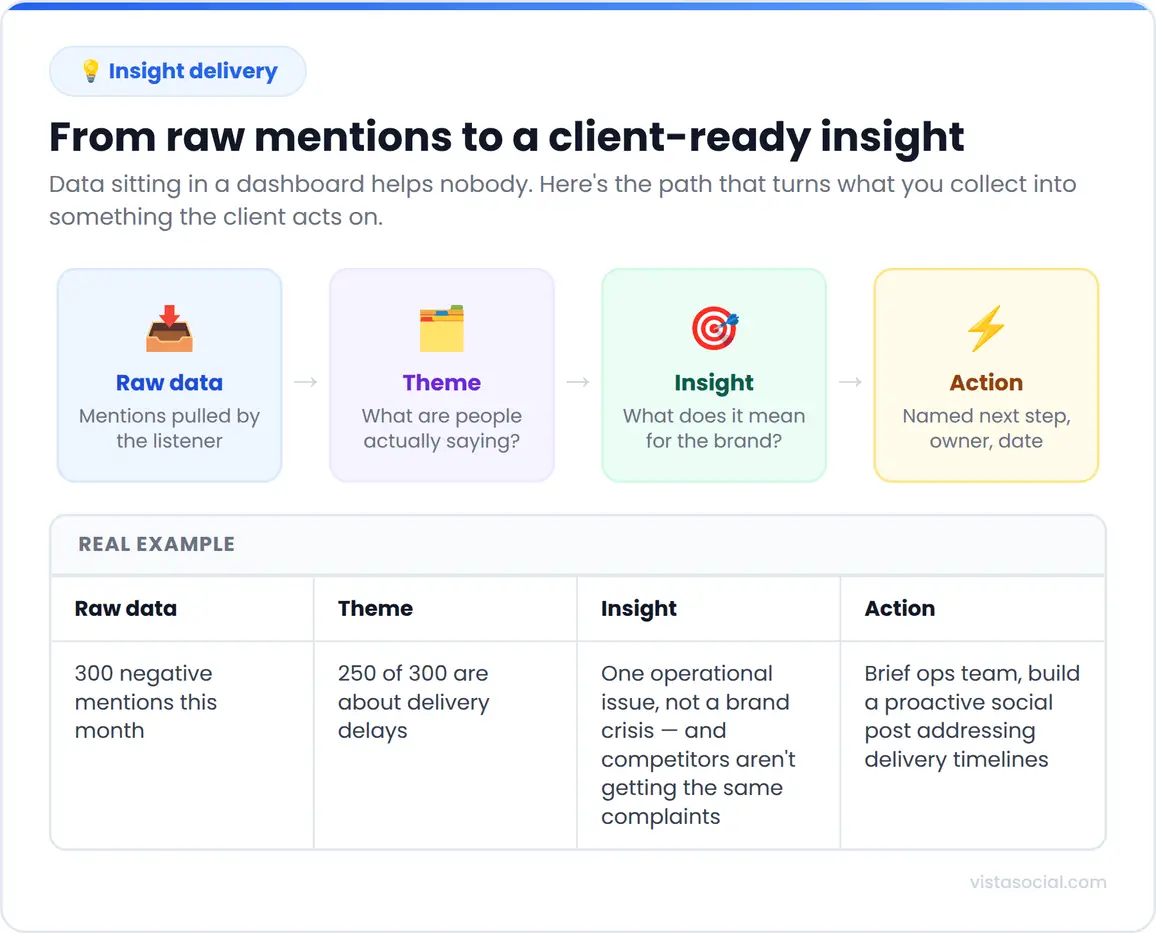
Showing a client that mentions are up 23% this month is data. Telling them that their customers are increasingly talking about delivery times as a switching reason, concentrated in the 18 to 34 demographic on TikTok, with a specific campaign angle that could address it directly, is an insight. Put the insight up front and the supporting data behind it. The analysis is what the retainer pays for.
Use trend lines, not monthly snapshots
Vista Social’s social listening analytics tools let you track sentiment over custom date ranges, which is what makes strategic storytelling possible. A single month’s sentiment score is a data point. A six-month trend line showing sentiment improving after a campaign launch is evidence that the work is actually doing something.
Put competitor data next to client data
The most persuasive listening insight in a client presentation is the side-by-side view: here’s how your brand is being talked about, and here’s how your top three competitors are being talked about over the same period. It contextualizes performance, generates strategic conversations, and almost always opens a natural discussion about what it would take to close a gap or press an advantage.
Deliver white-labeled reports on a schedule
Clients should never see a tool logo on a report your agency produced. Vista Social’s report builder lets you create custom report templates, including Listener Performance Reports and Competitor Analysis Reports, that you build once and regenerate across clients on a set schedule.
For a 15-client agency, moving from one-off manual report exports to scheduled, branded report delivery is one of the highest-leverage operational upgrades available.
Query listening data through Vista Social’s MCP integration
Vista Social’s MCP integration with Claude and ChatGPT means a strategist can ask “what are the top complaint themes for this client over the last 30 days” in plain language and get an answer without navigating the dashboard or waiting for a report to generate.
For strategists who work fast and need context quickly, this closes the gap between the data existing and the insight actually getting used. The MCP for agencies guide covers how to set this up.
Common mistakes agencies make with social listening
Don’t waste your time and your client’s billable hours on social listening data and reports that don’t actually tell you anything. Avoid these mistakes by ensuring your social listening process actually works.
Setting up generic queries
A listener tracking just a brand name without Boolean operators, exclusions, or handle qualifiers will pull in a lot of irrelevant noise alongside the mentions that matter.
Boolean operators include:
AND: Results will include mentions of both items, like “Competitor 1” AND “issue”
OR: Results will include mentions of either keyword, like “Competitor 1” OR “Competitor 2”
NOT: Results will exclude mentions of a keyword, like “Competitor 1” NOT “happy”
Vista Social’s query builder supports full Boolean logic and keyword groups, making this straightforward to configure properly.
Treating it as a reporting checkbox
Data with no clear path to action is expensive noise. Every listening insight your team surfaces should have a named next step attached, whether that’s a content angle, a campaign pivot, a client conversation, or an escalation. If the consistent output of your listening workflow is a slide that gets presented and not referenced again, the program isn’t generating value.
No handoff between listening and strategy
The analyst pulls the data and the strategist makes the decisions, but without a structured way for one to hand off to the other, including a consistent format for what gets communicated and a clear expectation for what happens with it, the data tends to stay in the analyst’s view and go nowhere.
Measuring volume instead of theme
“300 negative mentions this month” tells you almost nothing on its own. If 250 of those 300 are about the same returns policy, that’s one operational issue, not a reputation crisis.
Vista Social’s automatic sentiment tagging across all listener results turns volume numbers into directional signals, and pairing that with manual theme grouping in your review workflow makes the data useful for decision-making.
Ignoring the platforms where real conversations happen
Reddit threads, Bluesky posts, App Store reviews, Yelp comments, and OpenTable feedback are where some of the most candid and detailed brand conversations happen, often more revealing than anything posted on the mainstream five.
Vista Social’s external listeners support all of these alongside Facebook, Instagram, X/Twitter, LinkedIn, YouTube, TikTok, and Threads, which means your listening program covers where people are actually talking rather than just where it’s convenient to look.
Not reviewing listener performance regularly
Vista Social refreshes listener results every four to six hours, but a listener tracking outdated queries is still pulling the wrong data every four to six hours. Build the quarterly review into the team calendar and protect it.
What to look for in a social listening tool for agencies
Most listening tools were built for a single brand team running one or two monitors. Agency needs are different, and the evaluation criteria should reflect that.
Criteria
Why it matters for agencies
Multi-client architecture
Profile groups, per-client permissions, and white-label reporting. Tools built for single-brand use create operational headaches at agency scale
Multiple simultaneous listeners per client
Running the four-listener framework requires four active queries per client. Tools that cap you at one or two force trade-offs that weaken your program
AI-powered sentiment analysis
Keyword-based sentiment misses sarcasm, nuance, and irony. Vista Social’s automatic sentiment tagging handles the full range of how people actually express frustration or enthusiasm
Source breadth
Bluesky, Reddit, App Store, Google Play, Yelp, OpenTable, Threads, news, and web search. Most tools cover the obvious networks and miss where real conversations happen
Scheduled white-label reporting
Custom templates you build once and regenerate across clients. Manual report assembly per client doesn’t scale past five accounts
Agency-friendly pricing
Per-user pricing punishes growth. Per-profile-group pricing scales proportionally with the client roster
MCP and AI integration
Native AI agent support means plain-language queries via Claude or ChatGPT, which accelerates insight delivery for strategists who need answers fast
Vista Social is the right social listening solution for agencies
The social listening market is valued at $10.91 billion in 2026 and projected to reach $20.51 billion by 2031 according to Mordor Intelligence. Most of that growth is being captured by enterprise tools built for brand teams with dedicated analysts and a single client to focus on.
Vista Social was built for how agencies actually work. Profile groups keep every client’s data cleanly separated. Internal and external listeners run simultaneously per group, covering brand, competitor, category, and crisis monitoring without forcing trade-offs. Automatic sentiment tagging handles nuance across all conversations your listeners pull. Source coverage includes Bluesky, Reddit, App Store, Google Play, Yelp, OpenTable, Threads, Tumblr, news, and web search, giving you a broad range of conversation monitoring.
The Report Builder supports custom templates, scheduled delivery, and white-label formatting, so reporting becomes a calendar event rather than a project. And MCP integration means your strategists can query listening data in plain language without opening a dashboard.
Social listening for agencies is the practice of systematically monitoring and analyzing online conversations across multiple client brands simultaneously, using that data to surface strategic insights, identify competitive opportunities, and demonstrate value beyond standard engagement metrics. Unlike monitoring, which is reactive, listening is analytical and informs strategy over a longer time horizon.
How do agencies use social listening?
Agencies often use social listening for things like market insights, brand perception tracking, and cultural trend analysis. In practice, this means running listeners across brand mentions, competitor activity, category keywords, and crisis signals for each client and turning what surfaces into insights that inform content strategy, campaign planning, and retainer growth conversations.
What tools do agencies use for social listening?
Agencies need tools with multi-client architecture, specifically profile groups that keep client data separate, white-label reporting, multiple simultaneous listeners per client, and sentiment analysis that handles nuance. Vista Social’s social media listening platform supports many sources per listener, automatic sentiment tagging, and scheduled white-labeled reporting across the full client portfolio.
How often should agencies review their listening setup?
Quarterly at minimum. Listeners decay as brands evolve, competitors launch new products, and platforms change. A structured quarterly review where each strategist audits their active listeners, updates Boolean queries, and confirms source coverage keeps the program accurate rather than quietly missing the conversations that matter most.
Try Vista Social for free
A social media management platform that actually helps you grow with easy-to-use content planning, scheduling, engagement and analytics tools.
Orion loves to write content that refuses to be boring. As part of Vista Social, he helps brands, creators, and agencies stop doom scrolling and start winning with social media. When he's not in front of a keyboard, he's watching films in IMAX with his wife, dissecting football tactics (the European kind), and getting lost in a good book.
Loading related tools...
By continuing to use this site you consent to the use of cookies in accordance with our cookie policy.
Social listening vs. social monitoring
It’s worth separating these two things clearly, because conflating them is one of the main reasons listening programs go unused.
Social monitoring is reactive. Someone mentions the brand, you see it, and you respond or escalate. It lives in the community management workflow and the inbox, and it’s focused on what’s happening right now.
Social listening is analytical. It’s the process of looking across all the conversations happening around a brand, a category, or a competitor over time and finding the patterns that inform strategy. It lives with the strategist, feeds into planning, and operates on a longer time horizon than a single mention.
Give this table a quick review to understand more about the differences between the two:
Agencies need both, but they should operate separately. When listening data gets mixed into the community management queue, it either gets ignored or it creates noise that slows down reactive work. Keep the workflows distinct, and both get the attention they deserve.