

Published on February 25, 2026
9 min to read
20 Essential Social Media Metrics to Track for Your Brand

Summarize with AI

Table of contents
Summarize with AI

ChatGPT

Claude

Perplexity
Share

Vista Social

X (Twitter)


You’ve been posting on social media to promote your brand, but now you need to actually report on how those posts did. So now you’re putting together your first social media report, wondering which metrics are most important to highlight.
If you open up any social media analytics tool, whether it’s the built-in Instagram or TikTok analytics or a report in Vista Social, there’s a ton of data in there. But which numbers actually mean you’re doing well?
Let’s dive into some of the most essential social media metrics you should be tracking for your brand—plus, take a quiz that can help you pinpoint the best ones specific to your strategy.
Table of contents
What are social media metrics?
Social media metrics are data and insights that help you track how well your social media content is performing. They include metrics like:
- Likes
- Comments
- Shares
- Engagement rate
- Click-through rate
Pretty much any interaction someone could have with your brand’s social media presence can be found via social media metrics. These metrics tell you things like:
- How many people are you reaching with your content?
- Are people interested in your content?
- Is your content helping people find your business?
You can find these metrics in each social media app or by pulling a report with a tool like Vista Social:
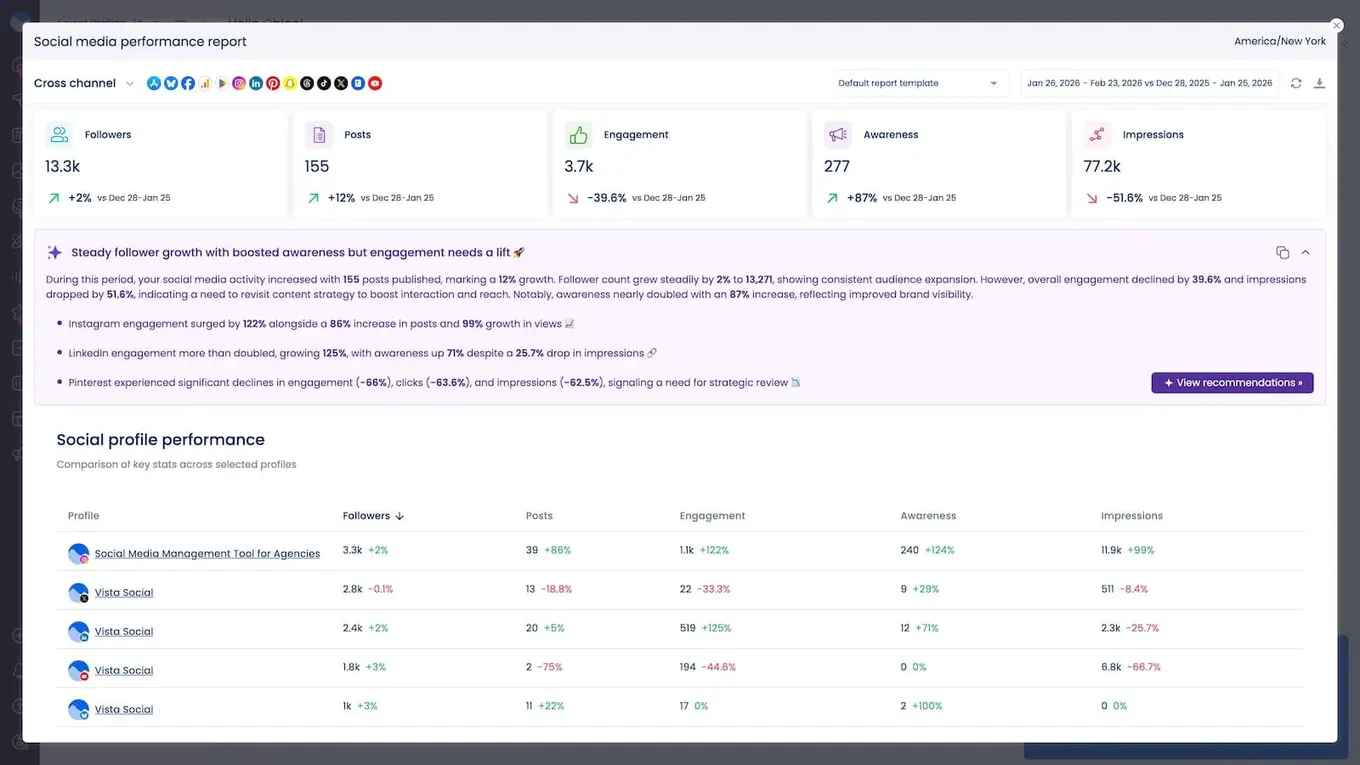
But not every metric means all that much to your bottom line, so it’s important to focus on the data that actually matters.
20 social media metrics you should be tracking
Don’t go into your reporting blind. Walk through this guide with us as we introduce you to 20 social media metrics you’ll want to track and why.
Awareness metrics
Awareness metrics tell you how far your content has traveled and how many people have encountered your brand. These indicate whether your content strategy is putting your brand in front of the right audiences.
1. Impressions
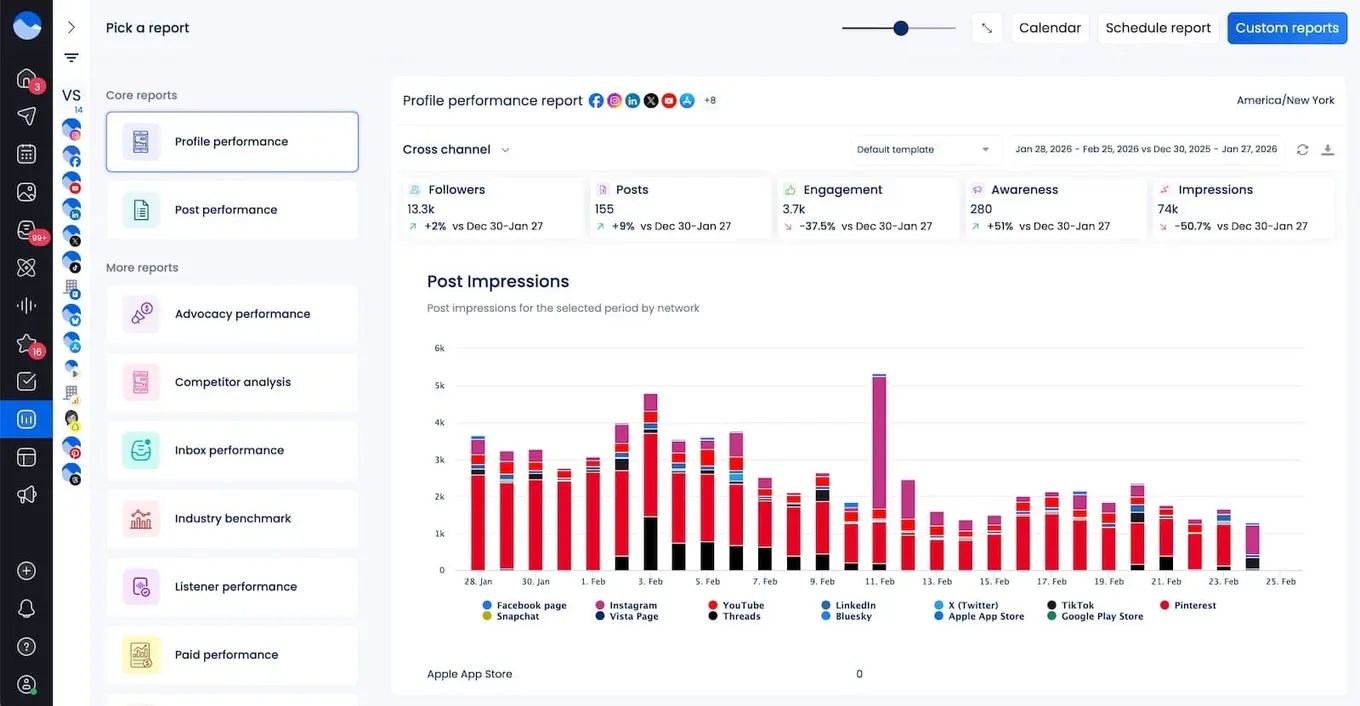
Impressions tell you the total number of times your content is seen, regardless of whether it was clicked or engaged with. A single user might generate multiple impressions if they see your post more than once.
A high impressions-to-reach ratio suggests your content is being shown repeatedly to the same audience, which can be useful for brand recall but may also signal the need to broaden your targeting.
2. Reach
Reach represents the total number of unique users who have seen your content. Unlike impressions, reach counts each person only once, giving you a clearer picture of your actual audience size.
Monitoring reach over time helps you gauge whether your content distribution is expanding or contracting.
3. Follower growth rate
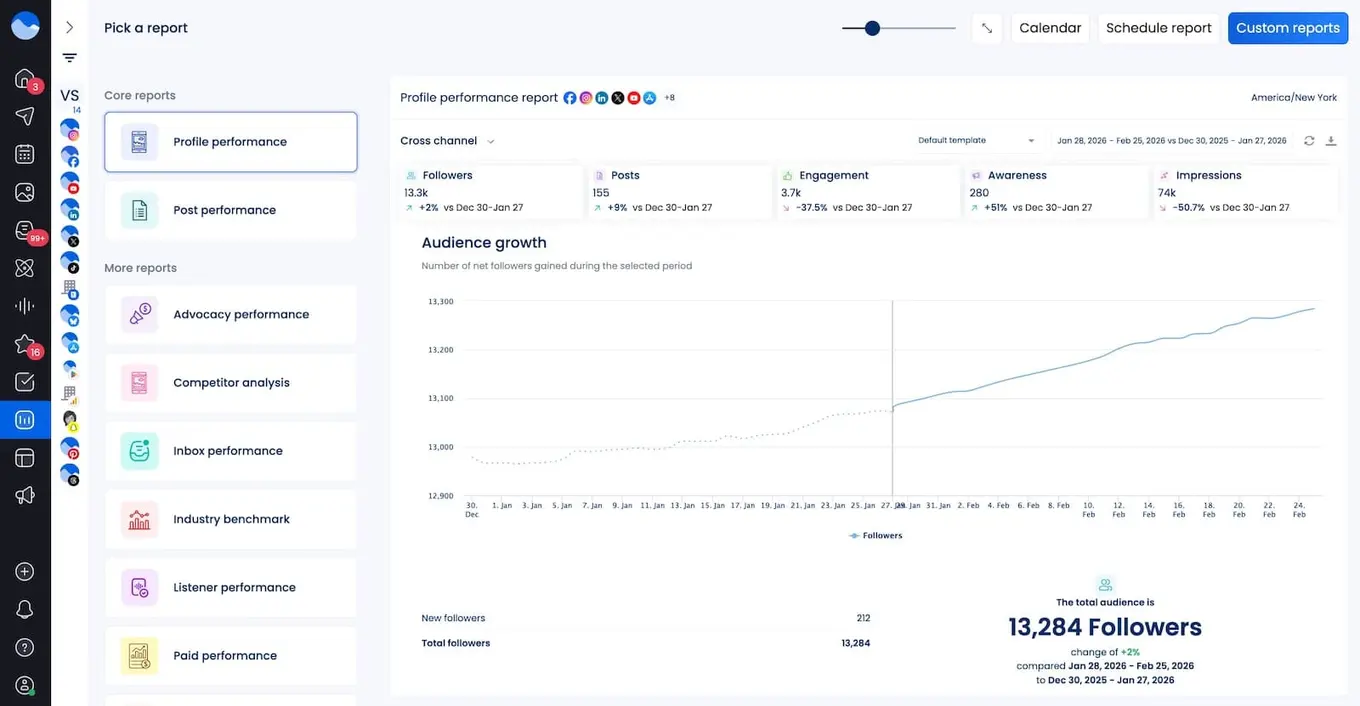
Follower count can be a good metric to follow, but an even better one is actually paying attention to the rate at which your audience grows.
A steady growth rate indicates that your content strategy is consistently attracting new followers, while sudden spikes or drops can help you identify which campaigns or events have the greatest impact on audience acquisition.
Engagement metrics
Engagement metrics reveal how your audience interacts with your content. High engagement signals that your content resonates with your audience and encourages meaningful interaction.
The social media algorithm likes this, which can help boost your content to even more feeds. Long story short: You want to see high engagement metrics.
4. Engagement rate
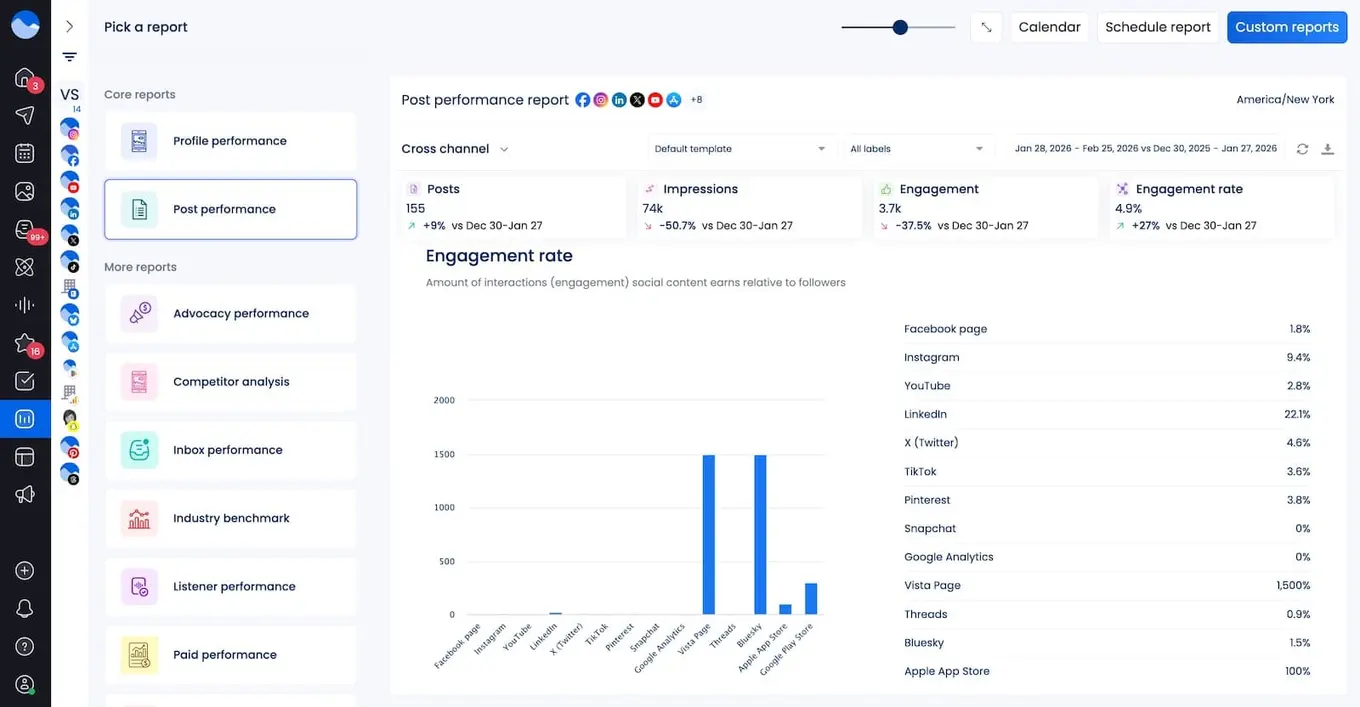
Engagement rate is the percentage of people who interact with your content relative to those who see it. It typically includes likes, comments, shares, and saves.
This is one of the most important metrics to track because it normalizes performance against your audience size, allowing you to compare content effectiveness over time and across platforms.
You can calculate your own engagement rate, but Vista Social’s post performance report does all of the work for you.
5. Likes/reactions
Likes (or reactions on platforms like Facebook and LinkedIn) are the most basic indicator that someone is interested in your content. However, it’s better to pay attention to more intentional interactions like comments or shares.
6. Comments
Comments require more effort than a simple like, making them a stronger indicator of audience interest and investment. Tracking comment volume and sentiment provides insight into how deeply your content connects with your audience. A healthy comment section often signals an active, loyal community.
7. Shares
Shares extend your content’s reach organically, acting as personal endorsements from your audience. If someone is sharing your content with their friends, they obviously really like it—or at least think someone else will!
8. Saves
Saves, particularly on platforms like Instagram, indicate that users find your content valuable enough to revisit. Both metrics are strong signals of high-quality content that platforms tend to reward with greater visibility.
Video performance metrics
With video dominating social feeds across every major platform, tracking video-specific metrics is essential for brands investing in this format.
9. Video views
Video views tell you how many people are watching your video content. It’s important to keep tabs on how many eyes your videos get so you can see which ones seem to be more popular than others.
10. Watch time
Now while your video views tell you how many people started watching, watch time reveals how long they stayed.
Average watch time and total watch time are more meaningful than view counts alone because they indicate whether your content holds attention. Platforms like YouTube, TikTok, and Instagram Reels all use watch time as a key ranking signal.
11. Completion rate
Completion rate measures the percentage of viewers who watch your video from start to finish. A high completion rate signals compelling content, while a steep drop-off early on may suggest your hook needs work. Analyzing where viewers leave helps you refine components like pacing and length.
Conversion metrics
Conversion metrics bridge the gap between social engagement and business impact. They demonstrate how your social presence drives tangible results like website visits, lead generation, and revenue.
12. Click-through rate (CTR)
Your click-through rate (CTR) measures the percentage of people who click on a link in your post relative to total views or impressions.
A strong CTR indicates that your content and call-to-action are compelling enough to drive traffic beyond the platform. This metric is especially important for brands or platforms focused on driving website traffic.
13. Conversion rate
Conversion rate tracks the percentage of social media visitors who complete a desired action, i.e., making a purchase, signing up for a trial, or downloading a resource.
By connecting your social analytics to your website analytics through UTM parameters and tracking pixels, you can attribute real revenue to your social media efforts.
14. Cost per click (CPC)
For paid social campaigns, your cost per click (CPC) measures how efficiently your ad spend generates results. CPC tells you what you pay for each click to your website or landing page. Monitoring these metrics ensures your paid strategy delivers a positive return on investment.
15. Cost per acquisition (CPA)
Cost per acquisition (CPA) is another metric that gives you insight into your ad spend. Your CPA reveals the cost of each conversion, which is key for ensuring you’re not paying more to earn a customer than that customer is spending with you.
Customer care metrics
Social media is increasingly the first place customers turn for support. Tracking customer care metrics helps ensure your brand is responsive and that your social team is effectively managing incoming inquiries.
16. Response time
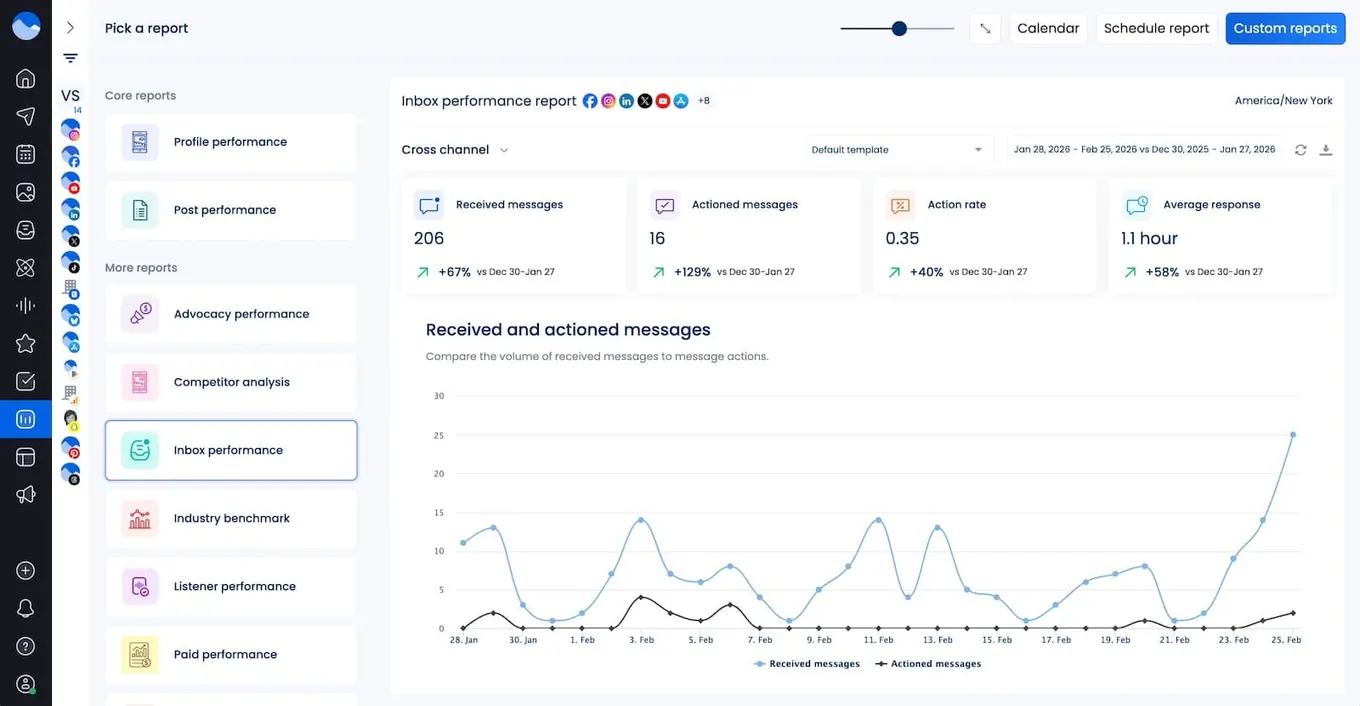
Average response time measures how quickly your team replies to comments, messages, and mentions. Faster response times improve customer satisfaction and signal to your audience that your brand is attentive and reliable.
Many social management platforms (like Vista Social in the report above) provide this metric automatically to help you benchmark your team’s performance.
17. Sentiment analysis
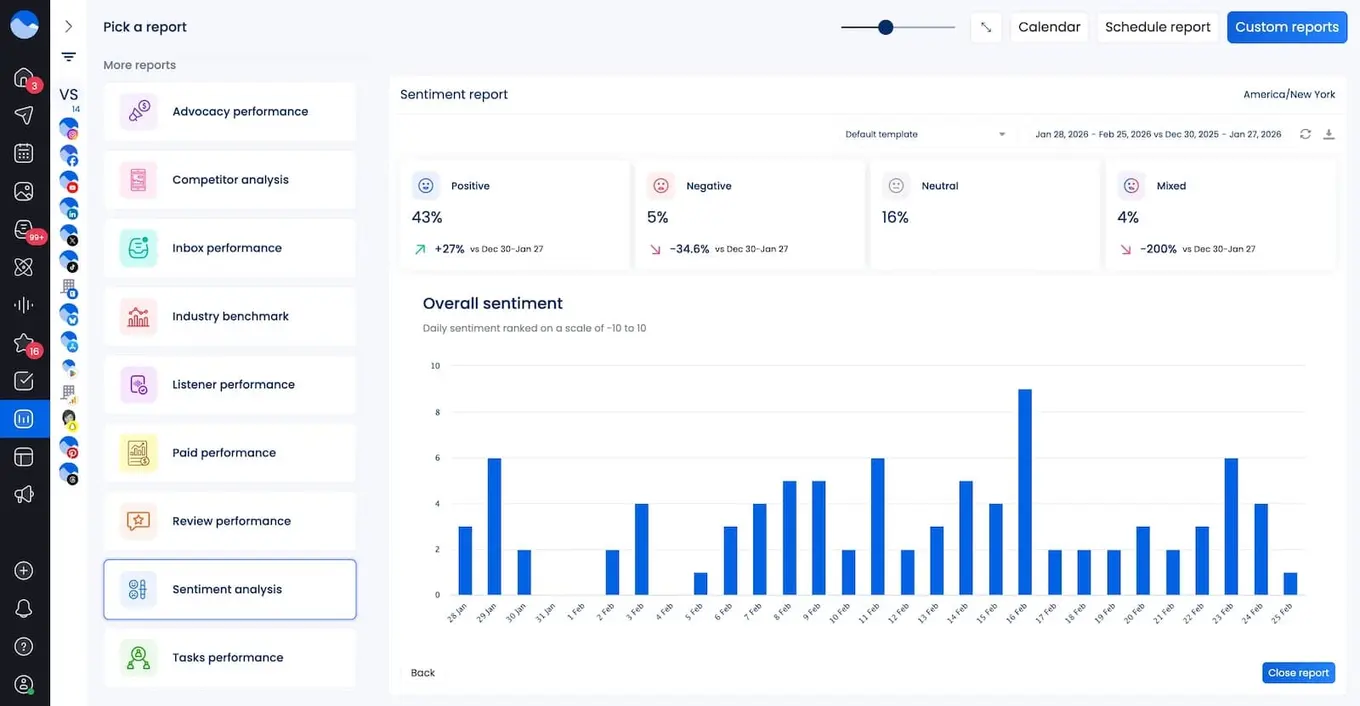
Sentiment analysis categorizes incoming messages and mentions as positive, negative, or neutral. Tracking sentiment trends over time helps you catch emerging issues early, measure the impact of campaigns on brand perception, and understand the overall health of your customer relationships on social media.
Competitive analysis metrics
Your metrics are most meaningful when viewed in context. And that means comparing your own performance to that of your closest competitors or your industry as a whole.
Looking at your competitive analysis metrics helps you see how you’re actually performing in a way that actually matters.
18. Share of voice
Your share of voice covers how many mentions your brand gets in your industry compared to how many mentions your competitors get. You can use social listening tools to help you gather these numbers and determine your brand’s social share of voice.
19. Industry benchmarking
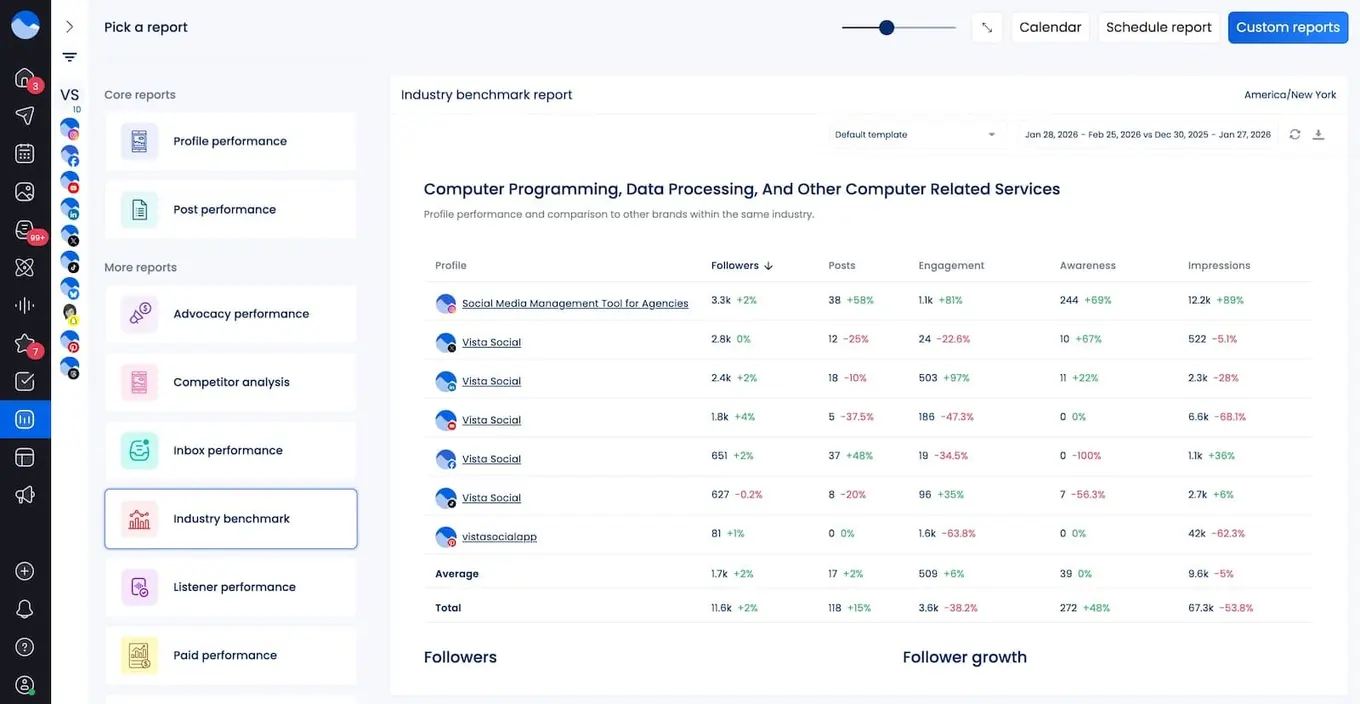
Industry benchmarking compares your performance against similar brands to help you understand whether you’re leading or lagging behind in key areas like follower growth, posting frequency, engagement rates, brand awareness, and reach.
20. Competitor benchmarking
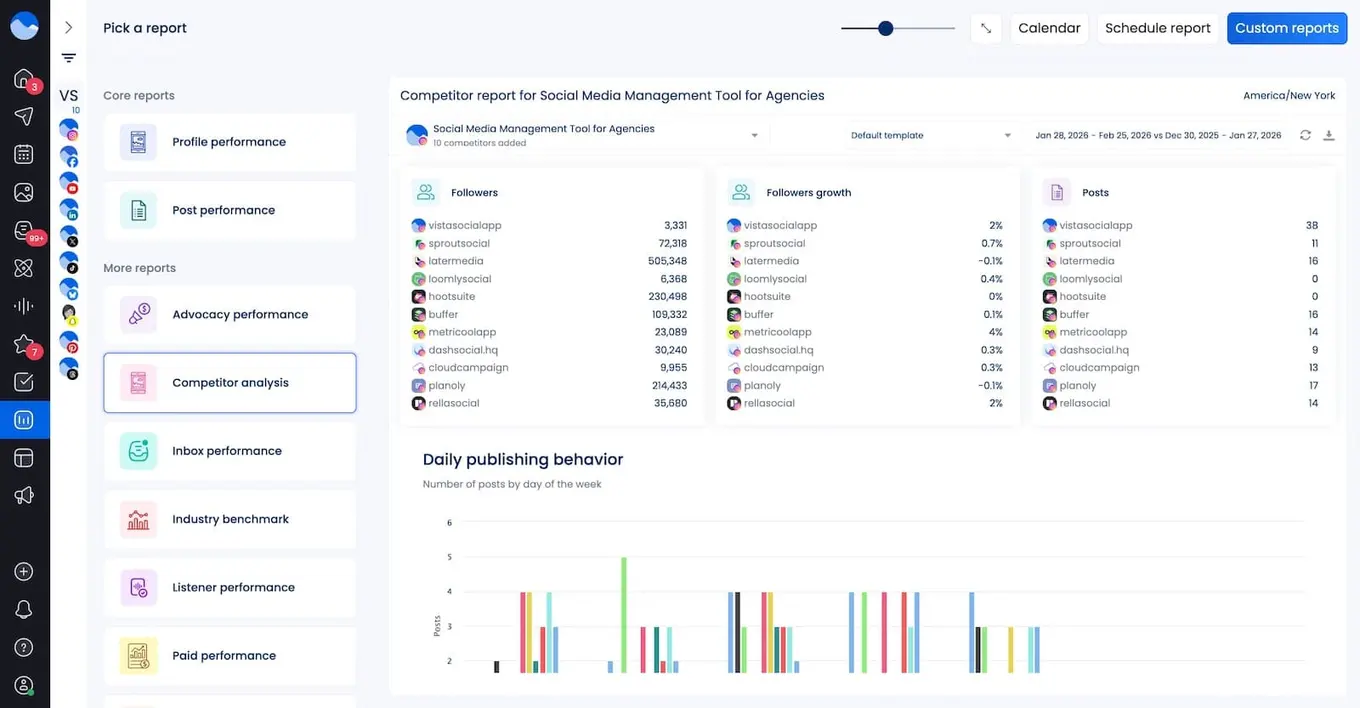
Benchmarking helps answer critical strategic questions:
- Are we posting enough compared to our competitors?
- Is our engagement rate above or below the industry average?
- Where should we focus our efforts to gain a competitive edge?
Without this context, even strong-looking metrics may mask underperformance relative to your market.
Try Vista Social for free
A social media management platform that actually helps you grow with easy-to-use content planning, scheduling, engagement and analytics tools.
Get Started NowAbout the Author

Content Writer
Chloe West is a content marketing manager for Vista Social. She has over seven years of experience in digital marketing for B2B SaaS companies. When she's not working, you'll find her spending time with her family, reading a book, or watering her plants.
Loading related tools...




Tools
PublishingAnalyticsEngagementIntegrations
FacebookInstagramLinkedInRedditSnapchatThreadsTikTokX (Twitter)YouTubeBlueskyVista Page (link-in-bio)All IntegrationsCopyright © 2026 Vista Social LLC. All Rights Reserved.
Social media metrics FAQs
What is the difference between reach and impressions?
Reach refers to the number of unique users who see your content, while impressions count the total number of times your content is displayed, regardless of whether it is clicked. Both metrics provide insights into your content’s visibility.
What is a good conversion rate for social media?
A good conversion rate varies by industry and specific goals, but generally, rates between 2% to 5% are considered average. Monitoring your own conversion rates over time is essential for evaluating performance.
How often should I review my social media metrics?
Regularly reviewing your essential social media metrics—ideally weekly or monthly—can help you stay informed about your performance, allowing you to make timely adjustments to your strategy.
What are some common mistakes to avoid when tracking social media metrics?
Common mistakes include focusing on vanity metrics (like follower count) instead of meaningful engagement metrics, failing to set clear goals, neglecting to analyze data consistently, and not adjusting strategies based on insights gained.