


Published on May 29, 2026
17 min to read
25+ LinkedIn Summary Examples That Get You Noticed

Summarize with AI

Table of contents
Summarize with AI

ChatGPT

Claude

Perplexity
Share

Vista Social

X (Twitter)


Most LinkedIn profiles have an About section that reads like a job description submitted to an HR database. Three bullet points about driving results, a sentence about being passionate about the space, and a closing line about being open to new opportunities. The problem is that when everyone writes the same thing, nobody remembers anyone.
For brands, agencies, and the social media managers building their professional presence on LinkedIn, the About or Summary section is often the first thing a potential client, collaborator, or hiring manager actually reads.
According to DataReportal, LinkedIn has more than 1 billion registered users worldwide as of 2025, which means the competition for attention on the platform is real. The professionals who cut through it almost always have one thing in common: their summary reads like a real person wrote it for a specific audience, with a clear reason in mind.
If you’re working on your broader LinkedIn marketing strategy, the About section is where profile visitors become real connections.
This guide collects LinkedIn summaries from founders, executives, content leaders, sales professionals, and thought leaders who are getting this right. For each one, there’s a breakdown of the specific technique at work so you can take the lesson.
Table of contents
What makes a LinkedIn summary actually work
Before the examples, a quick framework. Looking across all the profiles in this guide, the ones that perform consistently share a small number of traits that have nothing to do with word count or keyword stuffing.
The opening line does almost all the work. Whether the summary opens on a problem the reader recognizes, a result that proves scale, or a story that earns curiosity, the first sentence determines whether anyone reads the second.
A LinkedIn About section that opens with “I am a dedicated marketing professional with 10+ years of experience” has already lost most of the people who landed on it.
Numbers work when they’re specific. Follower counts and engagement rates are easy to inflate and harder to trust. Revenue attributed to content, deals closed, products launched, and teams built tell a more credible story, and buyers and hiring managers know the difference.
The personal details earn their place. The best summaries in this guide include at least one detail that has nothing to do with professional credentials. “Dog mom” in a two-sentence summary does more to make a profile memorable than a third paragraph about core competencies ever could.
The closing line should always point somewhere. A summary that trails off into vague language about being open to new things leaves the reader without a next step. The best ones close with a clear signal: what you’re building, who you want to work with, or what the reader should do next.
LinkedIn summary examples for agency founders
Agency founders face a specific challenge on LinkedIn: they’re trying to attract clients, recruit talent, and build credibility in an industry full of people making the same claims.
These four summaries show different ways to cut through that. If you manage social media as an agency, this section in particular shows how to position a firm around genuine expertise rather than a services menu.
1. Joe Davies, CEO at fatjoe
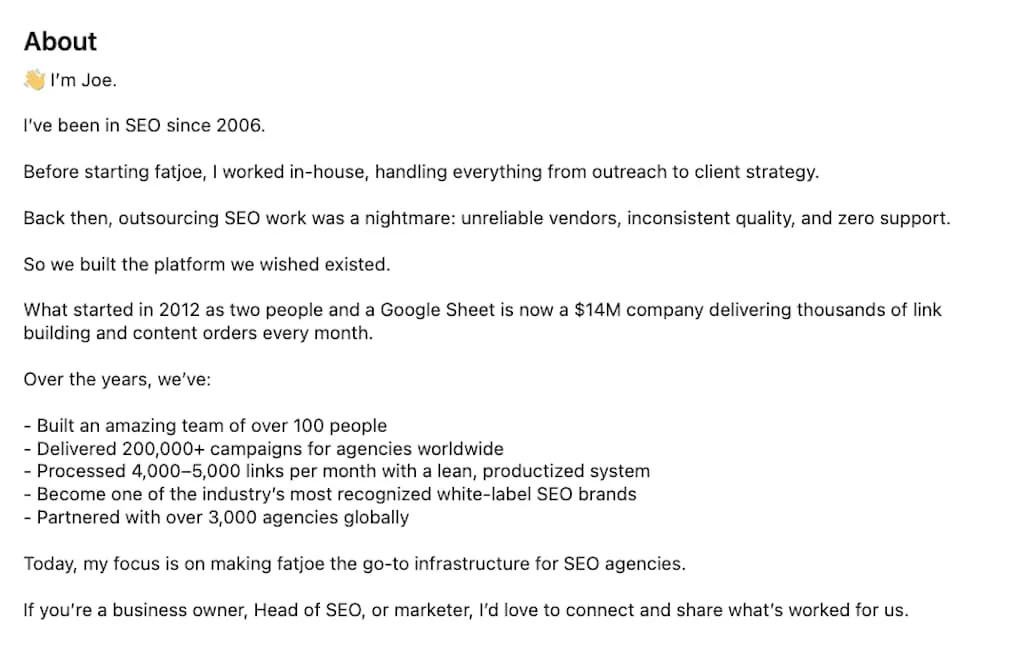
Joe’s summary opens on a problem he experienced personally: working in-house in SEO, finding that outsourcing the work was a mess of unreliable vendors, inconsistent quality, and zero support. That experience becomes the origin story for fatjoe, which he describes as the platform he wished had existed. The story works because it’s specific to the problem his clients are trying to solve before they ever contact him.
The numbers come in after the story, not before it: a $14M business, 200,000+ campaigns delivered, 4,000-5,000 links processed per month, 3,000+ agency partners globally. That sequence matters. The story earns trust; the numbers back it up.
The technique: An origin story rooted in your own frustration with the problem you now solve is one of the most credible opening moves available. It shows you built the solution because you needed it, not because you spotted a market opportunity.
2. Ferdinand Goetzen, Co-Founder at The Growth Syndicate
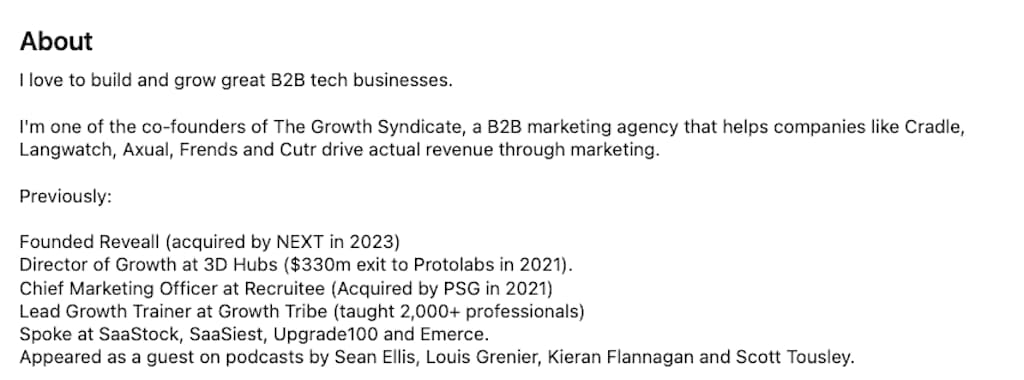
Ferdinand’s summary opens with one sentence: “I love to build and grow great B2B tech businesses.” Then it moves straight into what The Growth Syndicate does and who they serve. The rest is a credentials list: Reveall (acquired by NEXT in 2023), 3D Hubs ($330M exit), Recruitee (acquired by PSG in 2021). Every line is a proof point, and the whole thing takes about 15 seconds to read.
The summary leaves you with a clear picture of someone who has worked at the intersection of B2B marketing and successful exits. That’s the specific audience he’s trying to reach, and the summary is built entirely around what that audience needs to know.
The technique: Strip the summary down to positioning plus proof. One sentence on who you are, one on what you do now, and then evidence.
3. Kiasha Naidoo, Founder at Transfigure Media
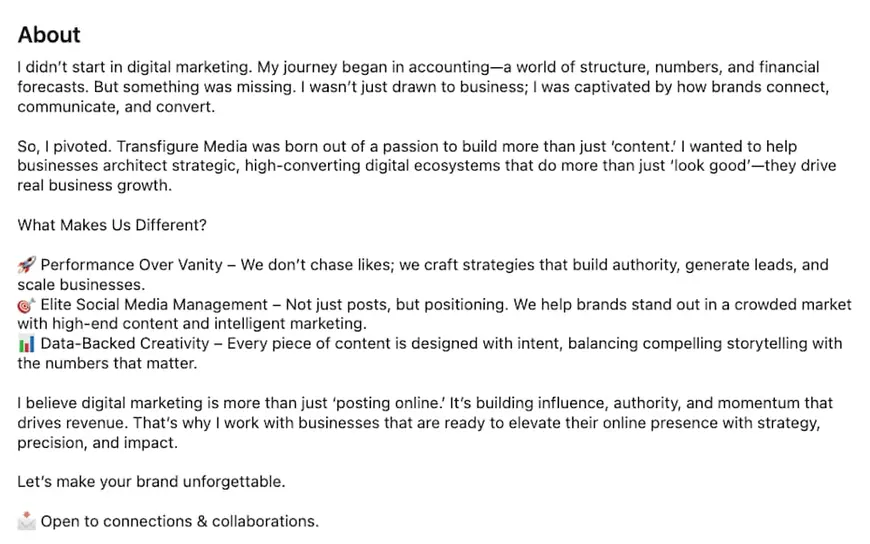
Kiasha’s summary starts with an unexpected pivot: she began her career in accounting, not marketing, and found that something was missing. That detour becomes the foundation for why Transfigure Media exists.
The summary goes on to explain the agency’s approach: performance over vanity, data-backed creativity, elite social media positioning. The personal pivot story at the start makes the pitch more believable, because it comes from lived experience rather than a services menu.
The technique: A non-obvious career pivot, framed as the origin of your current work, differentiates you from every other founder who followed the predictable path to the same destination.
4. Matthew Witchalls, Founder and Creative Director at Prima Nuro
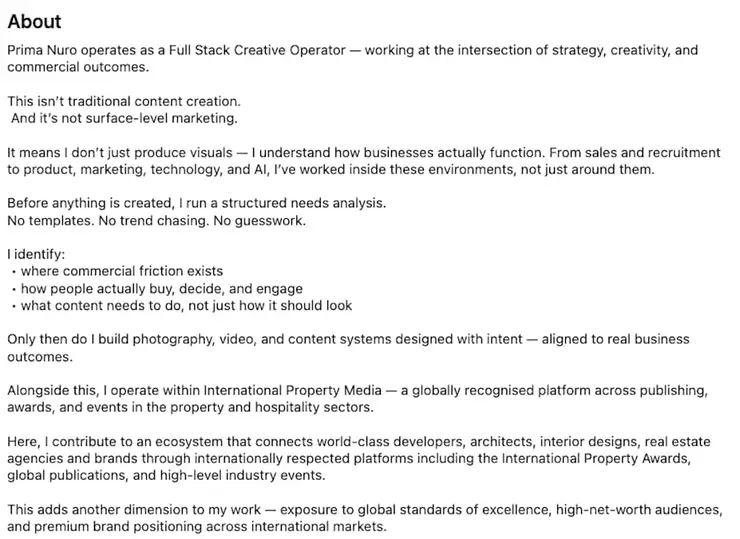
Matthew’s summary doesn’t lead with a story or a credentials list. It leads with an operating philosophy: Prima Nuro runs structured needs analysis before creating anything, understands how businesses function from the inside before producing content, and maps what content needs to do commercially before deciding how it should look. The methodology is the pitch.
That framing is designed to attract clients who’ve been burned by agencies that jump straight to deliverables without understanding the problem. The summary self-selects for clients who value process, which is a smart filter.
The technique: If how you work is your competitive advantage, make that the opening of the summary rather than what you make. The methodology signals maturity in a way that a portfolio alone never could.
LinkedIn summary examples for executives and brand leaders
Senior leaders face a different LinkedIn challenge: their title already carries weight, but their summary often reads like a job description rather than a perspective. These four profiles show how executives are using the About section more strategically.
5. Melody Lee, CMO at Mercedes-Benz USA
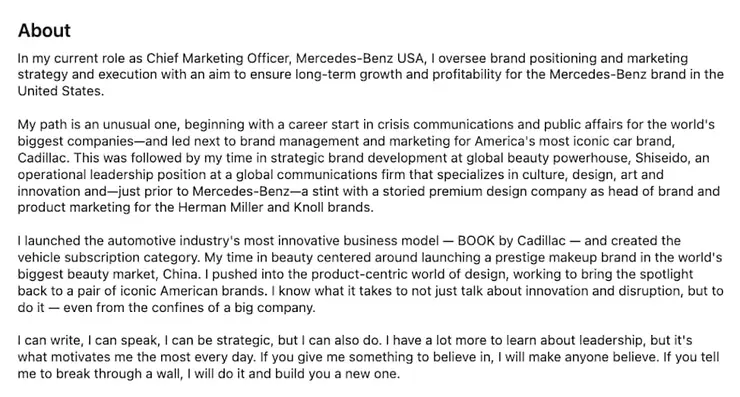
Melody’s summary traces an unusual career: crisis communications, Cadillac brand management, global beauty company Shiseido, a global communications firm, and then Herman Miller and Knoll before Mercedes-Benz.
Each stop adds a dimension rather than just adding time. The closing lines do the most distinctive work: “I can write, I can speak, I can be strategic, but I can also do.” For a CMO at a major automotive brand, that bluntness is unusual and memorable.
The technique: A multi-industry career history works when you frame each stop as evidence of range, not just experience. Connect the dots for the reader; don’t assume they’ll do it for themselves.
6. Brandon Sammut, Chief People & AI Transformation Officer at Zapier
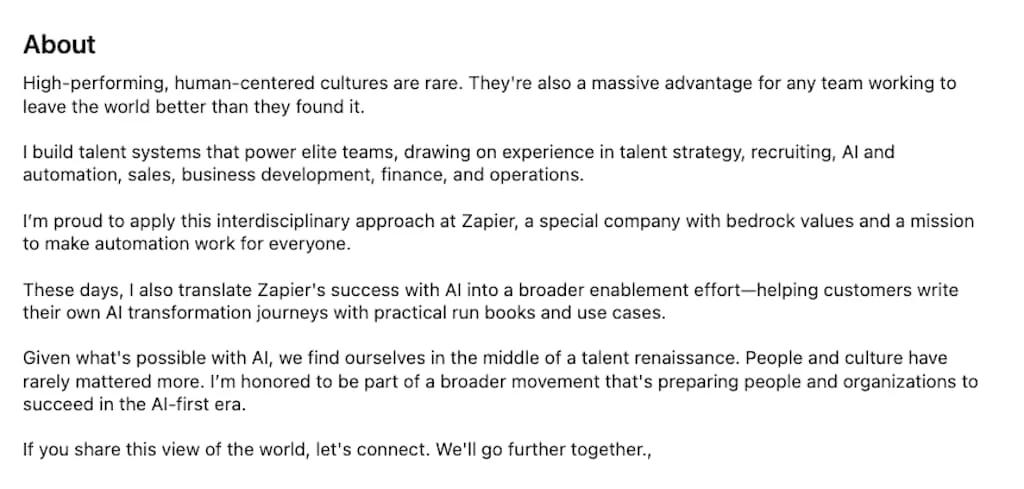
Brandon’s summary frames his People function through an emerging lens: talent systems built for an AI-first era, where people and culture represent a genuine competitive advantage.
That’s more specific and more current than most HR executive summaries, which tend to default to language about culture building and organizational design. His summary closes with a clear invitation to connect if you share that view of the world, which acts as a filter for exactly the kind of collaborator he wants.
The technique: Anchoring your expertise to an emerging problem, rather than a traditional function title, positions you as someone ahead of the curve rather than someone experienced in the status quo.
7. Varun Anand, Co-Founder at Clay
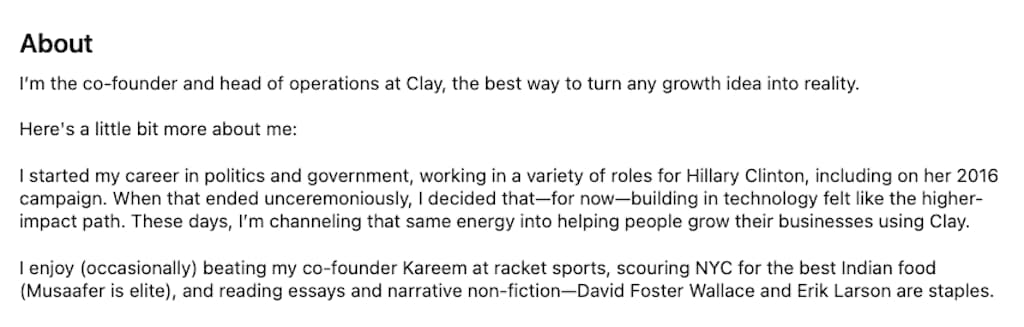
Varun’s summary makes a confident product claim in the first sentence: Clay is the best way to turn any growth idea into reality. Then it pivots to a personal career history starting in politics and working on the 2016 Clinton campaign.
The summary closes with genuinely human details: losing occasionally at racket sports to his co-founder, searching New York City for the best Indian food. Those details aren’t distractions; they’re what make the profile feel like a person worth knowing.
The technique: Human details in an executive summary do more to make a profile memorable than any credential. The professional content tells people what you’ve done, and then the personal detail tells them who they’re dealing with.
8. Zoe Pearson, International Content Lead at Canva
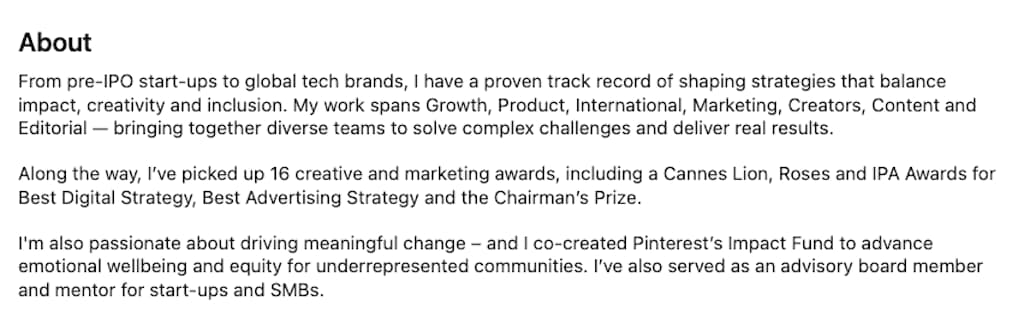
Zoe’s summary sequences its content deliberately: professional range first (pre-IPO startups to global tech brands, spanning Growth, Product, International, Marketing, Creators, Content, and Editorial), then awards to validate it (16 creative and marketing awards including a Cannes Lion and IPA Awards), then values to humanize it (co-creating Pinterest’s Impact Fund to advance emotional wellbeing and equity for underrepresented communities). Each section builds on the one before.
The technique: Professional range needs credentials behind it to land, and credentials need a values layer to become memorable.
LinkedIn summary examples for marketers and social media managers
This is the largest category in this guide, because content and social roles vary enormously in scope, context, and audience. Each profile here uses a different approach worth learning from. For social media managers building their own presence, how you frame your results is directly tied to how well you can articulate the value of a strong social media content strategy to clients and leadership.
9. Annalisa Rodriguez, Senior Content Marketing Manager at Vector
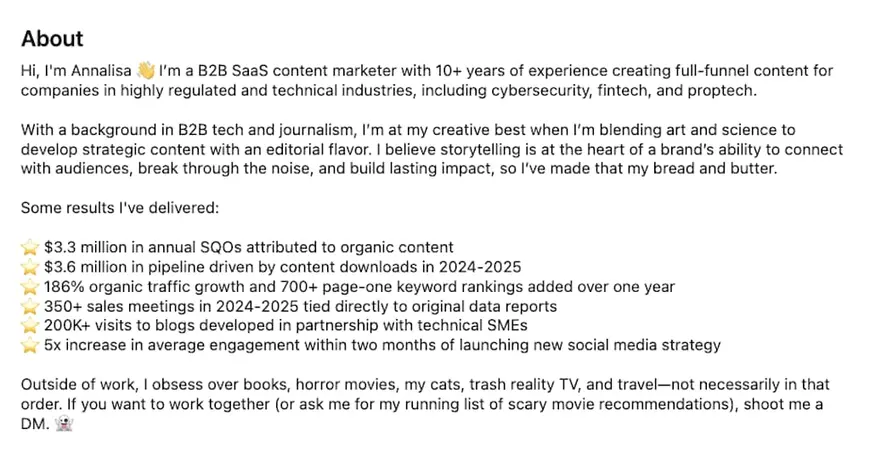
Annalisa’s summary leads with revenue-adjacent numbers: $3.3M in annual SQOs attributed to organic content, $3.6M in pipeline driven by content downloads, 186% organic traffic growth, and 350+ sales meetings in 2024-2025 tied to original data reports.
These aren’t soft engagement metrics; they’re the kind of numbers a CMO or VP of Revenue reads and immediately understands. The summary closes with something entirely human: she obsesses over books, horror movies, cats, trash reality TV, and travel. The contrast between the metrics and the personality is what makes the whole thing land.
The technique: If your content work connects to revenue, that’s the lead. Engagement numbers are table stakes; pipeline and SQO attribution are what get you hired.
10. Naomi Liddell, Content Lead at Doist
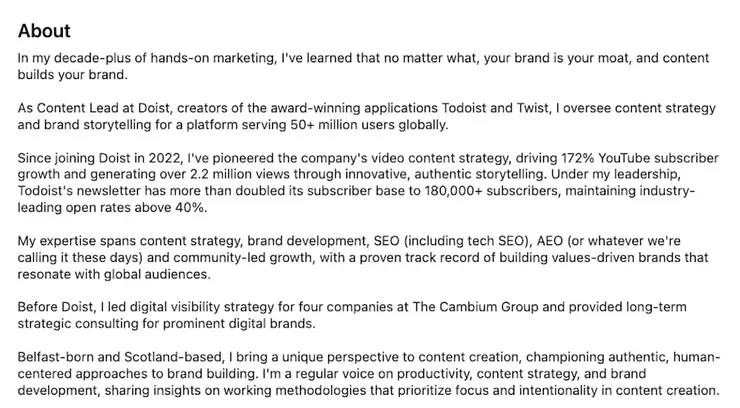
Naomi’s summary opens with a thesis: your brand is your moat, and content builds your brand. It then demonstrates that thesis with outcomes: 172% YouTube subscriber growth, a newsletter at 180,000+ subscribers, open rates consistently above 40%. Her expertise areas follow naturally from the proof.
The technique: A strong opening thesis backed by proof is more compelling than a list of skills. State your belief about the work first, then show you’ve delivered on it.
11. Drew Evans, Content at Notion
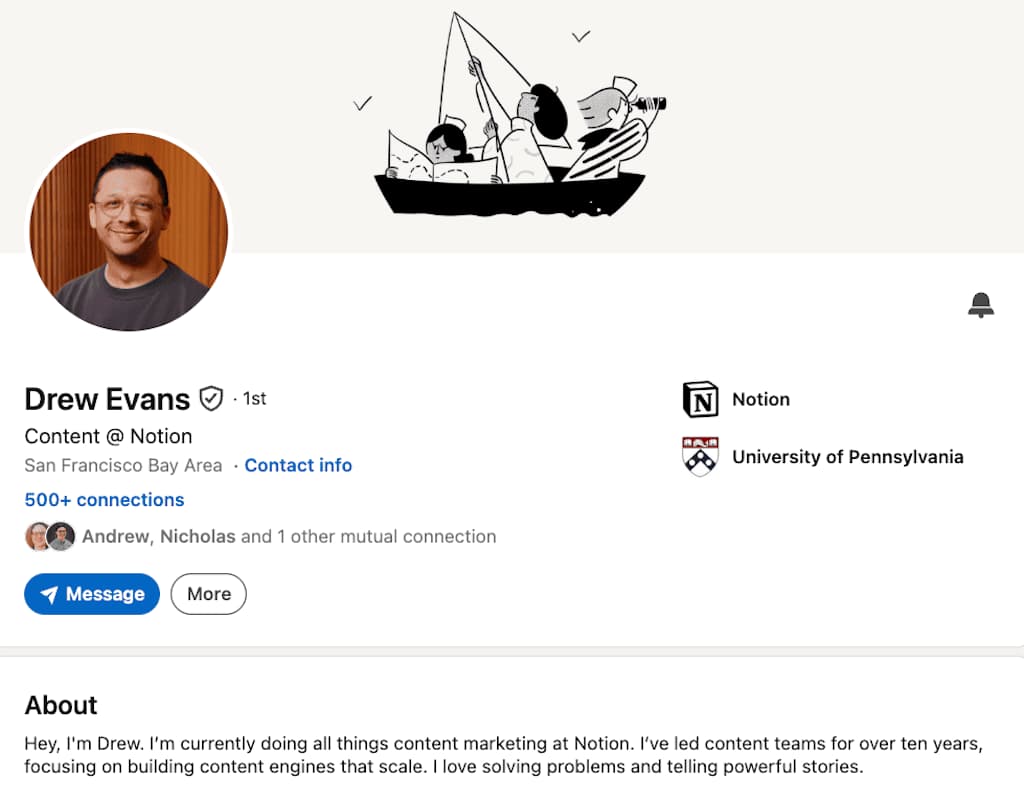
Drew’s summary is four sentences long: a greeting, a statement of current role at Notion, a decade of experience building content engines that scale, and a line about loving to solve problems and tell powerful stories. There’s nothing wasted and nothing missing. For someone doing content at one of the most recognized SaaS brands in the market, that brevity is a deliberate choice, and it’s the right one.
The technique: Brevity is a legitimate strategy when your current employer already carries the weight. If “Content at Notion” is doing the credentialing work, a short and warm summary outperforms padding it out to prove something that’s already proven.
12. David Broderick, B2B SaaS writer and Community Manager
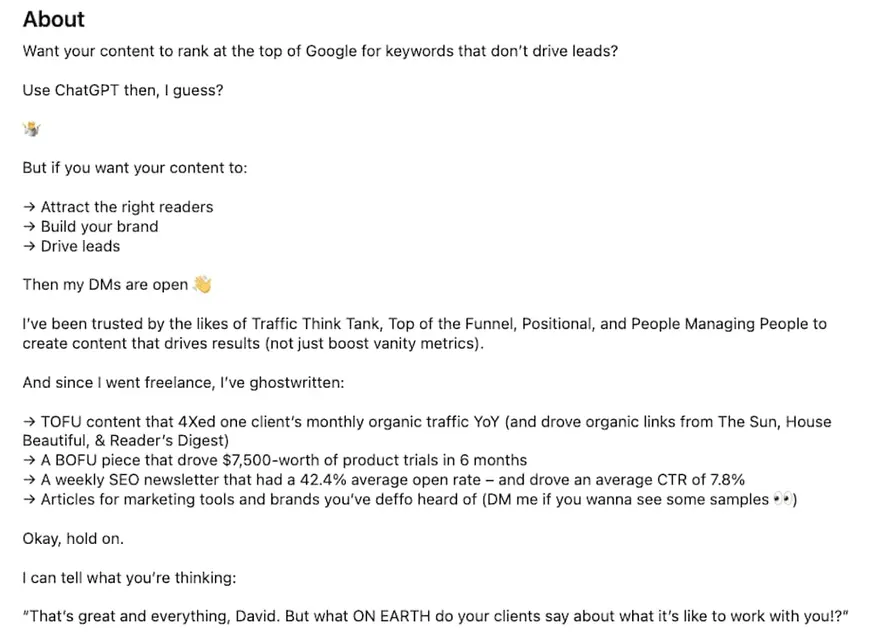
David opens his summary with a pointed joke directed at anyone optimizing for rankings rather than leads, then pivots immediately to results: content that quadrupled a client’s monthly organic traffic year on year, a BOFU piece that drove $7,500 in product trials over six months, and a newsletter averaging 42.4% open rates. The humor in the opener sets an expectation for the kind of work he does, and the results confirm it.
The technique: A well-aimed joke in the opening line does more positioning work than a paragraph of self-description. If you can make someone laugh while making a point, you’ve already distinguished yourself from 90% of the profiles they’ll see that day.
13. Peri Elmokadem, Sr. Content Marketing Manager at Uscreen
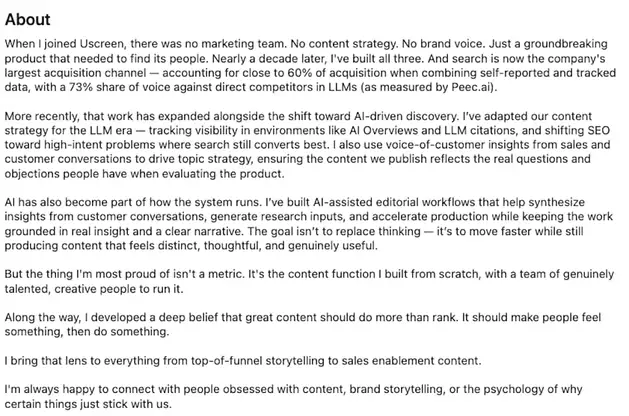
Peri’s summary tells a zero-to-one story: she joined Uscreen when there was no marketing team, no content strategy, and no brand voice. Nearly a decade later, search is the company’s largest acquisition channel, accounting for close to 60% of acquisition, with a 73% share of voice against direct competitors in LLMs.
The summary describes how she’s adapted the content strategy for the AI-discovery era, tracking visibility in AI Overviews and LLM citations. That framing signals genuine seniority in content leadership.
The technique: A zero-to-one story, built rather than inherited, is among the most compelling structures for a content role. It shows initiative and outcome in a single arc.
14. Anna Wendt, Content at Nectar
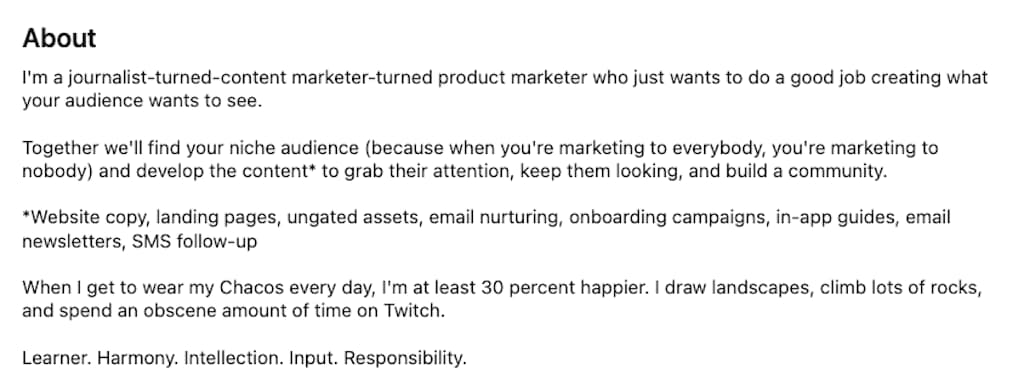
Anna describes herself as a journalist-turned-content marketer-turned product marketer who just wants to do a good job creating what her audience wants to see. The hyphenated career history is unusual and makes you read it twice.
The summary explains her approach: find the niche audience, build the content they want, and grow a community. It then closes with a detail that has nothing to do with any of that: when she gets to wear her Chacos every day, she’s at least 30 percent happier.
The technique: A career told through pivots adds a dimension with each turn rather than replacing the last one. It signals range without requiring you to claim range.
15. Angelee Carandang, Content at Workflows.io
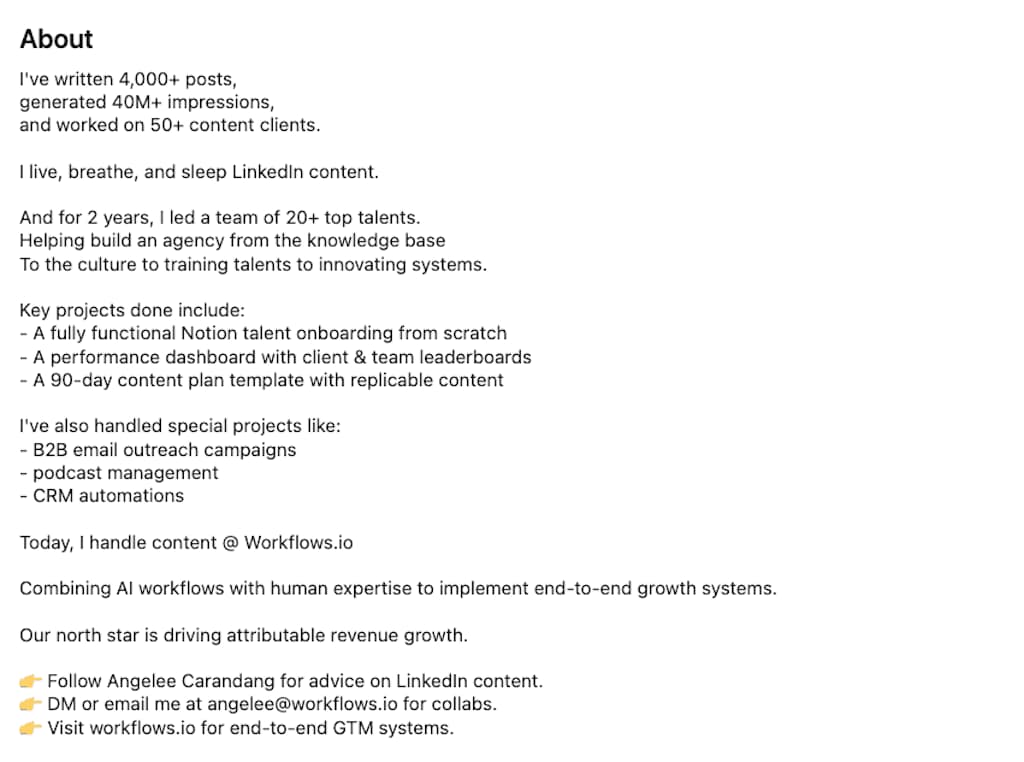
Angelee’s summary leads with volume: 4,000+ posts, 40M+ impressions, 50+ content clients. Then it lists what that production involved. Building agency systems from scratch, performance dashboards with client and team leaderboards, and 90-day content plans with replicable templates. For a content execution role, output volume is itself a credential, and her summary doesn’t undersell it.
The technique: In high-output creative roles, the sheer amount of work you’ve shipped is evidence. A summary that only describes your approach without indicating scale leaves out the most important thing a prospective client wants to know.
16. Alexus Brittain, Head of Social at Vista Social
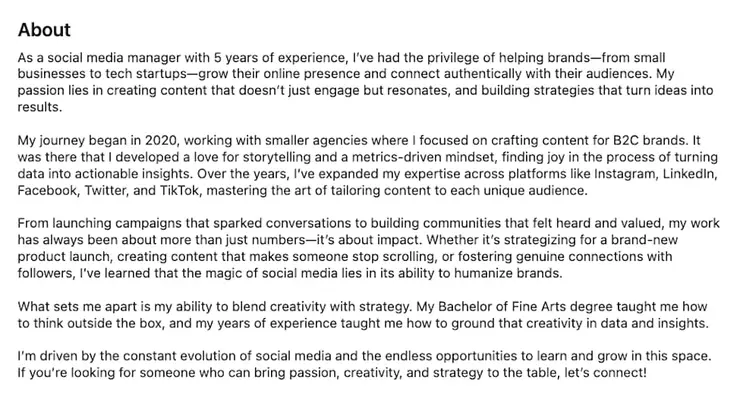
Our very own Alexus Brittain’s headline is already doing strategic work: “Building the Brand Behind the Tool Social Media Managers Actually Love Using.” Her About section extends that, describing five years of experience across brand building, storytelling, and community growth for brands from small businesses to tech startups.
The summary is warm and personal, which is the right tone for someone whose job is community and brand. For a social media manager evaluating Vista Social as a platform, Alexus’s profile is part of the product experience.
The technique: For social media professionals, how you present yourself on LinkedIn is a portfolio piece. The way you write your own summary signals exactly how you’ll write for the brands you manage.
LinkedIn summary examples for sales professionals
Sales professionals do a good bit of outreach and research on LinkedIn, making a good LinkedIn summary essential. Here are a few examples to help you write your own.
17. Cheri Kyle, VP of Revenue Strategies at Ryan & Jacobs
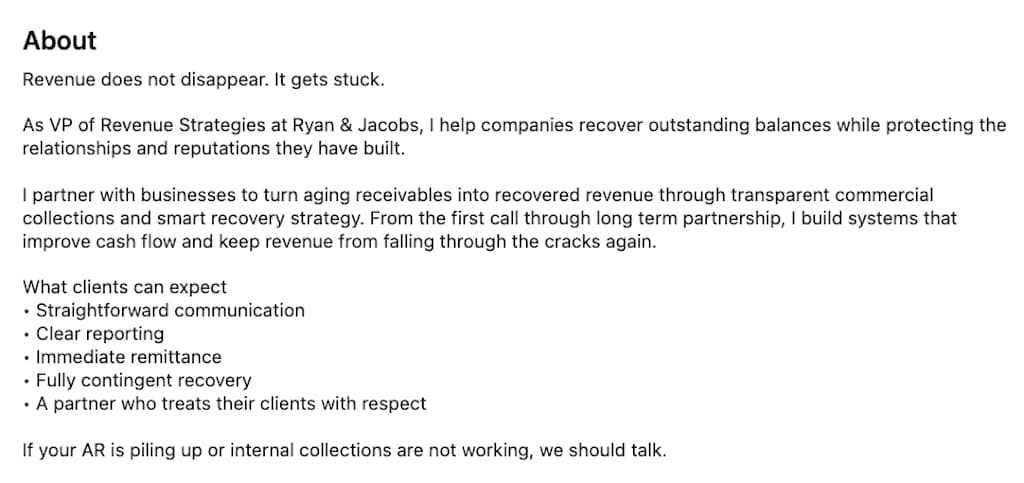
Cheri opens with a reframe that makes the reader nod immediately: “Revenue does not disappear. It gets stuck.” That sentence repositions commercial debt recovery from a dry operational function into something visceral and recognizable to any business owner managing cash flow.
The rest of the summary explains what working with her looks like. Transparent collections, smart recovery strategy, clear reporting, and immediate remittance. It closes with a direct CTA: “If your AR is piling up or internal collections aren’t working, we should talk.”
The technique: Reframe the problem before describing the solution. A problem statement that makes the reader nod immediately does more sales work than any service description ever could.
18. Derek R. Kelliher, Head of Sales at Protex AI
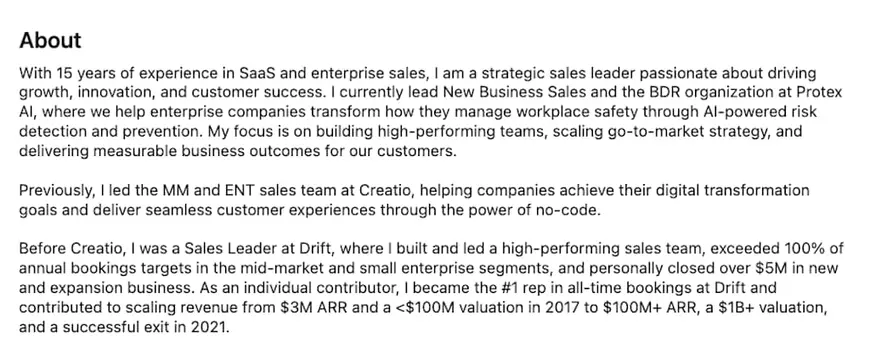
Derek’s summary is a credentialing document. Fifteen years in SaaS and enterprise sales. Number one rep in all-time bookings at Drift. More than $5M personally closed in new and expansion business. Revenue growth from $3M ARR to $100M+ ARR during his time at the company.
The technique: In sales roles, numbers are your voice. Any summary that doesn’t include deal sizes, revenue ranges, or growth multiples is leaving credibility on the table, regardless of how well written the prose is.
19. Alexandra Rynne, Content Strategy Lead at LinkedIn Ads
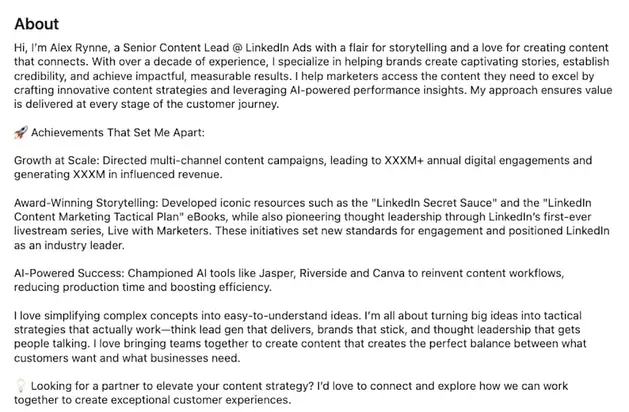
Alexandra’s summary describes her work through specific named assets. the LinkedIn Secret Sauce ebook, the LinkedIn Content Marketing Tactical Plan, and LinkedIn’s first-ever livestream series. These aren’t vague references to campaigns, but rather resources her audience has likely already used.
She also identifies a specific competency, helping marketers access content at every stage of the customer journey, that positions her as a strategic practitioner rather than just a content operator.
The technique: When your work has produced named, findable assets, use them in your summary. Specific named projects are more credible than generic descriptions of high-performing content resources.
LinkedIn summary examples for people and HR leaders
Gather inspiration from these LinkedIn summary examples if you work in the HR department.
20. En-Szu Hu-Van Wright, Head of Talent Strategy at Chili Piper
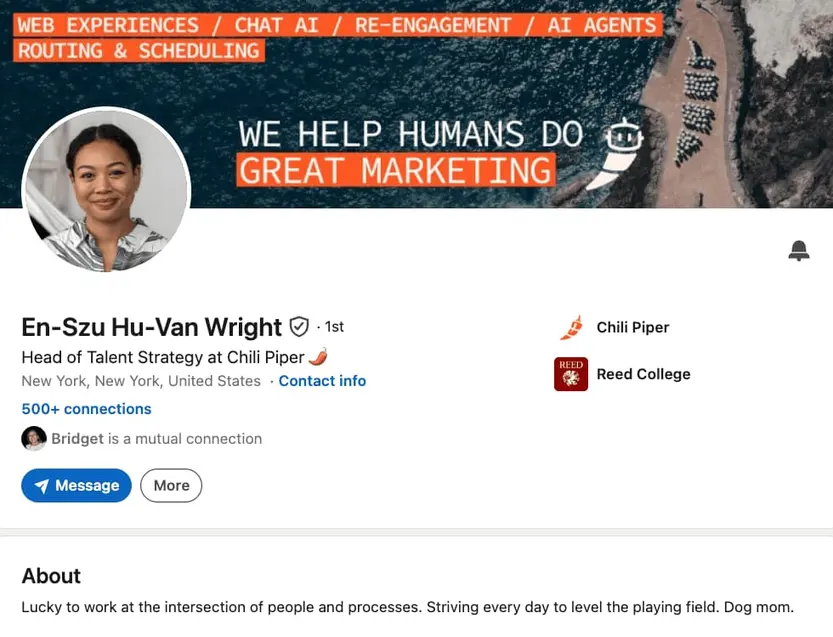
En-Szu’s summary is literally just three sentences:
- Lucky to work at the intersection of people and processes.
- Striving every day to level the playing field.
- Dog mom.
And that’s all she needs. A professional frame, a values statement, and a human detail, in that order.
The brevity is a signal: someone operating at a senior level in talent strategy at a fast-growing SaaS company probably has 40 other things to do. The “Dog mom” at the end does more to make her profile feel like a person than a full paragraph of professional context ever could.
The technique: Short, personality-forward summaries can outperform long ones when the title and employer already carry the professional weight. Don’t feel obligated to fill the space.
21. Dajana Berisavljevic Dakonovic, Head of People at Toggl
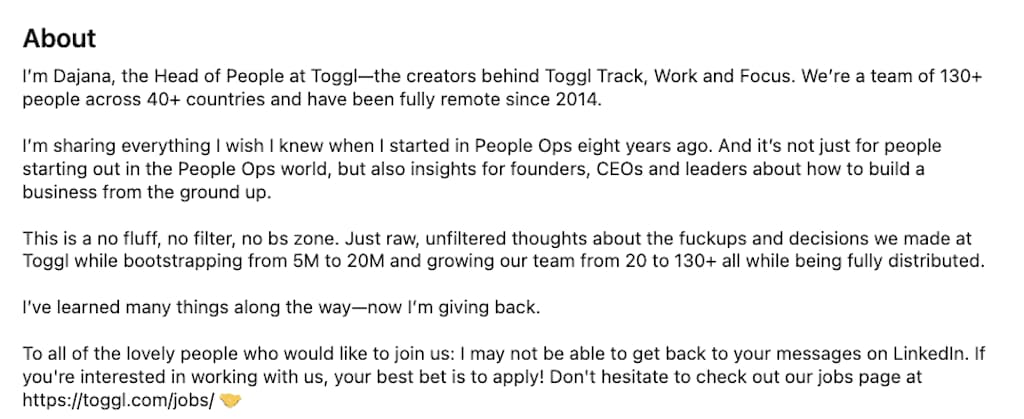
Dajana’s summary introduces Toggl (130+ people across 40+ countries, fully remote since 2014) and then immediately pivots to what she shares on LinkedIn: everything she wishes she knew when she started in People Ops eight years ago. The most memorable line positions the content directly: “This is a no fluff, no filter, no bs zone.” That kind of directness is rare in HR content, which is exactly why it stands out.
The technique: Positioning yourself as a practitioner who shares what they’ve actually learned, rather than an authority issuing guidance from a position of expertise, is a more compelling and more trustworthy frame, especially in a function where credibility is hard-won.
LinkedIn summary examples for thought leaders and personal brand builders
If you’re building a personal brand and aiming to be a thought leader in your industry, that kind of LinkedIn summary takes its own sort of formula. Here are a few examples you can base yours off of.
22. Charlie Hills, Founder at MarTech AI
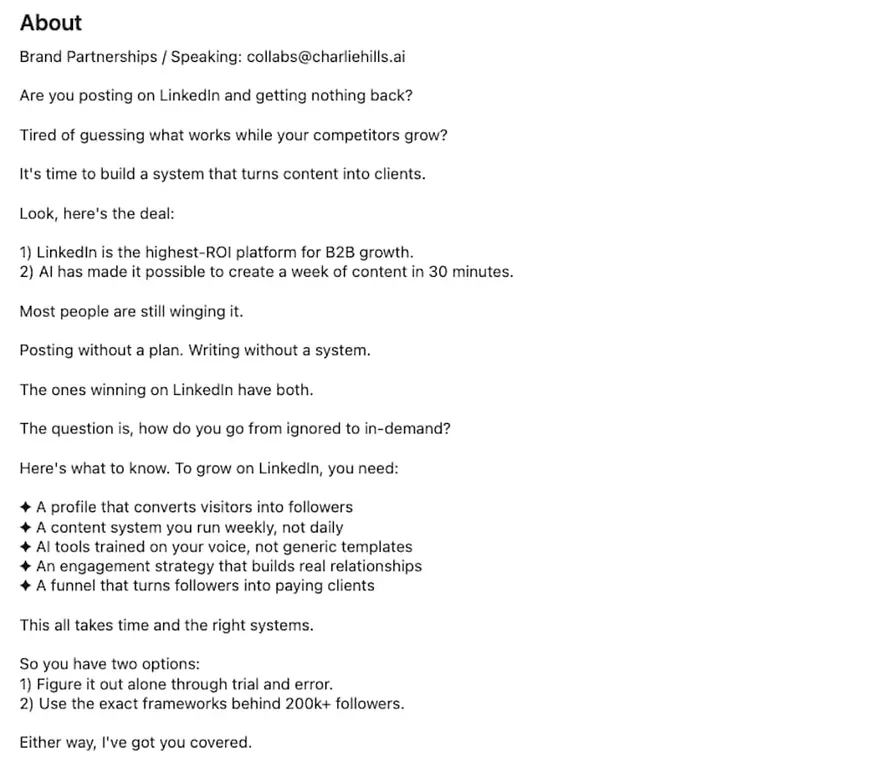
Charlie’s summary opens on the reader’s frustration rather than his own credentials. Then it pivots to a specific system. A profile that converts, a content system you run weekly, AI tools trained on your voice, and an engagement strategy that builds real relationships. The summary reads like a landing page, which makes sense because that’s exactly what it is.
The technique: If your LinkedIn presence is also a lead generation asset, treat your summary accordingly. Address the reader’s frustration directly, name the system you offer, and close with a call to action.
23. Lara Acosta, Founder at Literally Academy
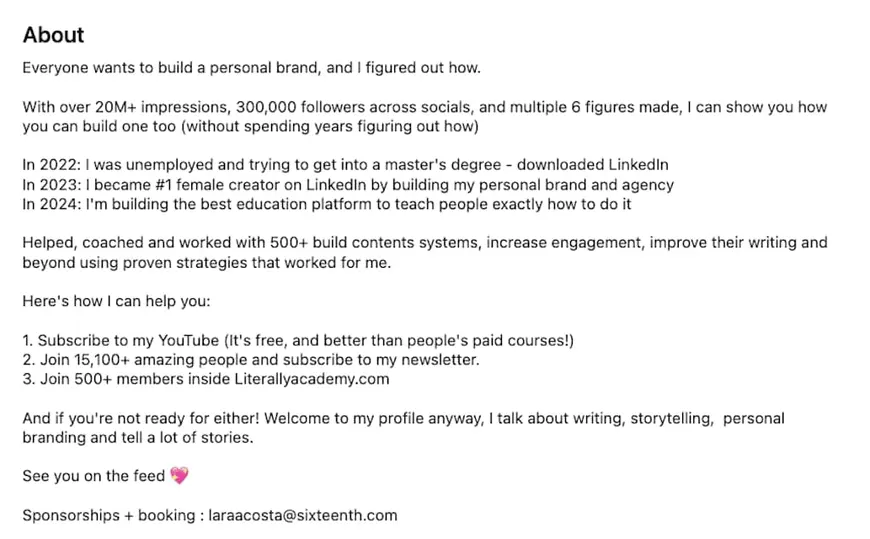
Lara’s summary tells a three-year story in timeline form. 2022, unemployed and downloading LinkedIn; 2023: the number one female creator on the platform, 2024: building an education platform to teach others how to replicate the process. That arc from zero to a recognized platform in three years is more persuasive than any follower count because it shows the trajectory rather than just the destination. The summary closes with three CTAs in order of commitment.
The technique: A timeline-based before/during/after structure works far better than a list of accomplishments because it shows how you got here.
24. Anna York, Founder at Citation School
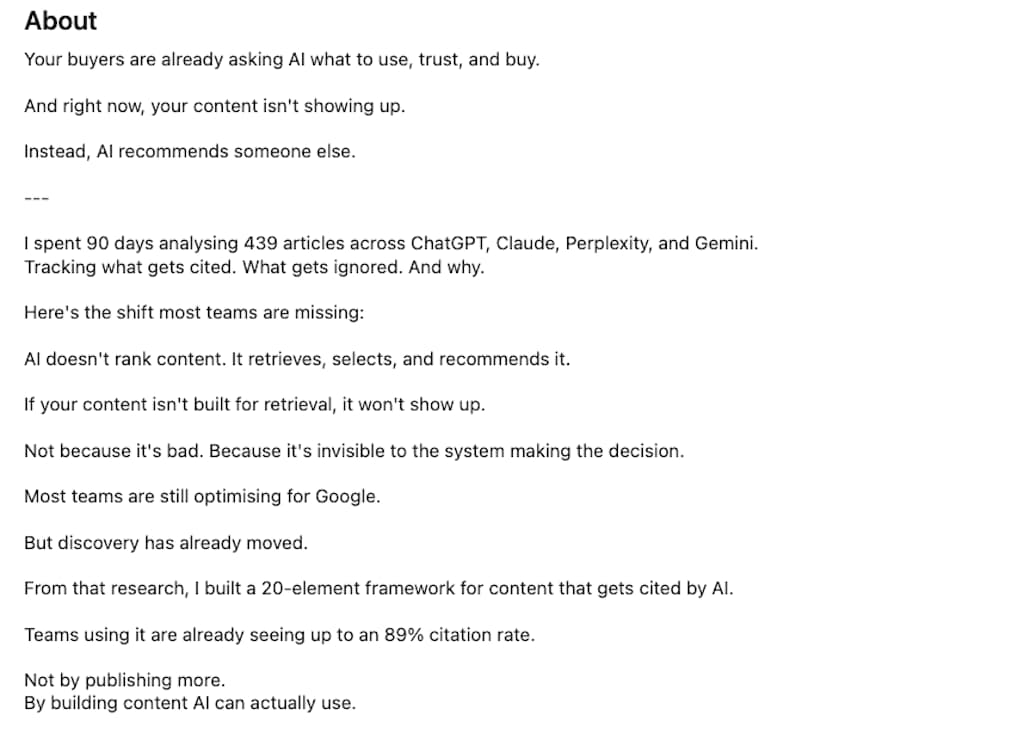
Anna’s summary opens on a tension her audience lives with daily. How buyers are already asking AI what to use and trust, and most brands’ content isn’t showing up in those answers.
She then explains what she did about it: 90 days analyzing 439 articles across ChatGPT, Claude, Perplexity, and Gemini to understand what gets cited and what gets ignored. The summary closes with a concrete outcome. Teams using her framework are seeing citation rates up to 89%.
The technique: Your summary is a demonstration of your expertise, not only a description of it. A content strategist with a strong summary proves the point more effectively than one who simply claims to be good at content.
25. Dr. Arthur Brooks, Professor at Harvard Business School
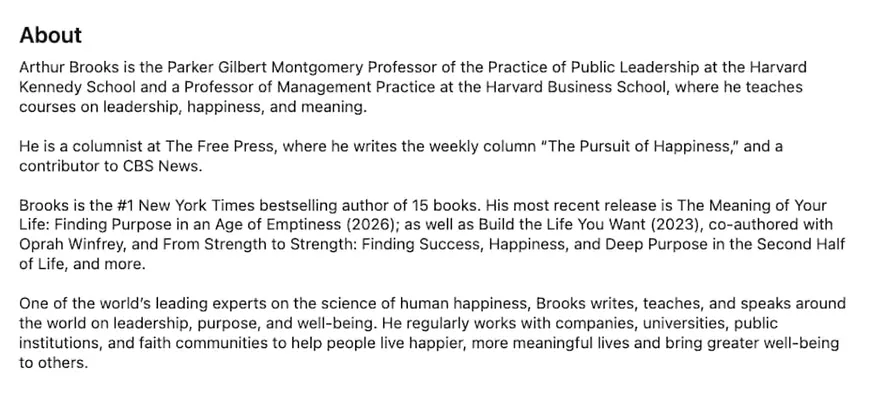
Arthur’s summary moves in a logical sequence: institutional affiliation (Harvard Kennedy School and Harvard Business School), publications (a weekly column at The Free Press and contributions to CBS News), and books (number one NYT bestselling author of 15 books).
The summary closes with a clear statement of what he does with all of that: he helps people live happier, more meaningful lives. That pivot from credentials to application is what makes a high-credential summary feel purposeful rather than merely impressive.
The technique: For academics and thought leaders, institutional affiliation is the strongest opening signal you have. Lead with the credential and quickly pivot to the application; otherwise, the summary reads as a CV, and not a profile.
26. Kerry-Lyn Stanton-Downes, Founder at Be Relational
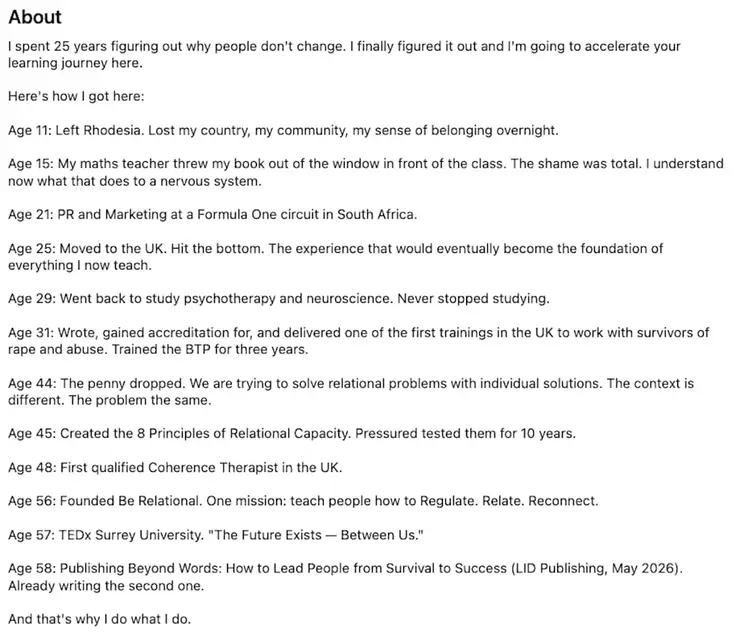
Kerry-Lyn’s summary is structured as a biographical timeline by age: leaving Rhodesia at 11, public shame in a classroom at 15, PR and marketing at a Formula One circuit at 21, hitting bottom after moving to the UK at 25, returning to study psychotherapy and neuroscience at 29, and publishing her first book at 58.
By the time you’ve tracked the journey to its conclusion, you understand not just what she does but why she does it, and that’s a more powerful foundation for trust than any credential.
The technique: An age-by-age autobiographical structure is a high-risk, high-reward format. It works when the journey has genuine turning points and when the destination makes the path feel necessary. Skip it if your story has been straightforward.
What the best LinkedIn summaries have in common
- The opening line carries almost all the weight: Whether it opens on a problem the reader recognizes, a result that establishes scale, or a story that earns curiosity, the first sentence determines whether anyone reads the second. Summaries that open with a title or a list of skills lose most readers before they get there.
- Numbers land when they’re specific and outcome-focused: Revenue attributed to content, deals closed, and companies scaled are more persuasive than follower counts and engagement rates because they speak to outcomes rather than activities.
- Personal details are doing real work, not filling space: A single specific human detail, whether it’s a dog, a food obsession, or a strong opinion about Chacos, makes a profile memorable in a way that a third paragraph about core competencies never will.
- The best summaries know exactly who they’re talking to: They’re not written for everyone on LinkedIn; they’re written for the specific person the profile owner wants to reach. The more clearly a summary addresses a specific reader, the more likely that reader is to feel like the summary was written for them.
LinkedIn summary examples FAQs
How long should a LinkedIn summary be?
There’s no single right answer, but most effective summaries land between 100 and 300 words. LinkedIn allows up to 2,600 characters in the About section, and only the first two or three lines display before the “See more” fold. Whatever the total length, those opening lines have to earn the click.
Should you write your LinkedIn summary in first or third person?
First person, in almost every case. Third-person summaries create a strange distance between the writer and the reader and tend to read like press releases rather than profiles. The only context where third person works is a deliberately formal executive setting where the rest of the profile matches that tone throughout.
What should a brand include in its LinkedIn company page summary?
A company page About section should cover what the company does, who it serves, and what makes it meaningfully different in its category. Avoid mission statements generic enough to apply to any business. Specific clients, outcomes, and use cases are more useful than broad positioning claims, and the About section should close with a clear indication of what someone should do if they want to learn more.
How often should you update your LinkedIn summary?
Review it at least once per year. Update it whenever your role, focus, or positioning changes significantly, and after any major professional milestone worth adding to your proof points: a new role, a significant outcome, a published work, or a product launch.
Does the LinkedIn summary affect how you appear in search results?
Yes. LinkedIn’s search algorithm uses the content of your About section to determine relevance for keyword-based searches. If you want to surface for specific skills, specialisms, or industry terms, those need to appear naturally in your summary, as well as in your headline and experience sections.
Try Vista Social for free
A social media management platform that actually helps you grow with easy-to-use content planning, scheduling, engagement and analytics tools.
Get Started NowAbout the Author

Content Writer
Orion loves to write content that refuses to be boring. As part of Vista Social, he helps brands, creators, and agencies stop doom scrolling and start winning with social media. When he's not in front of a keyboard, he's watching films in IMAX with his wife, dissecting football tactics (the European kind), and getting lost in a good book.