

Published on April 2, 2026
6 min to read
Do Scheduled Posts Get Less Views? Debunking the Rumor

Summarize with AI

Table of contents
Summarize with AI

ChatGPT

Claude

Perplexity
Share

Vista Social

X (Twitter)


“Will scheduling my posts hurt my reach?” We hear some version of this question all the time in our sales calls, and it’s because rumors like this have run rampant.
Anytime reach drops or users aren’t getting the results they want or expect, they always look for some rational expectation. It’s only natural to try to figure out what went wrong.
So we’re here to tell you once and for all, that the answer to the question, “Do scheduled posts get less views?” is emphatically no. Using a social media scheduling tool versus posting natively to the platform has zero impact on the performance of your posts.
But let’s talk about it—and look at some examples that show you that keeping your third-party scheduler in your toolbag is perfectly fine.
Table of contents
How did this rumor even start?
Like we said, people are always looking for answers as to why their content might not be performing. Looking to something like a third-party scheduler when it might seem like platforms want you to use their native tools instead seems like a reasonable issue.
And honestly, I could see social media platforms doing this back in like 2011 or 2012, when social media scheduling tools were just starting to become a thing.
But now? When there are millions of brands across the world managing social media and needing the help of tools to do it effectively? Algorithms wouldn’t dare.
How do we know that scheduled posts don’t get less views?
I get it, you need proof. You don’t want to tell your boss, “Well a blog post from a social media scheduling tool said using social media scheduling tools isn’t a problem,” because, like, obviously we’d say that.
But we can also cite our sources.
The head of Instagram said so himself
If you want to hear it straight from the source, Instagram Head Adam Mosseri addressed this directly in a Q&A that he later shared to his profile. His answer was clear: using scheduled posts will not affect your reach in any way.
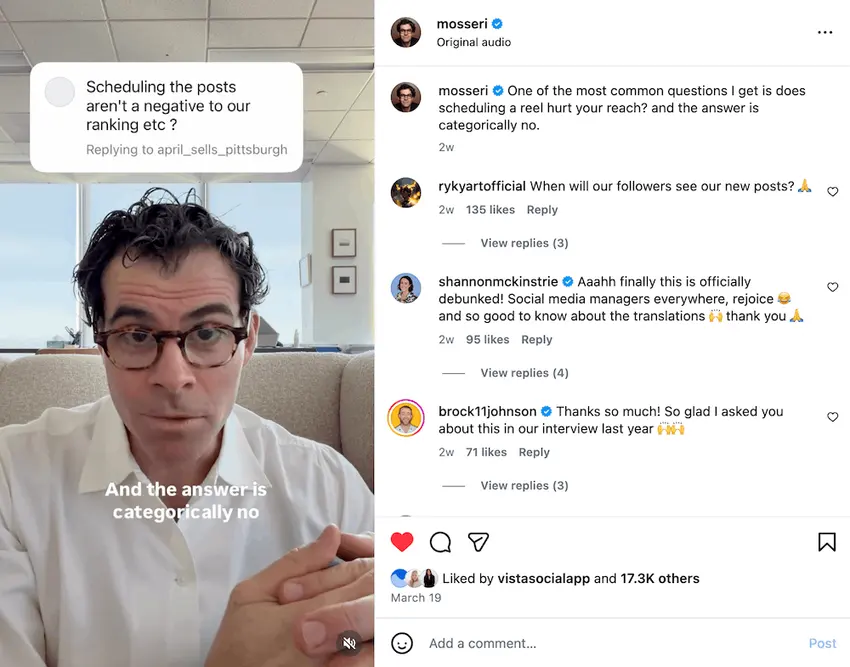
In fact, he went on to share that there can be benefits to scheduling your content ahead of time (something that we’ll talk more about shortly).
And honestly, that’s about as definitive as it gets. The person running Instagram is telling you that the platform doesn’t penalize scheduled content. If you’ve been second-guessing your strategy or manually posting everything because you’re worried about reach, you can officially let that go.
But let’s not just rely on him, because there are other platforms out there too.
The data is on our side, too
Because this question has been asked again and again over the years, many other tools in our space have conducted research into it.
And the answer over and over and over again (from Sendible, Hootsuite, Agorapulse, Buffer, and so on) has all been that no—using a scheduling tool does not hurt your reach or overall performance.
In fact, some of their studies have found the opposite—that using a scheduling tool has somehow actually helped performance. (Though that could be entirely coincidental.)
But let’s look at some of our own posts that have been published natively versus scheduled in Vista Social.
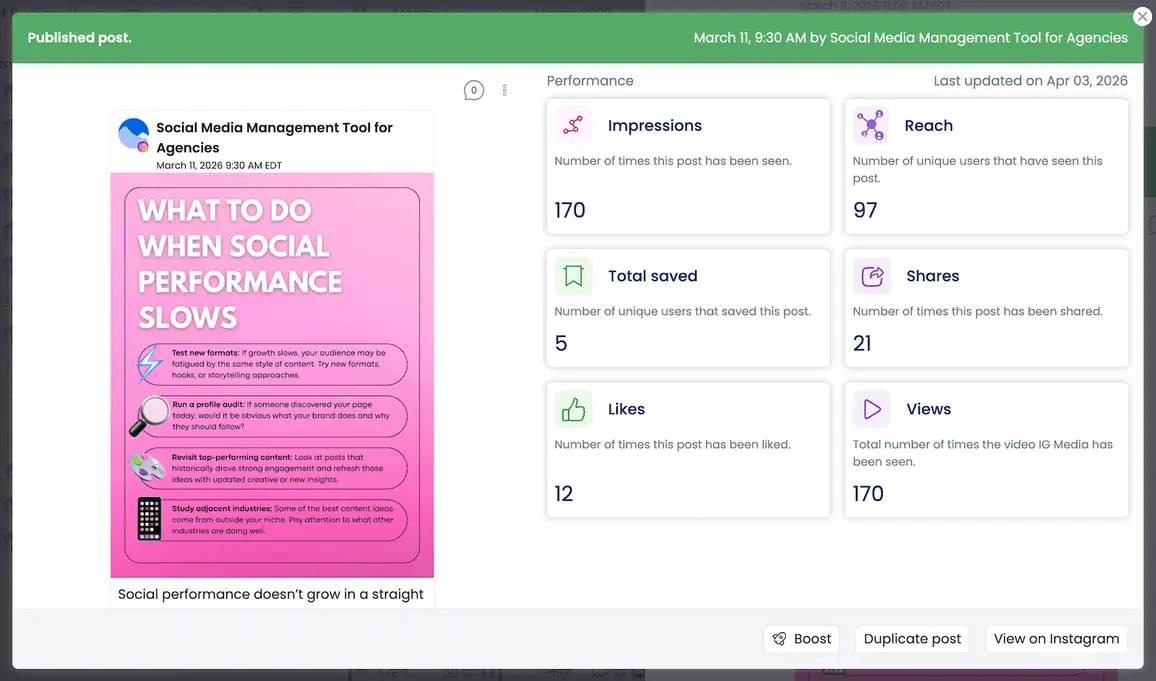
We published this post natively within the Instagram app:
And here’s one we published within Vista Social:
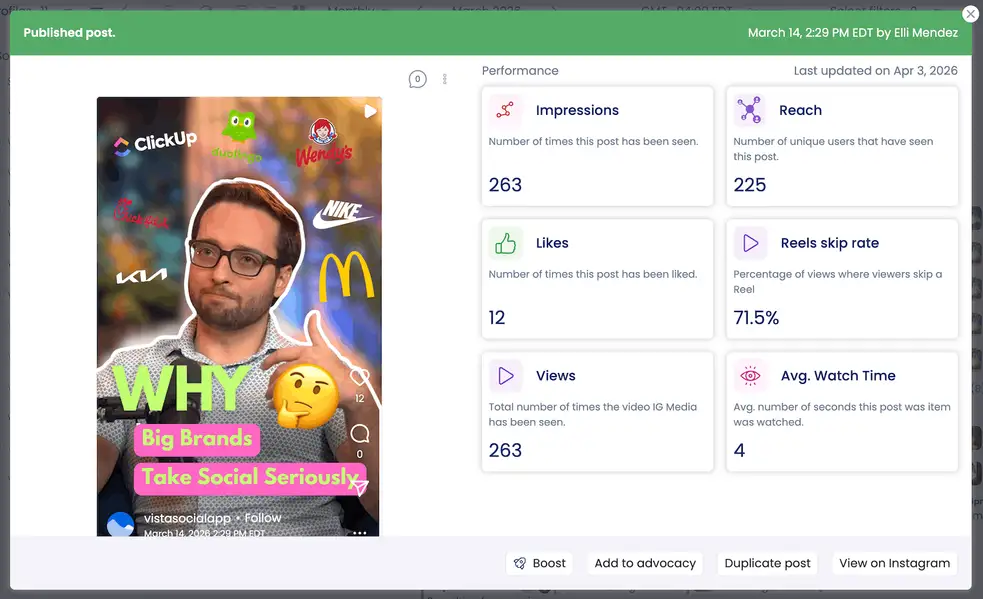
We can see that both posts got the same number of likes, but that reach, impressions, and views are actually all higher on the post scheduled inside Vista Social.
So what actually affects your reach?
If scheduling isn’t the problem, why are your posts sometimes getting fewer likes? It’s the question on everyone’s mind.
Let’s talk a bit about what the platforms actually care about.
Content quality
This is the big one. Instagram’s algorithm in particular looks at watch time, likes per reach, and sends per reach. If people aren’t watching your content, aren’t liking it, and aren’t sharing it—that’s not because you scheduled it. That’s because the content itself isn’t connecting.
We also see this on other platforms. Many users have been concerned that link posts on LinkedIn don’t do well (which is why you’ll see many LinkedIn posts share links within the comments, rather than as part of the post).
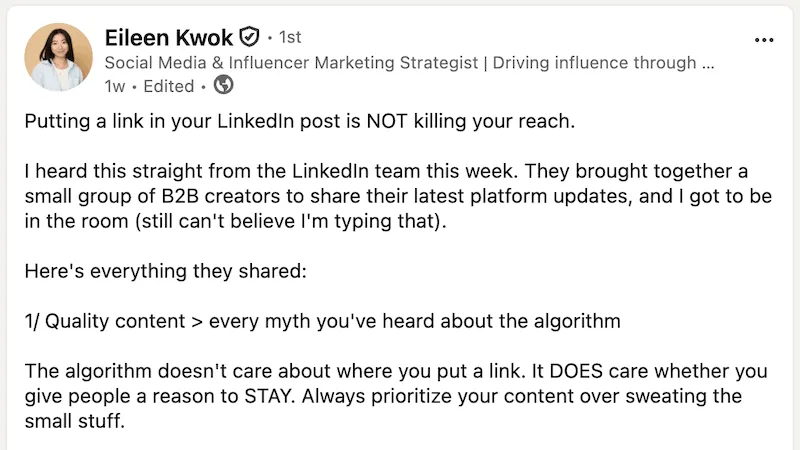
But as long as the quality of your content is there, it doesn’t matter the format. (You can read more about what Eileen has to say about LinkedIn content quality here.
As our head of social Alexus Brittain puts it, we’re in an era of “lurking”—people are following less and less unless your content is really, really good.
Timing
Posting when your audience is actually online makes a massive difference in how much initial engagement your content gets.
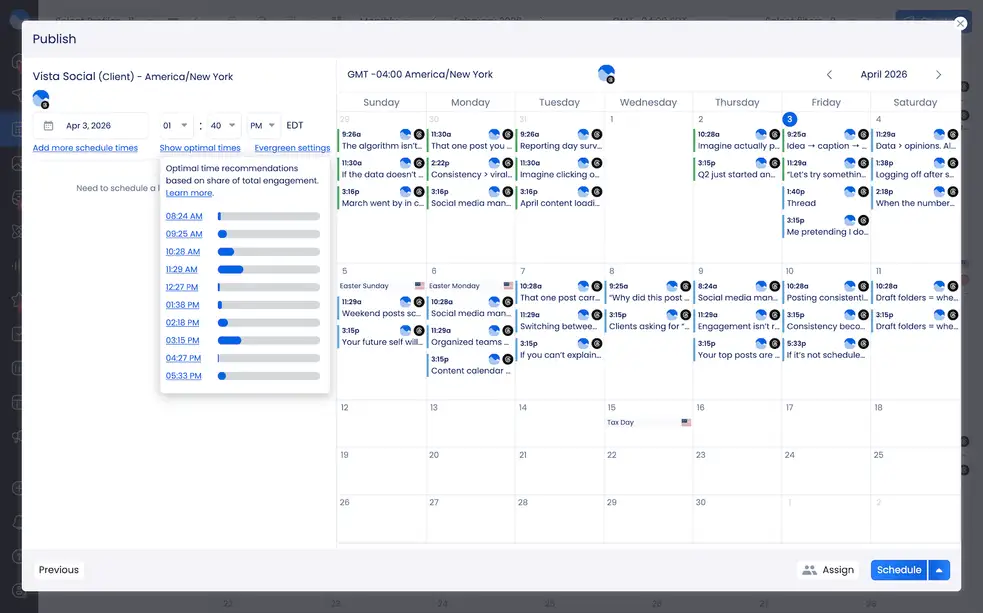
And a scheduling tool is going to be the best way to nail your timing consistently. You’re not going to remember to manually post at 6:47 AM every Tuesday. But your scheduler will.
Plus, Vista Social provides users with optimal posting times so you can always find the best times to post for your audience and platforms:
Consistency
If you’re a social media manager, you’ve seen these words a million times across a million different educational resources: consistency is key.
And that’s because it’s one of the truest pieces of the social media marketing puzzle.
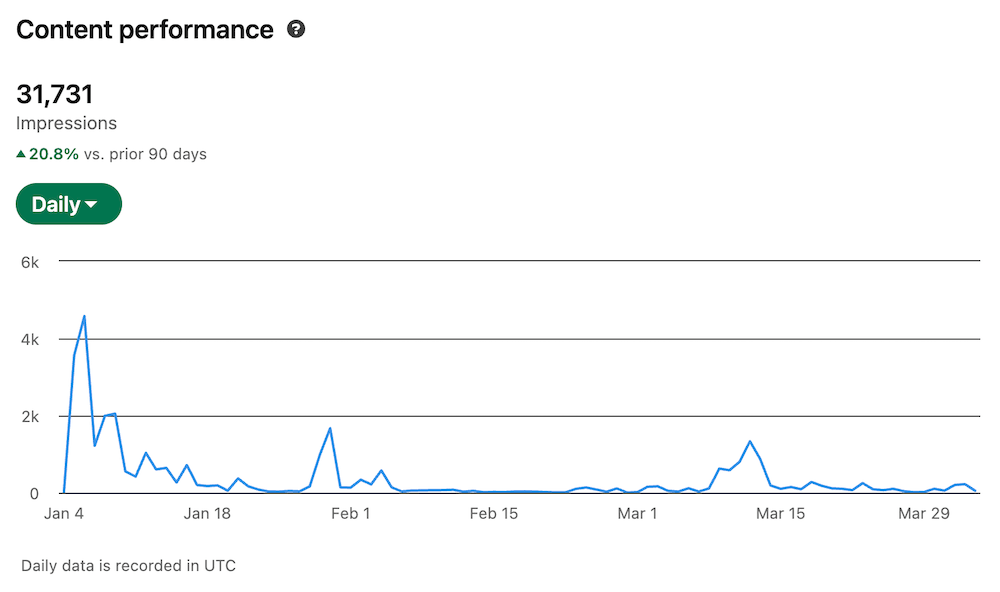
If you have a post perform really well, but then you don’t post any kind of follow up for a couple of weeks, the algorithm is going to deprioritize your content.
I can speak about this personally with LinkedIn. When I post consistently to LinkedIn, my reach consistently grows and grows with each post. But when I hit a brain block for a week or two, my next post essentially makes me start all over again.
This is another way that scheduling can help. Creating content ahead of time (content batching is a great way to do this) and then scheduling it out for a week or so at a time helps you keep a consistent presence without having to think about posting every day.
Engagement after posting
This is where scheduling could actually have a negative impact. Just because your post has gone live automatically doesn’t mean your job is done.
You still need to engage with other users on the platform, respond to people commenting on your post, and hold up the “social” part of “social media.” If you don’t also add consistent engagement to your strategy, then yeah, you might not get the overall reach and engagement you’re hoping for on your own content.
Authenticity
Social media users don’t want overly polished, robotic, corporate content. In the “content era” (if you will) that we’re currently in, those types of posts simply will not perform.
What does perform is authenticity. That means you need to showcase people. You need to create content that’s actually engaging. And you need to be real with your audience.
People go to social media to consume fun and interesting content. Your latest “Call our law firm if you’ve been injured” tweet is not what people are here for. That might work as a targeted ad—but it’s not what people want to see or engage with as they scroll through their feeds.
Bottom line: Say “yes!” to scheduling—and here’s why
If you take one thing away from this, let it be this: Not only is scheduling “not bad,” there can actually be some major benefits (just like Adam Mosseri said in his video).
Here are just a few advantages that scheduling your posts ahead of time can give you:
- You can post at optimal times without being glued to your phone. Vista Social shows you exactly when your optimal posting times are. Schedule your content to go out during those windows and your posts hit feeds when eyeballs are actually there.
- You can batch create content. Instead of scrambling for something to post every day, you sit down once or twice a week, create a batch of content, and schedule it all out, giving you more time to focus on the creative side.
- You stay consistent across platforms. Managing multiple platforms manually is a recipe for inconsistency. A scheduler keeps everything balanced and on track.
- You free up time for actual engagement. By automating the publishing side, you actually free up more time to do the things that truly impact reach—like engaging with your community and participating in genuine conversations.
Try Vista Social for free
A social media management platform that actually helps you grow with easy-to-use content planning, scheduling, engagement and analytics tools.
Get Started NowAbout the Author

Content Writer
Chloe West is a content marketing manager for Vista Social. She has over seven years of experience in digital marketing for B2B SaaS companies. When she's not working, you'll find her spending time with her family, reading a book, or watering her plants.
Loading related tools...



Tools
PublishingAnalyticsEngagementIntegrations
FacebookInstagramLinkedInRedditSnapchatThreadsTikTokX (Twitter)YouTubeBlueskyVista Page (link-in-bio)All IntegrationsCopyright © 2026 Vista Social LLC. All Rights Reserved.