

Published on January 14, 2026
15 min to read
What is AI Marketing? Your Guide to the Future

Summarize with AI

Table of contents
Summarize with AI

ChatGPT

Claude

Perplexity
Share

Vista Social

X (Twitter)


You’re juggling campaign analytics, personalizing messages for different segments, responding to customer service inquiries, and somehow still expected to produce fresh content daily. Sound familiar?
88% of employees in a McKinsey study state they now use AI in their organization’s daily workflows. But they’re not using it as a substitute for themselves or their creativity—they’re using it to reclaim time for the work that matters.
AI marketing, thankfully, isn’t about handing your job to a robot. It’s about building systems that handle the repetitive stuff so you can focus on what makes your brand memorable. From automating social media content scheduling to predicting which content will resonate with specific audiences, AI marketing tools are reshaping how marketing teams operate in 2026.
Table of contents
What is AI marketing?
AI marketing uses machine learning and natural language processing to create content from scratch, automate tasks, analyze performance, and more. Instead of manually scheduling posts or guessing which email subject lines will perform best, AI systems learn from patterns in your data and optimize automatically.
Think of it this way: AI in social media watches how your audience engages with content, identifies what works, and then helps you create more of it. It’s pattern recognition applied to marketing problems.
Vista Social’s AI Assistant demonstrates a similar practicality for social media managers and brands. It drafts captions, responds to comments and reviews, and helps maintain brand voice across platforms. The system learns your style over time, making suggestions that sound increasingly natural rather than generic.
Key AI marketing statistics to know
The numbers tell a clear story about where marketing (especially with regards to artificial intelligence) is heading.
- Revenue impact: Organizations report that revenue increases resulting from AI are most commonly found in use cases within marketing and sales, according to the McKinsey State of AI 2025 report.
- Departmental spending: Marketing now accounts for 7 percent of departmental generative artificial intelligence spending as businesses shift from experimentation to core implementation, based on Menlo Ventures research.
- Widespread adoption: Recent findings from the Stanford HAI AI Index Report 2025 show that 78 percent of organizations used artificial intelligence in 2024, a sharp rise from 55 percent the previous year.
- Economic potential: The integration of generative artificial intelligence could result in a 7 percent increase in global GDP by lifting labor productivity growth over the next decade, as reported by Goldman Sachs.
- Functional investment: Forecasts from IDC indicate that business functions like customer service, marketing, and sales are expected to see the most accelerated investment in artificial intelligence through 2028.
- But there’s still a risk: Strategy failure remains a significant hurdle for marketers, with research from the RAND Corporation indicating that more than 80 percent of artificial intelligence projects fail to deliver meaningful value.
Benefits of AI marketing
The marketing industry has both enthusiastic and reluctant AI adopters. But both still need to understand the benefits of why AI can be such a helpful tool for any marketer.
Increased efficiency
The promise of “doing more with less” usually means doing more bad work faster. AI flips this. When properly implemented, it handles repetitive tasks at scale while maintaining quality standards you define.
Vista Social’s publishing queue demonstrates this practically. Instead of manually scheduling posts across Instagram, Facebook, LinkedIn, and TikTok, you batch-create content and let the system publish at optimal times based on when your specific audience engages most. The platform analyzes historical performance and adjusts automatically.
Better personalization
Generic marketing died when consumers gained infinite possibilities in terms of what’s being shown to them online, making personalized content marketing essential. Personalization at scale used to require more hands on deck, but AI has made it operationally viable for any marketing team.
Spotify’s recommendation engine demonstrates this. Every user gets a unique experience based on listening history, time of day, and patterns across similar users. The system doesn’t just suggest songs you might like. It creates personalized playlists, curates discovery mixes, and even adjusts the flow based on your current activity.
Smarter decision-making
Good decisions require accurate data and the ability to process it before conditions change. Humans excel at the first part. AI excels at the second.
Predictive analytics helps marketing teams spot trends before competitors can. If holiday shopping patterns suggest a specific product category will spike in two weeks, you can increase inventory, ramp up product production, and adjust your ad spend proactively rather than reactively.
Improved customer experiences
Fast, relevant responses build trust. Slow, generic responses erode it. AI helps teams deliver excellent customer experiences consistently.
Human teams can’t scale to meet that expectation across thousands of simultaneous conversations. AI-powered chatbots can handle routine inquiries while routing complex issues to humans. AI-powered chatbots and voice agents can handle routine inquiries while routing complex issues to humans.
The key is implementation quality. Bad chatbots that trap customers in loops destroy experiences. Well-designed systems that understand context and escalate appropriately enhance them. Vista Social’s DM automation demonstrates how generative AI can detect intent and route messages appropriately while maintaining natural conversation flow.
Challenges and limitations of AI marketing
But not all that glitters is gold, and we can’t talk about the benefits that AI brings to the marketing industry without also bringing up the risks and downsides.
Data quality determines AI quality
AI systems learn from the data you feed them. Feed them garbage, and you’ll get unreliable outcomes. This isn’t theoretical. It’s the primary reason AI implementations fail.
A survey showed 57% of marketers worry about data safety and privacy when using AI, according to The Conference Board.
Building clean data infrastructure requires unglamorous work. It requires standardizing formats, removing duplicates, validating sources, and establishing governance policies. Most companies skip this step, rush into AI implementation, then wonder why results disappoint or make no sense.
Privacy and regulation aren’t optional
GDPR, CCPA, and emerging regulations worldwide make data privacy non-negotiable. Using AI doesn’t exempt you from compliance. It increases your responsibility because AI processes data at scale.
You need explicit consent for data collection, transparent explanations of how AI uses that data, and systems that honor opt-out requests. Violations could mean massive fines and permanent reputation damage.
Regular compliance audits are essential and protect your business. Vista Social follows official guidelines to keep customer data secure and compliant across all AI features.
Over-automation creates robotic brands
Automating every customer touchpoint sounds efficient, but it can have its drawbacks. Customers detect robotic responses quickly, and trust evaporates. This further emphasizes the need for authentic interactions in social media posts.
The balance matters. Use AI to handle FAQs, schedule content, and analyze data. However, it’s key to keep humans in the loop for complex questions, creative decisions, and relationship building.
Ethical considerations shape long-term trust
AI tends to mirror the biases found in its training data. If a past campaign showed high engagement in one demographic, the system might narrow its focus and exclude others entirely. This result limits a brand’s reach and raises serious ethical questions. For example, beauty retailers have seen reputations take a hit when AI tools lacked inclusivity for various skin tones.
Building trust requires radical transparency. Brands should explain their use of AI, allow users to opt out of personalized tracking, and audit their messaging for bias.
How to use AI in marketing
Now let’s talk about how to actually use AI in your marketing in a way that’s going to boost productivity without leaving you to post AI-generated slop on your brand channels.
AI for content creation
AI content creation tools handle everything from memes and video editing to graphic design and podcast transcription. They’re not just writing assistants. These tools essentially mimic entire production workflows.
Take video repurposing. Upload a 30-minute podcast episode, and AI tools automatically clip key moments, add captions, resize for different platforms, and suggest titles. The best part is, most of these tools are DIY with easy-to-follow instructions.
Image generation tools create custom graphics from text descriptions. Need a hero image for a blog post about sustainable fashion? Describe what you want, give it some brand design guidelines, and watch a near-perfect image emerge out of simple lines of text. No stock photo subscription needed.
AI for personalization and targeting
Dynamic content changes based on who’s viewing it. An ecommerce site shows winter coats to cold-climate visitors and swimwear to tropical ones. Email platforms adjust send times per recipient based on when they typically open messages. Product recommendations shift based on browsing patterns and purchase history.
The sophistication goes deeper. AI analyzes micro-behaviors like scroll speed, time on page, and mouse movement patterns to predict purchase intent. High-intent visitors see aggressive offers. Browsers see educational content. Cart abandoners get reminder sequences with escalating discounts.
Segmentation happens automatically. Instead of manually creating audience groups, AI identifies clusters based on behavior patterns you’d have a hard time spotting manually.
AI for social media management
Managing five platforms with different posting schedules and content formats is chaos. Vista Social’s publishing tools automate the mechanical parts so you can focus on strategy.
The platform analyzes when your specific audience engages most on each channel. LinkedIn might perform best Tuesday mornings, while Instagram peaks Sunday evenings and TikTok spikes Wednesday afternoons. Instead of guessing or manually tracking patterns, the system can schedule optimally by default.
Engagement automation handles the volume problem. When 50 comments land simultaneously across platforms, AI drafts responses matching your brand tone. You can input guidelines for the AI to follow as it replies, maintaining quality while cutting response time from hours to minutes.
AI for advertising optimization
Real-time bidding happens too fast for humans. Programmatic advertising uses AI to evaluate millions of ad placement opportunities per second, bidding based on predicted conversion probability.
The system considers user demographics, browsing history, time of day, device type, geographic location, and hundreds of other signals. It calculates expected return for each impression and bids accordingly. High-probability conversions get aggressive bids. Low-probability impressions get passed.
Creative optimization runs continuously. AI tests thousands of ad variations, learning which headlines, images, and calls to action resonate with different segments. Underperforming combinations get paused automatically. Budget shifts to winners without manual intervention.
Google’s AI advertising tools analyzed over a million campaigns from 2022 to 2024. Their Demand Gen product showed measurable ROI increases across food, retail, telecom, and automotive by automatically optimizing multi-format ads across YouTube and visual surfaces.
Turkish e-commerce brand Karaca restructured Google Ads using AI-driven product scoring. From May 2024 to February 2025, automated prioritization of top-performing SKUs delivered a 44% ROAS increase and 31% revenue growth.
AI for analytics and insights
AI processes data faster than human analysts, spotting trends and anomalies in real time. Instead of waiting for monthly reports, you get continuous insights that inform immediate adjustments.
Predictive analytics identifies which customers are likely to churn, which products will trend, and which campaigns will underperform before launch. This lets you intervene proactively rather than react after problems emerge.
Vista Social’s analytics dashboard uses AI to summarize performance across channels, highlighting what’s working and what needs adjustment. Weekly performance emails include AI-generated insights, saving hours of manual analysis. Learn more about AI brand voice to maintain consistency as you scale.
AI marketing tools for your business
Choosing the right tools depends on your specific needs. Here are five platforms solving different problems effectively.
Vista Social: The best for social media management
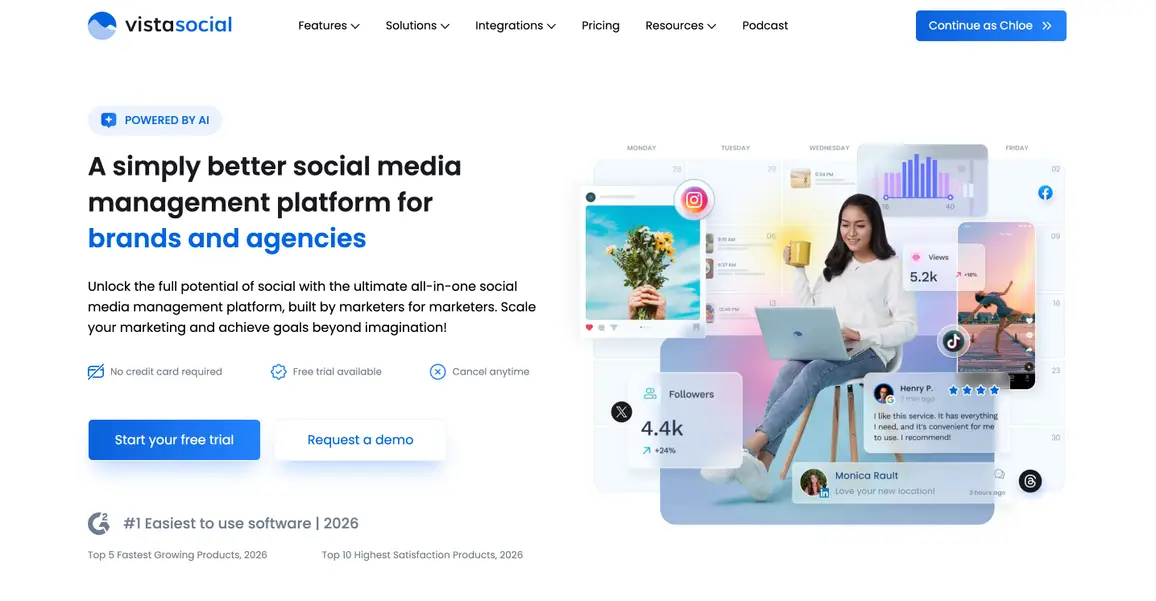
Vista Social is the most comprehensive platform for brands and agencies looking to scale their social presence through AI. It functions as a central hub for publishing, engagement, and deep analytics across all major networks.
Key features:
- Smart scheduling: This feature automatically identifies when your audience is most active to ensure every post is published at the perfect time.
- Model context protocol (MCP): This allows you to connect Vista Social to AI chatbots like Claude, enabling you to manage your entire social strategy through a simple chat interface.
- AI report summaries: Cross-platform performance reports include AI-generated summaries that offer quick insights and recommendations for your next steps.
- Social media analytics: Advanced reporting dashboards track profile performance, post engagement, sentiment insights, and competitor activity.
- Automations: Offers automation for smart scheduling queues, bulk publishing, content curation, and automatic comment and reply management
- Social listening: This tool monitors conversations, keywords, and brand mentions across networks, websites, and review sites to identify industry trends.
- Link-in-bio: Includes a customizable bio page that turns profile links into a hub for your latest content, products, or landing pages.
- Team collaboration: Built-in tools allow for content approval workflows, shared calendars, and multi-user access based on specific roles.
- Employee advocacy: Empowers team members to share pre-approved brand content on their personal networks to organically expand brand reach.
- Integrations: Offers extensive connections with social platforms and third-party apps for business intelligence, website tracking, and review management.
| Pros | Cons |
| Complete feature set: Includes social listening, reputation management, and employee advocacy in one tool. | Learning curve: New users may need time to navigate the extensive list of features and settings. |
| All-in-one dashboard: Centralizes management of multiple social media profiles and campaigns for maximum efficiency. | Profile limitations: The number of social profiles you can manage is strictly tied to your specific plan level. |
| Advanced team workflows: Role-based permissions and approval steps ensure consistent messaging across all channels. | |
| Scalable AI tools: The AI assistant helps teams create and respond to content significantly faster. | |
| Superior value: Provides a full suite of professional tools at a price point often lower than similar enterprise offerings. |
Pricing: Starts at $68/month, paid annually
Jasper: AI writing for marketing content
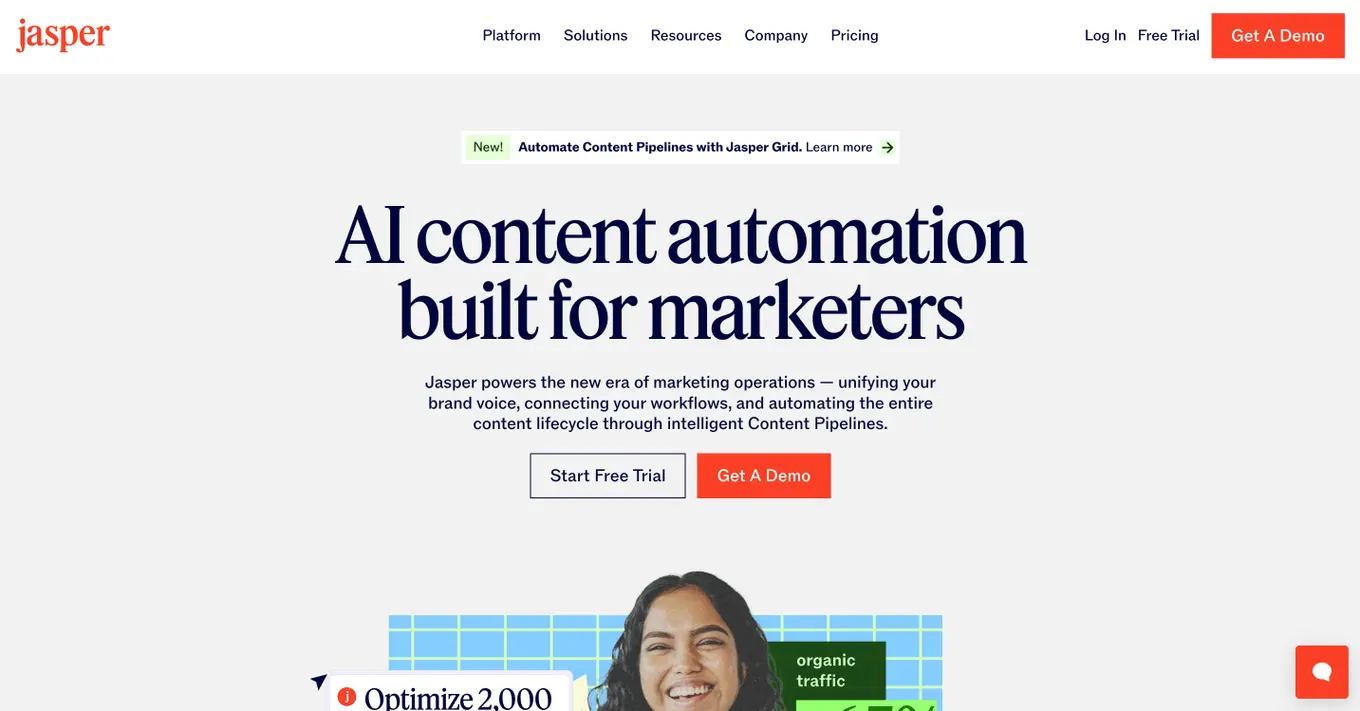
Jasper is a specialized writing assistant that helps marketing teams overcome writer’s block and accelerate first drafts for blogs and ad copy.
Key features:
- Brand voice: The platform learns your specific style to ensure content matches your existing identity.
- Content canvas: A collaborative space where teams build entire campaigns from research to final draft.
- Template library: Offers over 50 templates for specific needs like SEO blog outlines or product descriptions.
| Pros | Cons |
| Speed: Can generate a multi-thousand-word article draft in minutes. | Fact-checking required: The system can occasionally produce confident but inaccurate information. |
| SEO focus: Integrates with optimization tools to help content rank better in search engines. | Subscription cost: Highly expensive compared to using standard language models directly. |
| Language support: Generates accurate content in over 25 different languages. | Generic output: Writing can feel robotic without detailed human editing and context. |
Pricing: Plans start at $59/seat/month, paid annually
Midjourney: AI image generation
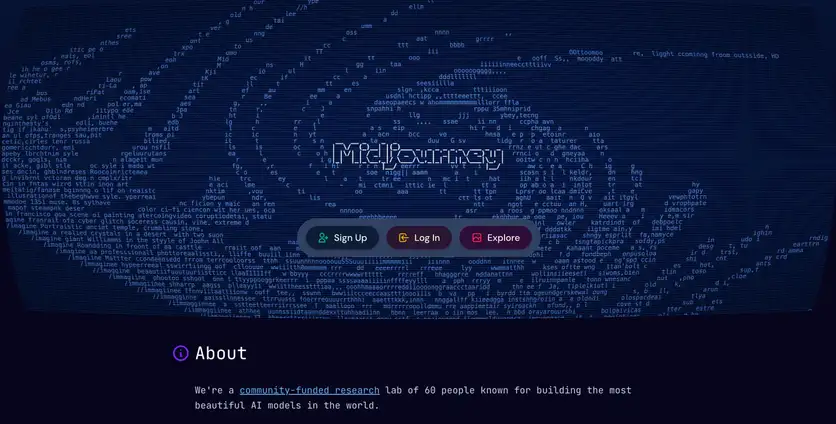
Midjourney uses artificial intelligence to turn text prompts into high-quality visuals for advertising and creative presentations.
Key features:
- Text-to-image: Generates highly detailed and realistic images based on simple textual descriptions.
- Stylize parameters: Marketers can use modifiers to control the style, composition, and aspect ratios of every asset.
- Image blending: The system can merge multiple images into one unified and coherent visual output.
| Pros | Cons |
| Visual quality: Produces professional-grade artistic assets in under 30 seconds. | Interface limits: Primarily accessible through Discord or a limited web interface. |
| Cost efficiency: Eliminates the need for expensive stock photo subscriptions for custom needs. | Public visibility: All generated images are public by default unless using a higher-tier stealth mode. |
| Versatility: Supports styles ranging from realistic photography to futuristic sketches. | No official API: Lacks an official API for deep integration into other marketing stacks. |
Pricing: Starts at $8/month, paid annually
Intercom: AI-powered customer service
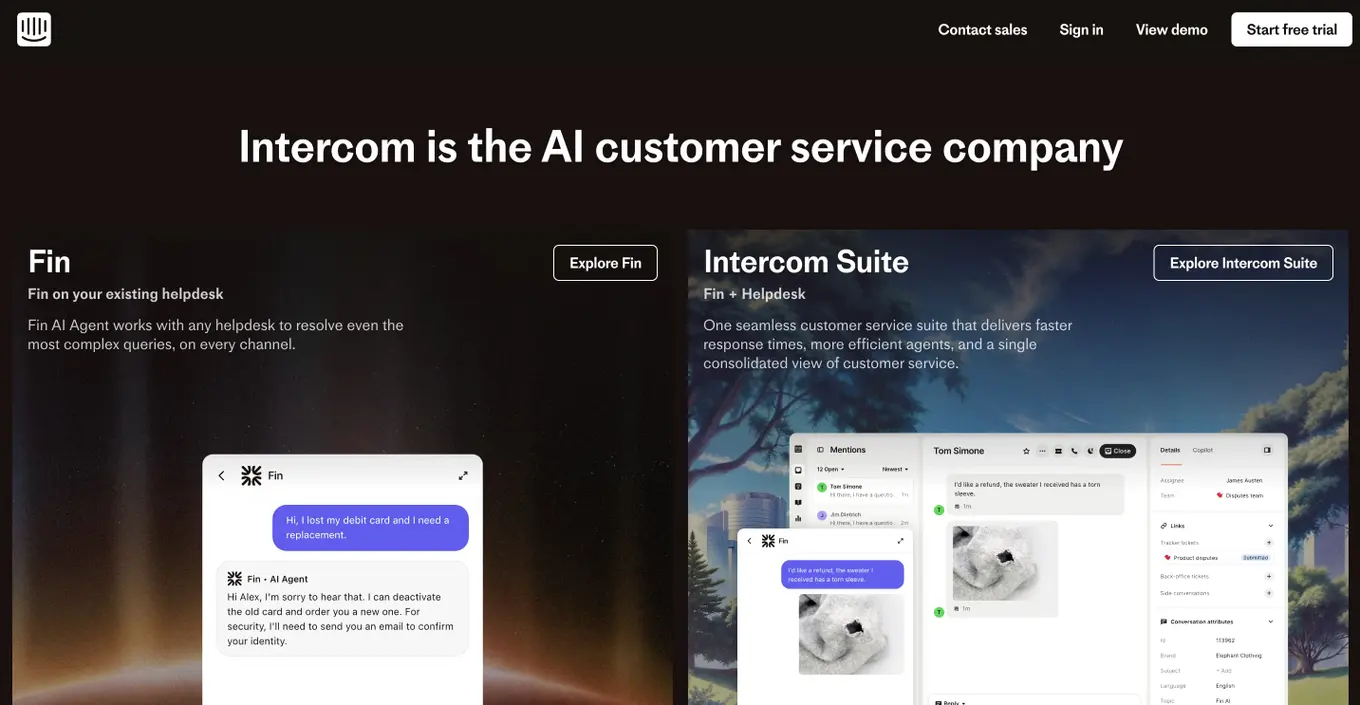
Intercom focuses on customer support through its AI agents, which resolve queries instantly using your brand’s knowledge base.
Key features:
- Fin AI agent: This bot provides human-like responses and handles routine tasks like query routing.
- Data connectors: The system pulls customer info from other tools to give personalized answers about order status.
- Sentiment analysis: AI analyzes conversation quality automatically to find trends and customer frustration.
| Pros | Cons |
| Fast setup: Teams can get the AI agent running and trained on their documentation quickly. | Predictability: A per-resolution pricing model makes it difficult to budget exact monthly costs. |
| Multilingual: Supports dozens of languages to chat with customers globally. | Platform lock-in: Designed to perform best only within the Intercom helpdesk suite. |
| Human handoff: Seamlessly routes complex issues to human agents with full context. | Learning curve: Navigating complex automation features can be challenging for new users. |
Pricing: The Fin AI agent starts at $0.99 per resolution, and adding on the Intercom suite adds $29/seat/month, billed annually
Seventh Sense: AI email send-time optimization

Seventh Sense is a specialized tool that uses machine learning to determine the perfect moment to deliver emails to each recipient.
Key features:
- Predictive engagement: AI analyzes individual behavior to pinpoint the best send time for every contact.
- Domain protection: The system monitors performance to protect your sender reputation and avoid spam folders.
- Audience management: Automatically throttles emails to unengaged contacts to prevent list fatigue.
| Pros | Cons |
| Integration: Functions as a native feature directly inside platforms like HubSpot. | UI design: The user interface can be intimidating and difficult to navigate for beginners. |
| Higher engagement: Significant improvements in open and click-through rates by reaching users when they are active. | Platform support: Currently limited in the number of email platforms it can integrate with. |
| Deliverability audit: Provides tools to identify roadblocks obstructing your email delivery. | Price variation: Costs can vary significantly depending on the volume of contacts in your CRM. |
Pricing: Starts at $960/year
The future of AI marketing
AI is definitely a game changer in the marketing industry. So what does the future look like with this new technology?
AI as an efficiency multiplier
The 2022 narrative was “AI will generate all your content.” The 2026 reality is “AI will make humans better at creating content worth reading.”
Early experiments with fully AI-generated blog posts and social content flopped. The writing was technically correct but lacked the nuance, personality, and lived experience that makes content memorable. Readers detected the generic quality quickly.
The shift now focuses on AI as a tool that enhances human capabilities rather than replaces them. AI researches topics, generates outlines, suggests angles, and drafts initial copy. Humans add context, personality, stories, and judgment.
Vista Social continues building AI features around this philosophy. The platform doesn’t claim to eliminate human involvement. It aims to eliminate tedious tasks so marketers can focus on work machines can’t replicate.
Hyper-personalization
Generic campaigns won’t cut it much longer. AI will enable personalization so sophisticated that every customer experiences your brand differently based on their behavior, preferences, and context.
This isn’t creepy when done transparently. It’s helpful. Netflix showing different thumbnails to different users isn’t manipulation. It’s recognizing that visual preferences vary. Amazon suggesting products based on purchase history isn’t invasive. It’s convenient.
Expect AI to dynamically adjust website layouts, email content, ad creative, and product recommendations in real time based on individual visitor patterns. What works for one segment won’t work for another. AI makes it operationally feasible to customize at scale.
Real-time optimization
Waiting for monthly reports to adjust campaigns is just too slow in the current marketing sphere. AI enables continuous optimization, adjusting budgets, creative, and targeting based on live performance data.
If a specific ad creative suddenly starts underperforming, AI can pause it and reallocate budget to better-performing variants within minutes, not days. If a particular audience segment shows unusual engagement patterns, the system can capitalize immediately.
This requires trusting AI to make tactical decisions within strategic guardrails you define. It’s a shift from manual control to supervised automation.
Privacy-first
As regulations tighten globally, brands that build privacy-respecting AI systems will differentiate themselves. Customers increasingly prefer companies that handle data transparently and ethically.
They appreciate AI that personalizes without hoarding data. AI that explains its decisions clearly and that honors opt-out preferences will win long-term trust. Brands cutting corners on privacy might see short-term gains but face long-term consequences.
Incorporate AI into your marketing strategy
Start with your biggest operational bottleneck. Don’t adopt AI because it’s trendy. Adopt it because it solves a specific problem costing you time or money.
If content creation is your constraint, start with creative AI tools. If customer service response times hurt retention, implement AI chatbots for routine inquiries. If campaign reporting consumes hours weekly, use AI analytics to automate summaries.
- Test incrementally: Pick one use case, implement it properly, measure results, then expand. Don’t try to AI-ify everything simultaneously. That leads to poor implementation and a wasted budget.
- Protect privacy from day one: Set up data governance, establish consent mechanisms, and ensure compliance with relevant regulations. Retrofitting privacy controls after launch is exponentially harder than building them in initially.
- Train your team: AI tools are only effective if people know how to use them properly, especially in the context of marketing automation. Invest in training, create clear guidelines, and celebrate early wins to build adoption momentum.
- Track meaningful metrics: Don’t just measure “AI usage.” Measure business outcomes. Did customer acquisition costs drop as a result of improved marketing automation techniques? Did content production time decrease? Did customer satisfaction improve? Connect AI implementation to tangible business results.
Vista Social offers onboarding support, training resources, and ongoing assistance to help teams implement AI effectively. Whether you’re an agency managing multiple clients or an enterprise scaling operations, the platform provides tools and guidance to make AI work for your specific needs.
AI can streamline your marketing efforts today. Start with Vista Social’s AI Assistant and experience how it adapts to your workflow.
AI marketing FAQs
Will AI replace human marketers?
No. AI replaces specific tasks, not jobs. Data analysis, routine reporting, and basic content drafts are increasingly automated. Strategic thinking, creative direction, relationship building, and ethical judgment remain distinctly human.
The role evolves. Marketers spend less time on manual execution and more time on strategy. Those who learn to leverage AI effectively become more valuable, not less. Those who resist adaptation face challenges.
What can we expect from AI marketing?
Expect AI to become invisible infrastructure rather than a separate tool category. Just as you don’t think about “email marketing software” as distinct from “marketing software” anymore, AI will simply be how marketing tools work.
Personalization will reach levels that feel prescient without feeling intrusive. Real-time optimization will become standard rather than aspirational.
The competitive gap between companies using AI well and those ignoring it will widen dramatically. Early adopters are already seeing efficiency gains. Those slow to adapt will struggle to catch up.
How is AI used in marketing?
AI connects to virtually every marketing function. It analyzes customer data to predict behavior. It personalizes website content, email campaigns, and ad targeting. It generates content drafts and optimizes distribution timing. It handles routine customer service inquiries and routes complex issues to humans. It tracks campaign performance and suggests adjustments.
Practical applications include automated social media scheduling, predictive lead scoring, dynamic pricing, chatbot customer service, content optimization, programmatic advertising, and sentiment analysis. Most marketing teams already use AI for multiple functions without thinking about it explicitly.
Try Vista Social for free
A social media management platform that actually helps you grow with easy-to-use content planning, scheduling, engagement and analytics tools.
Get Started NowAbout the Author

Content Writer
Orion loves to write content that refuses to be boring. As part of Vista Social, he helps brands, creators, and agencies stop doom scrolling and start winning with social media. When he's not in front of a keyboard, he's watching films in IMAX with his wife, dissecting football tactics (the European kind), and getting lost in a good book.
Loading related tools...




Tools
PublishingAnalyticsEngagementIntegrations
FacebookInstagramLinkedInRedditSnapchatThreadsTikTokX (Twitter)YouTubeBlueskyVista Page (link-in-bio)All IntegrationsCopyright © 2026 Vista Social LLC. All Rights Reserved.