

Published on February 23, 2026
23 min to read
Your Guide to Affiliate Marketing: How to Generate Passive Income

Summarize with AI

Table of contents
Summarize with AI

ChatGPT

Claude

Perplexity
Share

Vista Social

X (Twitter)


Almost every “how to start affiliate marketing” guide on the internet follows the same script. They define the model, list a few networks, tell you to “pick a niche you’re passionate about,” and send you on your way.
Meanwhile, the global affiliate marketing industry is sitting at $18.5 billion and projected to nearly double to $31.7 billion by 2031. So the money is clearly there. However, most of the advice given isn’t keeping up.
The beginner guides skip over the hard questions:
- How long does it actually take to earn a real income?
- Which niches pay, and which ones just sound cool?
- What do the traffic numbers look like when you go from hobbyist to full-time?
These details get buried under recycled tips or hidden behind expensive courses.
Our guide takes a different approach. We pulled data from various sources to build a walkthrough grounded in what’s working right now. You’ll get the income reality check, the step-by-step launch plan, and the mistakes that quietly drain affiliate businesses before they gain traction.
If you’re serious about building a revenue stream from affiliate marketing, this is your starting line.
Table of contents
What is affiliate marketing?
Affiliate marketing is a performance-based model where you earn a commission for promoting someone else’s product or service. You share a unique tracking link with your audience, and when someone clicks that link and completes a purchase, you get paid.
Think of it as a referral system with a digital paper trail. That tracking technology handles attribution automatically, so you can promote to thousands of people without manually keeping tabs on who bought what.
Every affiliate transaction involves three core players:
- The merchant (or brand): The company selling the product. They create the affiliate program, set the commission structure, and provide you with a unique tracking link tied to your account.
- The affiliate (that’s you): The person promoting the product through content, social media, email, or other channels. You don’t hold inventory, handle shipping, or deal with customer support tickets.
- The customer: The person who clicks your affiliate link and completes a purchase. They typically pay the same price whether they use your link or buy directly from the brand.
Here’s what this looks like in practice.
A fitness creator on Instagram posts a workout video and mentions the protein powder they use. In their bio, there’s a trackable link to that product. When a follower taps the link and buys the powder, the creator earns a percentage of the sale.
That simplicity is exactly why many brands run affiliate programs. It’s a low-risk channel for brands and a flexible income stream for creators and marketers who know how to create content that converts.
How does affiliate marketing work?
The three-player model above gives you the “who.” Now let’s dig into the “how,” because the mechanics behind tracking, cookies, and commission structures directly affect how much you earn and when you see the money.
Here’s the step-by-step flow from click to commission:
- You join an affiliate program or network and receive a unique tracking link (sometimes called a referral link)
- You share that link in your content, whether that’s a blog post, social media caption, YouTube description, email newsletter, or anywhere your audience spends time
- A reader or follower clicks the link, which drops a tracking cookie on their browser
- If they complete a qualifying action (usually a purchase) within the cookie window, the sale is attributed to you
- You earn a commission, which is typically a percentage of the sale price or a flat fee per action
Cookie windows vary by program. Amazon Associates gives you 24 hours after a click, while many SaaS affiliate programs offer 30, 60, or even 90-day windows. The longer the cookie, the more time your audience has to convert. That matters especially when you’re promoting higher-ticket items where the buying decision takes a few days.
The payment model determines both when and how much you’ll earn, and there are three main structures.
Pay-per-sale (PPS)
You earn a percentage of each completed purchase. This is the most common model and the one most people picture when they hear “affiliate marketing.” Commission rates can range anywhere from 1% on physical goods to 70% on certain digital products.
Pay-per-lead (PPL)
You earn a flat fee when someone completes a specific action like signing up for a free trial, filling out a form, or creating an account. This model is common in SaaS, finance, and insurance. Research notes that finance and fintech programs commonly pay flat fees of $50 to $200 per qualified lead, making them some of the most lucrative offers in affiliate marketing.
Pay-per-click (PPC)
You earn based on the traffic you drive, regardless of whether visitors buy anything. This is the least common model, but it exists in certain display-heavy programs and newer native commerce formats.
Most affiliate programs handle tracking, reporting, and payouts through a dashboard where you can monitor clicks, conversions, and commissions in real time. That visibility is one of the biggest advantages of affiliate marketing compared to other income models, because you can see exactly what’s working and adjust your approach quickly.
How much do affiliate marketers make?
If you’re reading this guide, you’re probably not planning to take a desk job running someone else’s affiliate program. You want to know what independent creators, bloggers, and content-driven affiliates actually earn working for themselves.
An industry survey of independent affiliate marketers found that the average monthly earnings came in at roughly $8,038, or just under $96,500 per year.
That’s a strong number, but it masks an enormous range.
According to Influencer Marketing Hub’s benchmark report, 57.55% of affiliate marketers earn less than $10,000 per year, while only 11.18% clear $100,000. Just 3.78% earn over $150,000 annually.
In other words, most people start slow, build a meaningful chunk into a real income, and a small percentage turn it into serious money. That’s actually consistent with most creator-driven businesses, and it becomes less discouraging when you see what separates the earners from the rest.
If you want to estimate how much you could earn as an affiliate, take advantage of this affiliate earnings calculator:
Affiliate Revenue Estimator
Estimate your potential monthly affiliate income based on your traffic, conversion rate, and commission structure.
Experience is the single biggest predictor of income
The same survey found that affiliates with three or more years of experience earn 9.45 times more than beginners. Not twice as much. Not three times. Nearly ten times more.
There’s a compounding effect at work here.
A beginner’s blog post might get 50 visits a month. After two years of consistent publishing, that same post might pull in 2,000 visits monthly because it’s built backlinks, earned search authority, and the site itself has gained trust signals.
Multiply that across 50 or 100 posts, and you start to see why the earnings gap between year one and year three is so dramatic.
For additional context, early-stage affiliates (under one year) average roughly 13,700 monthly visitors to their sites. Affiliates with three to five years of experience average 67,800 visitors, and those with ten-plus years pull in around 216,000 visitors monthly, according to compiled industry data. Traffic compounds, and so do commissions.
Your niche determines your ceiling
Not all affiliate niches pay equally, and the gap is wider than most people realize.
Based on aggregate data from multiple industry surveys, here’s what average monthly earnings look like by niche:
- Education and e-learning: $15,551 per month (highest-earning niche overall)
- Travel: $13,847 per month
- Beauty and skincare: $12,475 per month
- Finance: $9,296 per month
- Technology: $7,418 per month
- Arts and crafts: $1,041 per month (lowest-earning niche tracked)
- Pets and animals: $920 per month
What the top earners do differently
Over 77% of affiliate marketers are solopreneurs with no team members, and about 95% work in teams of five or fewer. This isn’t a field that requires a big operation. But the affiliates who consistently earn six figures share a few patterns worth noting.
They diversify their traffic sources rather than depending entirely on search. They use email marketing, which the data shows earns 66.4% more than affiliates who skip it. They attend industry conferences and network with other affiliates. And perhaps most telling, 31.3% of six-figure earners have considered quitting at some point, according to industry data.
The people at the top aren’t there because it was easy. They’re there because they pushed through the same slow periods every beginner faces.
The bottom line: Affiliate earnings are real, but they’re not fast.
The people earning $8,000 to $15,000 a month didn’t get there in six months. They got there by picking a profitable niche, publishing consistently, building traffic across multiple channels, and staying in the game long enough for compounding to kick in.
Now let’s walk through exactly how to start building that foundation.
How to get started with affiliate marketing
Getting started isn’t complicated, but doing it in the right order saves you months of wasted effort. The seven steps below take you from picking a niche all the way through to tracking your results and optimizing what’s working. Each one builds on the last, so resist the urge to skip ahead.
1. Choose a niche
Your niche is the foundation everything else builds on, and picking the right one requires more thought than “choose something you’re passionate about.”
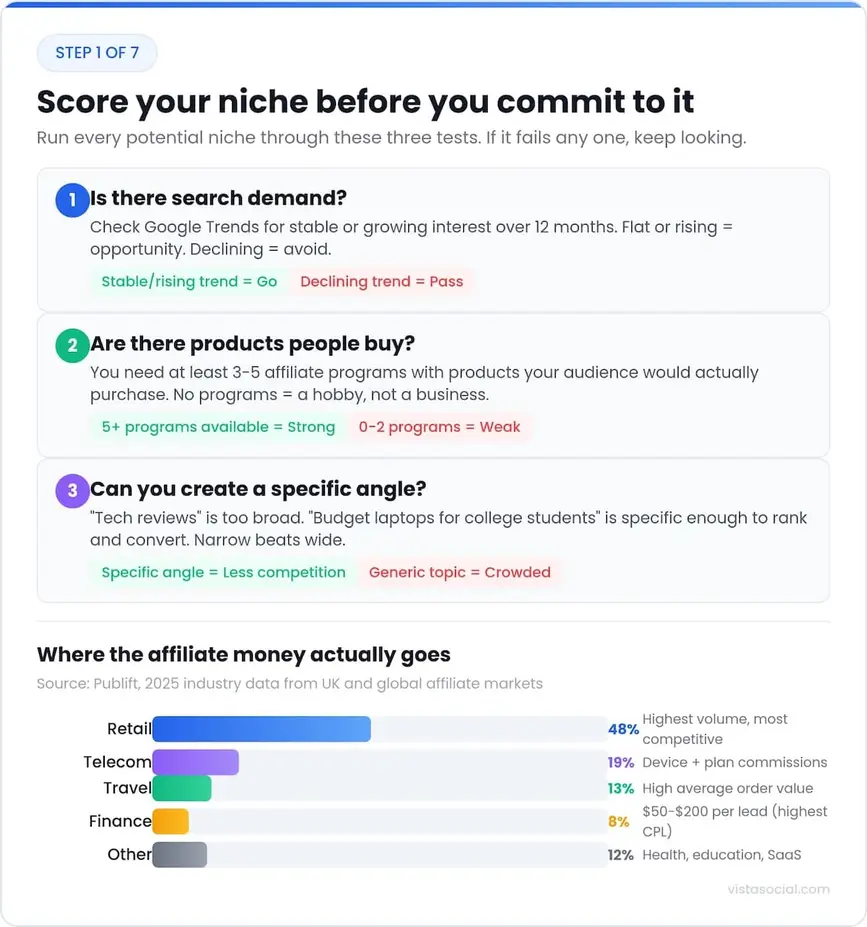
Passion matters because you’ll need to create content about this topic for months, possibly years, before the income catches up. But passion alone won’t pay your bills if the niche has no commercial intent.
A workable affiliate niche needs three things.
Audience demand
People are actively searching for information and solutions in this space. Use Google Trends to check whether search interest in your topic has been stable or growing over the past 12 months. Flat or declining interest is a red flag worth investigating before you commit.
Buyable products
There are products or services with affiliate programs that your audience would actually want to purchase. A niche with passionate followers but nothing to sell is a hobby, not a business.
Content opportunity
You can create specific, helpful content that connects your audience to those products. “Beauty” is a niche. “Clean beauty products for sensitive skin” is an angle. The angle is where you’ll win, especially in competitive spaces where broad topics are already dominated by established sites.
The most profitable niches are competitive for a reason. Retail, travel, beauty, finance, and technology all have large audiences, high-value products, and strong commercial intent. But you don’t need to dominate an entire niche. You need to work on owning a specific corner of it.
2. Pick your promotional channels
Where your audience spends their time should dictate where you show up. There’s no single “best” channel for affiliate marketing, but the data paints a clear picture of what’s driving results right now.
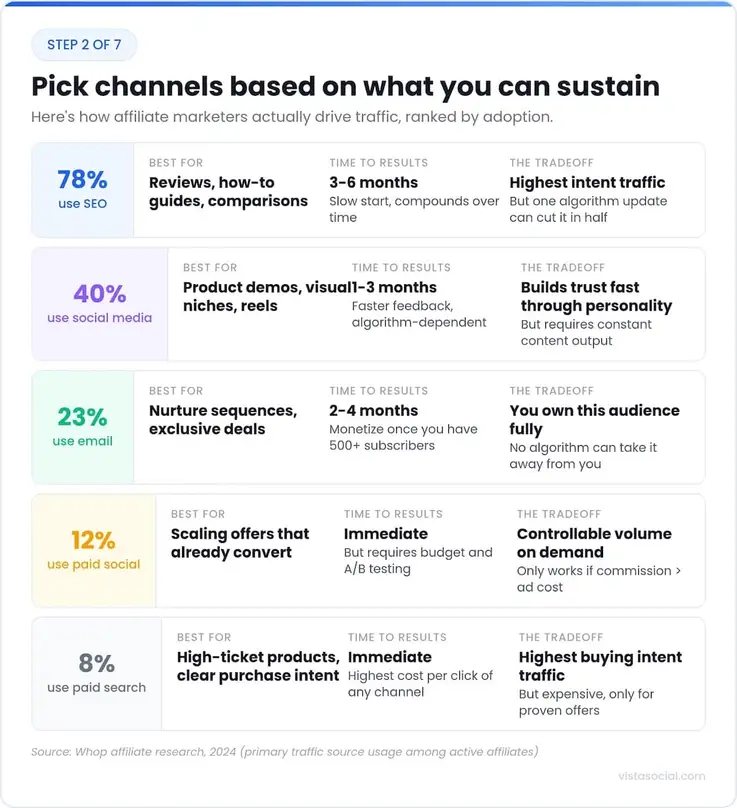
According to data compiled by Whop’s 2024 affiliate research, 78% of affiliate marketers use organic SEO as their primary traffic source. Organic social media comes in next at 40%, followed by email marketing at 23%, paid social ads at 12%, and SEM at 8%.
SEO and organic search
Written content remains the backbone of affiliate marketing. Product reviews, comparison posts, and how-to guides rank well in search and capture people at the moment they’re closest to making a buying decision. There’s a reason nearly 8 out of 10 affiliates prioritize search. It’s the one channel where the audience comes to you already wanting answers.
If you want to try out this channel, it’s as easy as incorporating your affiliate links naturally into your content. Some tactics include:
- Creating a dedicated product review and including your affiliate link
- Comparing products and adding affiliate links where you have them
- Writing helpful blog content and sprinkling in affiliate links as you mention applicable products or services
Here’s an example of this in action. This Yucatan travel guide provides a helpful resource for anyone looking to make the most out of their trip—but you can see their “May contain affiliate links” disclosure right at the top, telling us that they may make a profit off of anything purchased through their links.
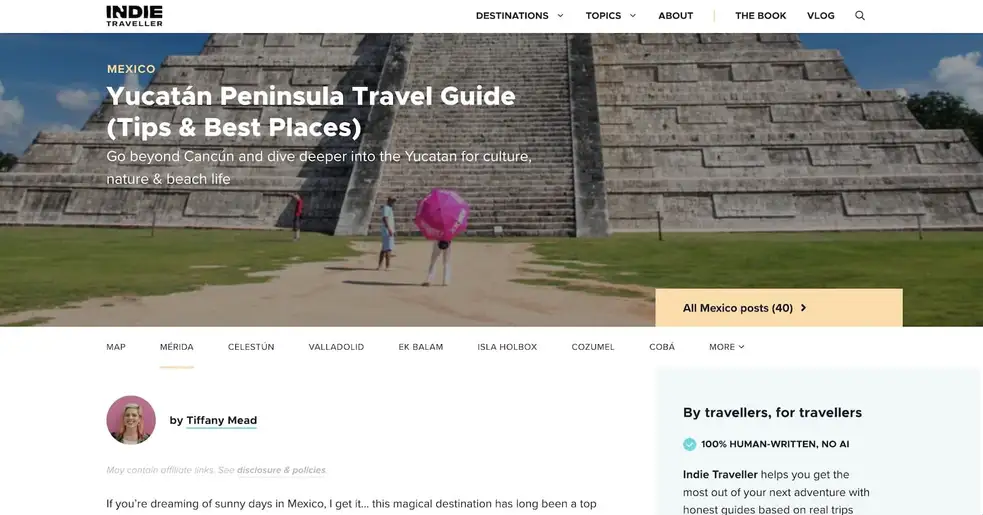
Scroll through the article to see affiliate links for hotels, flights, excursions, and more. This is the perfect way to generate an income from affiliate marketing.
Social media
Instagram, TikTok, and YouTube are especially powerful for product demonstrations and honest reviews. If your niche is visual (fashion, fitness, beauty, food, or travel), social media should be a core part of your strategy from day one.
Here’s a great example of this in action. This review influencer created a video highlighting a product and set up a DM automation to send interested buyers the link. This is the perfect way to promote your affiliate products on social media.
Email newsletters
Email gives you a direct line to your audience without depending on any algorithm. When platforms change their rules overnight, and they do, your email list is the one audience asset you fully own.
Here’s a great example of what this might look like. This newsletter, Freelancing Females, ends every email with a quick “Open Tabs” section where they share links, job opportunities, and more. And wouldn’t you know it, some of the links they share are affiliate links!
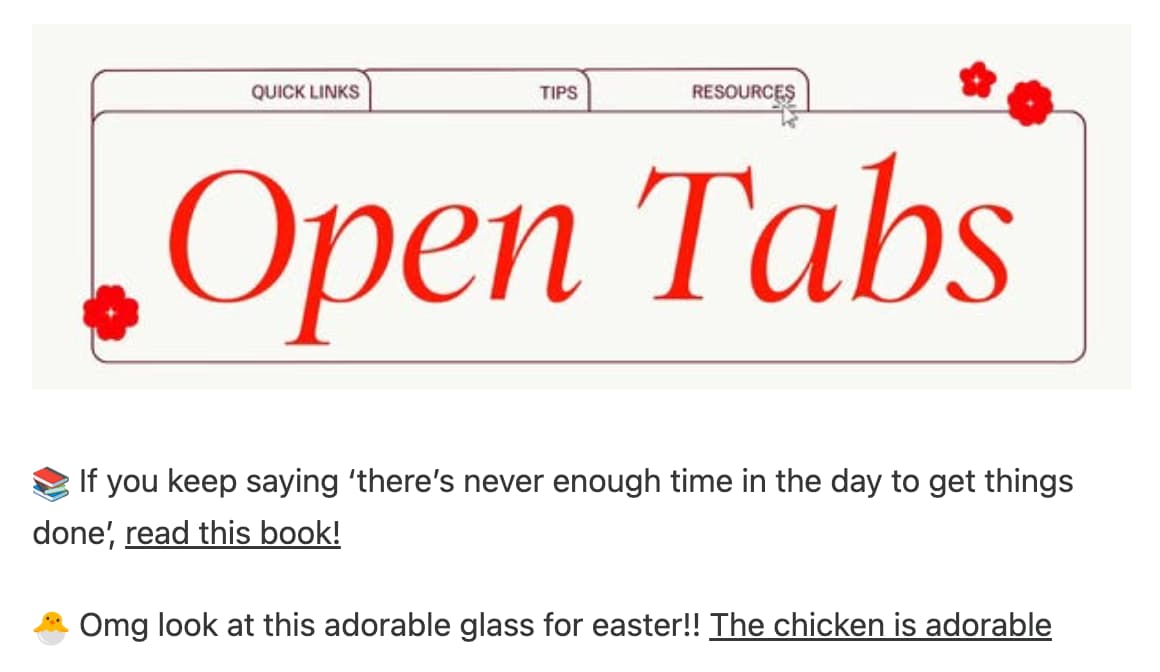
This is a great way to provide educational value through a newsletter while also using it to generate revenue.
However, the strongest affiliates combine multiple channels.
A blog post captures search traffic, a social post drives awareness, and an email sequence nurtures the relationship. Each channel feeds the others and creates multiple entry points for conversions.
If you’re managing affiliate content across multiple social channels, a platform like Vista Social can save you a real chunk of time. You can schedule posts across all your profiles, track link performance with UTM parameters, and manage engagement from a single dashboard instead of bouncing between apps all day.
3. Find the right affiliate programs
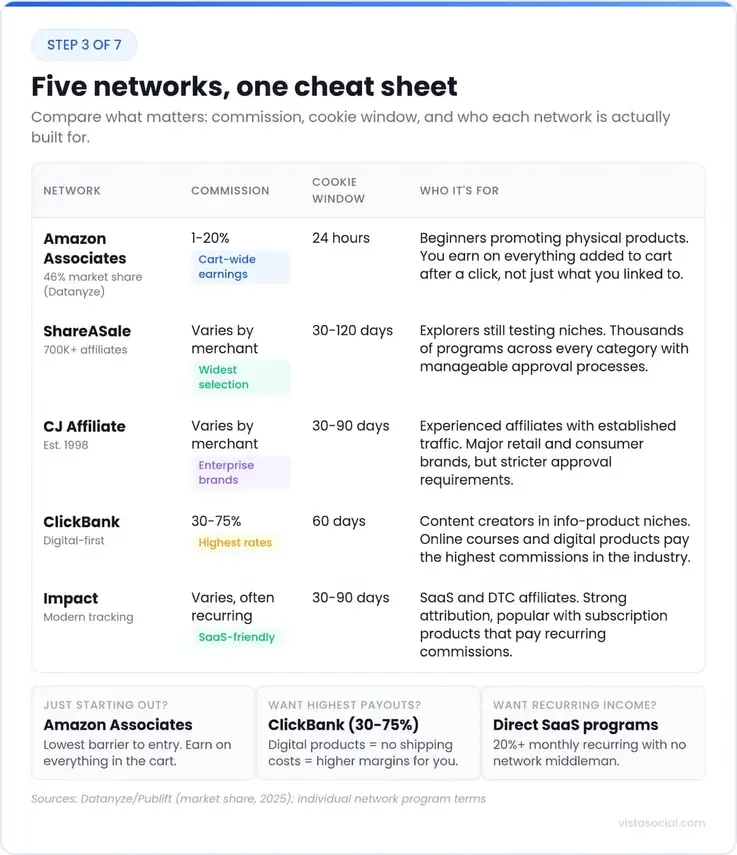
With your niche and channels locked in, you need programs worth promoting. These fall into two broad categories: Affiliate networks that aggregate programs from hundreds of merchants and individual programs run directly by brands.
Affiliate networks
Networks are a solid starting point because they give you access to a wide selection of programs in one place:
- Amazon Associates: The largest affiliate network in the world. Datanyze reports nearly 86,000 companies use the network, capturing roughly 46% of the industry total. Commission rates range from 1% to 20% depending on the product category, with Amazon Games at the top (20%) and luxury beauty at 10%. Most everyday categories fall between 1% and 4.5%. The 24-hour cookie window is short, but Amazon’s strong conversion rates and cart-wide commissions (you earn on everything the customer adds, not just your linked product) help offset that
- ShareASale: Hosts thousands of merchant programs across nearly every niche, making it versatile for beginners who are still refining their focus. Over 700,000 affiliates used the platform in 2023
- CJ Affiliate (formerly Commission Junction): One of the oldest networks, with strong representation in retail and enterprise brands
- ClickBank: Focuses on digital products and online courses, offering some of the highest commission rates in the industry
- Impact: A newer platform popular among SaaS and direct-to-consumer brands
Direct brand programs
Many brands run their own affiliate programs with better terms than networks because there’s no middleman. This is especially common with SaaS companies that offer recurring commissions on monthly subscriptions. Instead of earning once on the initial sale, you earn every month the customer stays subscribed.
Vista Social’s own affiliate program is a good example. You can earn a 20% recurring commission for up to 12 months on every referral, and the people you refer get 10% off their first year.
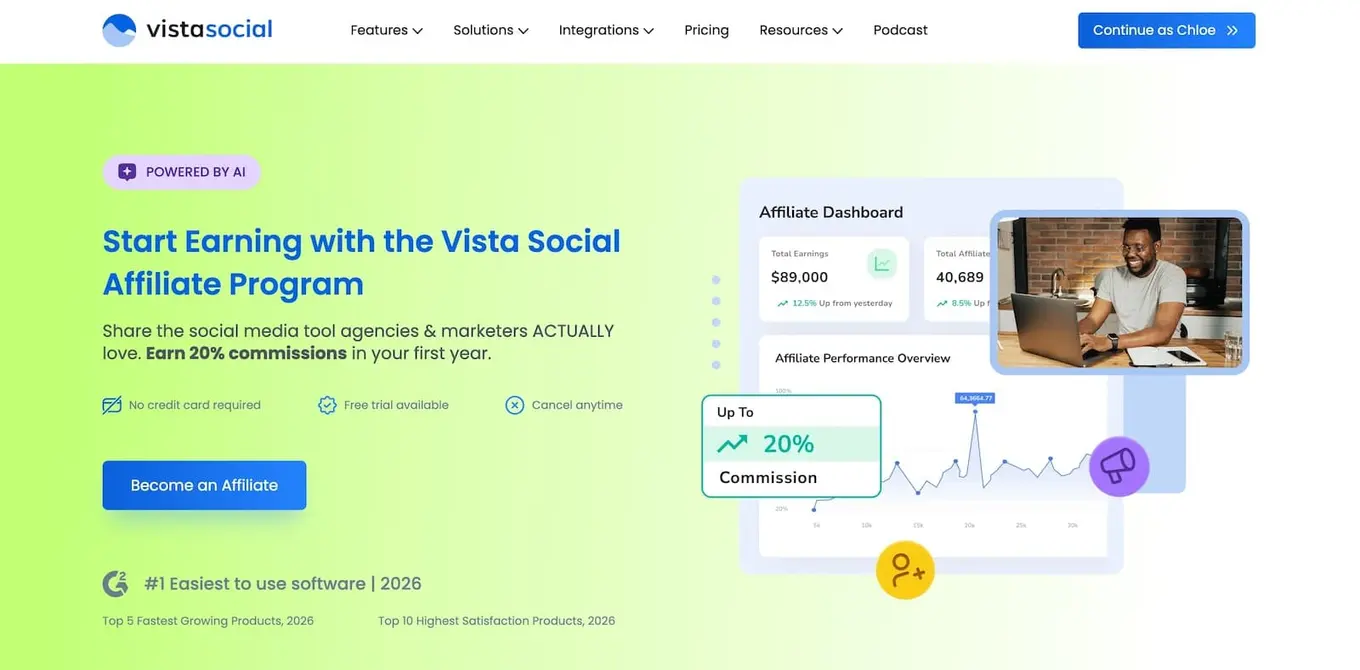
For affiliates in the social media marketing or SaaS space, recurring commissions like this build a compounding income stream that grows over time without requiring you to constantly find new buyers.
When evaluating any program, weigh the commission rate, cookie duration, payment terms, and how well the product matches your audience. A 50% commission means nothing if the product has no relevance to the people reading your content.
4. Create content that converts
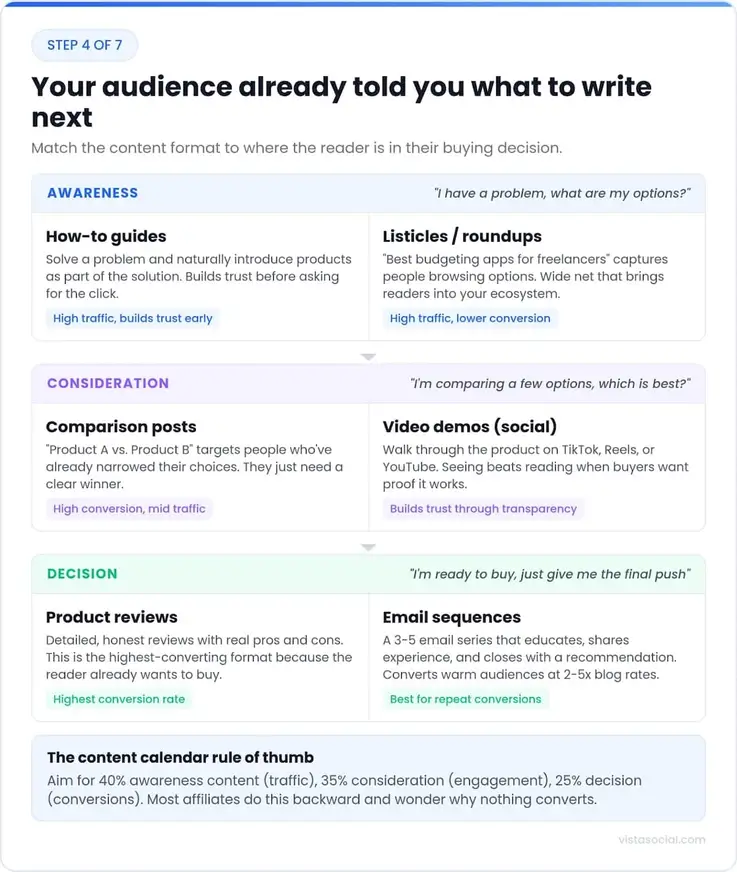
With your niche, channels, and programs in place, it’s time to build the content engine. The type of content you create should match both your channel and your audience’s intent at the time they see it.
Product reviews
These are the highest-converting affiliate content formats because they capture people already considering a purchase. A review that’s honest about pros and cons, includes real experience, and compares the product to alternatives builds trust and makes the buying decision easier.
Here’s an example of a post like this in action. If someone is searching for the best espresso machine, this product review roundup will pop up at the top of their search results.
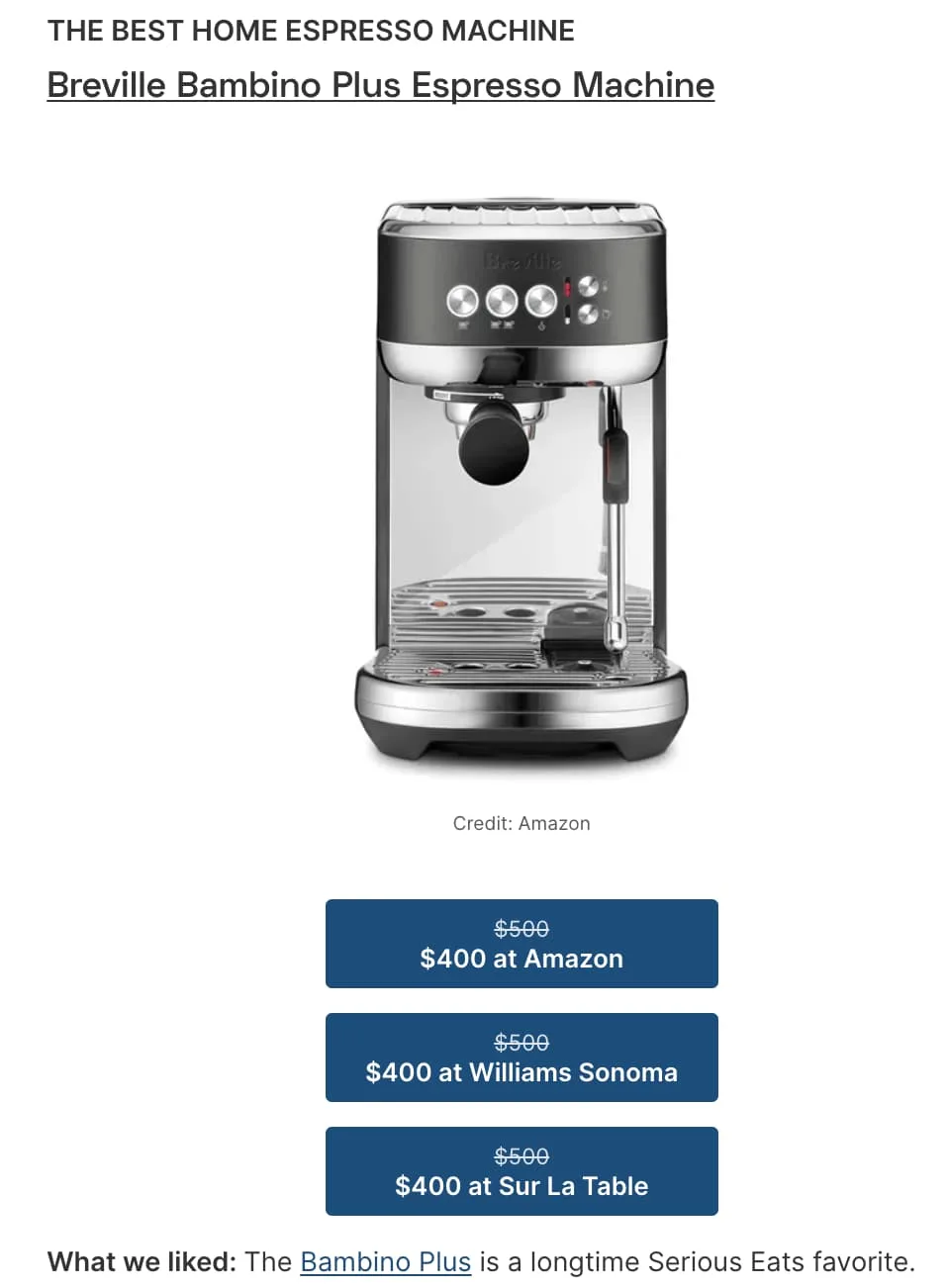
It dives into 14 different espresso machines with clear reviews for each one—plus affiliate links if anyone makes a purchase through their website. This can be done for products, services, and software.
Comparison posts
Content like “Product A vs. Product B” attracts searchers deep in the decision-making process. These posts tend to convert at higher rates because the reader has already narrowed their options and is looking for a final nudge.
Take a look at what this can look like below—complete with the affiliate disclosure right at the top of the article.

How-to guides and tutorials
Walk your audience through solving a specific problem, and naturally introduce the affiliate product as part of the solution. These work especially well for software and tool recommendations, where showing the product in action is more compelling than describing it.
A blog article or even a video is a great way to go about this. In this video example below, the creator is walking users through how to use software tool Zapier to do something—while including his Zapier affiliate link in the video description.
Listicles and roundups
With a listicle or roundup, you’re able to promote multiple products all at once. This could be something as simple as “Best budgeting apps for freelancers” (see an example of this below) where you link to similar tools. Or you could create a listicle of “Apps I can’t live without” to share even more tools you have affiliate links for.
These posts can rank well for competitive keywords because they match the search intent of people in the early research phase.

Social media content
On Instagram, TikTok, or YouTube, the content itself needs to be visual and value-driven first. The affiliate link lives in your bio, stories, or comments. The goal of the post is to build curiosity and trust, not to lead with a sales pitch.
No matter which format you choose, here’s the principle that matters most: recommend products you would genuinely use yourself. Audiences can spot hollow endorsements, and affiliates who promote products they have personal experience with consistently build stronger, longer-lasting relationships with their readers.
Here’s an influencer who does a great job of this. She regularly posts photos of the interior decorating she’s done in her family’s home, and people naturally come to the comments to ask about different decor, pieces of furniture, and other elements from her home.

In response, she simply sends them an affiliate link or mentions a story highlight she houses all of her links in. This is such an organic way of influencing while also generating affiliate income.
5. Grow your audience
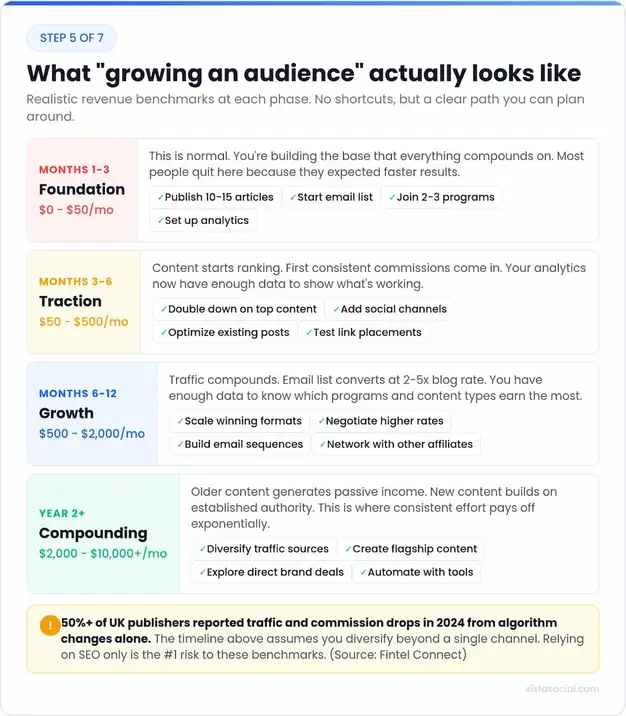
Traffic is where most affiliate marketers get stuck. Driving consistent, qualified traffic remains one of the biggest challenges affiliates face, regardless of experience level. Here’s what works.
Search engine optimization
SEO drives the most affiliate traffic overall. Focus on content that targets specific long-tail keywords your audience is searching for. “Best CRM for small agencies” will convert better than “CRM software” because the searcher already knows what they want.
Social media consistency
Post regularly, respond to comments, collaborate with creators in your niche, and lean into the formats each platform rewards. Short-form video on TikTok and Reels continues to drive massive organic reach for affiliates who invest in it.
Email list building
Start this on day one, even before you think you need it. Offer something valuable, like a free guide, template, checklist, or resource, in exchange for an email address. Your email list is the one traffic source that can’t be taken away by a platform change.
Networking
This one might surprise you, but it correlates directly with higher earnings. The relationships you build with other marketers open doors to collaborations, guest posts, and shared insights that you’d miss working in isolation. Higher-earning affiliates consistently report that professional networking was a turning point in their growth.
6. Promote your affiliate links strategically
Getting traffic and getting clicks are two different problems. Link placement is a skill in itself, and it sits right at the intersection of helpfulness and persuasion.
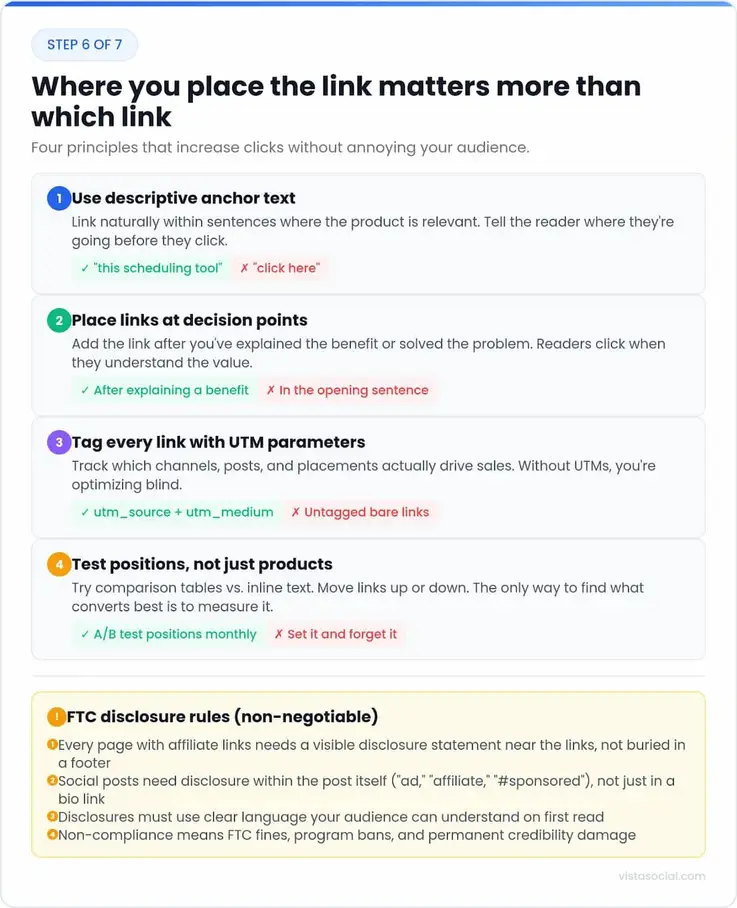
Here are practical guidelines for promoting your affiliate links effectively:
- Use contextual anchor text in blog posts rather than generic “click here” language
- Add disclosure statements to every piece of content with affiliate links. The FTC requires clear disclosure whenever you have a financial relationship with a brand. This isn’t optional, and skipping it can result in fines
- Track your links with UTM parameters so you know which channels and pieces of content drive the most conversions
- Test placement. Sometimes a link higher in the content outperforms one at the bottom. Sometimes a comparison table converts better than a text link. The only way to know is to experiment
For affiliates running promotional content across social platforms, keeping everything organized becomes critical as you scale. Scheduling tools let you batch your content, maintain a consistent posting rhythm, and make sure your links go live when your audience is most active. Vista Social’s publishing and scheduling features handle exactly this kind of workflow, letting you plan, preview, and push content across multiple profiles without juggling ten different tabs.
7. Track your performance and optimize
You can’t improve what you don’t measure. Every affiliate program dashboard shows clicks, conversions, and earnings. But the marketers who consistently grow are the ones who dig deeper into the patterns behind those numbers.
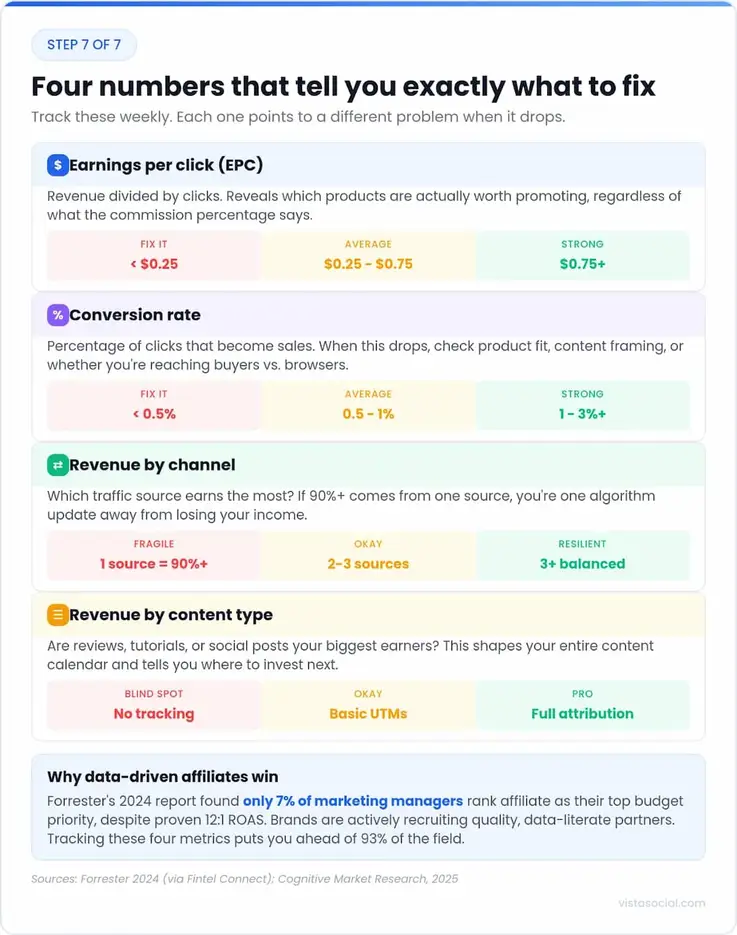
Earnings per click (EPC)
This tells you how much you earn on average per click and helps you identify which products are worth promoting more heavily. A product with a lower commission rate but higher EPC might actually be your best performer.
Conversion rate
The percentage of clicks that result in a sale, lead, or any other form of goal agreed upon between the affiliate and the brand. If your conversion rate is low, the issue might be the product itself, the audience fit, or how you’re framing the recommendation in your content.
Revenue by channel
Knowing which channel drives the most commissions lets you double down where it matters. Maybe your email list converts at 3x the rate of your blog traffic. Maybe your TikTok audience clicks but rarely buys. You won’t know unless you’re tracking it.
Revenue by content type
Identifying whether reviews, tutorials, or social posts are your highest converters helps you prioritize what kind of content to create next. Over time, these patterns become more valuable than any generic strategy guide, because they’re built from your own audience’s behavior.
Affiliate marketing mistakes to avoid
With the strategy mapped out, let’s cover the pitfalls that trip up both new and experienced affiliates. Some of these are obvious. Others are the kind of mistakes that feel productive while they’re quietly costing you money.
Promoting products you’ve never used
This is the fastest way to lose an audience. When your recommendations come from genuine experience, your content carries a level of detail and honesty that readers pick up on immediately. Generic product descriptions copied from a sales page don’t build trust. If you can’t speak to the actual experience of using a product, your audience will find someone who can.
Ignoring FTC disclosure requirements
The FTC’s guidelines strengthen compliance expectations for affiliates to clearly disclose financial relationships with brands. That means a visible, easy-to-understand statement near your affiliate links, not buried in your site’s footer or hidden in a terms page. Non-compliance can result in fines, and beyond the legal risk, hiding your affiliate relationships erodes the credibility you’ve worked to build.
Chasing high commissions over audience fit
A SaaS product offering 50% recurring commissions looks incredible on paper. But if your audience is hobbyist gardeners, they’re not buying enterprise software. Commission rates matter less than product-market fit. The affiliates who earn the most promote products their specific audience actually needs and wants.
Relying on a single traffic source
Algorithm changes can wipe out an organic traffic stream overnight. According to research, over half of UK publishers reported traffic and commission losses from search engine algorithm changes in 2024. Diversifying across SEO, social media, email, and other channels protects you from that kind of volatility.
Quitting too early
The early months of affiliate marketing are slow by nature. Content takes time to rank, audiences take time to build, and trust takes time to earn. The people who break through are the ones who stay consistent through the flat-line period, even when the numbers don’t feel like they’re moving. Industry data consistently shows that the income gap between first-year affiliates and those with 3+ years of experience is massive, which tells you that time in the game matters more than talent at the start.
Neglecting published content
Publishing a blog post or social series and walking away is a missed opportunity. Affiliate content needs regular updates to stay accurate, especially product reviews where features, pricing, or availability can change. Outdated information hurts your search rankings and damages credibility with readers who notice the details are wrong.
Spreading across too many programs
Signing up for 20 affiliate programs sounds productive, but promoting that many products well is nearly impossible. The affiliates who build real income tend to go deep with a handful of programs that fit their niche, learning the products inside out and creating thorough, detailed content around them. Depth creates the kind of trustworthy content that converts.
Get started with affiliate marketing today
The global affiliate marketing industry is valued at $18.5 billion and growing at an 8% compound annual growth rate through 2031. In the U.S., eMarketer’s August 2025 forecast projects spending will climb past $13.2 billion in 2026. These aren’t optimistic guesses, but clear evidence of trends backed by year-over-year growth that has held steady over the years.
The path forward isn’t complicated, but it does require patience and consistency. If you’re ready to start, Vista Social’s affiliate program is a strong place to begin, especially if you’re already creating content about social media marketing, digital tools, or agency workflows.
And if you’re building affiliate content across social channels, Vista Social can help you manage the work. Schedule your posts, track your links, and engage your audience from one dashboard. The real competitive advantage in affiliate marketing isn’t the commission rate but rather showing up consistently. And consistency gets a lot easier when your workflow lives in one place.
Join the Vista Social Affiliate Program today to see how it makes your affiliate marketing efforts a breeze!
Affiliate marketing FAQs
How do beginners get into affiliate marketing?
Start by choosing a niche you know well and enjoy creating content about. Build a platform, whether that’s a blog, YouTube channel, social media presence, or email list, and then join affiliate programs that match your niche. Amazon Associates is the most beginner-friendly option because of its massive product catalog and zero cost to join.
From there, create helpful content that naturally incorporates your affiliate links, focus on building traffic, and give yourself at least 6 to 12 months before expecting meaningful income. The biggest mistake beginners make is giving up before their content has had time to gain traction.
How much do Amazon affiliates make?
It really comes down to how much traffic you can move and what you’re talking about. Amazon’s commissions are a bit of a mixed bag; you might earn 20% on digital games or 10% on luxury beauty, while home goods usually sit around 3%. While that sounds small, the real magic is that Amazon pays you for everything in the customer’s cart. If they click your link for a spatula but end up buying a flat-screen TV, you get a cut of the whole bill.
Because of that “everything counts” rule and Amazon’s massive trust factor, earnings vary wildly. Industry reports show that while many beginners start with a few hundred dollars, those who treat it like a serious business can easily move into the mid-to-high five figures.
Can you make $10,000 a month with affiliate marketing?
Yes, it’s absolutely possible, but let’s be real, though. It’s a marathon, not a sprint. Data suggests that “advanced” affiliates (the top 10-15% of the industry) frequently hit or exceed that $10,000 monthly mark. Reaching this level usually means you’ve moved past just “blogging” and are strategically targeting high-value keywords, building an email list, and diversifying where your traffic comes from so you aren’t relying on luck.
The reality is that hitting five figures a month usually takes a few years of consistent effort. Most successful creators see a “hockey stick” growth curve: you might make very little for the first year while building your foundation, but once your authority grows, your income can spike quickly. It’s a legitimate business model, but it requires patience and a solid strategy rather than looking for a “get rich quick” shortcut.
Try Vista Social for free
A social media management platform that actually helps you grow with easy-to-use content planning, scheduling, engagement and analytics tools.
Get Started NowAbout the Author

Content Writer
Orion loves to write content that refuses to be boring. As part of Vista Social, he helps brands, creators, and agencies stop doom scrolling and start winning with social media. When he's not in front of a keyboard, he's watching films in IMAX with his wife, dissecting football tactics (the European kind), and getting lost in a good book.
Loading related tools...




Tools
PublishingAnalyticsEngagementIntegrations
FacebookInstagramLinkedInRedditSnapchatThreadsTikTokX (Twitter)YouTubeBlueskyVista Page (link-in-bio)All IntegrationsCopyright © 2026 Vista Social LLC. All Rights Reserved.